An SO(3)×SO(8)-invariant Einstein metric on S3×S7
Abstract: In this paper, we prove the existence of an SO(3)×SO(8)-invariant Einstein metric with positive scalar curvature on S<sup>3×</sup>S<sup>7.
- Positive Einstein Metrics with $\mathbb{S}^{4m+3}$ as Principal Orbit (2022)
- An $S^3\times S^3$ bundle over $S^4$ and new supergravity solutions (2024)
- Computationally-assisted proof of a novel $\mathsf{O}(3)\times \mathsf{O}(10)$-invariant Einstein metric on $S^{12}$ (2024)
- Curvature of an exotic 7-sphere (2024)
- A non Ricci-flat Einstein pseudo-Riemannian metric on a 7-dimensional nilmanifold (2020)
- Invariant Einstein metrics on SU(N) and complex Stiefel manifolds (2020)
- Extrinsic geometry of the Gromoll-Meyer sphere (2019)
- Left-invariant Einstein metrics on $S^3 \times S^3$ (2017)
- Classification for smooth manifolds looking like $\mathbb{CP}^3\times S^7$ (2025)
- Doubly warped product Einstein metrics on spheres (2026)
Summary
- The paper demonstrates the existence of a non-standard SO(3)×SO(8)-invariant Einstein metric on S³×S⁷ by leveraging precise winding estimates of Ricci flat trajectories.
- It employs a detailed cohomogeneity one ODE analysis to track invariant metric trajectories and their intersection properties in phase space.
- Numerical and analytical evidence confirms that the excess winding in the Ricci flat trajectory ensures the additional intersection necessary for constructing the novel metric.
An SO(3)×SO(8)-Invariant Non-Standard Einstein Metric on S3×S7
Overview
The paper establishes the existence of a non-standard Einstein metric with positive scalar curvature on S3×S7 that is invariant under the SO(3)×SO(8) action (2606.08888). Despite the abundance of product Einstein metrics on products of spheres, finding invariant but non-product (non-standard) Einstein metrics remains a central pursuit in Riemannian geometry. The cornerstone of the construction is a detailed analysis of the cohomogeneity one Einstein ODEs and the winding behavior of Böhms's Ricci flat trajectories in invariant metric spaces, culminating in new existence results for S3×S7.
Context and Motivation
While canonical product Einstein metrics are trivial to construct for S3×S7, non-standard homogeneous and cohomogeneity one Einstein metrics are exceptional. Previous breakthroughs—Jensen's homogeneous Einstein metrics, Böhms's cohomogeneity one Einstein metrics for d1+d2≤8, and the nearly Kähler metric on S3×S3—serve as important precedents. The method for analyzing invariant Einstein metrics leverages reductions to ODEs via symmetry (cohomogeneity one), where geometric and topological features are encoded in the dynamical properties of the system.
Notably, for dimensions d1+d2=9, Nienhaus-Wink found non-round Einstein metrics on S10 using estimates on the trajectory of Böhms's Ricci flat metric in the phase portrait of the Einstein ODEs. Inspired by these techniques, this work isolates a case—S3×S70—where the winding behavior is particularly pronounced, allowing for the detection of a novel invariant metric on S3×S71.
Formulation of the Einstein ODEs and Symmetry Structure
An Einstein metric on a manifold S3×S72 satisfies S3×S73 for some real S3×S74. On S3×S75 with S3×S76-invariant metrics, the geometry is determined by two warping functions and the system can be re-expressed using coordinates S3×S77 adapted from recent advances [EinsteinMetricsOnTheTenSpheres]. These coordinates facilitate the ODE analysis and compactification of the solution space.
A crucial geometric feature is that the phase space S3×S78, parametrized by S3×S79, is compact and invariant, ensuring global existence for solutions. The variable S3×S70 (a normalized mean curvature) is strictly decreasing in the relevant region, and various fixed points correspond to significant geometric collapses (singular orbits and cone solutions).
The challenge is to characterize entire trajectories emanating from a fixed point corresponding to the collapse of S3×S71, and to track their behavior up to where S3×S72 may collapse—a process corresponding to the existence of a smooth Einstein metric on the double sphere product.
The Winding Analysis and Key Numerical Findings
The novelty of this work resides in a precise winding estimate for Böhms's Ricci flat trajectory S3×S73 within the S3×S74-plane, particularly for the critical case S3×S75. The core result is the measurement of the winding angle as S3×S76, which is substantially larger than for other dimension splits where S3×S77 but S3×S78. This surplus winding is essential to ensure that the unstable manifold from the initial singular orbit loops far enough in phase space to permit additional intersections corresponding to non-standard Einstein metrics.
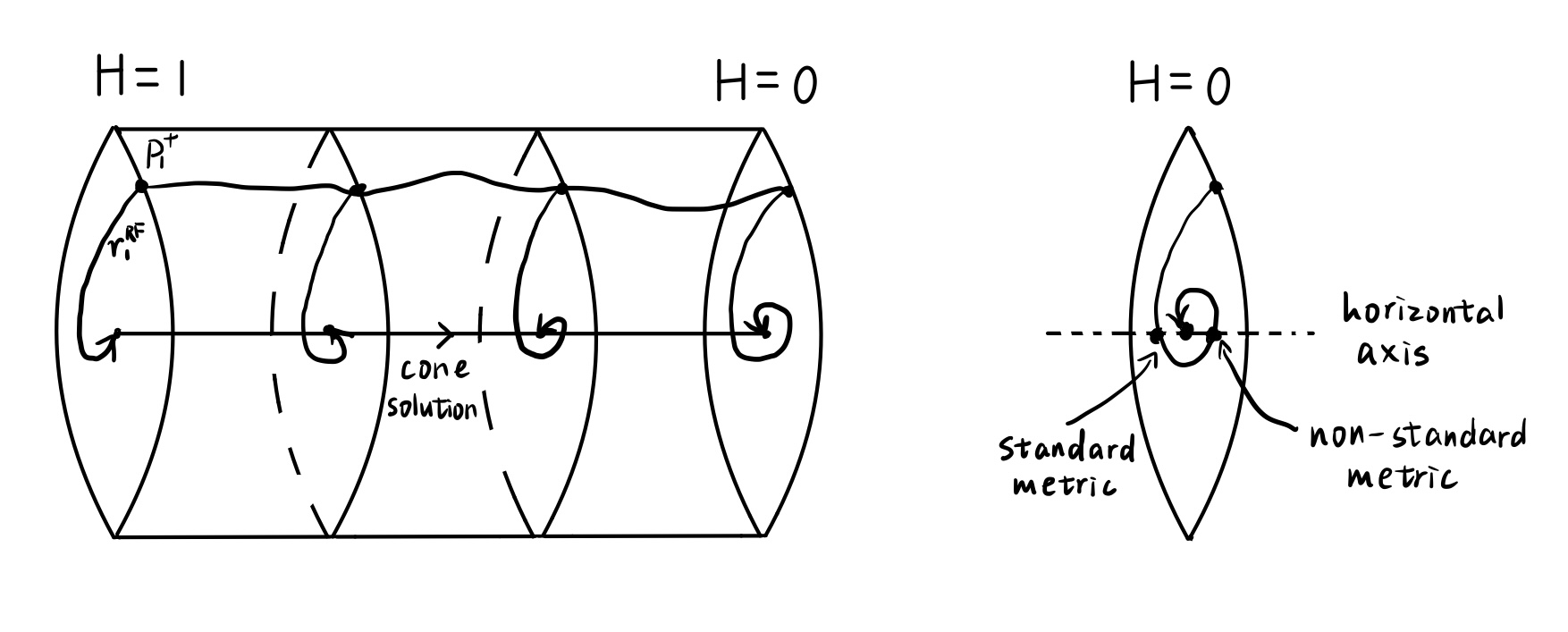
Figure 1: Distinctive winding of the Ricci flat trajectory for S3×S79 enables the construction of a non-standard invariant Einstein metric.
By comparison, other configurations with SO(3)×SO(8)0, such as SO(3)×SO(8)1, etc., exhibit insufficient winding, as visualized in Figure 2. This difference is not merely quantitative but underpins the qualitative emergence (or failure) of new geometric structures.
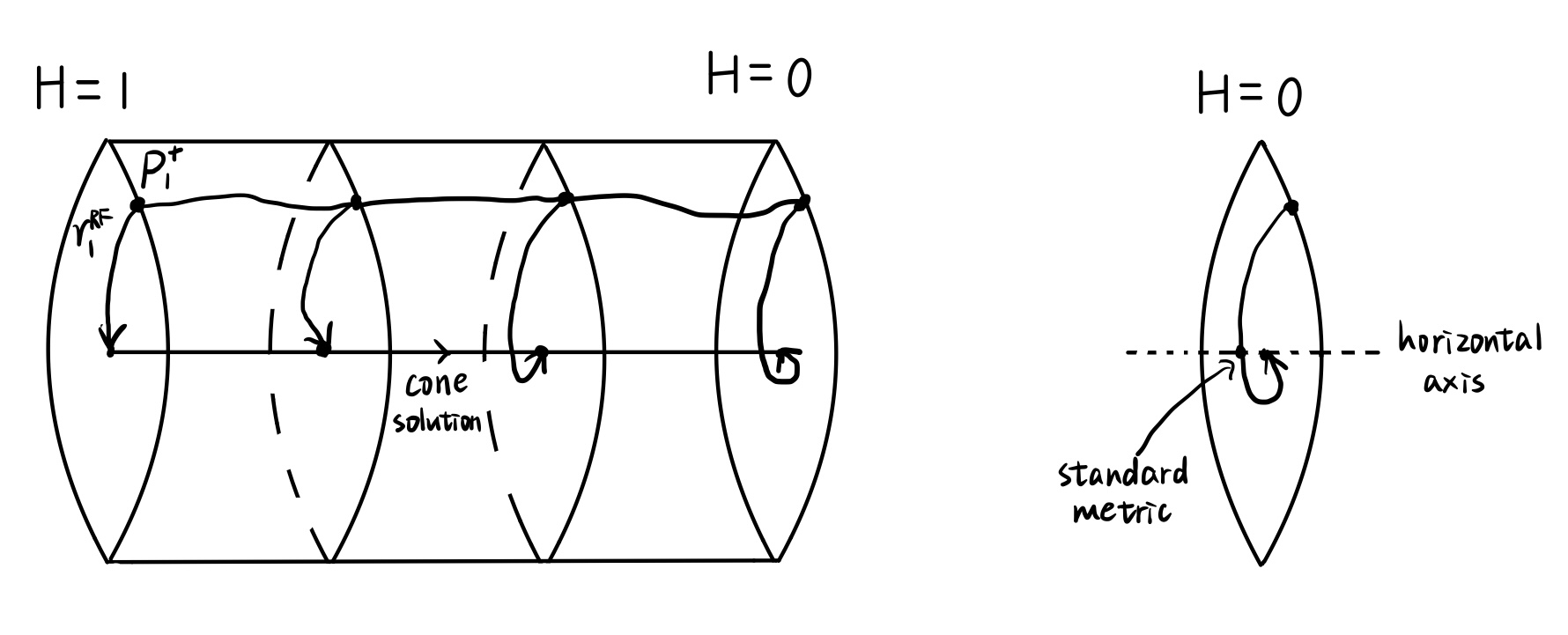
Figure 2: In cases with SO(3)×SO(8)2, SO(3)×SO(8)3, the winding is insufficient to produce additional intersections in the moduli space.
Through a combination of analytical and numerical methods, the author rigorously constructs a forward invariant set SO(3)×SO(8)4 in the phase space, trapping the Ricci flat trajectory and allowing sharp control over its terminal angle as it approaches the cone solution. The construction of SO(3)×SO(8)5 (see Figure 3) is critical for establishing the robustness of the winding estimate.
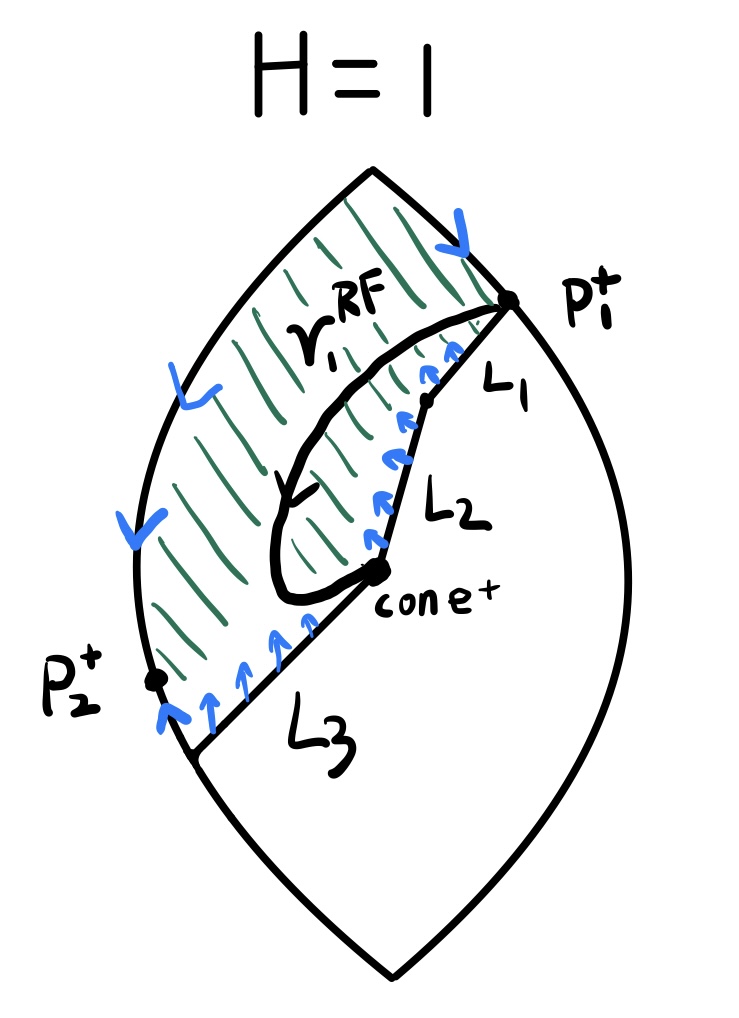
Figure 3: The forward-invariant set SO(3)×SO(8)6 in the SO(3)×SO(8)7 plane, which prevents escape of trajectories and guarantees a precise winding behavior.
Main Theorem and Existence Argument
The central theorem is the existence of a non-standard SO(3)×SO(8)8-invariant Einstein metric with positive scalar curvature on SO(3)×SO(8)9. The existence is reduced to demonstrating that the curve (unstable manifold) in phase space parametrizing Einstein metrics intersects the locus corresponding to smooth collapse of both singular orbits more than once: once for the product metric, and once for a genuinely non-standard metric. The excess winding for S3×S70 ensures that the curve passes through the region of interest twice.
A key technical device is a carefully designed angle barrier function, leveraging linearization along the cone solution and the construction of explicit "barrier" ODEs to bound the approach angle to the fixed point. This, combined with monotonicity and symmetry properties, implements a shooting argument: if the terminal angle exceeds S3×S71, the intermediate value theorem guarantees an additional intersection corresponding to a non-standard Einstein metric.
Numerical and Analytical Evidence
Strong corroboration comes from both the phase portrait windings and auxiliary algebraic lemmas verifying forward invariance of prescribed sets. The analysis is structurally robust due to hyperbolicity of the fixed points and the compactness of S3×S72, which preclude pathological trajectory escape scenarios.
Further, the argument unifies and generalizes earlier existence arguments for non-standard Einstein metrics on sphere products and links them tightly to the geometric analysis of cohomogeneity one Ricci flat manifolds.
Implications and Future Directions
This work contributes a new example of a rigid, non-standard Einstein metric with high symmetry, directly relevant for geometric analysis, global differential geometry, and the theory of special holonomy. The explicit construction in dimension 10 suggests that winding-based analysis could yield additional non-product Einstein metrics in higher dimensions, particularly as numerical and computer-assisted analytic techniques become more powerful.
Practically, the result has implications for the landscape of Einstein metrics on homogeneous spaces, with potential repercussions for string theory, global analysis, and the construction of Ricci solitons or more exotic geometric flows.
On a theoretical level, it raises further questions regarding necessary and sufficient conditions for the existence of non-standard invariant Einstein metrics across arbitrary product manifolds and suggests that topological or representation-theoretic features (encoded via winding phenomena) may provide general criteria.
Conclusion
The paper conclusively demonstrates, via meticulous analysis of phase space windings in the Einstein ODEs and careful barrier construction, the existence of an S3×S73-invariant, non-standard Einstein metric with positive scalar curvature on S3×S74. The result bridges geometric intuition and rigorous dynamical analysis, expands the known catalog of such metrics, and sets the stage for further exploration of Einstein geometry on highly symmetric manifolds.
Paper to Video (Beta)
No one has generated a video about this paper yet.
Whiteboard
No one has generated a whiteboard explanation for this paper yet.
Paper Prompts
Sign up for free to create and run prompts on this paper.
Top Community Prompts
Open Problems
We haven't generated a list of open problems mentioned in this paper yet.
Continue Learning
- How does the cohomogeneity one approach reduce the Einstein equations to a system of ODEs in this context?
- What specific role does the winding behavior of Ricci flat trajectories play in establishing the non-standard metric?
- How do barrier functions and fixed points contribute to the proof of existence for the invariant Einstein metric?
- What implications does this new metric have for further studies in global differential geometry and special holonomy?
- Find recent papers about invariant Einstein metrics on sphere products.
Tweets
Sign up for free to view the 1 tweet with 2 likes about this paper.