- The paper presents the novel MRM approach that retroreflects light by reflecting the view vector before evaluation, ensuring physical plausibility.
- The method integrates seamlessly with conventional microfacet models, preserving reciprocity and energy conservation while enabling efficient rendering.
- Empirical comparisons show that the MRM model accurately replicates retroreflective highlights observed in safety materials and road markings.
The Minimal Retroreflective Microfacet (MRM) Model: Physically Plausible Retroreflection via a Simple Modification
Introduction
The Minimal Retroreflective Microfacet (MRM) model introduces an efficient, physically plausible method for modeling retroreflective BRDFs by a minimal modification of conventional microfacet models. While classical microfacet theory yields widely adopted and physically consistent BRDFs for a plethora of materials, standard models lack the ability to accurately represent retroreflective behavior—critical for the rendering of materials such as safety tape, road markings, or high-visibility garments. The MRM model achieves retroreflectivity by simply reflecting the view direction about the surface normal prior to evaluating the microfacet BSDF. This modification preserves the core physical properties, such as reciprocity and energy conservation, and fits seamlessly into existing microfacet-based rendering pipelines.
The key insight in MRM is the substitution of the view direction v with its mirror image v′ reflected against the surface normal n. For a standard microfacet model, the BRDF is evaluated with half-vector selection based on v and the light direction l. MRM replaces this by constructing the back-vector b(v,l)=∥v′+l∥v′+l and using this as the microfacet normal selector. This produces a retroreflective lobe, peaking when v≈l, with an angular profile that matches empirical observations of retroreflective materials.
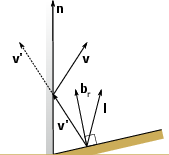
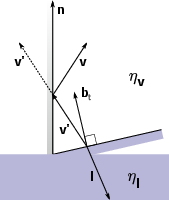
Figure 1: Geometry of the back-vector for reflection (left) and refraction (right) in MRM, illustrated in two dimensions. The view vector v is reflected about the surface to obtain v′, and b is then formed with the light vector v′0.
By construction, this modification preserves the lobe structure of the parent microfacet model but reorients the main axis of the lobe into the retroreflection direction. The Jacobian and other geometric terms remain unaltered since the transformation is orthogonal. The only requirement for full physical plausibility—guaranteeing reciprocity and energy conservation—is a reflection-symmetric NDF, a condition met by all standard normal distributions (isotropic and anisotropic GGX, Beckmann, Phong, etc.).
Physical Plausibility: Reciprocity and Energy Conservation
The paper provides rigorous demonstrations that the MRM model satisfies both reciprocity and energy conservation:
Reciprocity: By reflecting the role of incident and outgoing directions using the involutory Householder reflection (v′1), it is shown that swapping v′2 and v′3 in the BRDF calculation is mathematically equivalent to swapping v′4 and v′5, thereby preserving the reciprocity condition v′6 for reflection, and for transmission up to the index-of-refraction factor.
Energy Conservation: Analytical integration over the relevant hemispheres demonstrates that the single-direction albedo of MRM equals that of the parent microfacet model, merely evaluated at v′7 instead of v′8. For reflection-symmetric NDFs, this implies that the energy budget is preserved.
Implementation and Practical Integration
Implementing MRM in existing rendering code is trivial and incurs negligible performance or maintenance cost. The necessary steps for evaluation, sampling, and PDF computation are merely to reflect the input view direction before passing it to the underlying microfacet routines, as illustrated in the pseudocode provided in the paper.
This allows MRM to inherit all features of microfacet rendering infrastructure, including existing importance sampling strategies, multiple scattering energy compensation, pre-integrated tables, and analytic or measured albedo compensation.
A notable property is that the energy compensation, masking-shadowing treatments, and Fresnel models used for classical models are directly applicable to MRM without modification, enhancing practicality for production systems.
Visual Analysis and Evaluation Against Measured Data
The MRM model replicates key perceptual and physical characteristics of true retroreflective materials. It exhibits a specular lobe centered precisely in the retroreflection direction; for curved surfaces, this retroreflective highlight covers the entire visible surface when v′9, mimicking the real-world appearance of retroreflective safety fabrics or tapes.
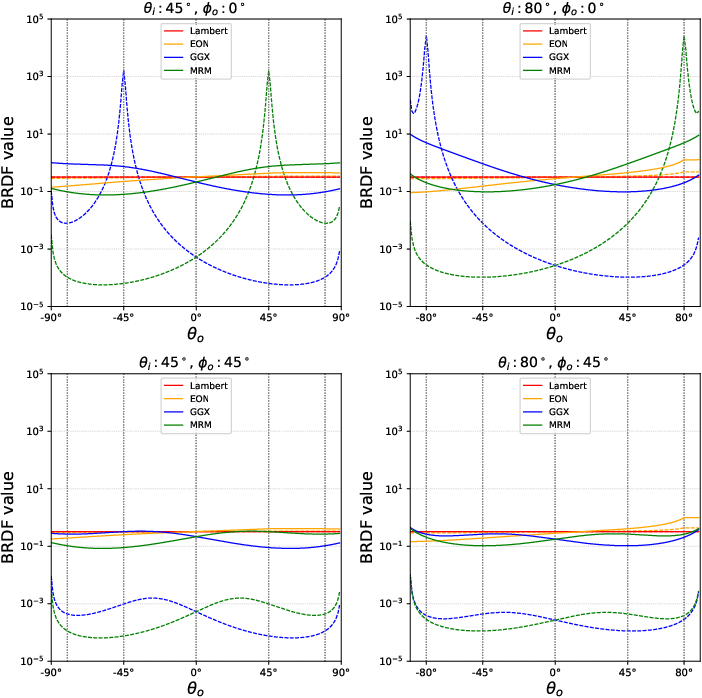
Figure 2: Comparison of the retroreflective MRM BRDF (green) to the regular GGX microfacet BRDF (blue) and rough-diffuse EON model (orange) as a function of outgoing direction for fixed light angles.
This contrast with standard GGX can be observed visually, where the MRM’s lobe does not merely shift with light position but “blinks in” broadly when the retroreflection geometry is activated, then disappears as the light and view directions diverge.




Figure 3: Specular shaderball with GGX (left two) and MRM (right two) for n0 and n1. Under retroreflection, the MRM highlight is extensive and vanishes entirely for n2.
Critically, when fit to measured BRDF data from commercial retroreflective tapes, the MRM model is able to closely reproduce both the magnitude and angular concentration of the retroreflective peak, with errors attributable mainly to limitations of the single-lobe functional form or to bulk material effects outside the scope of the microfacet abstraction.
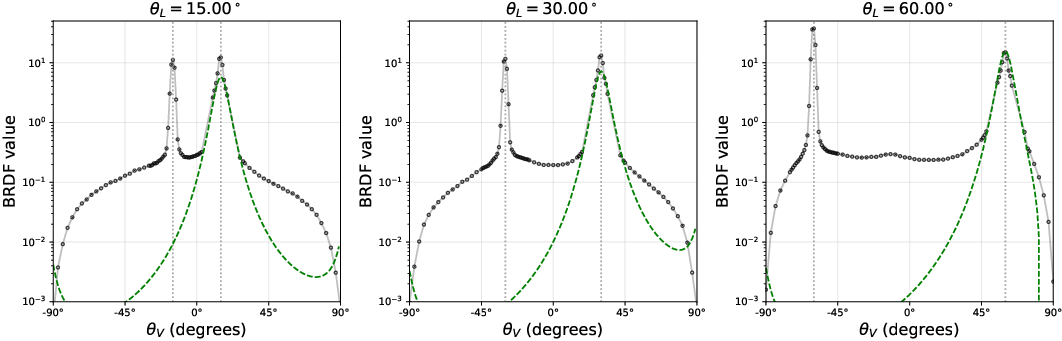
Figure 4: Measured BRDF of retroreflective tape (black dots) and MRM (green line) at different illumination angles, demonstrating strong empirical agreement.
Generalization to Conductors and Dielectrics
The model generalizes to both conductors and dielectrics by composition: for conductors, it serves as a direct drop-in replacement for classic microfacet BRDFs; for dielectrics, it is possible to combine the retroreflective BRDF with either a classic or retroreflective BTDF according to material needs, with albedo handled consistently due to structural equivalence.






Figure 5: Renderings of a metallic shaderball: top row uses classic GGX, bottom row uses retroreflective MRM, for several view/light angles, illustrating the shift of the specular lobe for retroreflection.



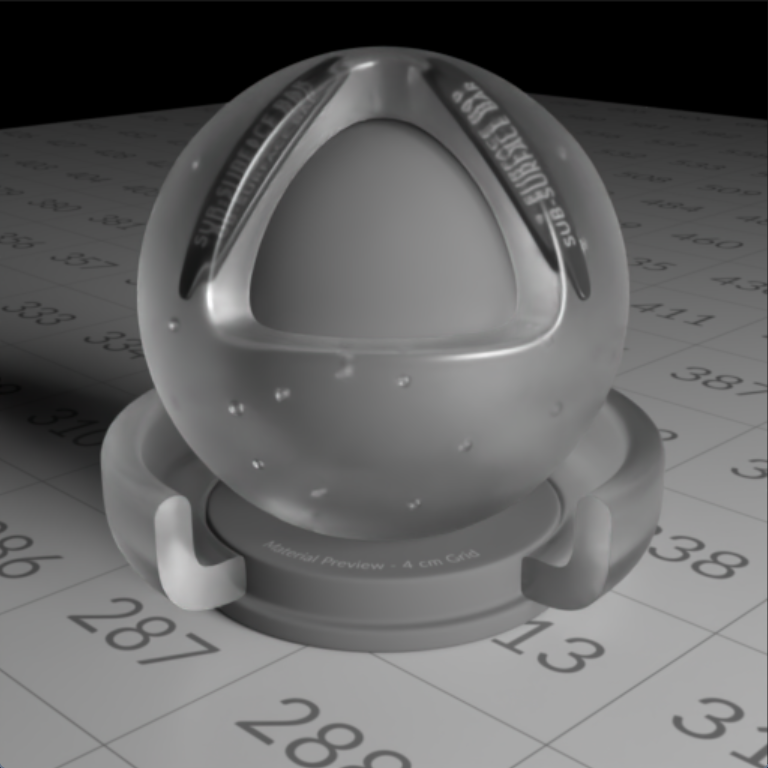
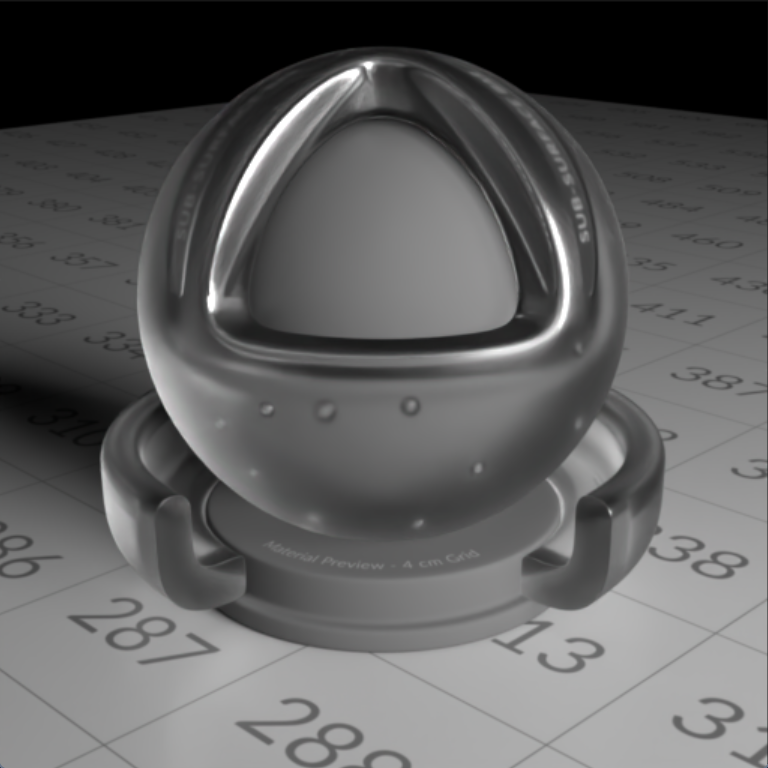

Figure 6: Glass shaderball illuminated from the side: classic microfacet (left), full retroreflective MRM (middle), retroreflective BRDF plus classic BTDF (right), showing flexibility in BSDF construction.
This flexibility is particularly useful for material libraries and standardized shading frameworks, as it allows for seamless, parameterizable blending between forward and retroreflective behavior as desired.
Adoption and Implications
MRM is already adopted in the OpenPBR material standard and MaterialX shading framework. Its introduction allows for accurate, physically plausible digital reproduction of retroreflective materials with negligible implementation risk or computational overhead, simplifying both offline and real-time physically based rendering.
The model’s compatibility with importance sampling and energy compensation pipelines ensures its utility in predictive simulation contexts, such as automotive safety visualization and sensor simulation for autonomous vehicles.
Future research directions may address multi-lobe retroreflective behaviors, more sophisticated Fresnel attenuation models matched to specular bead or prismatic microgeometry, or data-driven hybridizations for arbitrarily complex retroreflective effects.
Conclusion
The Minimal Retroreflective Microfacet model provides a rigorously justified, practically trivial, and physically correct method to incorporate strong retroreflective behavior into physically based shading systems. Its single substitution—reflection of the view vector—preserves core theoretical requirements and empirical fidelity, and its generality and ease of adoption make it suitable for broad use in rendering pipelines requiring both efficiency and accuracy in retroreflective material depiction.

