Macrofacet Theory for Gaussian Process Statistical Surfaces
Abstract: We present macrofacet theory, taking microfacet theory from micro-space to macro-space by stretching a surface to a volume to make it have microfacet characteristic in marco-space. In this way, we have a macroscopic microfacet formulation that uses a classic exponential participating medium. Meanwhile, we observe that traditional microfacet models are equivalent to Gaussian processes in definition but ignore the correlation along the geometric normal of macro-surface. We extend microfacet theory so that macrofacet can handle this problem and represent Gaussian process implicit surfaces in a statistical way. As a result, our approach converts Gaussian process implicit surfaces into classic exponential media to render surfaces, volumes and in-betweens without realization. These enable efficient rendering with performance improvement compared to realization-based approaches, while bridging microfacet models and Gaussian processes theoretically. Moreover, our approach is easy to implement and friendly for artists.
Paper Prompts
Sign up for free to create and run prompts on this paper using GPT-5.
Top Community Prompts
Explain it Like I'm 14
Overview
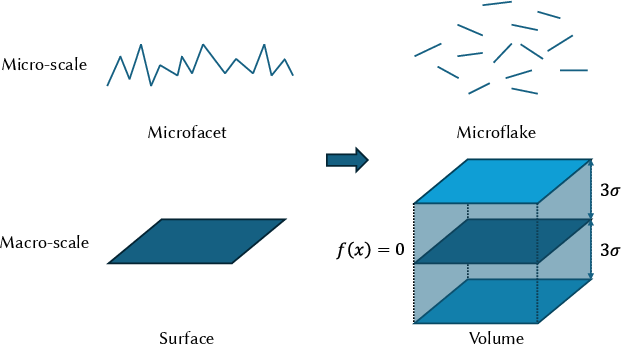
This paper is about a new way to render (draw) materials that look like they’re somewhere between a solid surface and a fluffy or hole‑filled material (like foam, felt, or porous stone). The authors introduce “macrofacet theory,” which takes ideas used to render rough shiny surfaces (microfacet models) and scales them up so they also work for fuzzier, more complex structures that live in a thin layer around a surface. Their key trick is to turn a surface into a thin volume and treat the tiny surface details as little flakes floating in that volume. This connects two worlds: classic surface rendering and volume rendering, and it also links these ideas to Gaussian processes, a math tool for making realistic random shapes.
Key Questions the Paper Asks
- Can we use one simple method to render surfaces, volumes, and the fuzzy “in‑between” without switching tools?
- How can we extend microfacet models (tiny mirror-like facets on a surface) to handle materials that have holes and overlapping layers?
- Can we represent complex “random” surfaces (made by Gaussian processes) without generating many slow, detailed versions of them?
- Can we do all this using standard, easy-to-implement volume rendering tools that artists and engines already support?
How They Did It (Methods, in simple terms)
First, a few friendly explanations:
- Microfacet model: Imagine a rough shiny surface (like glittery paint). It looks shiny because it’s covered with countless tiny flat mirrors (“microfacets”). Microfacet math predicts how light reflects from all those tiny mirrors.
- Volume rendering: Think of fog or smoke. Light gets absorbed and scattered as it travels through the fog.
- Gaussian process (GP): A way to create natural-looking random shapes. A Gaussian Process Implicit Surface (GPIS) is a “hidden” surface defined by a function; the surface is where the function equals zero. It’s a nice way to describe bumpy or fuzzy things.
- The problem: GPIS-based rendering usually needs to generate many full “realizations” (many random versions of the surface) and average them, which is slow.
What the authors do:
- Stretch the surface into a thin “shell” volume: Instead of treating the surface as infinitely thin, they inflate it into a thin layer on both sides (like giving the surface a fluffy jacket). Inside this layer, the tiny surface pieces become tiny “flakes” floating in a volume.
- Use classic volume math to move light through that shell: They describe how light fades (extinction), how it changes direction (phase function), and how much light remains after traveling a distance (transmittance). These are standard volume concepts that existing renderers already know.
- Handle “height-field” and “not height-field” cases:
- Height-field: There is only one surface along any straight-up line (like a normal rough surface). This case matches classic microfacet behavior.
- Not height-field: There can be multiple layers, holes, and overlaps along the same line (think porous material). They generalize the math so it still works using volume tools.
- Make a simplifying independence assumption: To keep things fast and practical, they assume some parts of the randomness aren’t tightly linked over distance. This lets them use standard “exponential” media (the simplest and most common volume model) and avoid slow GP realizations.
- Connect normals and gradients: To decide how the tiny flakes are oriented, they link the distribution of surface normals (which direction the flakes face) to the distribution of gradients (slopes) from the underlying GP math. This keeps everything consistent and physically sensible.
Main Findings and Why They Matter
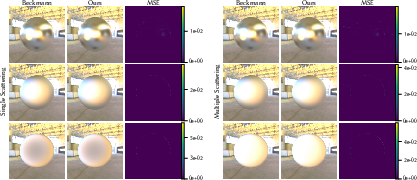
- One method for surfaces, volumes, and in-betweens: By turning a surface into a thin volume and using microflake ideas, they can render surface-like, volume-like, and fuzzy in-between appearances with the same framework.
- Matches known behavior when it should:
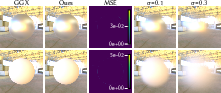
- When the shell becomes very thin, their “macrofacet” model behaves like the standard microfacet BRDF (so it doesn’t break old results).
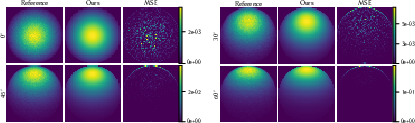
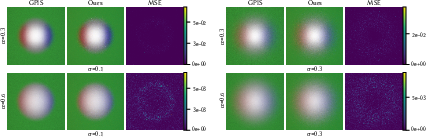
- For height-field GP surfaces, their method’s light behavior matches what Gaussian-process methods predict.
- Handles porous, overlapping structures: Their generalized model works even when there are multiple layers and holes along the same line of sight, which classic microfacet models struggle with.
- Faster and easier to implement: Because they don’t generate many slow GP realizations, their approach renders faster and fits easily into existing renderers that already support standard volumes. Their tests show big efficiency gains compared to earlier GP-based methods.
- Artist-friendly control: Artists can choose familiar “normal distribution functions” (like Beckmann or GGX) to shape the look, without needing to understand the heavy math of Gaussian processes.
What This Could Mean (Implications)
- A practical bridge: This unifies surface and volume rendering, making it easier to create materials that look like real-world stuff (porous rock, foams, fabrics) without switching techniques.
- Better performance in production: It plugs into common rendering engines via standard volume tools, so teams can get complex looks with less code and faster renders.
- Honest trade-offs: The method uses a simplifying assumption (treating some parts as independent), so it might slightly differ from the “perfect” GP result in some edge cases (e.g., sharp transitions). Still, the speed and simplicity make it very attractive in practice.
- Future directions: The authors suggest exploring more advanced (non-exponential) volume models to capture correlations even more accurately, better sampling for the tiny flake orientations, support for non-metallic (dielectric) materials, and denoising for even faster, cleaner images.
In short, the paper shows a neat, practical way to make fuzzy, porous, and rough materials look right and render fast, by cleverly reusing well-known volume rendering tools and extending microfacet ideas to a larger, “macro” scale.
Knowledge Gaps
Unresolved Knowledge Gaps, Limitations, and Open Questions
Below is a concise list of concrete gaps and limitations that remain open for future work:
- Correlation along paths: The method assumes independence of SDF/gradient between the ray origin and current point to obtain a classic exponential medium. It does not model full path correlation inherent in GPIS, leading to biased transmittance (non-multiplicativity). A practical, renderer-compatible non-exponential or correlated-medium formulation is needed.
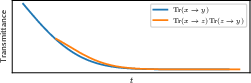
- Transmittance accuracy: The generalized macrofacet transmittance deviates from GPIS for longer distances. Conditions of validity, quantitative error bounds, and correction terms for the de-correlation approximation are not derived.
- Phase function under correlation: The conductor phase function is derived assuming the generalized vNDF and independence. How to construct phase functions that remain reciprocal and energy-conserving when path correlation is modeled is unresolved.
- Importance sampling of generalized vNDF: The vNDF contains error functions, preventing inverse-CDF sampling. The current mixture (Beckmann-vNDF + uniform hemisphere) is ad hoc. A robust, low-variance sampler (e.g., rejection/MIS with tight proposals) with variance analysis is needed.
- Material coverage: Only conductors are handled. Extensions to dielectrics (refraction, transmission lobes, total internal reflection), participating boundaries, and subsurface effects are unaddressed, including how to maintain reciprocity/energy conservation.
- Kernel generality: Derivations target the squared-exponential (SE) kernel. Generalization to other kernels (e.g., Matérn, periodic, rational quadratic) and non-stationary/heteroscedastic GPs (spatially varying length scales or variance) is not developed.
- Posterior (conditioned) GPIS: The mapping assumes a simple mean (e.g., SDF plane) and stationary covariance. How to compute spatially varying macrofacet parameters (ρ, Λ, NDF) from posterior GPIS conditioned on observations without costly realizations is not shown.
- NDF from general GDFs: The NDF derivation relies on Gaussian gradient statistics. How to compute NDF/vNDF for non-Gaussian gradient distributions (e.g., from non-SE kernels or other stochastic processes) is open.
- Shell truncation at ±3σ: The shell thickness is fixed by a heuristic. There is no analysis of the radiance error introduced by truncated tails or guidelines for adaptive shell extent based on target error.
- Numerical stability of ρ(f)=φ/Φ: The Gaussian hazard-rate becomes ill-conditioned when Φ is small (e.g., large negative f). Stable evaluation strategies and error control are not provided.
- Reciprocity and energy conservation proofs: Reciprocity is asserted via numerical equivalences (e.g., normalization equals projected area). A full analytical proof of energy conservation/reciprocity for the generalized full-sphere NDF/vNDF (with overlaps) is not included.
- Parameter inference: A procedure to infer GP hyperparameters (σ, l_x, l_y, l_z) or macrofacet parameters from measured appearance or desired BRDF/BSDF characteristics is not provided.
- Renderer integration details: The approach is demonstrated with null-scattering in PBRT on CPU. Integration with bidirectional/MLT methods, correct MIS weights with next-event estimation, and GPU implementations remain unexplored.
- Spatial variation and performance: While a spatially varying example is shown, strategies for efficiently evaluating spatially varying parameters (caching, precomputation, acceleration structures) and their memory/performance implications are not detailed.
- Composition with other media/surfaces: Rules for physically consistent combination of macrofacet volumes with external participating media and surfaces (overlapping volumes, boundary interactions, index mismatches) are not established.
- Degenerate limit σ→0: Although the model should reduce to a surface, numerical robustness (e.g., very large ρ near the mean surface, step-size control, and variance behavior) is not analyzed.
- Multiple scattering correctness: Beyond demonstrating capability, there is no analysis comparing multi-bounce behavior against microflake theory or GPIS ground truth (e.g., path length distributions, bias vs. microflake solutions).
- Downward-facing normals and full-sphere vNDF: The framework accommodates full-sphere normals, but the implications for visibility/shadowing definitions, and consistent handling of overlaps in the visible-normal formulation, need formal treatment.
- Extension to non-exponential media: The authors suggest non-exponential media may be required for accurate correlation, but no concrete formulation or efficient estimator is provided.
- Validation breadth: Comparisons are primarily to GPIS/microfacet renderings. Validation against measured porous/aniso materials, perceptual studies, or physical benchmarks is absent.
- Temporal/animated GPIS: Handling time-correlated stochastic surfaces (animated GP parameters, temporal coherence in sampling) is not discussed.
- Choice of NDF vs. GP consistency: Allowing arbitrary NDFs gives artist control but can break direct correspondence with the underlying GP statistics. The trade-off and means to constrain NDF choices to be statistically consistent are not defined.
Practical Applications
Immediate Applications
Below are applications that can be deployed with today’s rendering pipelines and workflows, leveraging the paper’s formulation of Gaussian-process statistical surfaces (GPSS) as classic exponential participating media, its derived extinction/phase functions, and its compatibility with standard volumetric renderers.
- Production rendering: faster “fuzzy” and porous materials
- Sector: Media & Entertainment (VFX/animation), Product visualization
- What: Replace GPIS realization-based workflows with macrofacet volumes to render in-between surface/volume appearances (e.g., powder-coated metals, frosted/oxidized metals, porous stone, foam, dust-coated surfaces) without stochastic field realizations.
- Tools/workflows: Integrate a “Macrofacet (GPSS) Volume” BSDF into PBRT/Mitsuba/Arnold/RenderMan/Cycles; use existing null-scattering or path-traced volumetric integrators.
- Assumptions/dependencies: Classic exponential media and de-correlation assumption; conductor-only phase function in current formulation; primarily SE kernel alignment; requires engine support for anisotropic media and multiple scattering.
- Games/real-time path tracing for lookdev and offline baking
- Sector: Game development, Real-time engines (for offline baking)
- What: Use macrofacet during lookdev or to bake textures/BSDF parameters capturing “fuzziness” into real-time approximations (LUTs, reflection probes, prefiltered env maps).
- Tools/workflows: Unreal Engine/Unity path tracers for material previews; bake to GGX-compatible BRDF inputs.
- Assumptions/dependencies: Practical today for offline previews/bakes; real-time runtime usage may be limited by volumetric cost and vNDF sampling complexity.
- Material authoring with artist-friendly controls
- Sector: DCC/material design
- What: A material node exposing σ (shell thickness/variance), αx/αy/αz (anisotropic roughness), and NDF choice (Beckmann/GGX) to intuitively control fuzziness and porosity.
- Tools/workflows: Substance 3D Designer/Painter, Blender Shader Editor, MaterialX/MDL nodes; export to DCC/renderers.
- Assumptions/dependencies: Graphs must support volumetric materials; artists may choose NDFs independent of true GP kernels (physically inspired but not exact).
- Architectural and industrial visualization of rough/porous finishes
- Sector: AEC, Automotive, Consumer goods CMF
- What: Visualize micro-porous concrete, plaster, acoustic panels, bead-blasted/powder-coated finishes with multi-bounce energy-conserving appearance.
- Tools/workflows: V-Ray/Arnold/KeyShot/Octane with volumetric support; material presets library (“GPSS Macrofacet Materials”).
- Assumptions/dependencies: Volumetric path tracing or null-scattering in the renderer; conductor-focused model; GGX macrofacet for surface-degenerate cases.
- Faster synthetic data generation for inverse rendering/ML
- Sector: Computer vision & graphics research
- What: Generate datasets of rough/fuzzy materials more efficiently by avoiding GP realizations; improve throughput of supervised training or validation renders.
- Tools/workflows: PBRT pipelines, cluster/cloud rendering (lower cost/energy per frame).
- Assumptions/dependencies: Approximation accuracy guided by de-correlation assumption; primarily conductor-like materials.
- Uncertainty-aware visualization in surface reconstruction
- Sector: Geospatial, Robotics SLAM, 3D scanning
- What: Depict uncertainty of reconstructed surfaces (e.g., from point clouds) as “fuzzy shells” around surfaces using GPSS macrofacet volumes instead of explicit ensembles.
- Tools/workflows: Import SDF mean/variance into visualization tools; custom volume shader in ParaView/VTK/Blender for previews.
- Assumptions/dependencies: Availability of SDF mean/variance (or proxy); exponential-media approximation; performance depends on volumetric renderer.
- Education and research baselines
- Sector: Academia (Computer Graphics)
- What: Use macrofacet as a didactic and experimental baseline to study the continuum between surfaces and volumes and to prototype anisotropic media with microfacet lineage.
- Tools/workflows: Open-source PBRT implementation; comparative studies vs. GPIS/Renewal/Renewal+.
- Assumptions/dependencies: Only SE kernels analyzed in detail; independence assumption drives small differences at sharp geometry or long paths.
- Render farm cost and energy reduction
- Sector: Media & Entertainment IT/Ops
- What: Reduce compute time and energy by replacing realization-heavy GPIS materials with macrofacet volumes that converge faster at equal spp/time.
- Tools/workflows: Studio render pipelines; asset-level material substitution.
- Assumptions/dependencies: Visual match acceptance; production QA of look parity; conductor/material limitations.
- Asset library “GPSS macrofacet” presets
- Sector: Digital content libraries
- What: Distribute ready-to-use materials (e.g., frosted gold, powder coat, sandstone, ceramic glaze roughness bands) parameterized by σ and anisotropic α.
- Tools/workflows: Quixel/PolyHaven/Adobe libraries; MDL/MaterialX definitions.
- Assumptions/dependencies: Engine interoperability for volume materials; phase/σ tuning for visual parity.
- Manufacturing process visualization
- Sector: Industrial/Mechanical design
- What: Preview appearance impacts of processes (sandblasting, bead blasting, bead-laden coatings, additive manufacturing porosity) without explicit micro-geometry.
- Tools/workflows: CAD viewers with path tracing (KeyShot/VRED) supporting volumes; parameter sweeps to evaluate CMF decisions.
- Assumptions/dependencies: Parameter-to-process mapping requires calibration; conductor bias in current model.
Long-Term Applications
These opportunities require further development (e.g., non-exponential media, improved sampling, new phase functions) or broader ecosystem support.
- Accurate correlation handling via non-exponential media
- Sector: Rendering research, Engines
- What: Incorporate path-dependent extinction/transmittance to capture full GP correlations (non-multiplicative transmittance).
- Tools/workflows: New non-classical medium models; engine API support; sampling strategies.
- Assumptions/dependencies: Increased complexity; performance and integrator changes.
- Generalized vNDF importance sampling
- Sector: Rendering engines
- What: Develop efficient samplers for the generalized vNDF (with error functions) to reduce noise and enable real-time/faster offline rendering.
- Tools/workflows: Closed-form or rejection sampling, MCMC or neural samplers; GPU implementations.
- Assumptions/dependencies: Numerical stability; broad angular coverage.
- Dielectric and layered material support
- Sector: VFX/games/CAD
- What: Extend phase functions and energy partition (Fresnel) to dielectrics and layered constructs (clearcoat over fuzzy substrate, paint with micro-porosity).
- Tools/workflows: Layered BSDF/BSDF+volume stacks; material graphs with Fresnel-consistent layering.
- Assumptions/dependencies: Multiple scattering between layers; careful energy conservation.
- Real-time integration in game engines
- Sector: Games/AR/VR
- What: Approximate macrofacet volumes in rasterization/RT hybrid pipelines (screen-space or preintegrated BRDFs with “fuzz-shell” parameters).
- Tools/workflows: UE5/Unity HDRP material shaders; subsurface/fuzz lobes approximations; probe-based GI.
- Assumptions/dependencies: Strong approximations for speed; limited path-length correlation effects.
- Inverse rendering and material scanning
- Sector: Vision/Graphics, Digital twins
- What: Estimate {σ, αx, αy, αz} from images, potentially with priors over GP kernels; robustly capture fuzzy/porous appearances from real materials.
- Tools/workflows: Differentiable renderers with macrofacet volume; optimization/ML pipelines.
- Assumptions/dependencies: Identifiability under lighting/viewing; noise/regularization; need dielectric support.
- Standards integration in MaterialX/MDL/USD
- Sector: Tools & Standards
- What: Standardize a “Macrofacet Volume” node bridging microfacet and microflake semantics; presets for in-between surface/volume materials.
- Tools/workflows: Proposals to ASWF/NVIDIA MDL/MaterialX; DCC integration.
- Assumptions/dependencies: Consensus on parameters and physical constraints; cross-renderer consistency.
- Robotics and automotive sensor simulation
- Sector: Robotics/Autonomy
- What: Simulate LiDAR/ToF interactions with rough/porous surfaces using extended dielectric models and path-dependent media.
- Tools/workflows: Sensor simulators (CARLA, NVIDIA DRIVE Sim); materials parameterized by GPSS.
- Assumptions/dependencies: Wavelength-specific BRDF/BSDF; dielectric support; performance for large-scale scenes.
- Medical and scientific visualization of uncertain isosurfaces
- Sector: Healthcare, Scientific computing
- What: Represent uncertainty in isosurface extraction (MRI/CT/seismic) as macrofacet volumes rather than crisp surfaces or explicit ensembles.
- Tools/workflows: ParaView/VTK/ITK plug-ins; interactive volume path tracing or progressive previews.
- Assumptions/dependencies: Domain-specific transfer functions; real-time constraints; clinical validation.
- Hardware acceleration and library support
- Sector: GPU/SDK vendors
- What: Implement macrofacet extinction and phase functions in GPU libraries (OptiX, DXR, Metal) and add RT-core-accelerated sampling.
- Tools/workflows: Shading language intrinsics; vendor sample frameworks.
- Assumptions/dependencies: Demand across engines; numerical robustness of special functions.
- Procedural synthesis of stochastic micro-geometry guided by GPSS
- Sector: Content creation
- What: Use GP priors to synthesize consistent micro-structures (porosity, fuzz) that match macrofacet parameters—bridging procedural textures and physical appearance.
- Tools/workflows: Houdini/Designer nodes; auto-tuning to target σ/α.
- Assumptions/dependencies: Mapping from parameters to structural features; asset validation loops.
- Sustainability reporting for render pipelines
- Sector: Policy/Operations
- What: Quantify and report energy/carbon savings by switching from GPIS realizations to macrofacet volumes for certain materials in render farms.
- Tools/workflows: Pipeline metrics and dashboards; green computing initiatives.
- Assumptions/dependencies: Verified performance gains; studio adoption; limited to applicable materials.
- Cross-kernel generalization and learned surrogates
- Sector: Research
- What: Extend beyond SE kernels (e.g., Matérn) and/or use learned mappings from kernel hyperparameters to macrofacet volume parameters; neural phase/extinction approximators.
- Tools/workflows: Fitting pipelines; neural surrogate deployment in renderers.
- Assumptions/dependencies: Training data coverage; generalization fidelity.
- Coupled media and environment interactions
- Sector: VFX/Scientific rendering
- What: Jointly model macrofacet surfaces with surrounding participating media (dust, smoke) for complex multi-bounce light transport between “fuzz shell” and environment.
- Tools/workflows: Unified volumetric integrators; importance sampling across media boundaries.
- Assumptions/dependencies: Robust multiple-scattering control; noise management.
Notes on feasibility across applications:
- The approach is realization-free and compatible with classic volumetric rendering, so integration is straightforward in offline renderers.
- Key limitations to consider: the de-correlation assumption (can diverge for long paths/high correlation), current focus on conductors and SE kernels, and the lack of closed-form sampling for the generalized vNDF.
Glossary
- Anisotropic: Having direction-dependent properties; here, correlation lengths differ by axis. "When moved to 3D, it becomes a fully anisotropic 3D Gaussian process where the correlation on the geometric normal of macro-surface, that is, the -axis, is infinity, resulting in a height field."
- Beckmann distribution: A microfacet normal distribution derived from Gaussian surface slopes. "In the beginning, the Beckmann distribution \cite{Beckmann, CookTorrance} is widely used."
- Cumulative height distribution: The cumulative distribution function of micro-surface heights used in microfacet density. "\rho(h)=\frac{P1(h)}{C1(h)}."
- Exponential medium (classic exponential media): A participating medium with an exponential free-path distribution used for volumetric rendering. "We use classic exponential media to represent surfaces, volumes and in-betweens without realization of Gaussian processes."
- Extinction coefficient: The rate at which radiance is attenuated per unit length in a medium. "And the extinction coefficient is the product of microflake density and projected area:"
- Fresnel term: The reflectance component that depends on incident angle and material’s refractive properties. "p(\omega_o, \omega_i)=\frac{F(-\omega_o, \omega_h)D_{\omega_o}(\omega_h)}{4|-\omega_o\cdot\omega_h|},"
- Gaussian process: A distribution over functions specified by a mean and a covariance kernel. "Gaussian processes are used to model distributions over functions."
- Gaussian Process Implicit Surface (GPIS): An implicit surface defined as the zero level set of a Gaussian process. "A Gaussian Process Implicit Surface (GPIS) is the zero level set of a Gaussian process."
- GGX distribution: A microfacet normal distribution (Trowbridge-Reitz) that provides realistic highlights. "Walter et al.~\shortcite{GGX} adopt it as the GGX distribution to achieve a more realistic result."
- Gradient distribution function (GDF): The probability distribution of SDF gradients used to derive the NDF. "we can connect gradient distribution function (GDF) to NDF using the following equation:"
- Half vector: The normalized vector halfway between incident and outgoing directions. "where is the half vector."
- Invariance principle: A principle used to generalize shadow-masking from a single bounce to entire paths, reducing noise. "Cui et al.~\shortcite{Invariance-principle} further introduces the invariance principle to generalize the shadow masking function from a single bounce to an entire path to achieve less noise."
- Isotropic: Having properties that are identical in all directions (equal correlation lengths). "When , the covariance kernel is isotropic."
- Microfacet theory: A statistical model of rough surfaces composed of tiny specular facets defining BRDF behavior. "The microfacet theory describes a statistical model at micro-scale with a height distribution and a normal distribution of micro-surfaces."
- Microflake theory: A volumetric scattering framework analogous to microfacets, using oriented non-spherical particles. "There exist methods using microflake theory explaining microfacet theory to unify surface and volume \cite{16Heitz, Dupuy}."
- Next-event estimation: A direct-lighting technique that reduces variance by sampling light sources explicitly. "They also utilize next-event estimation to further reduce noise."
- Normal distribution function (NDF): The distribution of microfacet normals determining surface reflectance. "There are many types of normal distributions , usually referred to NDF."
- Non-exponential media: Participating media whose free-path distributions are not exponential, often due to correlation. "non-exponential media may be used \cite{bitterli-non-exp, jarabo-media}."
- Null-scattering: A volumetric rendering method using delta tracking with virtual collisions to handle heterogeneity. "We adopted null-scattering \cite{null-scattering} as our volumetric rendering method."
- Participating media: Volumes in which light interacts via scattering and absorption. "Dupuy et al.~\shortcite{Dupuy} and Heitz et al.~\shortcite{16Heitz} use participating media \cite{microflake,SGGX} to describe microfacet theory."
- Phase function: The angular distribution of scattering in a medium. "The phase function of a volume depends, describing how a ray is scattered in the medium, depends on the its material."
- Radiative transport equation: The fundamental equation governing light transport in participating media. "The standard form of radiative transport equation \cite{VRTE} is usually stated for spherical or randomly oriented particles, which is not the case for anisotropic media."
- Renewal model: A GPIS rendering approach that re-conditions per segment only on the last SDF value. "The Renewal model only conditions on the SDF of previous intersection,"
- Renewal+ model: A GPIS rendering variant that conditions on both SDF and gradient at the previous intersection. "while the Renewal+ model conditions on the SDF and gradient of previous intersection."
- SGGX distribution: A distribution for microflake orientation enabling spatially-varying anisotropic media. "Heitz et al.~\shortcite{SGGX} introduce the SGGX distribution to represent spatially-varying properties of anisotropic media based on microflake theory."
- Shadow masking term G1: The microfacet geometry term accounting for shadowing and masking from a single direction. "And calculating the transmittance of a GPIS is indeed calculating the shadow masking term ."
- Signed distance field (SDF): A scalar field giving the signed distance to the surface; its zero set defines the surface. "When the mean function is the signed distance field (SDF), GPIS appears like a surface or an in-between."
- Smith Lambda function: A function used to compute projected area and masking in the Smith microfacet model. "\sigma(\omega_o)=\int_{\Omega}\langle -\omega_o, \omega_m\rangle D(\omega_m)\mathrm{d}\omega_m=\Lambda(\omega_o)\cos\theta_o,"
- Smith's assumption: The de-correlation assumption allowing independent choice of height and normal distributions. "Walter et al.~\shortcite{GGX} use the Smith's assumption \cite{Smith} to apply more normal distribution functions to the model, such as the GGX distribution."
- Squared Exponential (SE) kernel: A stationary covariance function controlling variance and correlation in a Gaussian process. "We focus on the squared exponential (SE) kernel, which is a stationary kernel and defined as"
- Transmittance: The probability (or fraction of radiance) that survives propagation without interaction. "As we know the extinction coefficient, we can compute the transmittance which is the remaining energy when a ray travel at distance in the medium:"
- Visible normals' distribution (vNDF): The distribution of microfacet normals visible from a given outgoing direction. "The visible normals' distribution (vNDF) is defined as"
- Volumetric light transport: The modeling of light propagation and scattering in volumes. "It can be transformed to a volumetric light transport equation:"
- Wiener measure: The probability measure defining sampling over Gaussian process realizations. "where represents a set of constraints and is the classic Wiener measure, the probability density of sampling ."
Collections
Sign up for free to add this paper to one or more collections.