- The paper demonstrates a robust detection of a 1.97 keV narrow absorption line, indicating a candidate proton CRSF and a local magnetic field of approximately 4×10^14 G.
- Multi-epoch X-ray observations from XMM-Newton, NuSTAR, Chandra, and Swift tightly constrain the spectral shape and variability, ruling out an intermediate-mass black hole scenario.
- The findings imply that super-Eddington accretion can be powered by a strongly magnetized, multipolar neutron star, challenging traditional accretion models.
Broadband X-ray Evidence for a Magnetar-Strength Neutron Star in NGC 3583 X-1
Introduction
The paper presents a comprehensive broadband X-ray analysis of the transient hyperluminous X-ray source (HLX) NGC 3583 X-1, focusing on the detection and interpretation of a statistically significant 1.97 keV absorption feature in the context of neutron star accretion physics. The work addresses the longstanding ambiguity in the nature of HLX accretors and contributes critical observational constraints to the characterization and taxonomy of non-nuclear, extreme luminosity accreting systems.
Observational Data and Temporal Behavior
The authors utilize multi-epoch XMM-Newton, NuSTAR, and Chandra datasets, augmented by long-term Swift/XRT monitoring, to probe the flux, spectral and timing properties of NGC 3583 X-1. The source exhibits episodic transitions into the HLX regime with peak luminosities LX>1041erg s−1, while dropping by factors >45 to deep, low flux states.
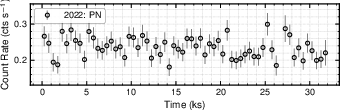
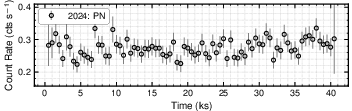
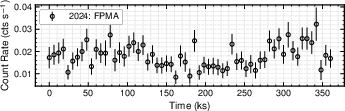
Figure 1: Light curves reveal pronounced variability and transient excursions into the hyperluminous domain in NGC 3583 X-1.
The absence of quasi-periodic oscillations and coherent X-ray pulsations was secured via exhaustive timing analyses. Stringent 90% upper limits were placed on the pulsed fraction (19.3% for the 0.3–10 keV and 36.3% for the 3–15 keV band), comparable to constraints in other ULXs lacking detected pulsations.
Spectral Modeling and Detection of the 1.97 keV Feature
Broadband spectral fitting demonstrates clear curvature with a prominent cut-off at 5–6 keV, robust against choice of continuum: phenomenological disk plus cutoff power-law, advection-dominated disk, and Comptonization models all converge on a characterization consistent with super-Eddington accretion by a compact object.
A highly significant (>3.9σ) narrow absorption line is detected at Eline=1.97±0.04keV with σ=74±40 eV and EW≈−67 eV. Monte Carlo and line-scan analysis firmly establish the feature’s significance and disentangle it from instrument artifacts and background sources. The feature’s statistical absence in earlier epochs is consistent with spectral state/luminosity coupling.
Interpretation: Magnetar-Strength Fields or Ultrafast Outflows?
The absence of accompanying blueshifted atomic features, in conjunction with requirement of extreme absorber velocities (vLOS>0.36c) if interpreted as an ionized outflow, severely challenges the ultrafast wind scenario. Statistical and physical self-consistency point instead to cyclotron resonance scattering off magnetically quantized protons in the vicinity of the compact object:
- Proton CRSF interpretation: The observed centroid energy yields a local field estimate of B≈4×10¹⁴G (assuming zg=0.3 for the gravitational redshift).
- Electron CRSF is excluded due to the combination of required field, line width, and lack of harmonics.
- The narrowness and isolated character of the feature, as well as the absence of significant harmonics consistent with proton scatterings, support the p-CRSF origin.
The continuum shape is incompatible with IMBH accretors, instead aligning with the “ultraluminous state” archetype consistent with highly magnetized neutron star accretors.
Physical Models and Theoretical Context
Empirically, the disk is advection-dominated with profile exponent p∼0.53–0.58, incompatible with thin disk models and reminiscent of other super-Eddington X-ray binaries. Using model normalizations, the implied inner disk radii and associated inferred black hole mass (>450) preclude an IMBH scenario.
A complex field geometry is implied: multipolar fields (>451 G) dominate close to the NS surface, enabling the p-CRSF, while a weaker dipole component (>452 G) at larger radii permits the formation of the observed super-Eddington accretion structure. This scenario is analogous to previous findings in M51 ULX-8 [Brightman et al. 2018], which similarly necessitated a strong surface-localized field.
Variability and State Transition Diagnostics
The extreme dynamic range in luminosity (a factor >453) is reminiscent of “propeller” transitions in the accretion flow, whereby centrifugal inhibition of inflow occurs for sufficiently strong magnetic and low spin regimes. HID and CCD diagnostics secure the hard-ultraluminous (HUL) state designation for NGC 3583 X-1 in all high-flux epochs, a state typically associated with low inclination and direct accretion column view.
Broader Implications and Future Directions
This detection adds to the emerging population of extreme ULXs and HLXs now recognized to host hyperaccreting, magnetar-strength neutron stars—contradicting legacy IMBH interpretations. Persistent non-detection of pulsations (allowed by the pulsed fraction limits) may be due to beaming geometry, accretion envelope smearing, or rapid spin/beam alignment, consistent with accretion torque theory at high >454.
The implication is that magnetar-strength (but possibly multipolar) NSs can support persistent (or transient) accretion at luminosities >455 erg/s—a regime previously thought to require IMBHs or be unreachable for neutron stars due to Eddington and magnetospheric constraints. The existence of such systems has ramifications for population synthesis, Galactic plane high-energy source catalogs, and models of feedback and star formation in their host galaxies.
Conclusion
The broadband temporal and spectral characterization of NGC 3583 X-1 demonstrates that transient HLXs can be powered by neutron stars with magnetar-strength local fields, as revealed by the detection of a robust p-CRSF candidate at 1.97 keV. The combination of spectral state, variability, and absence of competing wind evidence rules out IMBH or dominant outflow interpretations. This finding substantiates the presence of “hyperaccreting magnetar” ULX systems and deepens the challenge of distinguishing neutron star from black hole accretors in extragalactic surveys. Theoretical efforts must now focus on the evolution and observability of such multipolar field systems and their role in the broader context of compact object astrophysics.