- The paper identifies a candidate proton cyclotron resonant scattering feature at 1.89 keV, implying a surface magnetic field of approximately 4×10^14 G.
- The paper employs high-sensitivity Chandra spectral analysis and Monte Carlo simulations to confirm the feature with a detection significance up to 4.1σ.
- The paper observes a potential 7.4 s periodicity in the soft X-ray band, suggesting magnetar-like accretion behavior under super-Eddington conditions.
Detection of a Candidate Cyclotron Feature in NGC 4861 X-2
Introduction
The study presents a high-sensitivity spectral and timing analysis of Chandra/ACIS-S observations of the ultraluminous X-ray source (ULX) NGC 4861 X-2, located in a Magellanic-type irregular galaxy at 9.95 Mpc. ULXs with luminosities ≳2×1039 erg s−1 span the regime between typical X-ray binaries and AGN and may host either accreting stellar-mass black holes in a super-Eddington state or neutron stars with strong beaming or truly super-Eddington flows. The recent identification of coherent pulsations in ULXs has established a growing class of neutron star-powered systems, some requiring extreme (B∼1013--1015 G) magnetic fields. Direct measurements of the inner accretion geometry and B-field strength rely critically on the detection and interpretation of cyclotron resonant scattering features (CRSFs).
Spectral Analysis and Discovery of the 1.89 keV Feature
The focus of the study is a deep (∼58 ks) Chandra/ACIS-S exposure (ObsID 20992), supplemented by ancillary datasets. Spectra were extracted and modeled using both a multicolor disk blackbody (diskbb) and a curved cutoff power-law (cutoffpl), each with foreground (NH=1.3×1020cm−2) absorption.
Both models yield acceptable fits to the gross spectral shape, with kTin∼0.79--$0.80$ keV and Ecut∼1.3--$1.4$ keV, but both leave significant negative residuals near 1.89 keV. Introduction of a Gaussian absorption component (gabs) at this energy leads to a dramatic improvement in the fit statistic: B∼10130 (diskbb) and B∼10131 (cutoffpl), and suppresses the structure in the residuals.
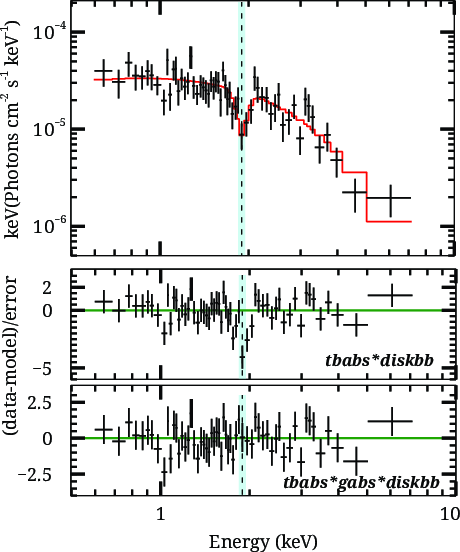
Figure 1: The Chandra/ACIS-S energy spectrum of NGC\,4861 X-2 shows a clear absorption-like deficit at B∼10132 keV in the continuum model, effectively removed with the addition of a Gaussian absorption component.
Robustness checks against binning/statistical treatment, background regions, and continuum choices all support the persistence of the feature at the same energy. Monte Carlo simulations yield a detection significance in the range B∼10133 (cutoffpl) to B∼10134 (diskbb). A blind line scan over the full 0.3–10 keV band identifies a single, highly significant improvement at 1.89 keV, with no evidence for harmonics or other similar features.
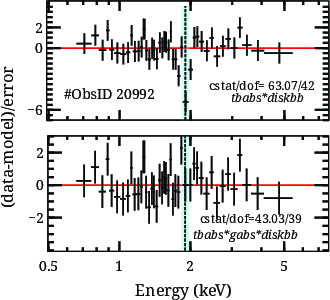
Figure 2: Residuals of the ACIS-S spectrum before and after including the gabs component, highlighting the model-independent nature of the absorption feature.
Verification and Secondary Detections
Analysis of a separate Chandra observation (ObsID 19497, B∼10135 ks) recovers a marginal feature at B∼10136 keV with a lower significance (B∼10137), consistent in centroid and width with the primary detection considering statistical uncertainties and instrumental calibration.
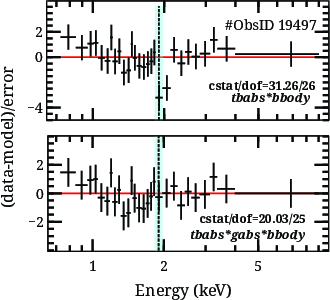
Figure 3: Residuals for the tbabs*bbody model of ObsID 19497 show a negative deviation near 1.9 keV, eliminated upon addition of a Gaussian absorption component.
Neither additional Chandra data nor archival XMM-Newton datasets yielded significant features, but the derived upper limits on line strength are consistent with the detection sensitivity limits imposed by photon statistics.
Timing Analysis
The paper examines the temporal properties of NGC 4861 X-2 through power-spectrum analysis and light-curve folding. The soft band (0.3–2 keV) light curve displays statistically significant variability, while the hard band (2–10 keV) does not, and the hardness ratio remains constant. The presence of a candidate periodicity at B∼10138 (B∼10139 Hz) is observed in the soft band in both deep and secondary Chandra observations, with a global significance of 10150 and 10151, respectively. The folded profile indicates a pulse fraction of 10152.
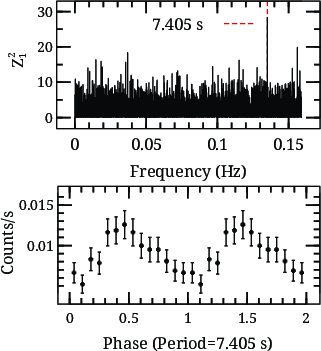
Figure 4: Power spectrum and folded light curve reveal a candidate periodicity at 7.4 s in the soft X-ray band.
No significant periodicity is detected in the remaining Chandra pointings, in line with photon counting statistics.
Interpretation: CRSF Origin and Magnetic Field Constraints
The authors interpret the isolated, broad (FWHM 10153 keV) absorption feature as a candidate proton CRSF. The absence of additional absorption lines disfavors an origin in highly ionized atomic transitions and detailed modeling, as well as consideration of instrumental effects, suggests a genuine astrophysical origin.
Assuming the canonical relation for proton cyclotron lines, 10154 keV, the 10155 keV centroid implies a surface 10156-field of 10157--10158 G for 10159--B0, consistent with local magnetar-strength conditions. An electron cyclotron origin is strongly disfavored as it would require B1 G, which is inconsistent with the expected CRSF energy range and the lack of analogous features at higher energies.
Modeling of the feature's width indicates that broadening is likely dominated by non-thermal processes, such as pulse-phase averaging, local field gradients, and angle-dependent scattering/reprocessing within a structured magnetosphere or wind funnel, rather than by purely thermal or rotational broadening.
Context and Comparisons
This detection joins an emergent class of ULXs with CRSFs interpreted as evidence for highly magnetized neutron stars, including M51 ULX-8 (proton CRSF at B2 keV) and NGC 4656 ULX-1 (proton CRSF at B3 keV). The lower energy of the feature in NGC 4861 X-2 suggests a somewhat lower B4-field, but still in the magnetar regime.
The inner-disk temperature (B5 keV) and low cutoff energy (B6 keV) are congruent with models for super-Eddington accreting magnetized neutron stars enveloped by optically thick outflows, as recently quantified in both phenomenological and simulation-based studies. The potential 7.4 s periodicity and corresponding pulse fraction are in line with established ULX pulsar properties.
Implications and Future Prospects
The detection of a proton CRSF at 1.89 keV in a persistent ULX adds further weight to the magnetized neutron star paradigm for ULXs, indicating the occurrence of accretion flows close to the quantum critical field strength. This result imposes stringent requirements on models of disk-magnetosphere interaction, super-Eddington mass transfer, and X-ray emission geometry, including the formation and preservation of the line-forming region. The observed feature constrains the surface B7-field and supports the presence of strong multipolar or locally enhanced fields, potentially decoupled from the large-scale dipole structure.
Continued monitoring with high-throughput, high-spectral-resolution X-ray and timing missions is essential for confirming the periodic signal, testing for pulse-phase dependence of the line, and searching for harmonics or line energy variability. The growing ULX pulsar population with CRSFs opens avenues for direct measurement of B8-field topology under extreme dynamical conditions and for distinguishing between competing models of ULX energy production, outflow, and feedback processes. The pursuit of phase-resolved spectroscopy with next-generation X-ray observatories could enable discrimination between competing scenarios for broadening and depth variability.
Conclusion
The detection of a statistically significant absorption feature at 1.89 keV in NGC 4861 X-2 is robust against continuum modeling and instrumental systematics and consistent with a proton cyclotron resonant scattering feature. The inferred surface magnetic field of B9 G identifies the system as a highly magnetized neutron star accretor, reinforcing the hypothesis that a subset of ULXs are powered by magnetars undergoing super-Eddington accretion episodes. Confirmation of candidate periodic pulsations in tandem with the CRSF feature will be critical for affirming the neutron star nature and for advancing our understanding of accretion physics under extreme conditions.
(2606.04734)