Published 18 May 2026 in gr-qc, hep-th, and quant-ph | (2605.17935v1)
Abstract: We show that the emergence of time evolution in an otherwise timeless nonrelativistic closed quantum system -- viewed as a poor man's model of generally covariant quantum theory -- can be understood from the perspective of the path integral representation. As often happens in the functional integral approach, this viewpoint offers a more intuitive account of features that become cumbersome in the operator/Hilbert-space formulation. We show how Schrödinger evolution emerges once a clock degree of freedom is identified and placed in a suitable semiclassical good-clock state'. Our analysis has a consequence that extends to path integral formulations of generally covariant systems with action $S$ (including gravity). In such theories certain transition amplitudes take the form $\exp(iS/\hbar)+\exp(-iS/\hbar)$ rather than the expectedforward propagating' $\exp(iS/\hbar)$. This feature, known as the {\em cosine problem}, appears in concrete regularizations of the path integral, for example in the spin foam representation defining the physical inner product between spin network states in loop quantum gravity. Both formally and in explicit regularizations, this apparent difficulty has led some authors to seek modifications of the basic amplitudes to eliminate backward propagation. Our model shows that the cosine problem is instead a natural consequence of time-reversal invariance of the fundamental dynamics together with the time-neutral boundary states commonly used in transition amplitudes. When a suitable clock system is identified and placed in a semiclassical good-clock state', it introduces a time arrow selecting theforward propagating' $\exp(iS/\hbar)$, without modifying the fundamental dynamics. The analysis clarifies how time emerges under suitable conditions and emphasizes that, in the canonical formulation, quantum gravity is fundamentally timeless.
The paper demonstrates that employing semiclassical clock states within the path integral framework resolves the cosine problem and yields an emergent arrow of time.
It partitions the closed system into a clock subsystem and a remainder, correlating internal time with Dirac observables to recover Schrödinger dynamics.
This approach confirms that unitary evolution arises naturally without ad hoc modifications, providing new insights into time in quantum gravitational systems.
A Path Integral Perspective on the Problem of Time in Quantum Gravity
Introduction and Context
The "problem of time" is a central conceptual and technical obstacle in canonical and path integral approaches to quantum gravity. The essential feature distinguishing generally covariant theories—most notably general relativity—is the absence of a preferred time variable and the requirement that all physical observables be gauge invariant under diffeomorphisms. This leads to the so-called "frozen formalism," where the Wheeler-DeWitt equation (in its quantum gravity incarnation) imposes a constraint that yields a fundamentally timeless quantum theory. The investigation by Diaz and Perez explores the emergence of time and Schrödinger dynamics in a non-relativistic closed quantum system, employing the path integral formalism to reveal physical intuition that is cumbersome in the operator formulation.
A key technical aspect is the "cosine problem" in the gravitational path integral, where formal amplitudes are time-arrow-neutral, yielding both exp(iS/ℏ) and exp(−iS/ℏ) contributions, rather than a unidirectional "forward" propagator. This paper elucidates the relationship between time-reversal symmetry, constraint quantization, and the emergent arrow of time from appropriate clock states, both in simple models and by extrapolation to quantum gravity.
Timelessness and Constraints in Generally Covariant Theories
Quantization of generally covariant theories leads to the imposition of constraints. In canonical quantum gravity, the physical states satisfy
H[N,Na,πab,hab]∣ψ⟩=0
for all lapse N and shift Na fields, enforcing invariance under all deformations of the spatial slice. This requirement is equivalent to projecting onto the kernel of the constraint, leading to a Hilbert space of states that are labeled only by constants of motion—Dirac observables. In this setting, traditional notions of time evolution are unobservable; observables must commute with all constraints, effectively becoming timeless correlation functions.
The path integral representation formalizes this structure by summing over all histories weighted by the action (more precisely, by the phase exp(iS/ℏ)), with the integration over all lapse and shift yielding a symmetry under N→−N. This symmetry both in the classical and quantum formalism is manifest in the Hamiltonian and path integral formulations as time-arrow neutrality. The technical manifestation is that the fundamental amplitude involves the cosine of the action rather than a single exponential.
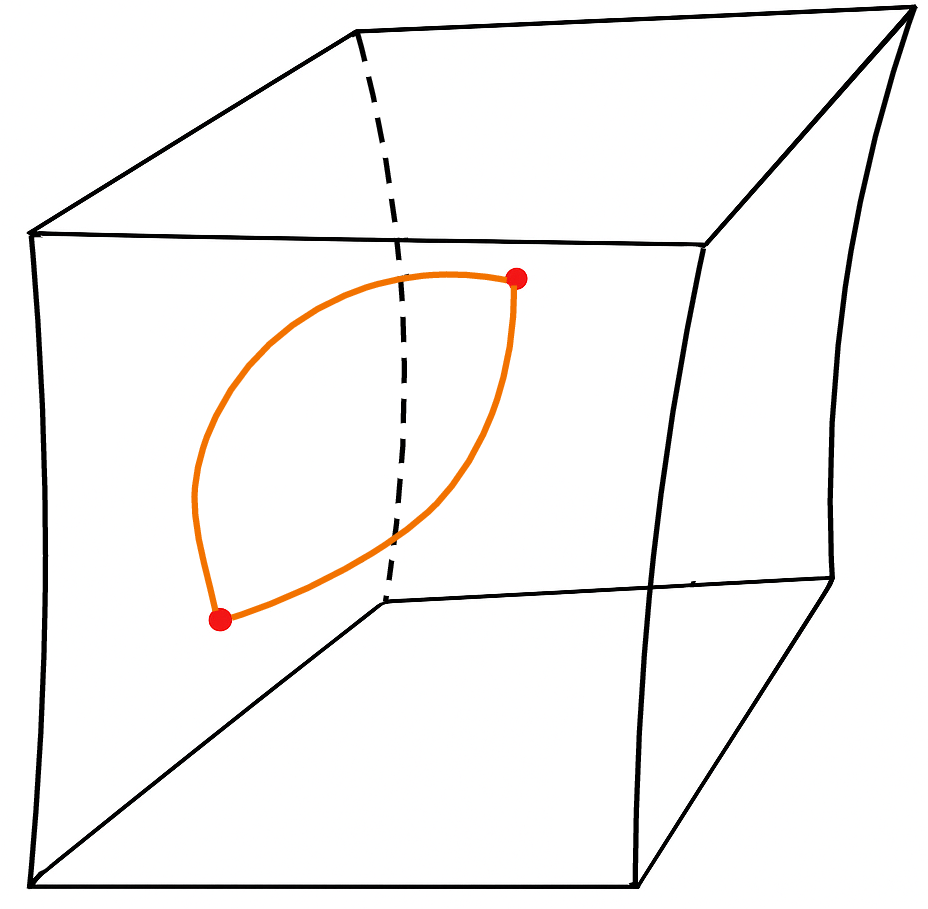
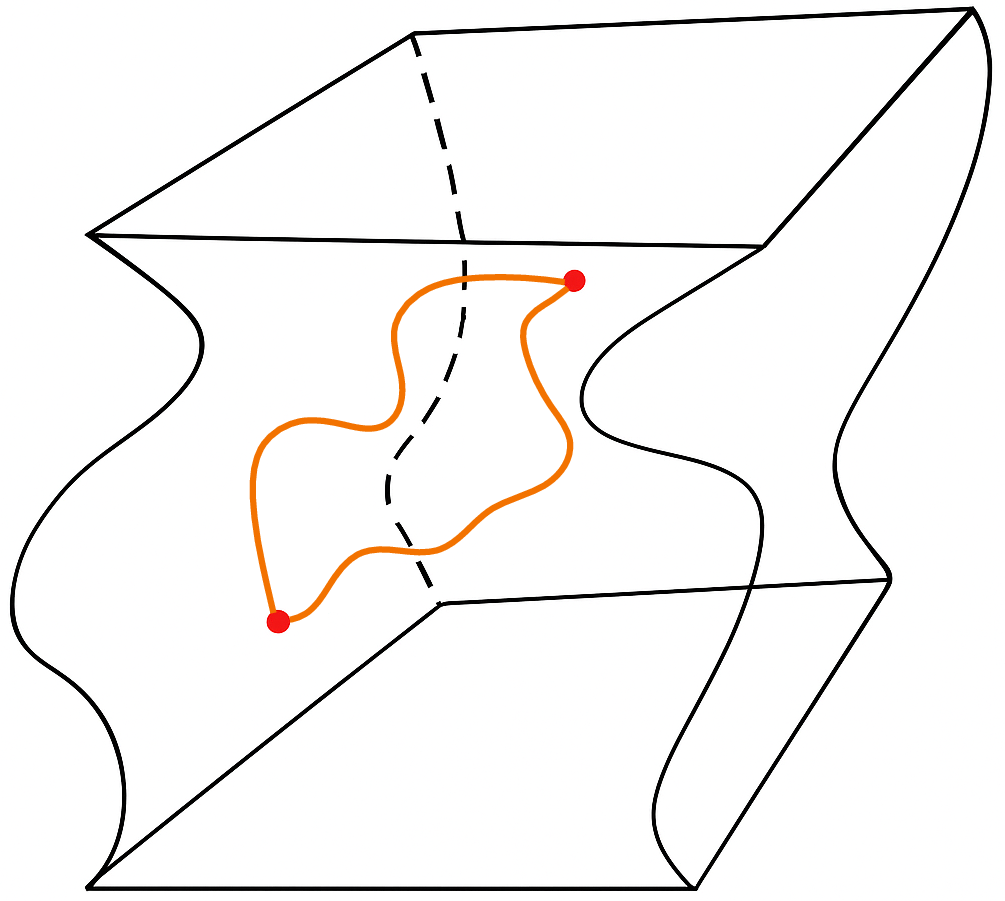
Figure 1: For any initial data, varying the arbitrary fields N(x) and Ni(x) yields different spacetime developments related by a spacetime diffeomorphism, underscoring the gauge redundancy and absence of absolute time.
The Emergence of Schrödinger Time through Semiclassical Clocks
To expose dynamics and a time parameter in a fundamentally timeless theory, one can partition the closed system into a clock subsystem and a remainder ("rest of the universe"). The total Hamiltonian is
H=Hc+HR
Path integral amplitudes between semiclassical "good-clock" states are computed for this composite system.
A central result is that if the clock is prepared in a semiclassical state with sharply peaked time (e.g., a coherent state for the harmonic oscillator or a Gaussian wave packet for a free particle), the path integral enforces a correlation between the configuration of the rest and the chosen clock reading. This leads to the emergence of an internal time variable and unitary dynamics given by the Schrödinger equation for exp(−iS/ℏ)0 in the time parameter defined relationally by the clock's initial and final states:
exp(−iS/ℏ)1
Here, exp(−iS/ℏ)2 is the total energy, exp(−iS/ℏ)3 the energy associated with the clock, and exp(−iS/ℏ)4 the physical time defined by properties of the clock states.
Figure 2: Emergence of Schrödinger time evolution from a timeless closed system when a clock subsystem is placed in a semiclassical "good clock" state; the transition amplitude encodes unitary evolution for the rest of the universe in the clock's internal time.
Resolution of the Cosine Problem
Transition amplitudes in the constrained path integral with time-neutral boundary states yield, generally,
exp(−iS/ℏ)5
where exp(−iS/ℏ)6 is the fluctuation prefactor. The presence of both forward (exp(−iS/ℏ)7) and backward (exp(−iS/ℏ)8) propagation is a direct consequence of the underlying time-reversal invariance and the absence of built-in time orientation. This "cosine problem" is not unique to the models studied here, but is well-documented in the semiclassical analysis of spin foams in loop quantum gravity.
The crucial insight offered is that when transition amplitudes are computed between "good clock" states—semiclassical boundary conditions that break the exp(−iS/ℏ)9 symmetry by being strongly peaked in one time direction—the path integral naturally selects the appropriate branch. Thus, no ad hoc modification of the fundamental amplitudes is necessary; the arrow of time emerges dynamically from the clock sector. This mechanism generalizes to the gravitational path integral and addresses the apparent need, sometimes asserted in the spin foam literature, to enforce forward propagation by truncating histories or altering vertex amplitudes.
Physical Time as a Dirac Observable
A repeated claim in canonical treatments is that "time" is not an observable, as it cannot commute with the constraints. The proposal in this work reaffirms this but clarifies that correlated quantities—relational Dirac observables defined with respect to the clock subsystem—do encode temporal information. The persistent entanglement between the clock and the remainder of the system allows the expectation values of composite Dirac observables to record the physical meaning of time, and the dynamical evolution of subsystems in the clock time can be explicitly observed in suitable amplitudes.
This perspective is aligned with and extends prior work on "evolving constants of motion," partial observables, and the program of conditional probability interpretations of quantum dynamics in closed systems.
Implications and Prospects
The analysis reinforces that time in quantum gravity—and in any fundamentally closed, generally covariant quantum system—must be understood as an emergent, relational property manifest only in states with sufficiently semiclassical clock sectors. For most states and especially in the deep quantum regime (e.g., near singularities or the Planck scale), no spacetime picture is valid and the dynamics remain "frozen" in the traditional sense.
Practically, this implies that modifying spin foam or path integral amplitudes to enforce forward causality is unwarranted; rather, physical predictions for the emergence of spacetime physics and time orientation must be extracted from the structure of boundary states used in computation.
Furthermore, the framework provides a rigorous handle for systematic analysis and extrapolation to field-theoretic (gravitational) settings. The connection to Dirac observables and relational quantization paves the way for investigating semiclassical limits and quantum-to-classical transitions in quantum gravity. The precise identification of the clock, its semiclassical regime, and its relation to the rest of the universe will be crucial for understanding time in cosmology and black hole interiors.
Conclusion
Time is fundamentally absent in generically covariant quantum theories, but it emerges as an internal, relational coordinate when a suitable clock degree of freedom is prepared in a semiclassical state. The path integral framework provides a transparent and physically motivated mechanism for this emergence and naturally resolves the "cosine problem" encountered in gravitational and covariant path integral quantizations. These results carry direct implications for the interpretation of transition amplitudes in approaches such as spin foam models and affirm that the arrow of time is not an input at the fundamental level but a property of the quantum state. In regimes where good clocks are unavailable—such as near quantum gravitational singularities—the universe remains genuinely timeless; extracting physical predictions there requires non-spacetime, relational correlation functions.
“Emergent Mind helps me see which AI papers have caught fire online.”
Philip
Creator, AI Explained on YouTube
Sign up for free to explore the frontiers of research
Discover trending papers, chat with arXiv, and track the latest research shaping the future of science and technology.Discover trending papers, chat with arXiv, and more.