- The paper presents a self-contained derivation of the GKLS equation using finite-dimensional operator theory to enforce complete positivity and trace preservation.
- It utilizes Kossakowski’s structural theorem and spectral analysis to detail the mathematical underpinnings of quantum Markovian semigroups.
- The derivation clarifies the interplay between Markovianity, positivity, and the physical consistency required for open quantum system dynamics.
A Self-Contained Derivation of the GKLS Equation and Kossakowski's Structural Legacy
Introduction and Context
The article "Another Legacy of Andrzej Kossakowski: A Self-Contained Derivation of the GKLS Equation" (2606.08579) provides not only a self-contained and rigorous derivation of the celebrated Gorini–Kossakowski–Lindblad–Sudarshan (GKLS) equation for quantum Markovian dynamics, but also contextualizes its structural underpinnings through the legacy of Andrzej Kossakowski. The GKLS equation, central to the theory of open quantum systems, characterizes the generators of quantum dynamical semigroups that are completely positive and trace-preserving on finite-dimensional (i.e., N-level) quantum systems. The note emphasizes the logical completeness of the structural arguments, focusing on the route from Kossakowski’s infinitesimal characterization of positive dynamical semigroup generators to the modern GKS/Lindblad form, encapsulating the interplay between Markovianity, trace preservation, and complete positivity.
Mathematical Preliminaries and Semigroup Framework
The exposition begins with a review of operator-theoretic and algebraic preliminaries relevant to finite-dimensional quantum systems. Quantum states are modeled as density operators ρ on a finite-dimensional Hilbert space, evolving either unitarily (closed system) or non-unitarily (open system). For open systems, the dynamical evolution is formulated as a family {Λt}t≥0 of trace-preserving, completely positive maps, forming a strongly continuous one-parameter semigroup (quantum dynamical semigroup).
The generator L of such a semigroup is defined via the limit
L(X)=t↓0limtΛt(X)−X,
with the master equation ρ˙t=L(ρt) and semigroup propagation Λt=exp(tL) holding for all t≥0.
A crucial axiom is complete positivity, which stipulates that the map Λt⊗idn preserves positivity for all n, guaranteeing physical consistency of the reduced dynamics even for entangled states of system and environment. The Kraus theorem and Choi’s criterion for CP-maps are invoked as foundational results.
Kossakowski's Infinitesimal Characterization
Kossakowski’s 1972 structural theorem characterizes possible generators of positive (not necessarily completely positive) trace-preserving semigroups in finite dimensions. A linear map ρ0 is a legitimate generator if and only if
- For all mutually orthogonal projections ρ1: ρ2
- For all projections ρ3: ρ4
These infinitesimal requirements embody the preservation of states and probabilities under the dynamical flow at the Markovian (no-memory) level.
The article clarifies how, given the finite-dimensional topology, one can always work with strong (uniform) continuity, sidestepping complications pertinent in the ρ5-algebraic/infinite-dimensional context.
GKLS (GKS/Lindblad) Representation Theorem
Imposing complete positivity in addition to trace preservation and Markovianity uniquely fixes the algebraic form of permissible generators—the GKLS equation:
ρ6
where ρ7 is a traceless self-adjoint operator (the effective Hamiltonian), ρ8 is an orthonormal Hilbert-Schmidt basis of traceless operators, and ρ9 is a positive semi-definite matrix.
Diagonalizing {Λt}t≥00 leads to the familiar Lindblad form: {Λt}t≥01
where the {Λt}t≥02 are the noise/jump operators.
Such a structure ensures not only contractivity and Markovianity but, crucially, that the CP property is maintained under tensor extensions with identity operations—thus enabling consistent descriptions of open-system dynamics and quantum information protocols.
Strong point: The derivation in the paper is strictly self-contained, working concretely with finite-dimensional operator theory, explicit basis expansions, and spectral arguments, avoiding reference to abstract {Λt}t≥03-algebraic results.
The Kossakowski Product and Contractivity
A notable technical device is the Kossakowski product, a semi-inner product on self-adjoint operators defined by: {Λt}t≥04
which reduces infinitesimal contractivity of the dynamical semigroup (w.r.t. the trace norm) to dissipativity of the generator. This is essential in the application of the Lumer–Phillips theorem for characterizing generators of contractive semigroups—a key structural insight championed by Kossakowski.
Proof Strategy and Nontrivial Steps
The proof proceeds by:
- Demonstrating correspondence between positive (resp. CP) semigroups on the system and their extensions (via identity) to CP semigroups on system+ancilla.
- Establishing a canonical ONB for operator spaces, and expressing general linear superoperators in terms of these basis elements and structure constants.
- Employing spectral theory for operator matrices to reduce the CP constraint on the generator to the positivity of the coefficient matrix {Λt}t≥05 in the expansion—a step that is not merely formal but reinforced via contractivity and the aforementioned Kossakowski product.
Figure: Personal and Structural Context
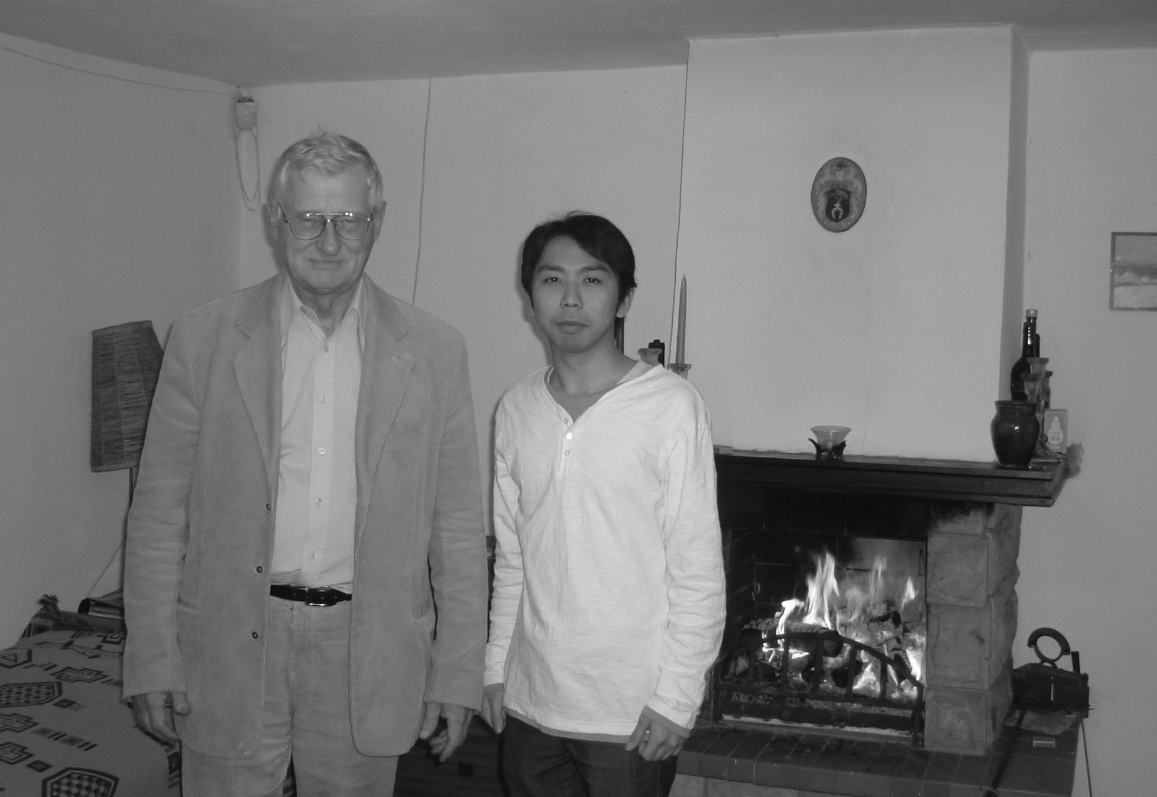
Figure 1: With Professor Andrzej Kossakowski in Toruń, September 2004.
The inclusion of personal recollections (see Figure 1) situates the mathematical development within the broader context of Kossakowski's influence as a mentor and his distinctive approach: deep structural analysis rooted in elementary verifications and attention to concrete, finite-dimensional examples—values that permeate the foundations of the GKLS theorem.
Implications and Future Outlook
The rigorous, elementary route presented in the paper illuminates the inevitability and uniqueness of the GKLS structure when operationally justifiable conditions—Markovianity, trace preservation, and complete positivity—are imposed. This has direct bearing on both practical quantum engineering (where the GKLS equation governs robust, stable dynamics of open systems, error models, and dissipative quantum computation) and foundational work (including the study of non-Markovian or non-CP dynamics and their physical admissibility).
The development also clarifies the boundary between merely positive and completely positive evolutions, emphasizing that only the latter ensures the composability and consistency of quantum dynamics in higher-composite and entangled systems.
Potential directions include:
- Generalizations to infinite dimensions, where the structural insights of Kossakowski and the contractive semigroup/CP dichotomy remain foundational but technicalities proliferate.
- The investigation of quantum non-Markovianity beyond the semigroup framework, using the techniques developed for GKLS as local reference points.
- Rigorous modeling of time-dependent (non-autonomous) GKLS-type evolution, and understanding the interplay between structural constraints and experimental verification.
Conclusion
The article (2606.08579) provides a logically closed, structurally transparent derivation of the GKLS equation, rooting the modern understanding of quantum Markovian master equations in Kossakowski’s theoretical and personal legacy. It highlights the centrality of algebraic positivity, semigroup theory, and the role of CP in quantum dynamics, using explicit operator-theoretic arguments. The note is not only mathematically rigorous but also reflects an ethos of scientific clarity and personal warmth, as embodied by Kossakowski's approach to research and mentorship. This dual legacy—mathematical and human—continues to inform the direction and interpretation of foundational work in open quantum systems and quantum information theory.

