- The paper formalizes pattern definition in statistical mechanics by using ε-machines and information measures to rigorously bridge structure and randomness.
- It employs transfer matrix methods and stochastic processes to derive key measures—Shannon entropy rate, excess entropy, and statistical complexity—in one-dimensional spin models.
- The study demonstrates that ε-machines can classify ordering regimes in spin lattices, providing actionable insights for condensed matter applications and phase transition analysis.
Introduction and Motivation
The paper "What Is a Pattern in Statistical Mechanics? Formalizing Structure and Patterns in One-Dimensional Spin Lattice Models with Computational Mechanics" (2606.08509) provides an information-theoretic and computation-theoretic framework for precisely defining structure and pattern in one-dimensional statistical mechanical systems, specifically spin lattice models. The work addresses the longstanding ambiguity regarding the operational meaning of "pattern" in statistical mechanics, which standard approaches fail to quantify in a state- and process-independent manner.
By interpreting the Boltzmann distribution over spin configurations as a stochastic process, the paper leverages computational mechanics to assign rigorous quantitative measures of randomness (Shannon entropy rate hμ), regularity (excess entropy E), and structure (statistical complexity Cμ) to spin models. The structural mechanism underlying such processes is exactly specified by their unique minimal sufficient statistic—the so-called ϵ-machine, a probabilistic deterministic finite-state automaton distinguished by first-principles derivation rather than ad hoc design.
The investigation is conducted across a set of prototypical 1D spin models: finite-range Ising models (including nnn variants), solid-on-solid (SOS) models, and three-body interaction models motivated by real surface physics. Analytical and computational results are systematically presented, with direct comparison of information and computational measures to the configuration ensembles arising from the equilibrium Boltzmann distribution.
Theoretical Framework
The core technical advance is the recasting of spin-lattice ensembles as stochastic processes indexed by site rather than physical time. By doing so, the authors enable the application of the machinery of computational mechanics, in which a "pattern" is formally defined as an equivalence class of pasts that yield identical conditional futures—that is, a causal state.
The key steps are:
- Reformulation of the Boltzmann measure: The Boltzmann distribution for spin blocks embedded in an infinite lattice is constructed via the transfer matrix formalism (see Equation (4)), assigning correct boundary weights via left/right principal eigenvectors. This enables a rigorous probability measure over cylinder sets (coarse-grained finite spin blocks), fully compatible with measure-theoretic and information-theoretic analysis.
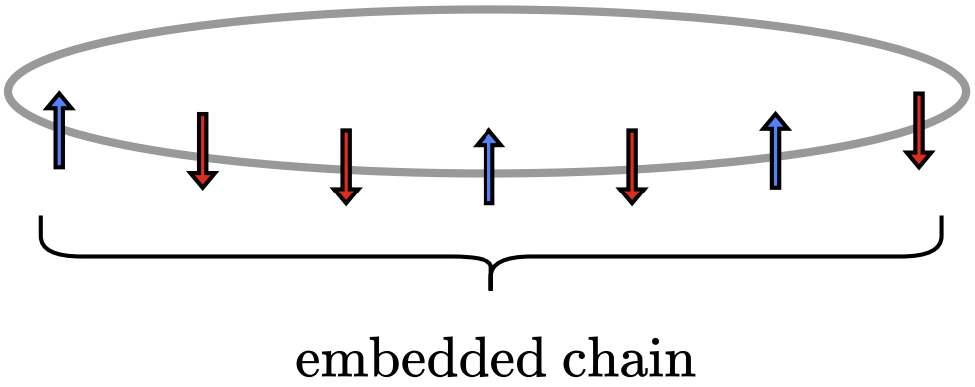
Figure 1: Depiction of a finite spin configuration embedded within an infinite spin configuration with periodic boundary conditions.
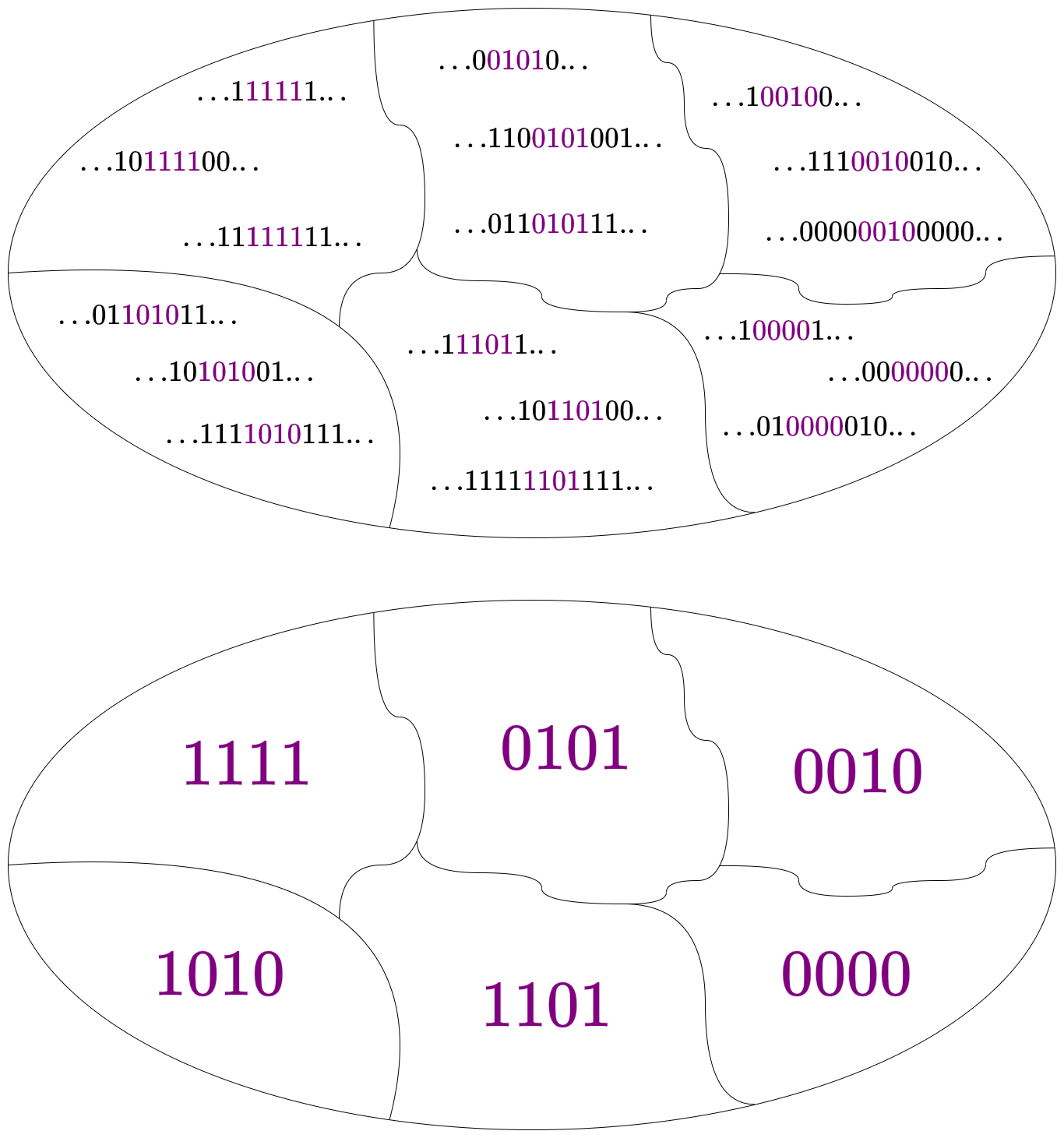
Figure 2: Graphical representation of the coarse-grained Ising phase space, with only purple spins fixed.
- Pattern as causal state: For a strictly stationary, (R-)Markovian process (which all models considered are), causal states collapse to site-level or block-level Markov contexts. The minimal automaton generating the configuration ensemble—the ϵ-machine—is determined by an analytic construction (Feldman & Crutchfield procedure), producing transition probabilities and stationary distributions in closed form for cases of interest.
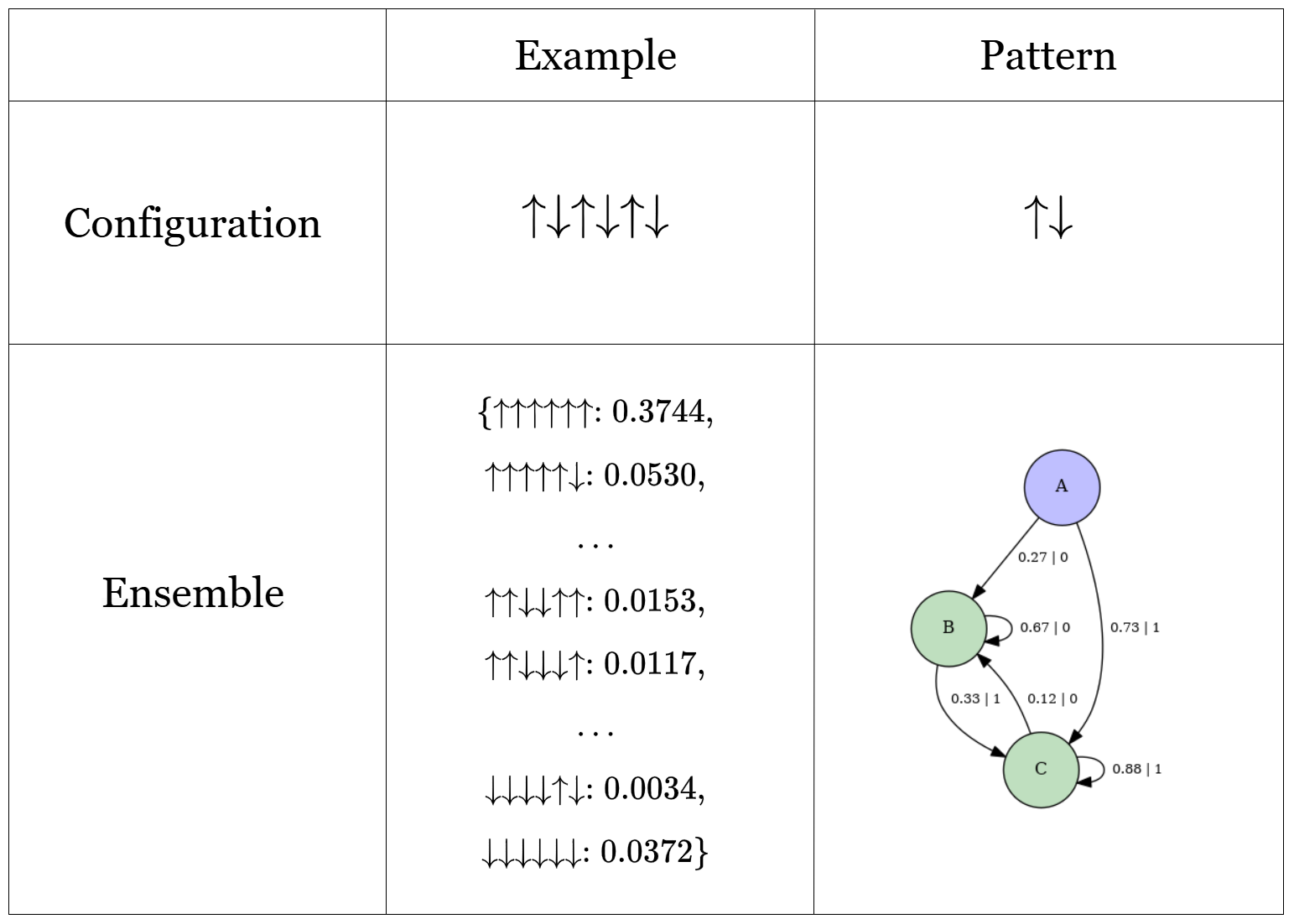
Figure 3: Schematic distinction between configuration-level and ensemble-level patterns, clarifying the mapping to ϵ-machines.
- Quantification of structure: The Shannon entropy rate hμ captures per-site randomness, excess entropy E quantifies redundancy or mutual information between past and future, and statistical complexity Cμ gives the entropy of the stationary distribution over causal states. The triple (E0, E1, E2) thus operationalizes both randomness and structure, while E3 additionally encodes memory required for optimal generation or prediction.
Results
Finite-Range Ising Models
Systematic parameter sweeps demonstrate the discriminative power of the computational framework. In nnn Ising models at low temperature and strong negative coupling, E4 and E5 indicate strict period-2 order, as confirmed by ensemble dominance of alternating patterns. For E6, all information measures approach zero, consistent with trivial period-1 order. Intermediate values produce high E7 and complex transition regions, corresponding to longer-period or frustrated states.
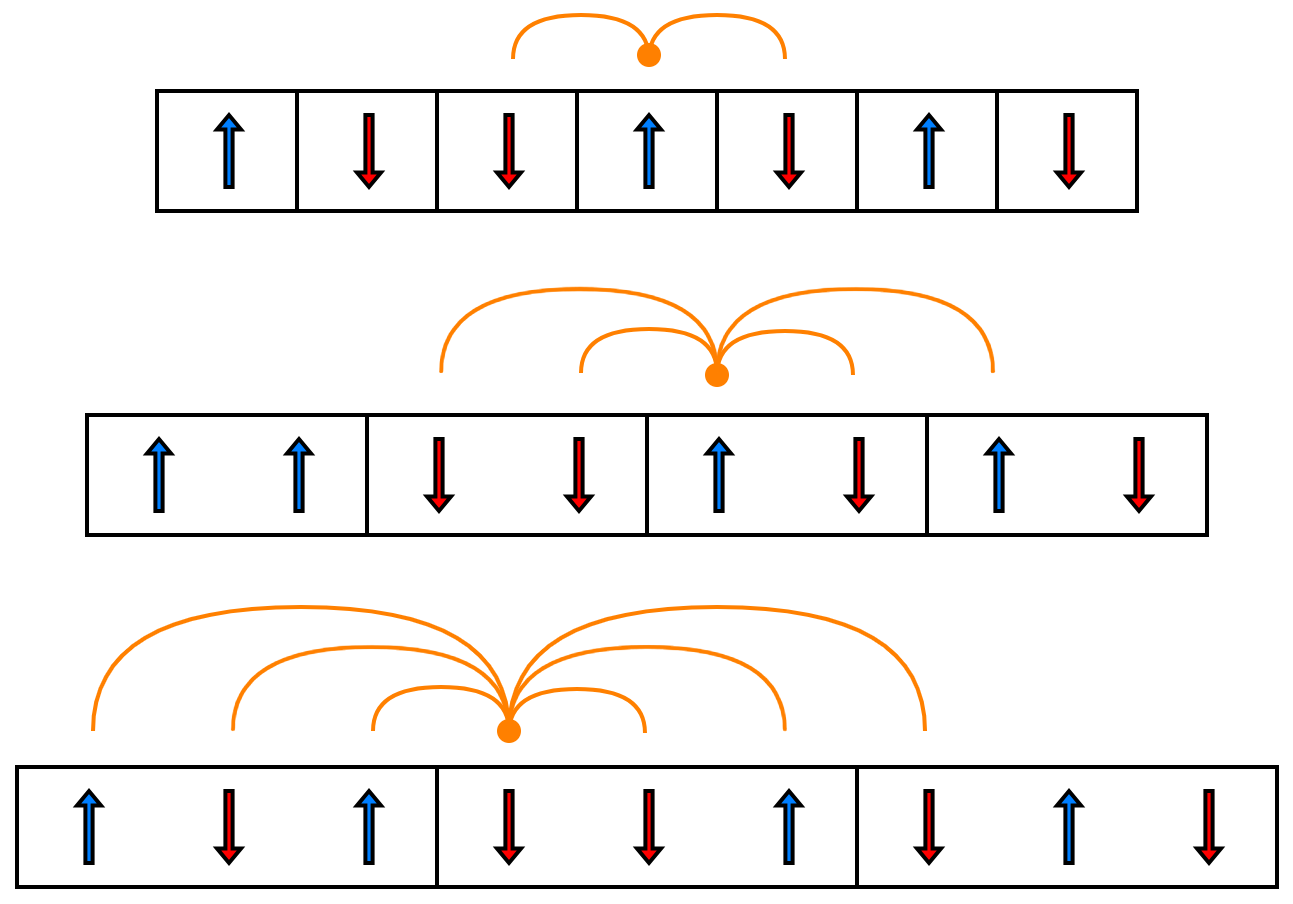
Figure 4: Illustration of spin interactions in Ising models with interaction radii E8, E9, Cμ0.
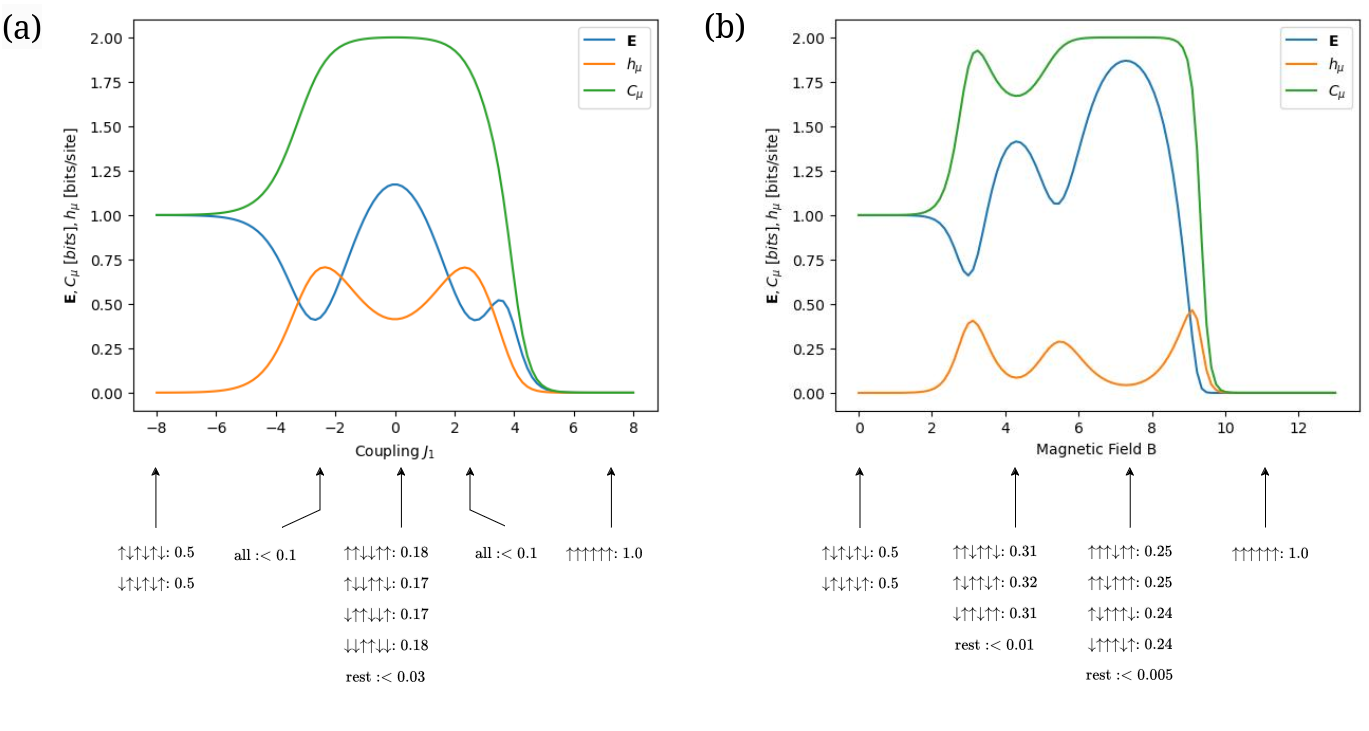
Figure 5: (a) Information measures Cμ1, Cμ2 and Cμ3 vs.~Cμ4 for the nnn Ising model showing regions of period-1, 2, and 4 order; (b) Cμ5, Cμ6 and Cμ7 vs.~Cμ8 for a three-range Ising model with multiple periodic regimes.
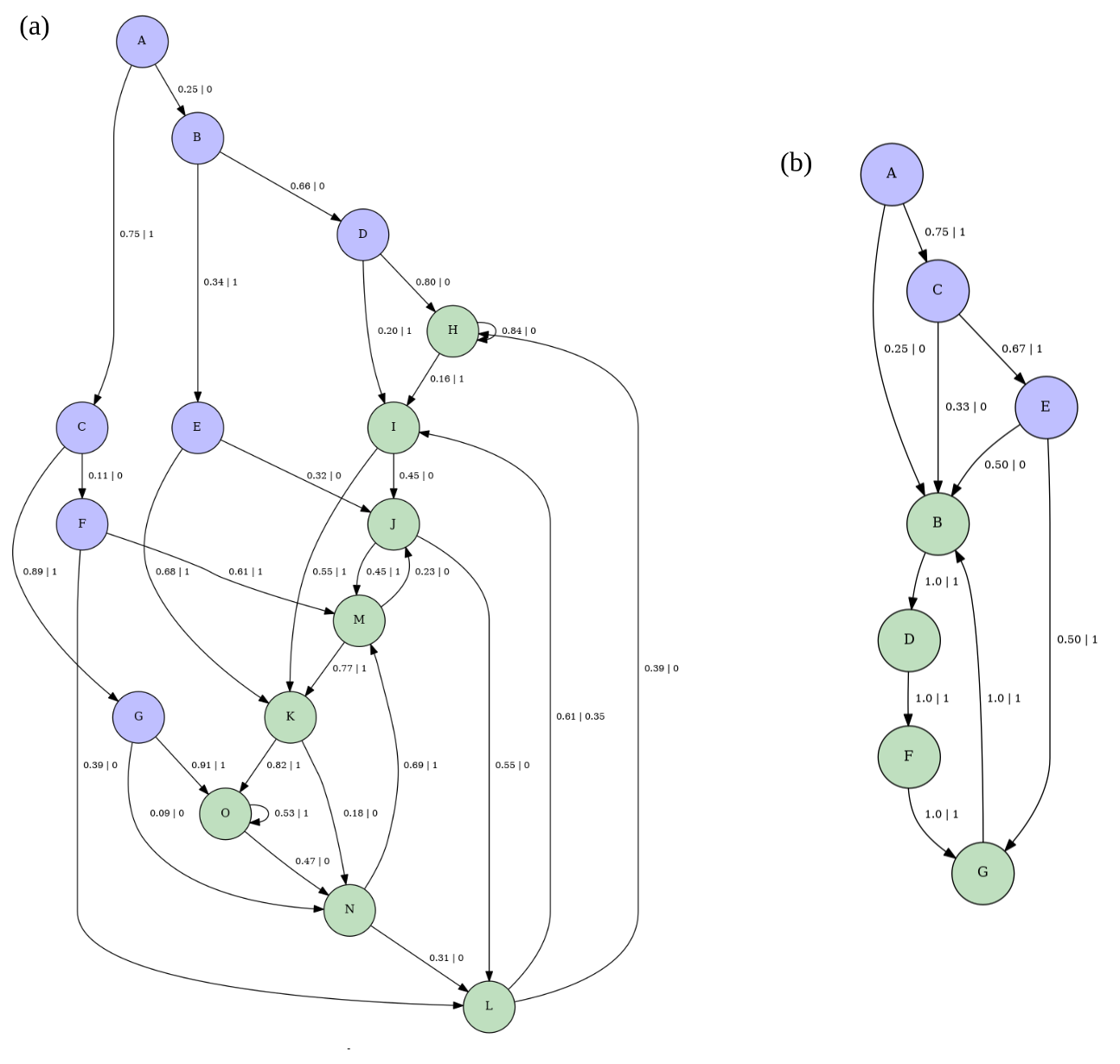
Figure 6: (a) Cμ9-machine of 3-range Ising model at high temperature and weak field with maximal recurrent state count; (b) at low temperature and strong field, only period-1 structure remains and the ϵ0-machine is highly compressed.
Solid-on-Solid (SOS) Models
By tuning the kink energy ϵ1 and wall strength ϵ2, the SOS model exhibits transitions between period-2 and period-1 configuration patterns, again identified unambiguously by the behavior of ϵ3 and confirmed in the ϵ4-machine structure. Turning on the wall parameter systematically reduces ϵ5 and favors flat interfaces, reflected directly in the reduction of the transient and recurrent state complexity of the inferred machine.
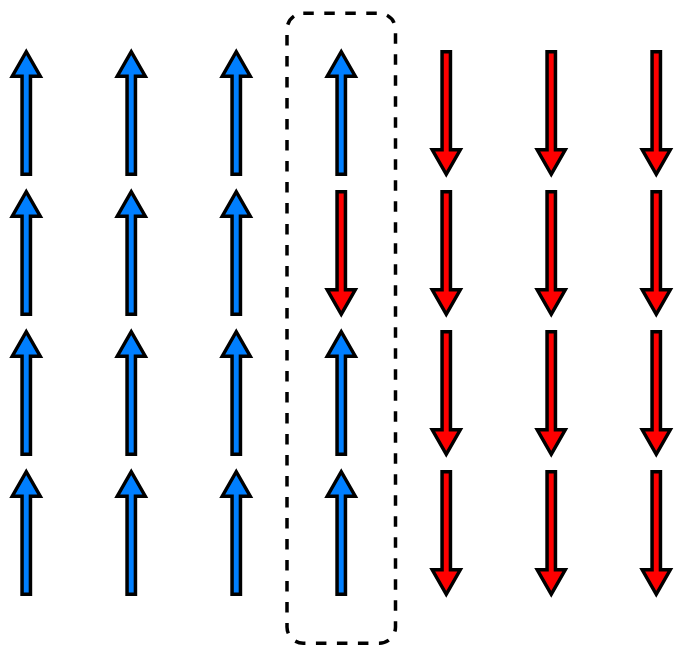
Figure 7: 2D spin lattice with boundary-induced 1D spin chain interface (SOS context).
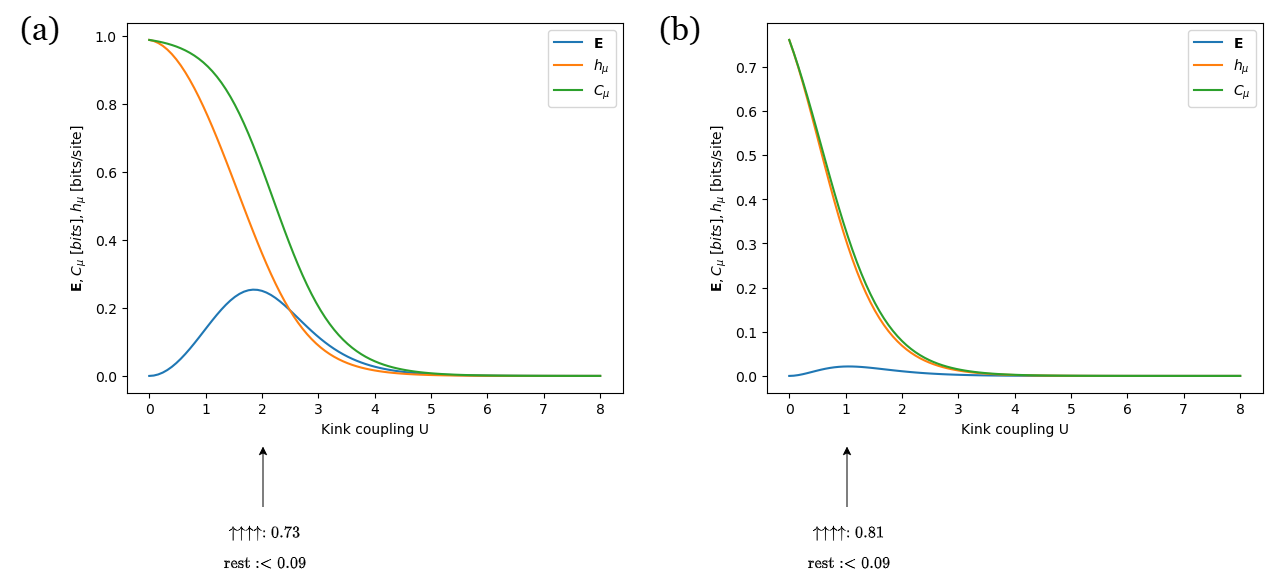
Figure 8: ϵ6, ϵ7, and ϵ8 vs.~kink coupling ϵ9 for SOS model with and without wall pinning, demonstrating suppression of complexity with nonzero R0.
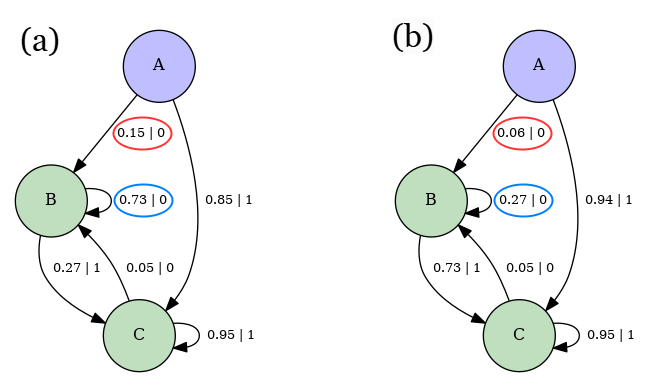
Figure 9: (a) R1-machine for zero wall, exhibiting higher complexity and greater transition probability uniformity; (b) R2-machine with wall, showing compressed and biased transitions abetting synchronization.
Three-Body Interaction Models
Inclusion of explicit three-site couplings yields broader regimes of higher-period structure not present in standard Ising chains. For large three-body antiferromagnetic coupling and low R3, R4 approaches the theoretical maximum, signaling period-4 typicality; with competing nearest-neighbor ferromagnetic interactions, period-3 and period-4 configurations compete, as reflected in nontrivial R5 and increased R6-machine complexity.
Temperature sweeps show that R7 and R8 can simultaneously increase, revealing nuanced regimes where pattern diversity is high but synchronization is difficult due to increased randomness. This demonstrates that R9 alone is not monotonic in physical order parameters or redundancy measures.

Figure 10: Illustration of spin interactions in three-body models, showing the range and structure of coupled terms.
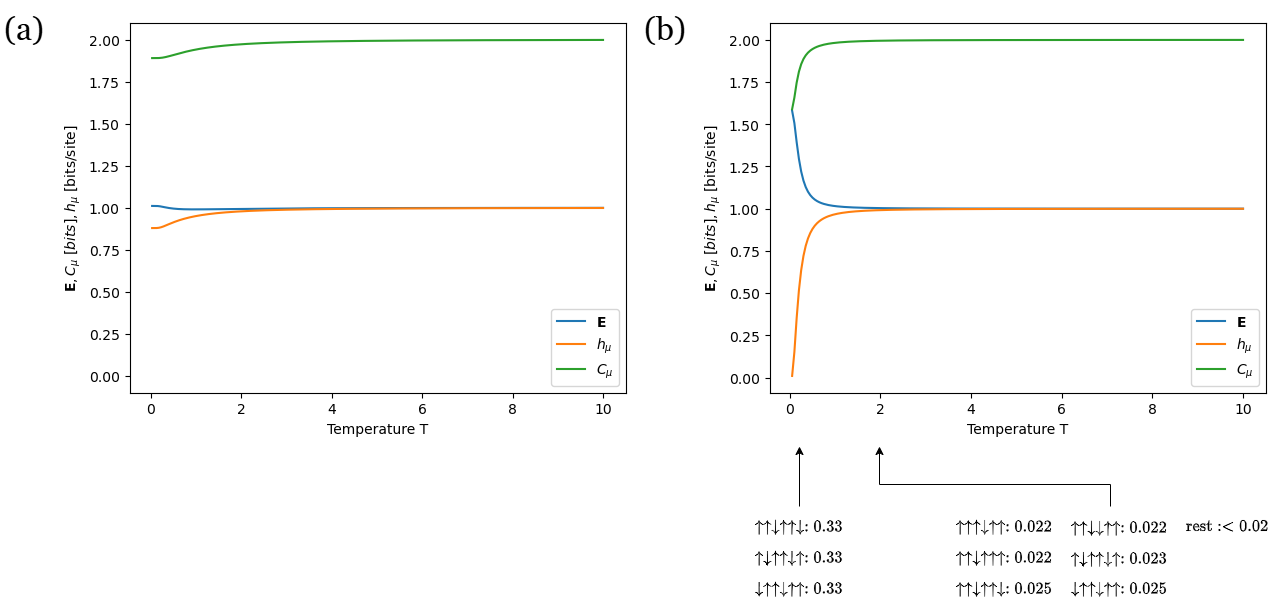
Figure 11: (a) ϵ0, ϵ1, and ϵ2 vs.~ϵ3 for three-body models; low ϵ4, large ϵ5 yields maximal complexity and period-4 order.
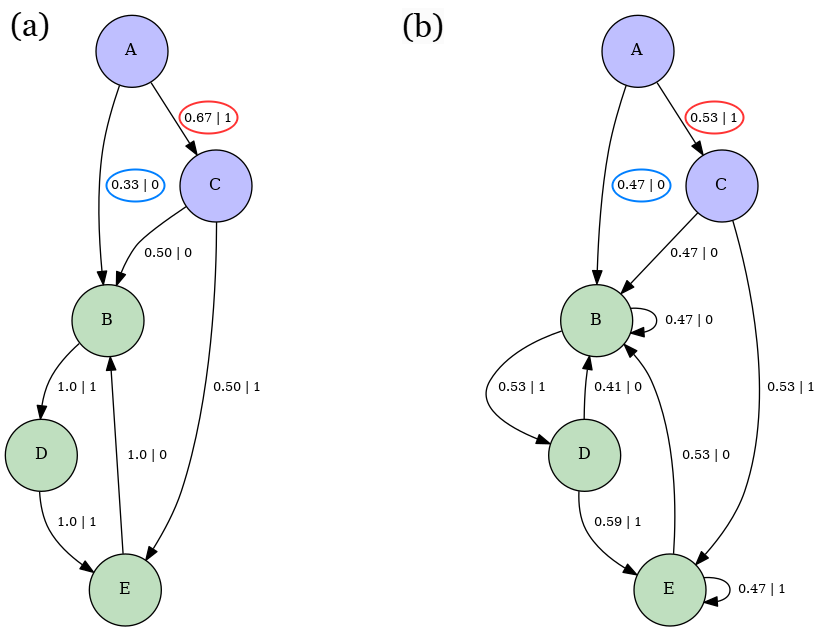
Figure 12: (a) ϵ6-machine with pronounced period-3 structure and high synchronization facility at ϵ7; (b) at elevated ϵ8, increased connectivity and multimodal outgoing transitions make synchronization challenging, as confirmed by information measures.
Implications and Perspectives
The formalism developed affords a definitive answer: for 1D spin-lattice equilibrium systems, the minimal computational representation (the ϵ9-machine) uniquely specifies the mechanism generating typical ensemble patterns, and the statistical complexity ϵ0 quantifies intrinsic structural content. Configurational regimes with high ϵ1 are marked by increased diversity and nontrivial periodicity, while regions where ϵ2 is non-flat indicate computational transition zones (analogous to, but distinct from, traditional phase boundaries).
Practically, this enables rigorous, representation-independent identification and classification of pattern formation as a function of thermodynamic control parameters. The approach is robust to the choice of observable or blocking scheme and can distinguish between degenerate physical regimes where traditional macroscopic observables (e.g., net magnetization) fail. The theoretical importance lies in unifying pattern, randomness, and computation under a principled, first-principles information-theoretic and automata-theoretic language.
Applications are immediate in the theory of condensed matter (e.g., frustrated magnetic systems, disordered spin chains, surface growth and roughening phenomena), and have implications for the study of information processing in physical substrates.
Future Directions
- Systematic extension to higher-dimensional spin systems, where state space and possible automata architectures proliferate; the formalism suggests scalable inference algorithms for large alphabets and interacting neighborhoods.
- Application to quantum spin systems via quantum ϵ3-machines, with direct comparison of quantum and classical memory requirements.
- Generalization to nonequilibrium and driven processes, leveraging the machinery for ensemble inference from physical trajectory data.
- Exploration of automated detection of critical transitions, glassy dynamics, and emergent computation in complex materials using the developed tools.
Conclusion
The paper rigorously formalizes the concept of pattern in statistical mechanics for one-dimensional spin lattice models using the framework of computational mechanics. The analysis demonstrates that the ϵ4-machine and associated information measures furnish a universal and operational theory of pattern, structure, and intrinsic computation in these systems, fully consistent with statistical mechanics while transcending its traditional descriptive limitations (2606.08509).