- The paper presents a novel demonstration of entropic crystallization in geometrically frustrated Tsai-type quasicrystal approximants via extensive Monte Carlo simulations.
- It employs parallel tempering and finite-size scaling on up to 192,000 spins to characterize a continuous, second-order phase transition.
- The study uncovers the coexistence of long-range magnetic order and finite residual entropy driven solely by entropic mechanisms.
Entropic Crystallization in Geometrically Frustrated Magnets on the 1/1 Approximant Tsai-Type Quasicrystal
Introduction
The study elucidates the equilibrium statistical mechanics of the antiferromagnetic Ising model on the icosahedral body-centered cubic (bcc) lattice—a geometric motif underlying the 1/1 Tsai-type quasicrystal approximant. This structure consists of periodic arrays of icosahedral clusters, each hosting localized spins, and is representative of rare-earth-based quasicrystal approximants such as Yb–Cd systems. The work leverages large-scale Monte Carlo simulations with parallel tempering to characterize thermodynamic behavior, focusing on the nature of the phase transition, low-temperature degeneracy, and the mechanism driving spontaneous order in this prototypical class of geometrically frustrated magnets.
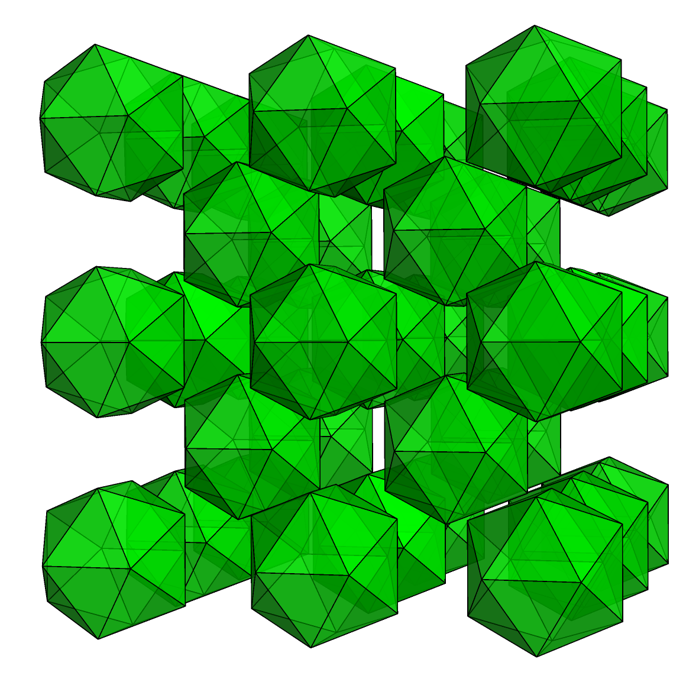
Figure 1: The icosahedral bcc network of magnetic ions on the 1/1 quasicrystal approximant.
Model and Computational Approach
The Hamiltonian parameterizes antiferromagnetic near-neighbor couplings (J1>0) confined within each icosahedron and inter-icosahedral ferromagnetic (J2<0) couplings connecting triangles on adjacent icosahedral shells. The degrees of freedom are classical Ising variables. Crucially, each spin belongs to a unique icosahedron, ensuring the non-corner-sharing character of the fundamental geometric units, a distinct departure from canonical frustrated magnets such as pyrochlore lattices. Dynamically, single-spin and two-spin updates, combined with parallel tempering, substantially alleviate ergodicity breaking inherent to such frustrated topologies.
System sizes approach L=20 bcc unit cells (corresponding to Nspin=192,000), ensuring robust finite-size scaling analyses.
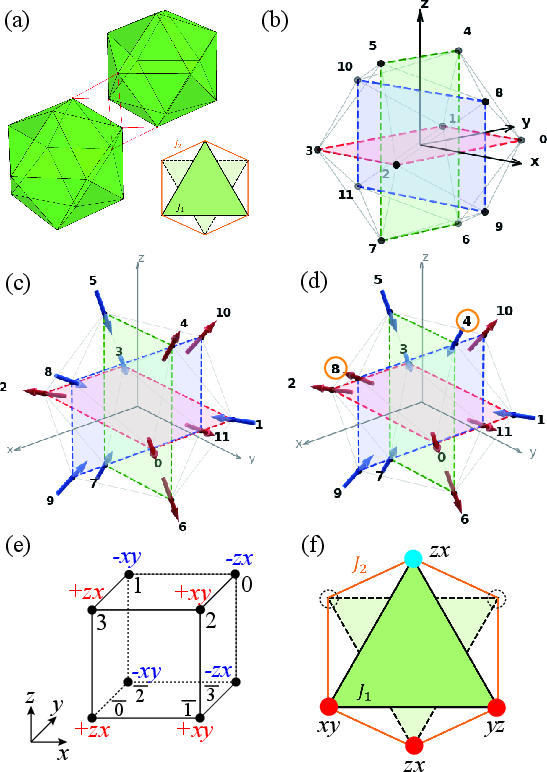
Figure 2: (a) Inter-icosahedral coupling geometry, (b) numbering of intra-icosahedral sites, (c)-(e) representative sector spin configurations, (f) constraints imposed by inter-icosahedral couplings.
Local and Global Degeneracy: Ground-State Structure
At J2=0, the model fragments into isolated icosahedra, each supporting a 72-fold degenerate ground state arising from local triangle rules (the sum of spins on each triangle equals ±1). These states are organized into six distinct sectors (each with twelve states, further partitioned into four "primary" and eight "secondary"), defined by the orientation of specific zero-magnetization planes (short/long-side-staggered rectangles in the icosahedron). The inter-icosahedral coupling, which becomes significant for J2=0, does not fully lift this degeneracy, but strongly selects sectors compatible across neighboring clusters, imposing intricate local constraints on the permissible arrangements for each icosahedral unit.
Thermodynamic Phase Structure and Transition
Monte Carlo calculations reveal a robust two-stage thermodynamic response with variation in temperature. The specific heat exhibits a high-temperature Schottky-like broad peak near T∼J1 followed by a sharply divergent low-temperature peak indicative of a second-order transition:
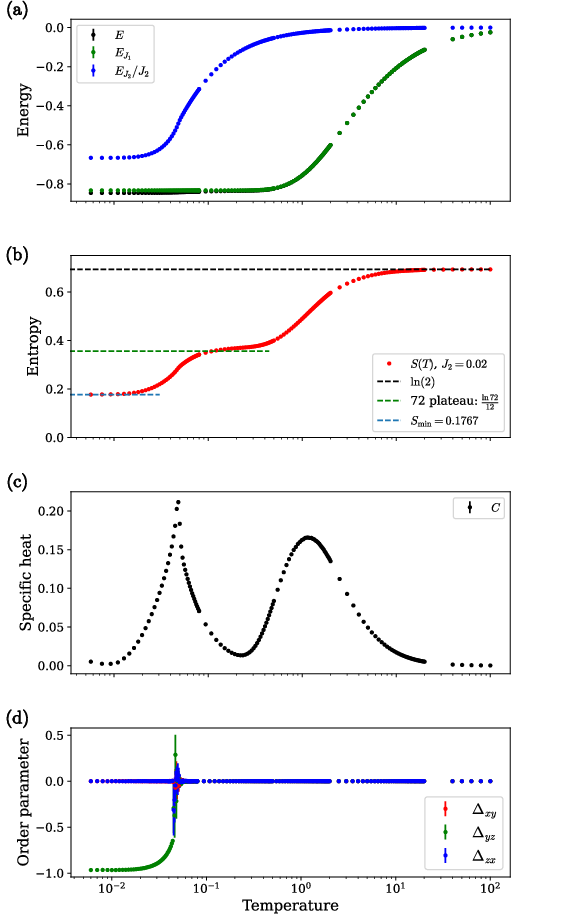
Figure 3: Temperature evolution of energy, entropy per spin, specific heat, and order parameter for L=14 (Nspin=65856).
- Above J2<00: The system is in a high-entropy paramagnetic phase.
- J2<01: The system enters a cooperative paramagnetic regime where each icosahedron independently samples its 72-fold degenerate ground manifold. The entropy per spin plateaus at J2<02, consistent with J2<03.
- J2<04: The onset of long-range order is signaled by growth in an order parameter J2<05 (detecting sector selection via rectangle magnetization), and a sharp reduction of entropy to a residual value J2<06 per spin, yet strictly nonzero.
Finite-size scaling of the specific heat and order parameter (Figure 4) confirms the phase transition is continuous.
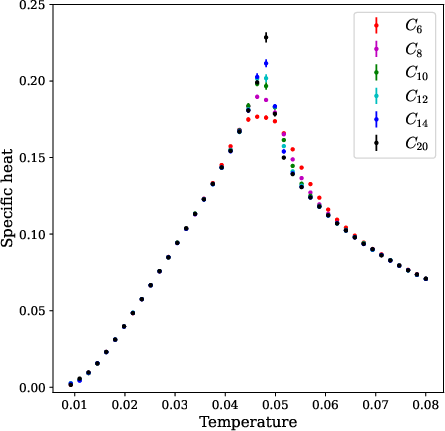
Figure 4: System size scaling of the specific heat peak at the magnetic transition further supports its second-order nature.
At low temperature, the system breaks a J2<07 symmetry, selecting a unique sector (magnetic long-range order) while preserving finite extensive ground-state entropy—a rare coexistence of order and disorder. This degeneracy is neither lifted by energetic effects nor by standard order-by-disorder mechanisms involving energetic selection among ground states, but rather by a genuinely entropic mechanism.
Creation of domain walls (i.e., boundaries across sectors) severely suppresses the local entropy due to the strong compatibility constraints on adjacent icosahedra, causing the local residual entropy loss due to a wall to overwhelm the gain in global configurational entropy. Consequently, entropic arguments alone suffice to select macroscopically ordered states: the ordered phase emerges not by energy, but by the system's quest to maximize the sum of local entropies—a phenomenon dubbed "entropic crystallization."
The residual entropy is quantitatively consistent with Pauling-type combinatorial estimates analogous to ice-type systems:
J2<08
as obtained numerically and via mean-field connectedness counting.
Implications and Prospective Developments
These findings directly inform the theoretical understanding of rare-earth quasicrystal approximants. They clarify the complex interplay of geometric frustration and large unit cell degrees of freedom, underlying the broad spectrum of experimentally observed behaviors (spin-glassiness, noncollinear magnetic order, incipient spin liquid regimes). The observed mechanism generalizes the concept of entropic selection beyond simple corner-sharing or tetrahedral cases to cluster-based lattices, suggesting new classes of materials may manifest entropic crystallization.
Crucially, this work demonstrates that order can be selected via local entropy maximization under strong geometric constraints, without explicit energy-lowering channels—a mechanism that could find counterparts in other frustrated, high-degeneracy systems such as cluster-based classical or quantum spin liquids, as well as in electronic or charge-ordered frustrated systems.
Conclusion
The study establishes the entropically-driven emergence of long-range magnetic order in a canonical geometrically frustrated system with large unit clusters, the 1/1 Tsai-type quasicrystal approximant. The exactness of the residual entropy, its mechanism of stabilization, and numerical validation underscore a robust and universal ordering principle in cluster-based frustrated magnets. Prospects include extending such analysis to quantum models, systems with more complex (e.g., RKKY) interactions, or to other cluster-based lattices, as well as experimental verification in rare-earth quasicrystal magnets.
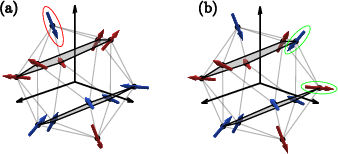
Figure 5: (a)-(b) Representative single-icosahedron ground states visualized with annotated effective local potential, illuminating entropic structure and connections within the manifold.