Pure and mixed Dicke state ansatz for equality and inequality constraints in variational quantum eigensolver
Published 7 Jun 2026 in quant-ph | (2606.08504v1)
Abstract: Combinatorial optimization can be addressed with quantum computing through variational quantum algorithms, but a central challenge in this approach is to design an ansatz expressive enough to explore the feasible subspace of the Hilbert space where the optimal solution lies. Another major challenge is tuning the Lagrange multipliers in penalty terms to enforce feasibility and guarantee solution quality. To address both challenges, we propose the first feasibility-preserving mixed Dicke state ansatz for Hamming weight constrained combinatorial optimization, extending the density matrix formalism to structurally encode equality and inequality constraints directly into the quantum circuit, thereby eliminating the need for penalty terms in the objective function. The proposed framework handles both constraint types, with the pure Dicke state ansatz recovered as a special case corresponding to equality constraints, and generalizes to multiple constraint groups via tensor products of individual pure or mixed Dicke states. We validate the proposed approach in the context of combinatorial portfolio optimization across three experimental scenarios with increasing constraint complexity, using the CMA-ES optimizer and comparing its performance against random search with replacement restricted to the feasible subspace. As the feasible search space grows, the proposed ansatz demonstrates a clear advantage over random search in terms of the number of objective function calls required to identify high-quality solutions. Hardware experiments on IBM NISQ processors confirm that noise mitigation and circuit transpilation optimizations remain open challenges for practical deployment. The framework is general and directly applicable to other combinatorial optimization problems with Hamming weight constraints.
The paper introduces a novel quantum circuit that uses pure and mixed Dicke states to encode equality and inequality constraints without relying on penalty terms.
It reduces the computational search space from exponential to combinatorial sizes (O(n^k)), enhancing optimization efficiency in portfolio and combinatorial problems.
It demonstrates robust performance with CMA-ES, yielding high-quality feasible solutions even under NISQ device noise and error conditions.
Pure and Mixed Dicke State Ansatz for Constrained VQE: A Technical Analysis
Background and Motivation
Variational quantum algorithms provide a pragmatic route for near-term quantum optimization, leveraging hybrid quantum-classical frameworks to tackle combinatorial problems. A notorious hurdle is the rigorous handling of optimization constraints—especially cardinality constraints, where classical penalty methods require delicate Lagrange tuning and often balloon the search space with infeasible states. This paper, "Pure and mixed Dicke state ansatz for equality and inequality constraints in variational quantum eigensolver" (2606.08504), addresses both ansatz expressivity and constraint enforceability by proposing novel quantum circuit constructions rooted in Dicke states and density matrix formalism. This construction obviates the need for penalty terms, directly encoding both equality and inequality constraints in the quantum ansatz.
Ansatz Construction: From Pure to Mixed Dicke States
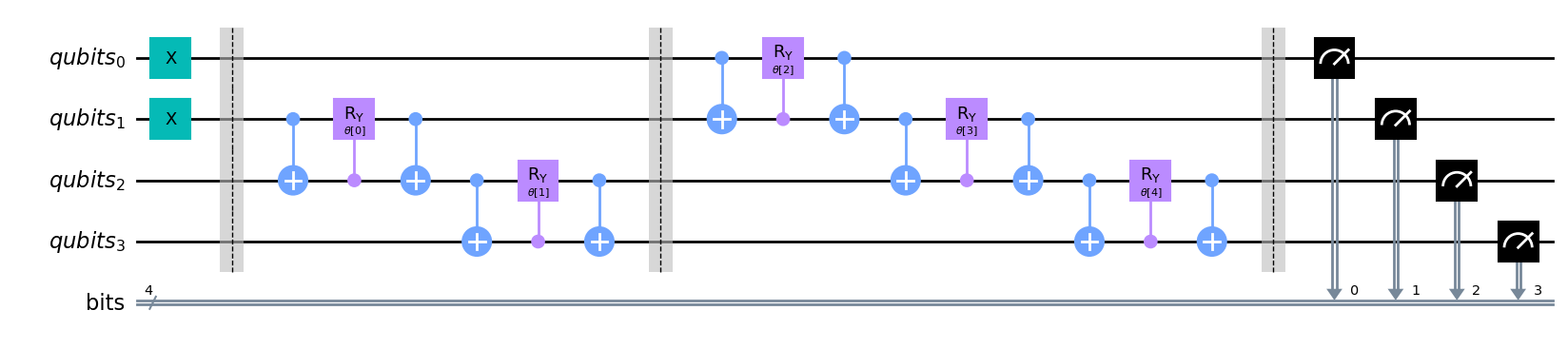
The authors utilize the combinatorial properties of Dicke states—symmetrical superpositions of n qubits with a fixed Hamming weight k—as the cornerstone for equality constraint enforcement. The parameterized pure Dicke state ansatz enables the VQE to search exclusively over states with a specific number of selected assets or features, drastically shrinking the optimization landscape from 2n to (kn).
Figure 1: Quantum circuit preparing a pure Dicke state ∣D24(θ)⟩, directly restricting exploration to Hamming weight 2.
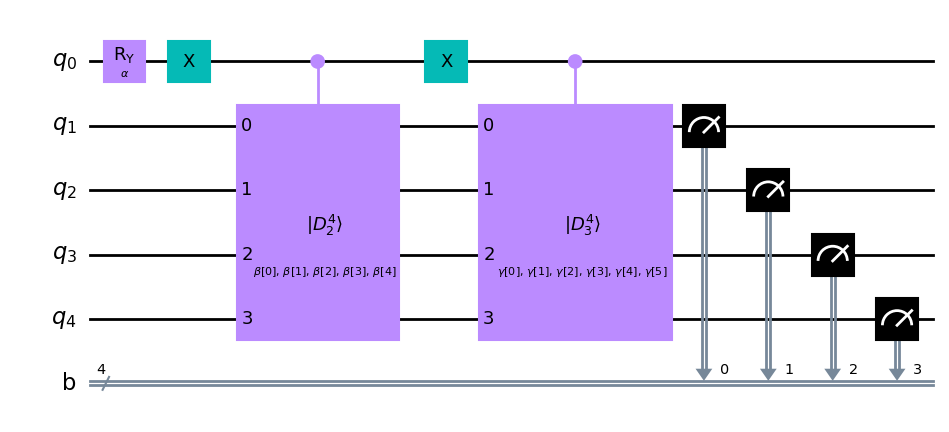
For inequality constraints, a significant extension is formulated: the mixed Dicke state ansatz, representing convex combinations of Dicke states with different permissible Hamming weights. This is realized through ancillary subsystems whose measurement and partial trace yield classical mixtures over Dicke subspaces.
Figure 2: Quantum circuit producing a mixture of Dicke states, e.g., ∣D24(β)⟩ and ∣D34(γ)⟩, with probabilities controlled through parameterized rotations.
The formalism is generalized to multiple, potentially heterogeneous, constraint groups. By taking tensor products of pure and mixed Dicke ansatze, the framework accommodates overlapping equality and inequality constraints across classes of variables. This construction, compatible with the density matrix-based VQE objective, yields a block-structured feasible space aligning exactly with the imposed combinatorial constraints.
Experimental Evaluation and Numerical Results
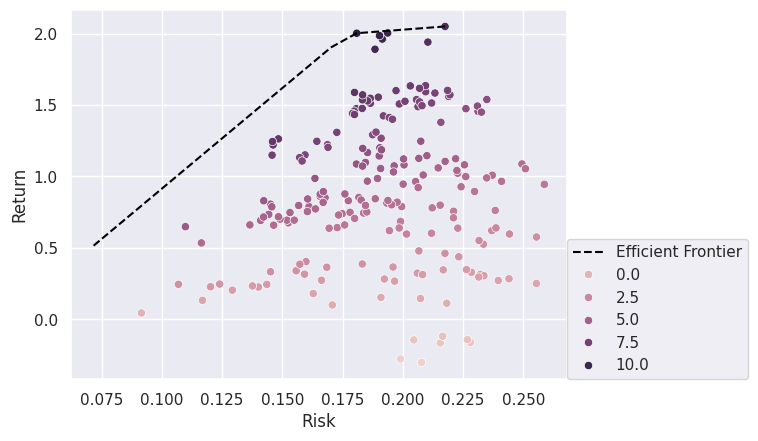
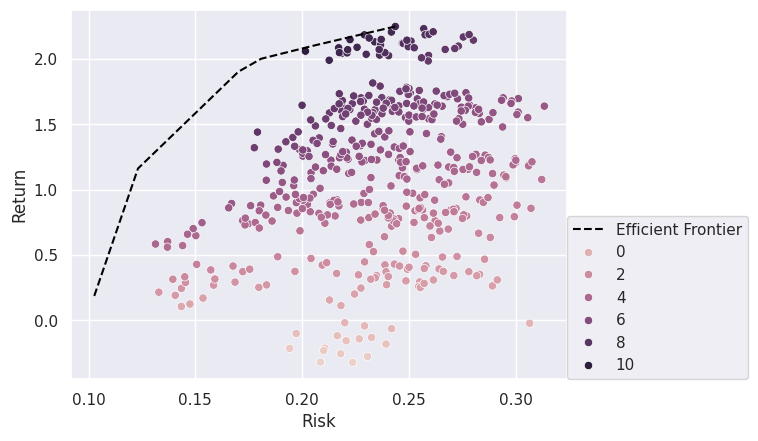
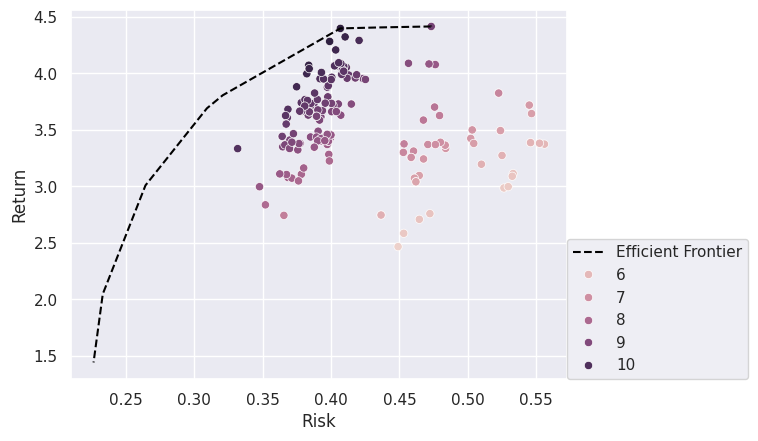
Three progressively complex portfolio optimization scenarios are considered, each using real market data but focusing on algorithmic performance, not financial advice. The scenarios: (I) single-group inequality k≤4 on 11 assets, (II) double-sided inequality 3≤k≤6 on the same set, (III) a multi-sector, block-structured problem combining equalities and inequalities across four classes drawn from S&P500 sectors.
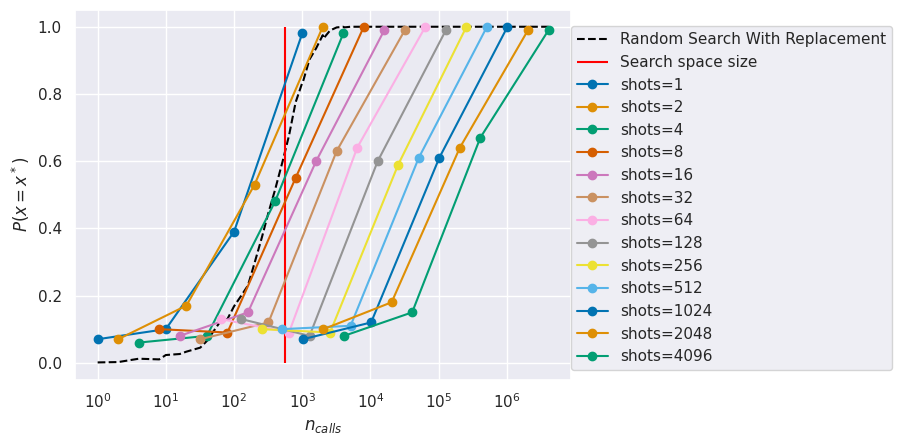
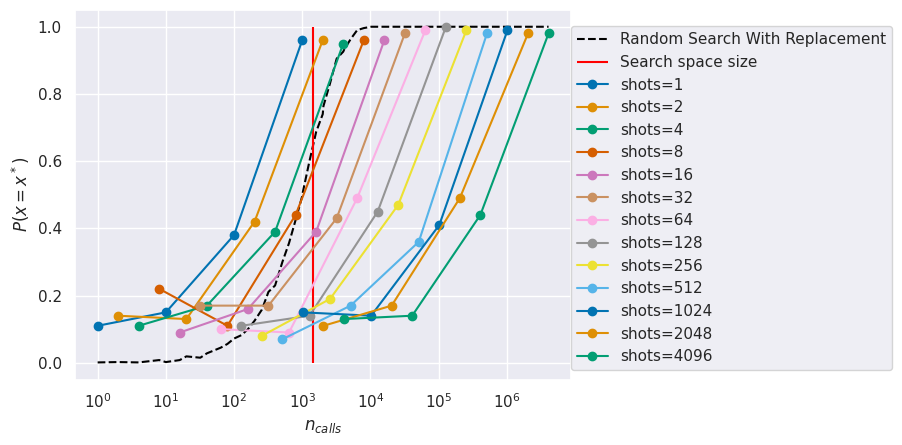
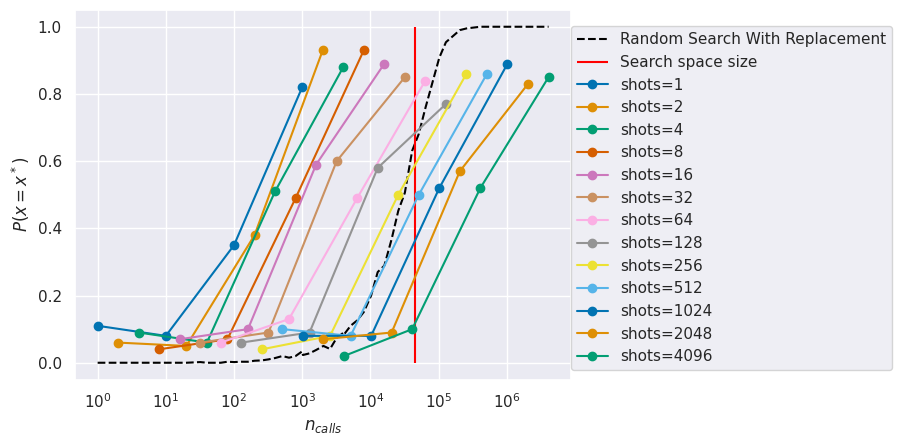
Performance is benchmarked against random search restricted to feasibility, focusing on the number of objective function calls versus probability of discovering the optimal solution. The VQE-Dicke approach, using CMA-ES as the optimizer, consistently converges to optima using substantially fewer function calls as the feasible subspace grows.
Figure 3: Probability of finding the optimum versus function calls for the VQE-Dicke framework and random sampling in Scenario I.
Figure 4: Analogous performance comparison in Scenario II, with a larger feasible space.
An important finding is that as the combinatorial search space size increases, the optimization's advantage over random sampling becomes increasingly marked—theoretical size ∣F∣ grows to 45,000 bitstrings in Scenario III.
Notably, even when the optimized density matrix does not collapse wholly onto the optimal state, the sampled distribution heavily favors high-quality, nearly efficient solutions. These fall on or near the classical mean-variance efficient frontier for the underlying financial problem.
Theoretical and Practical Implications
The principal advance is structurally embedding combinatorial feasibility into the quantum ansatz, rendering penalty terms unnecessary. Enforcement occurs at the circuit-level; the search is never polluted with infeasible states, and there is no gradient leakage or hyperparameter sensitivity due to penalties.
This approach yields several consequences:
Complexity reduction: Search space reduction from k0 to k1 (or to products of such terms for multi-block mixtures) leads to a corresponding decrease in required objective evaluations for practical optima discovery.
Error and noise considerations: Mixed Dicke state ansätze offer greater robustness to bit-flip and readout noise versus pure Dicke states, since only boundary states are displaced outside the feasible set by single bit-flip errors. Nevertheless, performance degrades sharply under realistic two-qubit gate noise—hardware experiments on IBMNISQ devices yielded relative function value errors of approximately k2.
Extracting high-quality solutions: When full convergence to a delta (Kronecker) distribution on the optimal bitstring is unattainable, empirical sampling provides a set of high-value feasible candidates, forming a practical quantum-assisted heuristic for combinatorial search.
Generalizability: The construction is broadly applicable to other Hamming weight-constrained combinatorial problems—potential use cases include feature selection in machine learning and discrete resource allocation in logistics or genomics.
Robustness to Sampling and Optimization Landscape Issues
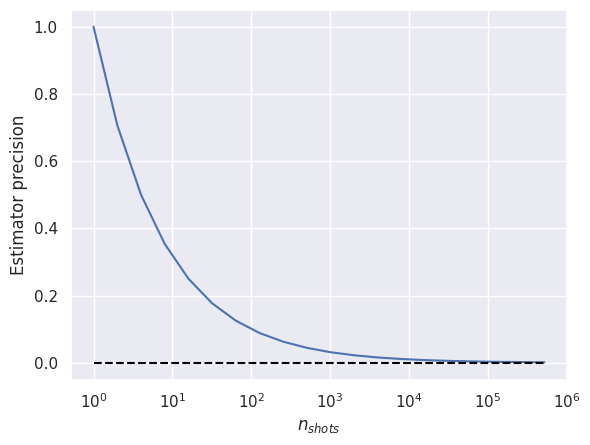
Finite measurement (shot) noise leads to non-smooth optimization landscapes with spurious local optima, especially harmful for gradient-based optimizers. The authors exploit gradient-free CMA-ES, which demonstrates resilience to such landscapes. Increasing the number of measurement shots smooths estimation, asymptotically recovering the true landscape in the large-shot limit.
Figure 5: Standard deviation of estimator k3 scales as k4, setting a trade-off between measurement cost and landscape smoothness.
Hardware Realization and Remaining Limitations
Hardware implementation demonstrates current limitations. KL divergences between simulated and device-obtained distributions remain high, and the Hellinger fidelity is low, indicating strong distributional distortion under NISQ regime noise levels. This validates the need for improved error mitigation (e.g., zero-noise extrapolation, advanced transpilation), as current NISQ technology cannot yet realize the theoretical benefits in full.
Conclusion
The pure and mixed Dicke state ansatz for VQE introduced in this work provides a principled method for exact constraint embedding in quantum combinatorial optimization. It eliminates the primary challenges of penalty parameter tuning and infeasible search proliferation, achieving exponential reductions in search space size aligned with problem feasibility. Experimental results confirm a clear optimization advantage over random feasible search as problem size increases. The framework's generality suggests promise for broad adoption in constrained combinatorial and machine learning contexts as quantum devices mature. Further advances in error mitigation are required to bridge the gap between simulation and realizable hardware performance.
“Emergent Mind helps me see which AI papers have caught fire online.”
Philip
Creator, AI Explained on YouTube
Sign up for free to explore the frontiers of research
Discover trending papers, chat with arXiv, and track the latest research shaping the future of science and technology.Discover trending papers, chat with arXiv, and more.