Simplest Nontrivial Maxwellian Random Field Models for Stochastic LoS MIMO Using the Dyadic Green's Function
Published 7 Jun 2026 in cs.IT, eess.SP, and math-ph | (2606.08463v1)
Abstract: This letter introduces a novel, full-wave, physics-compliant stochastic dyadic Green's function (SDGF) framework for modeling electromagnetic (EM) multiple-input-multiple-output (MIMO) channels under wavenumber uncertainty. Unlike conventional phenomenological fading models, the proposed approach provides what appear to be the simplest exact random field models of electromagnetic line-of-sight (LoS) propagation that are also exact solutions of Maxwell's equations. Hence, we dub them Maxwellian random field theoretic models. These physically consistent stochastic models, including an analytically tractable wavenumber Gaussian model and a more general stochastic plane wave (SPW) model, serve as fundamental baseline models for stochastic LoS channel characterization. By preserving the vectorial structure of Maxwell's equations and the dispersion relation, the framework naturally incorporates both propagating and evanescent modes. Our analysis of ergodic capacity and degrees of freedom (DoF) reveals that the key results of the complex SPW model can be reproduced by the simpler Gaussian model with limited variance. Furthermore, we provide examples using 2D continuous MIMO systems, illustrating how the model's Maxwell-consistent stochasticity explains observed increases in channel capacity and DoF over the deterministic MIMO capacity baseline. These idealized Maxwellian random field theoretic models offer a physically grounded reference point for understanding fundamental limits in stochastic LoS propagation environments.
The paper introduces Maxwellian random field models that rigorously incorporate electromagnetic uncertainties via the dyadic Green's function.
It compares a scalar Gaussian wavenumber model with a stochastic plane wave model to accurately capture vectorial and dispersive channel characteristics.
Simulation results show that increased stochasticity boosts ergodic capacity and spatial degrees of freedom, especially in near-field MIMO configurations.
Simplest Nontrivial Maxwellian Random Field Models for Stochastic LoS MIMO Using the Dyadic Green’s Function
Introduction and Motivation
The study presents a rigorous stochastic electromagnetic framework for line-of-sight (LoS) MIMO channels, explicitly grounded in Maxwell's equations via the use of the dyadic Green's function (DGF). Prior approaches to stochastic channel modeling have typically been phenomenological, abstracting away the physical constraints inherent to EM wave propagation, particularly vectorial and dispersive properties. This work addresses these limitations by introducing what are described as the simplest physically consistent random field models, termed Maxwellian random field models, that capture the influence of aggregated electromagnetic uncertainties (such as wavenumber fluctuations arising from variations in permittivity, medium inhomogeneity, or fabrication errors) directly in the DGF.
The framework systematically bridges electromagnetic theory, statistical channel modeling, and information theory—providing explicit tools to quantify ergodic capacity and DoF in physically plausible stochastic LoS MIMO environments. Two models are central: an analytically tractable scalar Gaussian wavenumber model (for weak stochasticity), and the more expressive stochastic plane wave (SPW) model, which randomizes each wavevector component and thus accounts for both isotropic and anisotropic random EM field variations.
Physically Consistent Stochastic Dyadic Green's Function (SDGF) Framework
The point of departure is recognition that DGF-based deterministic LoS models fail to capture the practical randomness found in real-world communication environments, especially at higher carrier frequencies and for large MIMO array apertures. Rather than merely appending randomness at the channel matrix level, the SDGF framework introduces stochasticity at the wavenumber/wavevector level, ensuring strict compliance with the Maxwellian vectorial structure and the electromagnetic dispersion relation.
In the scalar Gaussian model, the wavenumber is perturbed as k=k0+Δk with Δk∼N(0,σ2). However, global scalar randomization of k loses directional coupling information. The SPW model corrects this by randomizing each Cartesian component of the wavevector, k=[k1,k2,k3]T, with ki∼N(μi,σi2). The SPW model thus maintains the vectorial structure and enforces the correct dispersion relation, preserving the partition between propagating and evanescent spectral modes.
An explicit form of randomness is enforced as follows:
This formulation ensures the physical realism of the generated fields while making the SDGF framework suitable for rigorous channel capacity and DoF analyses.
MIMO Channel Construction and Performance Metrics
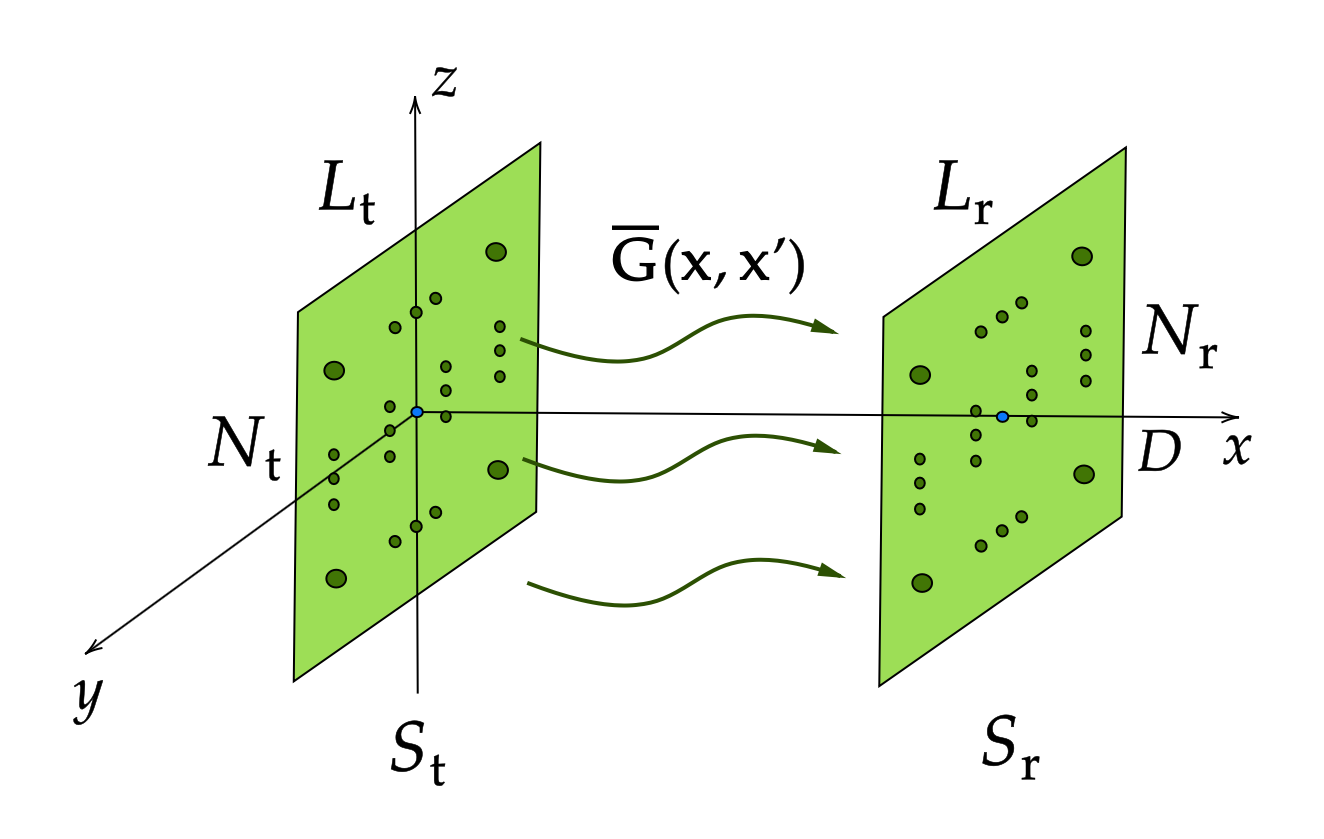
Modeling a MIMO system with Nt transmit and Nr receive elements distributed on square apertures (see Figure 1), the channel matrix construction is based directly on the random DGF tensors, preserving polarization and spatial coupling between all element pairs.
Figure 1: Schematic of the continuous MIMO system with Nt×Nr point elements located on two parallel square planes with side length L and separation Δk∼N(0,σ2)0.
The channel matrix for each Monte Carlo realization is built by first generating the random effective wavenumber(s) according to the stochastic model, then assembling the polarization-resolved DGF entries for each transmitter-receiver pair. To standardize comparison, the resulting channel matrices are normalized by their Frobenius norm before the computation of capacity and DoF.
Ergodic capacity: Computed as the expectation of the instantaneous capacity over stochastic channel realizations.
Degrees of freedom (DoF): The number of statistically significant spatial eigenmodes.
Effective DoF (eDoF): A continuous measure reflecting the practical multiplexing efficiency, weighted by eigenmode energy.
Simulation Results: Capacity and DoF Enhancement Through Maxwellian Stochasticity
Monte Carlo simulations assess the ergodic capacity and DoF for both stochastic channel models (Gaussian and SPW) in comparison with the deterministic LoS case. The main trends are:
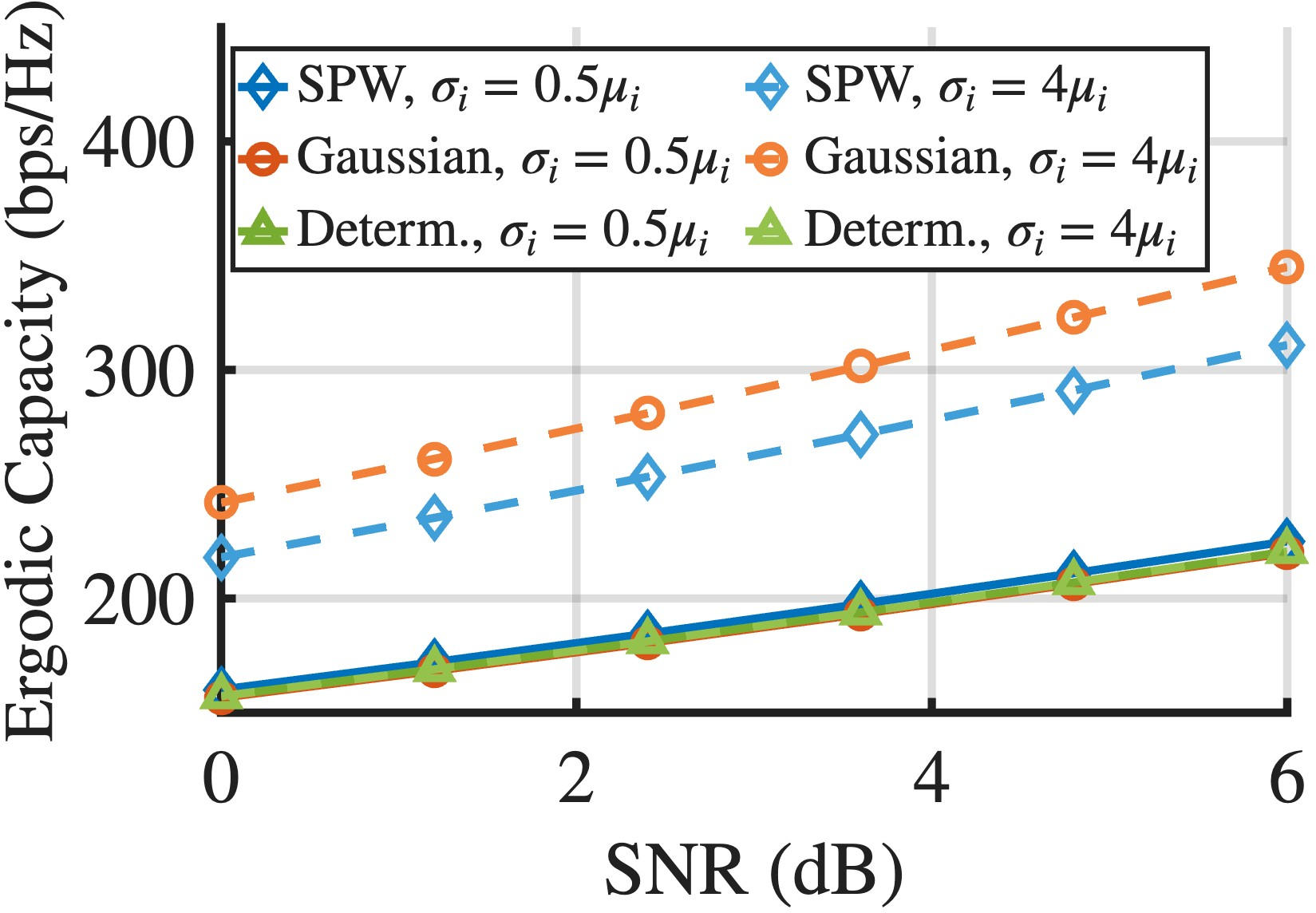
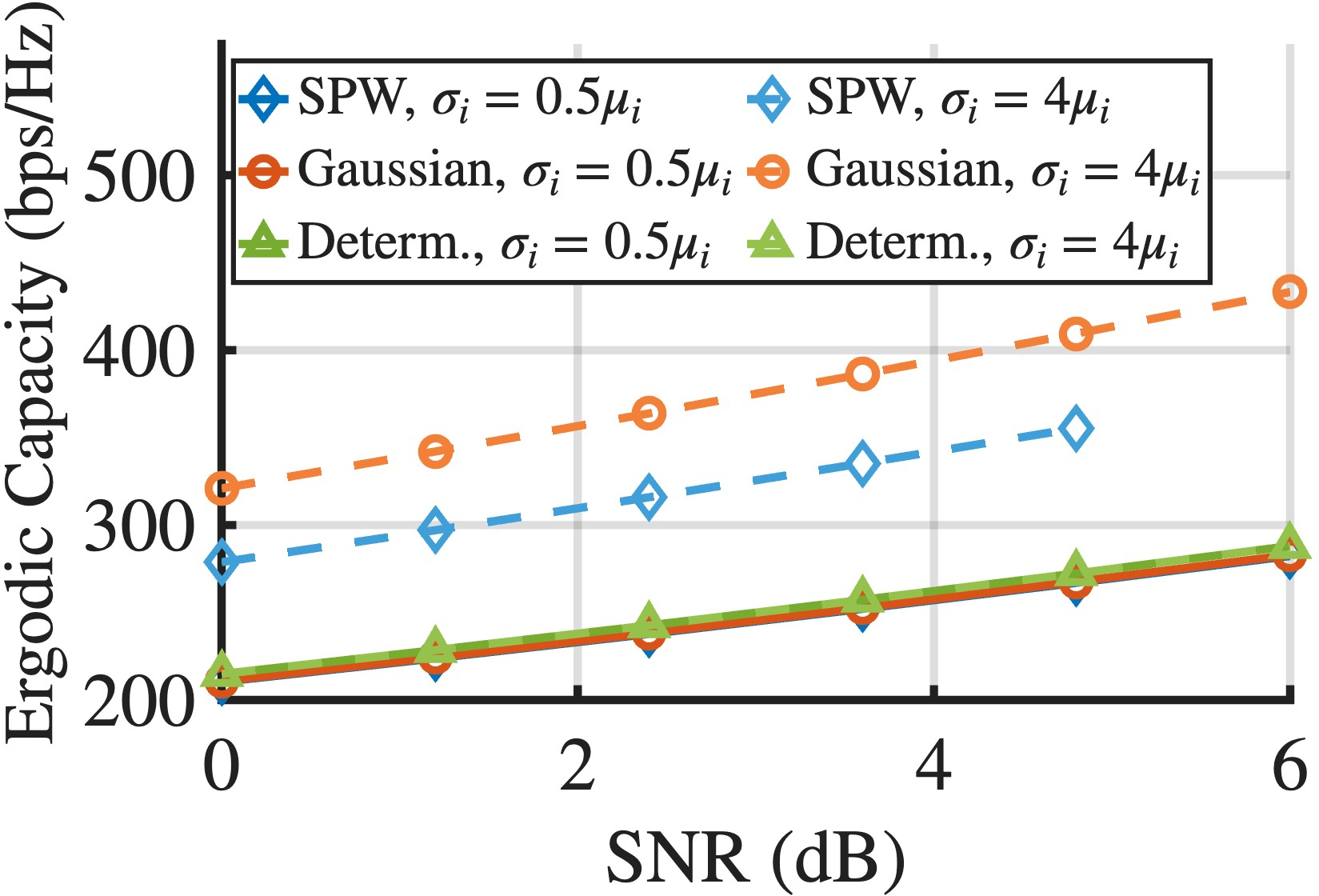
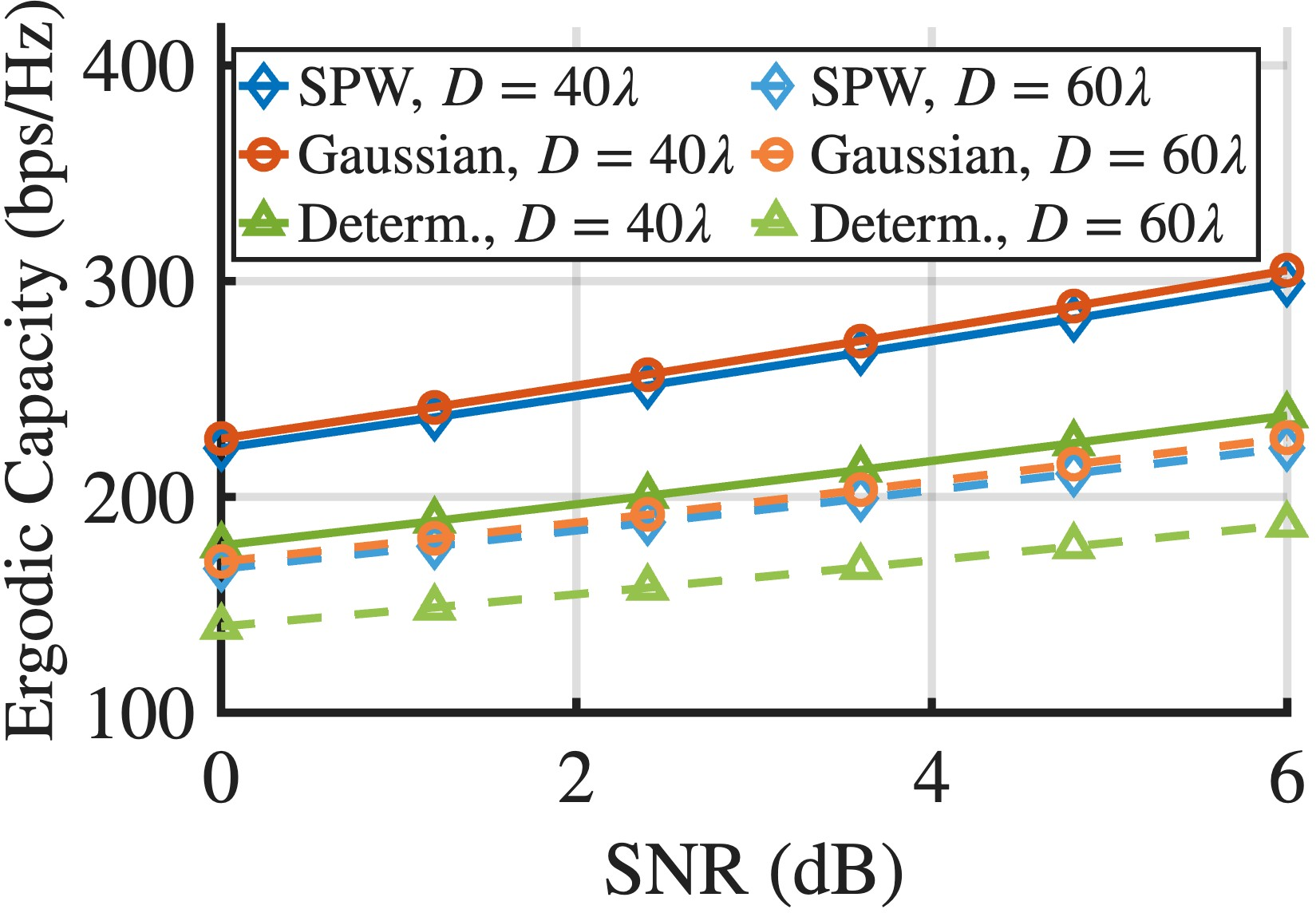
Spatial Resolution and Capacity: Decreasing the inter-element spacing (e.g., from Δk∼N(0,σ2)1 to Δk∼N(0,σ2)2) enhances the mode count, leading to increased ergodic capacity across all models (Figure 2, Figure 3).
Figure 2: Ergodic capacity versus SNR for various stochastic and deterministic models when inter-element spacing is Δk∼N(0,σ2)3.
Figure 3: Ergodic capacity versus SNR for Δk∼N(0,σ2)4 under different fluctuation strength regimes.
Impact of Fluctuation Strength: Increasing the standard deviation of the wavenumber or wavevector fluctuations (Δk∼N(0,σ2)5 from 0.5 to 4) substantially enriches the spectrum and increases channel capacity and DoF. For strong perturbations, the SPW model outperforms the Gaussian model, demonstrating the importance of vectorial (componentwise) randomization in capturing physically realistic EM modal diversity.
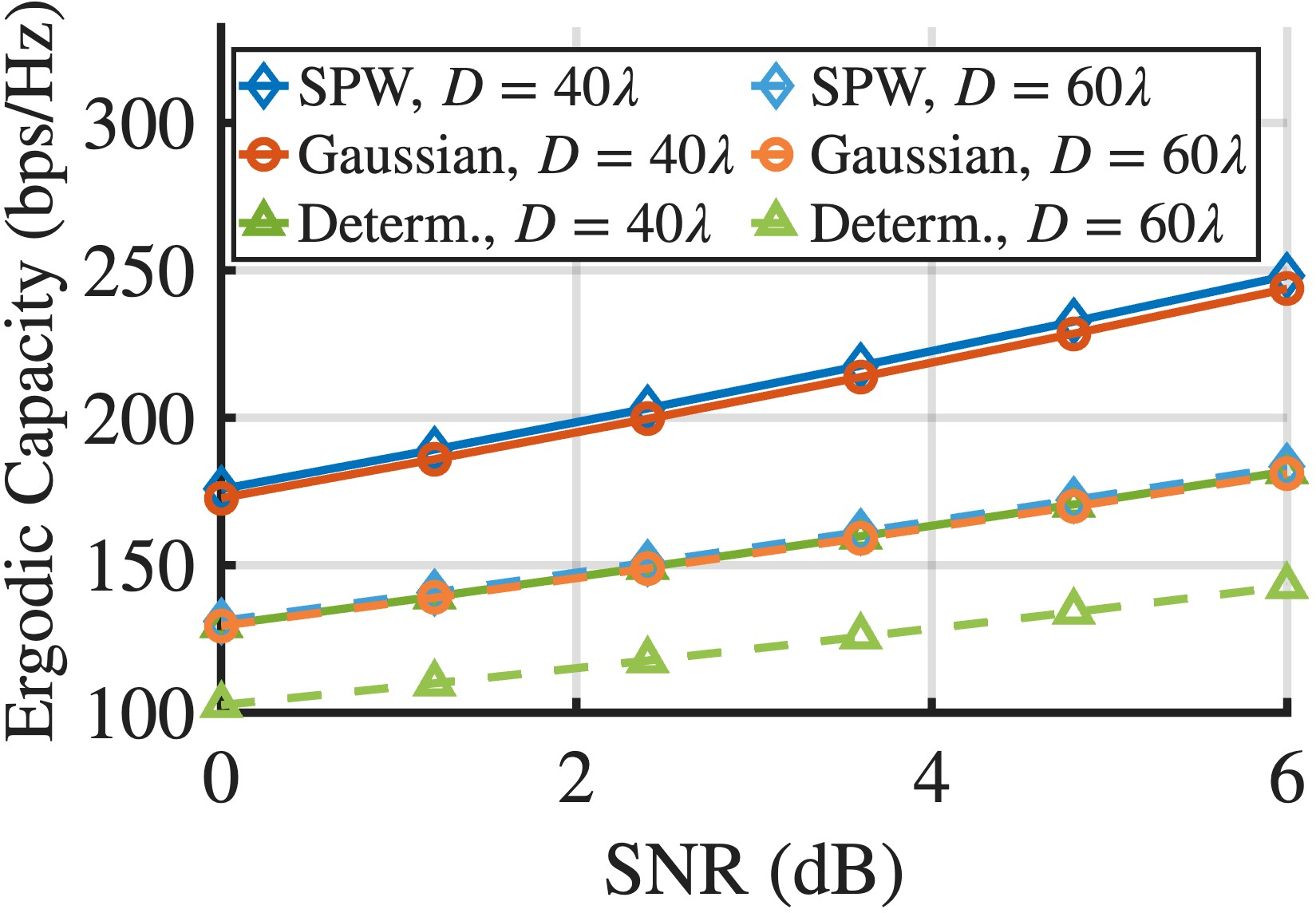
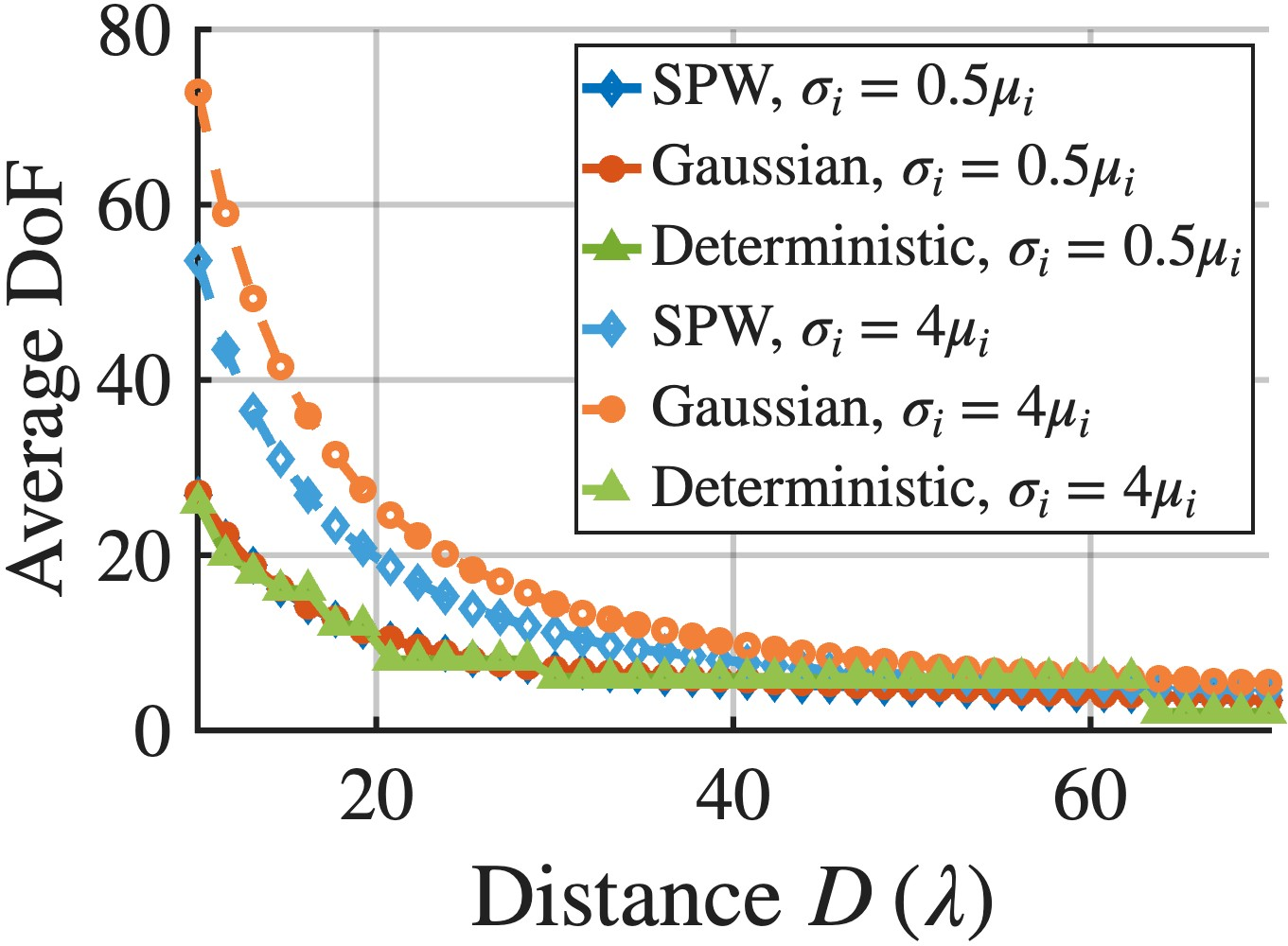
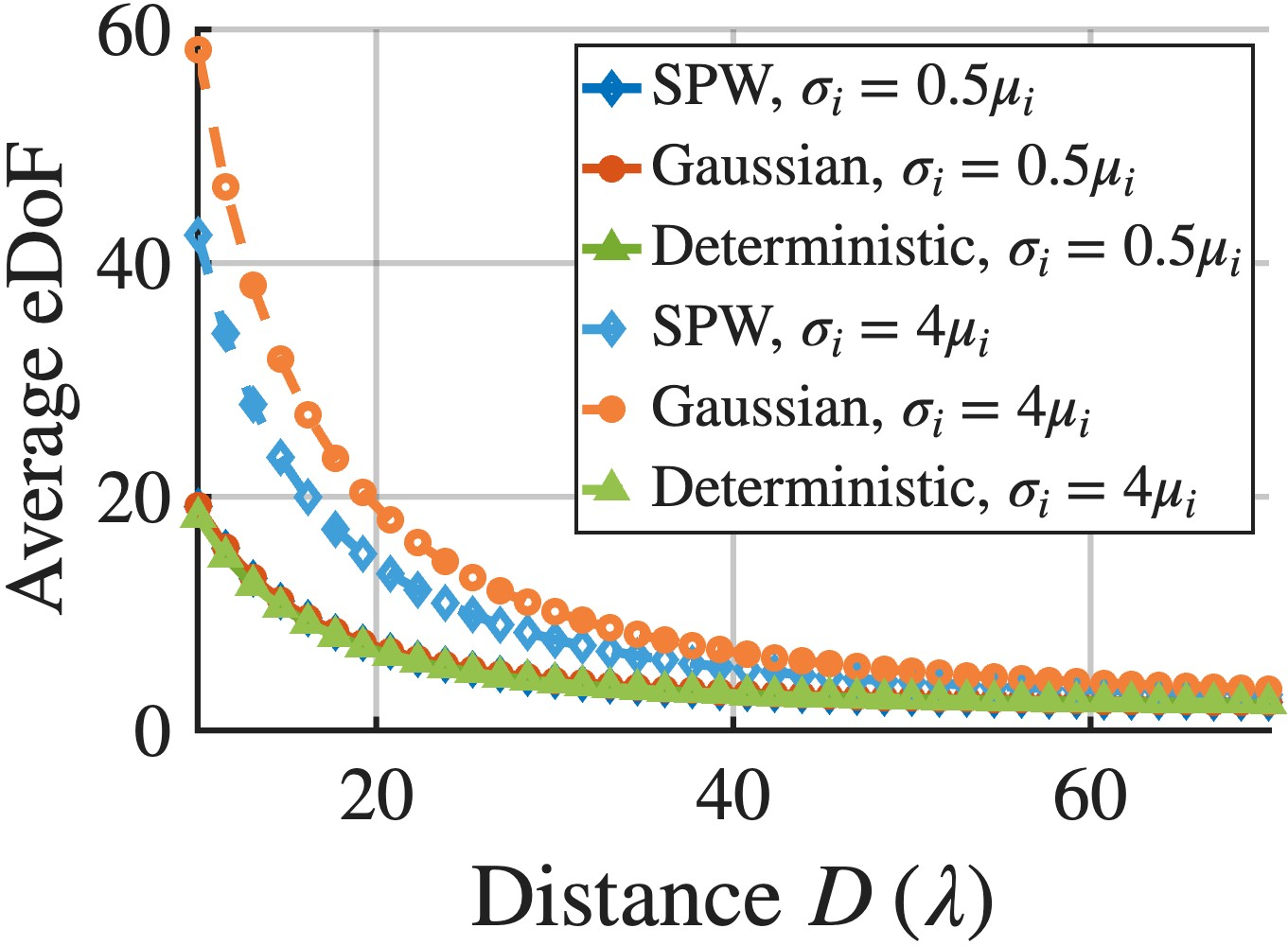
Distance-Dependent DoF: As the transceiver separation Δk∼N(0,σ2)6 increases, the DoF and eDoF for all models decrease—this contraction stems from the attenuation of evanescent spectral components with distance. In the far-field, all models converge to a DoF of 2, corresponding to the fundamental polarization limit for a planar MIMO system.
Figure 4: Effective DoF (eDoF) and DoF versus transceiver distance Δk∼N(0,σ2)7 for various amounts of wavenumber randomness—modal richness is largest in the near-field and shrinks with increasing distance.
Theoretical and Practical Implications
The results provide strong evidence that moderate stochasticity in the DGF—introduced in a physically consistent, Maxwellian fashion—can substantially increase ergodic capacity and spatial DoF beyond deterministic baselines. This enhancement arises not from artificial or phenomenological fading, but from the rigorous incorporation of real-world electromagnetic uncertainties. For future ultra-massive MIMO, near-field, and holographic MIMO systems, these findings establish a compact, analytic reference for understanding the limits and operational gains achievable through Maxwell-consistent random field theory.
It is further shown that while the Gaussian model serves as a useful analytic surrogate for weak randomness, only the SPW model accurately captures the full spatial and modal richness of stochastic LoS propagation, especially at large fluctuation strengths or in highly anisotropic environments.
Conclusion
This paper presents a rigorous stochastic LoS MIMO channel modeling framework built from minimal Maxwellian random field perturbations of the dyadic Green’s function. The Gaussian and SPW models offer a hierarchy of Maxwell-consistent randomness, with the SPW framework allowing physically grounded incorporation of both propagating and evanescent spectral diversity. Simulation evidence highlights significant ergodic capacity and DoF enhancements, underscoring the critical role of electromagnetic-aware stochastic modeling in characterizing and exploiting fundamental communication limits in realistic LoS MIMO scenarios (2606.08463).