- The paper establishes asymptotics for oscillatory murmuration densities in automorphic forms, demonstrating uniform behavior as conductor exponents grow.
- It employs advanced trace formulas on modular, quaternionic, and Maass forms to derive explicit statistical averages with controlled error terms.
- The findings suggest universality in the spectral statistics of automorphic representations, offering insights for further depth aspect analyses.
Introduction and Theoretical Background
"Murmurations in the Depth Aspect for Maass and Modular Forms" (2606.08353) investigates the phenomenon of murmurations—oscillatory structures in statistical averages of Dirichlet coefficients across families of automorphic representations. This work focuses on depth aspect behavior, particularly for holomorphic cusp forms of conductor ℓ2a with fixed weight, automorphic forms on definite quaternion algebras, and Maass cusp forms, as the conductor exponent a→∞ for a fixed odd prime ℓ, and as ℓ→∞ with exponent fixed. The analysis extends previous results on odd conductor exponents and demonstrates striking uniformity and predictability for the associated murmuration densities. All statements are conditional on GRH for Dirichlet L-functions.
Oscillations are grouped by root number and the main statistic considers prime-averaged Dirichlet coefficients, weighted by root number and Hecke eigenvalues, normalized relative to the spectral family under investigation. This connects to one-level density phenomena and the statistics of low-lying zeros of L-functions.
Notation and Structure of Murmuration Densities
For a fixed compact interval E⊂R>0, odd prime ℓ, and even k≥2, the central quantity is
ME,ℓ,k:=∣E∣1∫EDℓ,k(v)dv
where
a→∞0
with a→∞1 an explicit Euler product and a→∞2 the Chebyshev polynomial of the second kind.
The analogous construction applies in the Maass setting with an appropriate test function and Selberg/Abel transform, resulting in a family of "murmuration densities" parameterized by interval a→∞3, prime a→∞4, weight a→∞5, and in the Maass case, a test function smoothing over the spectral parameter.
Main Results: Uniformity Across Exponents and Families
A primary contribution is the establishment of asymptotics for the normalized sums
a→∞6
where the sum is over automorphic representations (holomorphic forms of level a→∞7, quaternionic forms, or Maass cusp forms), a→∞8 denotes the global root number, and a→∞9 the ℓ0-th normalized Hecke eigenvalue.
Theorems: For holomorphic cusp forms of level ℓ1 (modular forms and definite quaternion algebra forms) and Maass cusp forms of level ℓ2, as ℓ3 or ℓ4 with ℓ5 fixed, one has
ℓ6
with error terms matching those in [BKLMYMurms] up to sharper ℓ7-dependence and constants. The density ℓ8 does not depend on the parity of the conductor exponent and matches the value for odd exponents, thereby confirming uniform density for all ℓ9 as ℓ→∞0.
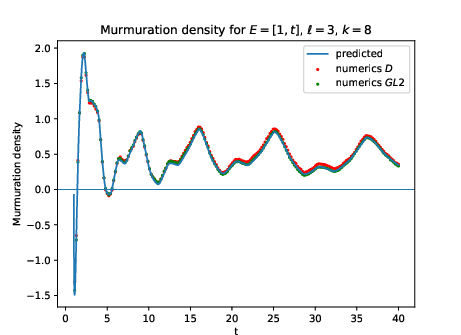
Figure 1: The function ℓ→∞1 for ℓ→∞2, with direct numerical evaluations (green and red dots) comparing to the theoretical quotient for modular and quaternionic forms.
For the Maass form family, comparable statements hold with a test function smoothing the Laplace spectrum:
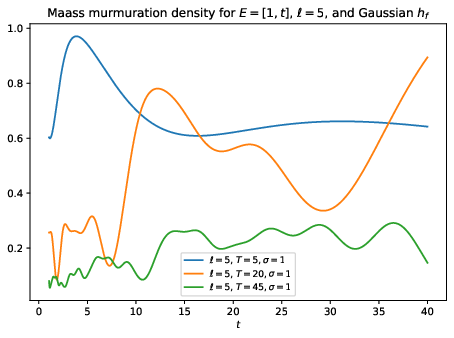
Figure 2: ℓ→∞3 for ℓ→∞4, where the test function ℓ→∞5 is a sum of two Gaussians in the spectral parameter.
An additional regime examines the limit as ℓ→∞6 (with exponent fixed), proving that the limiting density
ℓ→∞7
emerges and does not depend on the exponent or the family (modular, quaternionic, Maass). This demonstrates deep uniformity among automorphic families under conductor-exponent depth aspect growth.
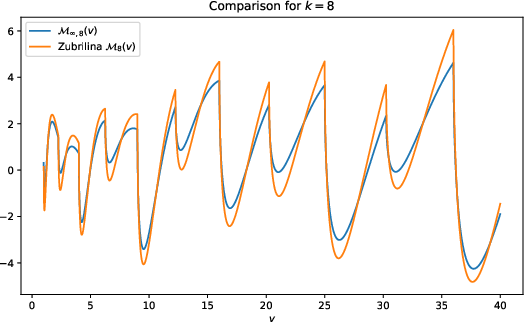
Figure 3: Comparison of the current work's ℓ→∞8 with earlier density computations in [ZubM].
A substantial part of the work is devoted to explicit trace formula computations in all families. For ℓ→∞9 modular forms, the Yamauchi–Skoruppa–Zagier version of the Eichler–Selberg trace formula combined with careful inclusion–exclusion over Atkin–Lehner newform spaces yields a formula for
L0
explicitly in terms of weighted class numbers and Chebyshev polynomials. In the quaternionic case, an adelic trace formula adapted to the definite quaternion algebra is constructed: the local part at L1 is engineered to extract forms of conductor L2. Maass form results derive from the adelic trace method, with attention to the residual, parabolic, and Eisenstein spectra.
A highlight is the technical control in the L3 regime, maintaining precise asymptotics and controlling auxiliary error terms.
Numerical Verification and Structural Observations
Direct numerical comparison (Figures 1 and 2) confirms precise agreement of the analytic quotient with theoretical predictions. One salient observation is that, despite structural differences in the trace formulas (e.g., elliptic conjugacy sums over varying determinants depending on parity of exponent or group), the limiting density is invariant and uniform.
In addition, the quadratic fields in the trace contributions are systematically classified, and the transition of bias between Chebyshev oscillation and the main term in the presence of supercuspidal or principal series components is elucidated.
Implications and Pathways for Future Work
- Statistical Automorphic Theory: The demonstration that murmuration structures persist and unify across all conductor exponent parities, and across both modular and quaternionic settings, is evidence of remarkable regularity and harmonization in the automorphic spectrum. It reinforces the view that, in depth aspect, certain non-semisimple statistical phenomena persist beyond the squarefree or level-varied families traditionally studied.
- Robustness Across Groups and Test Functions: The transfer via Jacquet–Langlands among L4 and the quaternion algebra, together with the spectral aspect for Maass forms, attests to the deep compatibility of the local–global trace machinery for the detection of murmuration signatures.
- Limit Shapes and Universality: In the L5 limit, the emergence of a universal density closely matches one-level density phenomena encountered in random matrix theory, hinting at spectral transitions and universality classes in families of automorphic L6-functions.
- Technical Analysis: The careful propagation of error bounds and sharp trace formula manipulations provide tools for the analysis of further depth aspect statistics, such as higher-rank groups or more general families; the methods are widely adaptable.
- Open Directions: The author notes the desirability of a more uniform proof of the density limit—one that transcends the current combinatorial distinctions between even and odd exponent presentations. The extension to alternative types of test functions or inclusion of small weights remains a possible avenue, as does unconditionality with respect to GRH, perhaps via a strengthened variant of the Bombieri–Vinogradov theorem for square moduli.
Conclusion
This work rigorously establishes the uniformity and robustness of murmuration densities in the depth aspect for both holomorphic and Maass automorphic forms—remarkably, across all exponents and both L7 and quaternionic contexts. The analysis advances the frontier of statistical automorphic representation theory by clarifying the oscillatory structure of root-number grouped averages, and sets the stage for further investigation into fine-scale statistics of the automorphic spectrum as automorphic parameters vary in depth.

