- The paper introduces a stochastic framework that recasts Swampland EFT boundaries as survival problems for cosmological moduli trajectories.
- It derives a universal boundary-layer response characterized by a singular Doob drift inversely proportional to the proper boundary distance.
- The analysis unifies various Swampland constraints and provides both numerical and analytic tools for assessing EFT control in early universe cosmology.
Stochastic Survival at Effective Field Theory Boundaries in the Swampland Program
Introduction and Motivation
This work develops a stochastic framework underpinning survival probabilities of moduli trajectories in the context of Swampland restrictions, targeting effective field theory (EFT) control boundaries in string cosmology. The Swampland program provides quantum gravity constraints on EFTs, typically demarcated by boundaries—such as species scale, string/Kaluza-Klein cutoffs, or weak-coupling limits—where EFT ceases to be valid.
However, cosmological evolution is inherently stochastic due to quantum fluctuations during inflation, causing moduli to undergo Brownian-like motion. The critical operational question in this environment is not only where the boundary of EFT control is, but which entire stochastic histories manage to survive within these quantum-gravity-imposed boundaries over cosmological timescales. This paper proposes a rigorous formalism to recast Swampland control data as survival problems for fluctuating cosmological histories, leading to a universal local law for the conditioned drift (the "Doob drift") near such boundaries.
Stochastic Survival Framework
The formalism treats the space of cosmological moduli as a domain MEFT, with control data encoded as:
- Hard boundary: specified by FA(ϕ)=0, with FA>0 on the controlled side.
- Soft loss: encoded by a killing profile κ(ϕ) that gradually decreases survival.
- Finite horizon: survival over a finite time span τ.
The stochastic evolution of moduli ϕi is defined by drift bi and diffusion tensor Dij, leading to the (backward) Fokker–Planck generator:
Lf=bi∇if+Dij∇i∇jf.
The key observable is the survival probability h(ϕ,τ)—the chance that a trajectory starting at FA(ϕ)=00 remains entirely within FA(ϕ)=01 up to time FA(ϕ)=02. The survival action is FA(ϕ)=03, which, via the Doob transform, yields a conditioned drift:
FA(ϕ)=04
This drift is not a modification of the physical force but a statistical effect emerging from conditioning on survival.
Universal Boundary-Layer Response
Near a regular, absorbing boundary with nonzero normal diffusion, the survival probability decays linearly with the boundary-normal distance FA(ϕ)=05, yielding:
FA(ϕ)=06
where FA(ϕ)=07 is the boundary-normal. In terms of the operational loss function FA(ϕ)=08,
FA(ϕ)=09
Thus, the singular (i.e., FA>00) response is universal, depending only on proper distance and diffusion, while microscopic details enter through the construction of the loss surface FA>01.
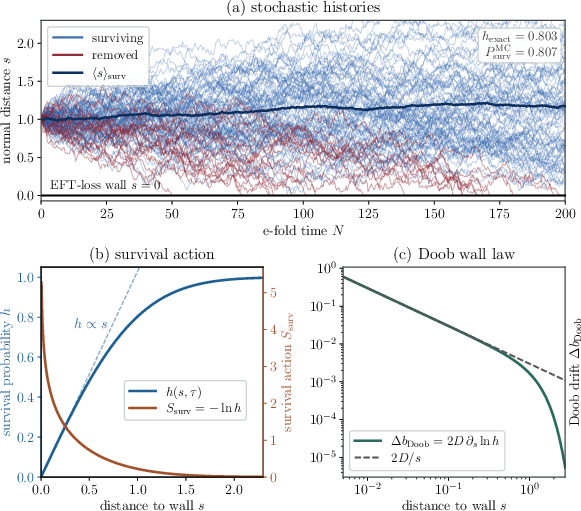
Figure 1: Local survival benchmark for a driftless half-line model exhibits the predicted singular Doob drift layer at the absorbing boundary.
This universality bridges various Swampland criteria—species bounds, string cutoffs, and gradient/Hessian potential diagnostics—by showing their role as input data specifying loss surfaces for survival, all accessing the same boundary-layer structure in the stochastic conditioned drift.
String Compactification and EFT Loss Criteria
String compactification data are systematically encoded as survival input channels:
- Species/tower cutoffs use FA>02;
- String or KK thresholds use FA>03 or FA>04;
- Potential-based constraints (gradient, Hessian Swampland conjectures) are recast as loss functions on histories.
Species scale bounds, direct tower thresholds, and combined tower configurations are translated to explicit logarithmic boundary functions, which can be treated equivalently in the stochastic survival framework.
Stochastic Boundary Layers and Scale Diagnostics
The survival-conditioned drift yields the operational "thickness" of the statistical boundary layer:
FA>05
where FA>06 is the classical inward drift, and FA>07 is the normal diffusion. In slow-roll inflation, this thickness is of order the quantum fluctuation step FA>08.
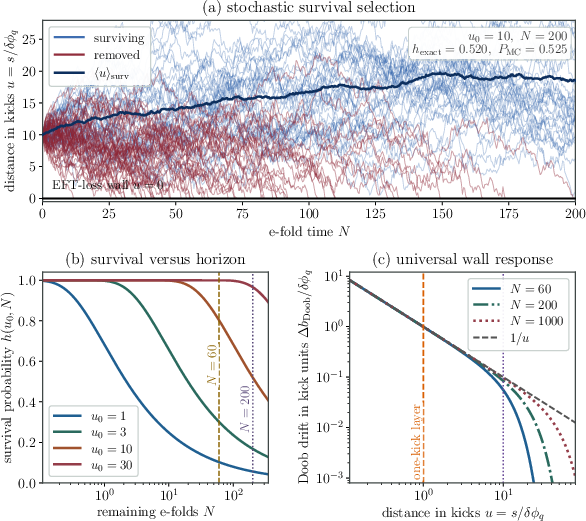
Figure 2: Kick-normalized diagnostics elucidate the survival probability profile and conditioned drift near a hard boundary in stochastic-kick units.
One-kick separation corresponds to a boundary region where the induced conditioned drift is order FA>09, matching the domain where stochastic effects are competitive with deterministic slow-roll.
Boundary-Normal Universality and Inverse Construction
The induced conditioned drift field can be inverted to reconstruct the operational loss function up to Doob equivalence: if
κ(ϕ)0
then κ(ϕ)1 is the effective scalar loss surface. An obstruction (non-vanishing curl of the associated one-form) signals the absence of representation by a single scalar loss surface, indicating more complex survival data (e.g., multiple boundaries, nonlocality in phase space, or degenerate diffusion directions).
This structure highlights an equivalence class under Doob transformations, so that distinct Swampland constraints that define identical boundary-normal layers yield identical dominant local stochastic responses within the survival ensemble.
Theoretical and Practical Implications
This construction offers an operational map from EFT control data—whether string-theoretic (species cutoffs, KK towers), potential-based (gradient/Hessian conjectures), or phenomenologically imposed (finite duration/horizons)—to a well-posed stochastic survival problem for cosmological moduli.
Bold claim: Near any regular hard control boundary, the leading layer of the survival-conditioned flow is always an inward statistical drift, singular in the proper boundary distance, insensitive to the microscopic details of the loss condition beyond its specification as a surface. This means that, at the operational level, diverse quantum gravity and Swampland constraints become unified in their impact on the survival ensemble through this universal boundary response.
The framework enables several applications:
- Systematic translation: From string/Swampland control data to quantitative stochastic drift and survival probabilities in the early universe.
- Diagnostic hierarchy: Identifies which potential-based diagnostics (e.g., κ(ϕ)2) can be operationally mimicked by species or cutoff-based boundaries at the level of the path ensemble.
- Numerical and analytic characterization: Quantifies the layer-width and probability cost for survival near the control boundary, facilitating computations in explicit string moduli spaces and multi-field stochastic inflation.
Furthermore, the inverse construction provides an analytical tool to infer control surfaces from measured statistical drifts or numerical simulations, aiding model-building and Swampland-compatibility assessments in inflationary cosmology.
Conclusion
This paper establishes an explicit stochastic interface between Swampland-inspired quantum gravity control data and the statistical ensemble of cosmological trajectories. The key result is the universality of the boundary-layer drift for survival-conditioned histories, which depends solely on the proper distance and normal diffusion to the control boundary. Microscopic differences among various Swampland constraints are mapped to differences in wall placement or boundary regularity, not to the leading boundary-layer effect. Extensions of this framework offer promising tools for both the analytic study of multi-field stochastic systems and their numerical exploration in the string landscape, as well as diagnostics for EFT control in cosmology, motivating further research on nonlocal survival problems, global geometry, and soft boundary generalizations.

