- The paper introduces a candidate-level BEV policy that captures human search intent for effective spatial-visual object navigation.
- It employs frontier-based human-intent labeling and angular soft targets to enhance search strategies and reduce redundant exploration.
- Empirical results show state-of-the-art success rates and SPL on MP3D and HM3D benchmarks, with robust zero-shot transfer across diverse robots.
IntentNav: Learning Spatial-Visual Object Navigation from Human Demonstrations
Object Navigation (ObjectNav) is a critical challenge in embodied AI, involving the search for a specified target object in previously unseen environments under partial observability. This task requires efficient high-level search strategies that adaptively explore promising regions based on spatial and semantic cues, closely mirroring human exploratory behavior. Human search utilizes spatial memory, semantic priors, and selective local scanning to avoid redundant revisits, scale exploration in large environments, and quickly commit to target detection. Most prior approaches either rely on first-person RGB inputs with reactive low-level action prediction or leverage map-mediated reasoning with highly abstracted representations, failing to maintain coherent long-horizon strategies and structured spatial-visual memories.
IntentNav introduces a candidate-level spatial-visual imitation framework, leveraging human demonstrations to directly model search intent and exploration strategies. The central contribution lies in recovering high-level waypoint decisions from low-level action trajectories, grounding search in a global BEV space suitable for both semantic and spatial reasoning.
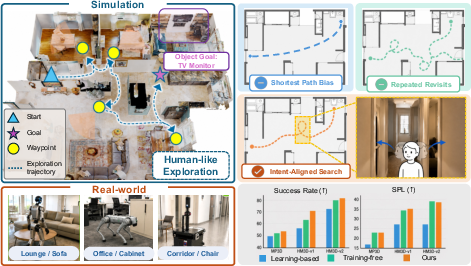
Figure 1: IntentNav learns spatial-visual ObjectNav from human demonstrations, grounding exploration and target selection in the BEV space and supporting cross-platform deployment.
Methodology
Candidate-Level BEV Policy and Human-Intent Labeling
IntentNav formulates ObjectNav as a candidate-level selection problem in a unified BEV space. At each timestep, the agent maintains a persistent BEV map that encodes explored areas, obstacles, trajectory history, and frontier boundaries. Candidate waypoints include both frontiers (expansion options) and target hypotheses (object detections), each paired with local RGB visual memory and agent-centric relative geometry. The agent’s vision-LLM (VLM) receives a serialized prompt containing the BEV crop, candidate memories, spatial features, and the target category, and outputs a reserved candidate-ID token corresponding to the selected waypoint.
To recover candidate-level supervision from human demonstration trajectories, the paper introduces Frontier-based Human-Intent Labeling. This method inspects future frontier evolution in replayed demonstrations to identify which current frontier most plausibly explains the demonstrator’s search direction, converting low-level actions into labeled candidate choices. Angular soft targets further enable approximate directional matching, reflecting human preference for directional exploration over exact waypoints.
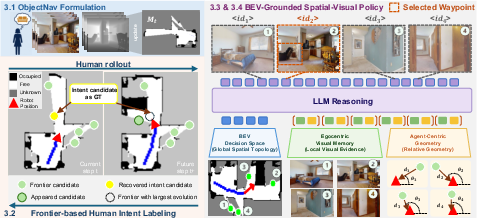
Figure 2: Overview of IntentNav architecture. ObjectNav is formulated as candidate selection in BEV space, with frontier-intent labeling providing proxy supervision from human rollouts, and the VLM predicting candidate waypoints.
Egocentric Visual Memory and Spatial Injection
Each candidate is associated not only with its BEV coordinates but also its birth-view egocentric RGB observation. This ensures that semantic evidence attached to each waypoint remains local and persistent, facilitating combined reasoning over spatial layout, scene context, and object category. Separate vision encoders for BEV and RGB ensure robust feature extraction. Agent-centric geometry is injected as explicit embedding features, encoding normalized distance and relative orientation to each candidate.
Policy Objective
The Intent-Aligned Objective facilitates learning coherent search intent. Frontier candidates are supervised via angular soft targets, allowing partial credit for candidates aligned with the labeled direction; target candidates use hard cross-entropy to enforce decisive commitment. This objective reduces locally repetitive behavior and encourages broader exploration coverage.
Empirical Evaluation
IntentNav achieves state-of-the-art SR and SPL across MP3D, HM3D-v1, and HM3D-v2 ObjectNav benchmarks. Trained solely on MP3D human demonstrations, the policy transfers zero-shot to unseen HM3D domains, outperforming both training-free VLM systems and learning-based policies.
Numerical highlights:
- MP3D: SR 53.8%, SPL 23.1%
- HM3D-v1: SR 70.5%, SPL 34.6%
- HM3D-v2: SR 82.2%, SPL 38.5%
These results surpass prior learning-based alternatives, indicating that human search intent supervision leads to more efficient, directed search behaviors and increased path optimality.
Ablations and Decision Paradigm
Removing candidate visual memory, spatial geometry, or reserved candidate-ID tokens substantially degrades performance and search behavior metrics. Random candidate selection in the BEV space improves over egocentric action prediction, validating the advantage of spatially grounded candidate selection. Angular soft objective improves coverage, scanning, and probing metrics without compromising decisive target commitment.
Search Behavior Analysis
IntentNav demonstrates effective large-scale spatial coverage, active local scanning, purposeful probing motions, and minimized redundant revisits. Human demonstrations serve as an upper bound for trajectory efficiency, but IntentNav exhibits more consistent coverage and commitment due to explicit objective regularization.
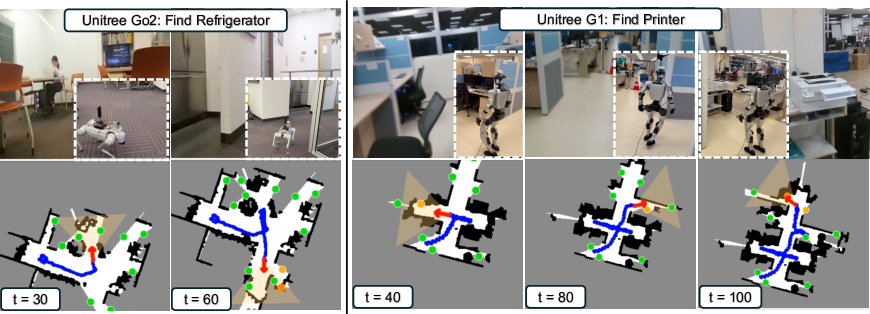
Figure 3: Representative trajectories showing IntentNav behavior—unexplored regions expansion, viewpoint scanning, and avoidance of redundant revisits.
Real-World Deployment and Generalization
IntentNav’s candidate-level BEV interface is platform-agnostic and transfers zero-shot to wheeled, quadruped, and humanoid robots without VLM fine-tuning. Physical deployments on diverse robots demonstrate consistent directed exploration and target commitment. The policy interface decouples high-level selection from local planning, allowing robust real-time inference and scalable execution.
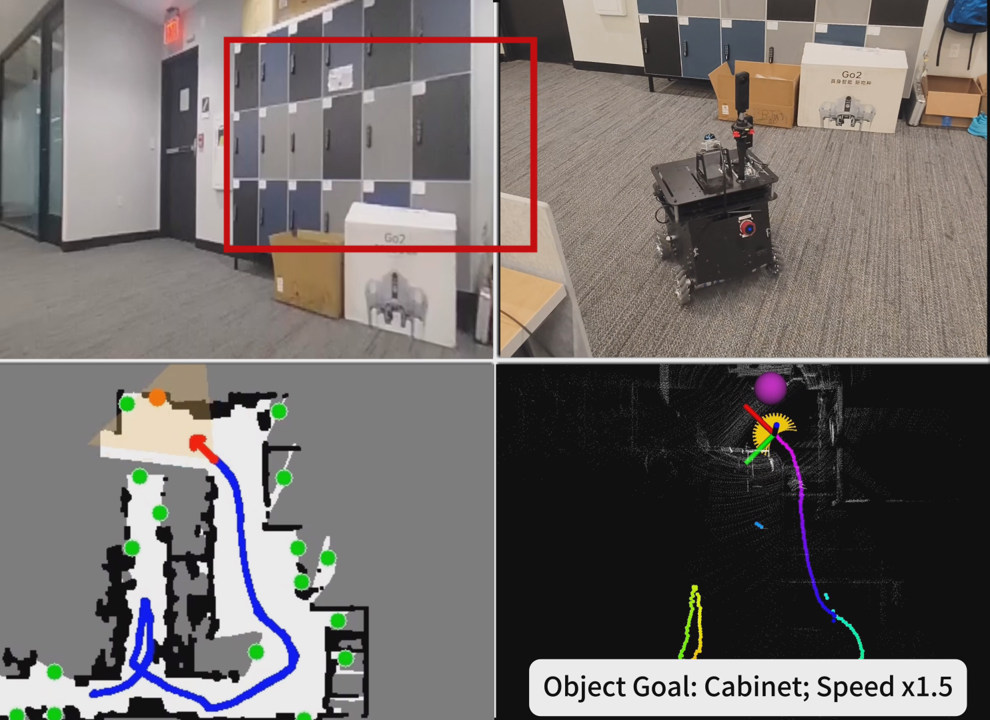
Figure 4: Wheeled robot searching for cabinet, with BEV trajectory showing quick abandonment of unproductive directions and refocused exploration.
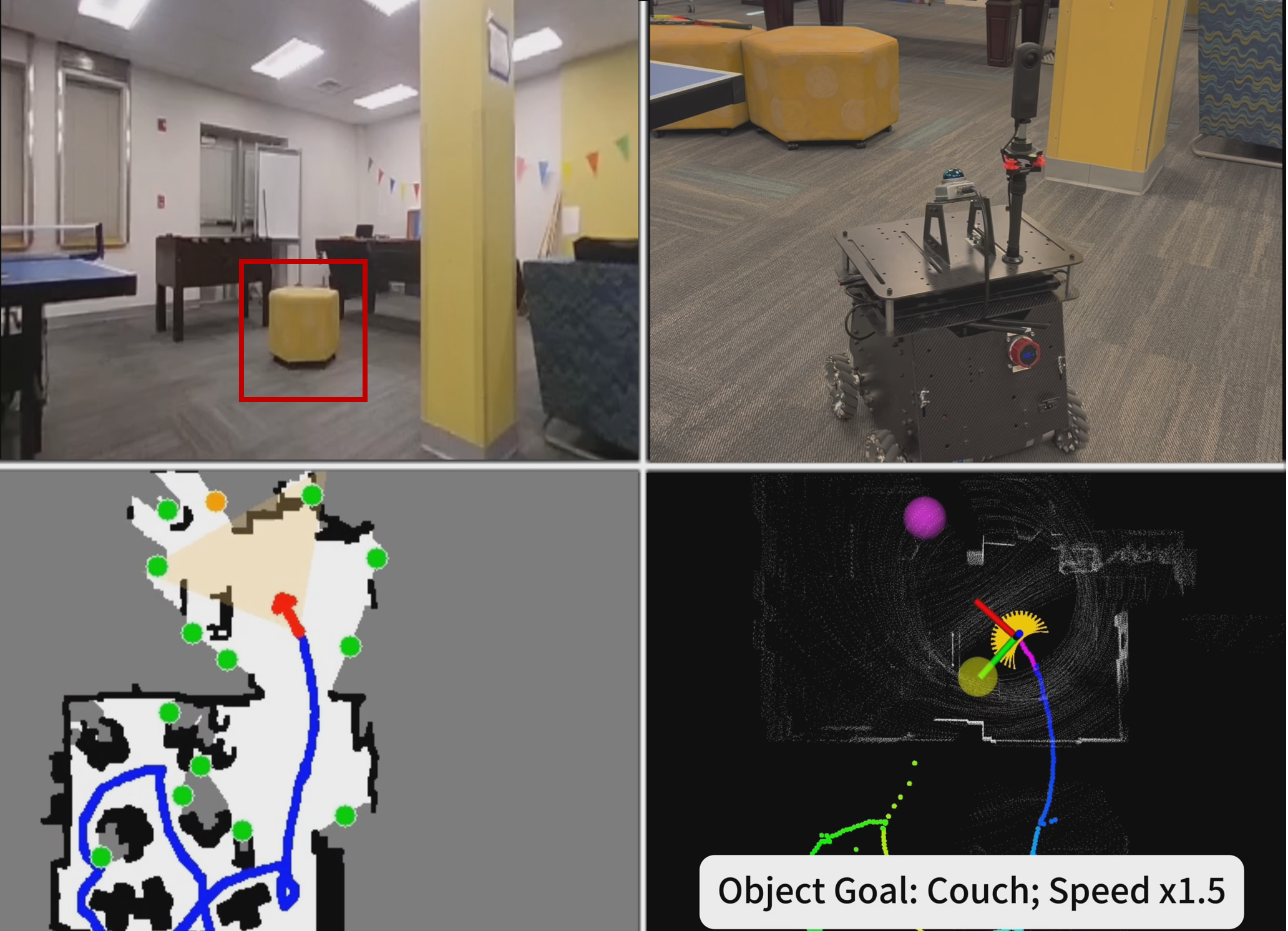
Figure 5: Wheeled robot approaching couch, efficiently sweeping cluttered spaces and resolving target among visually similar distractors.
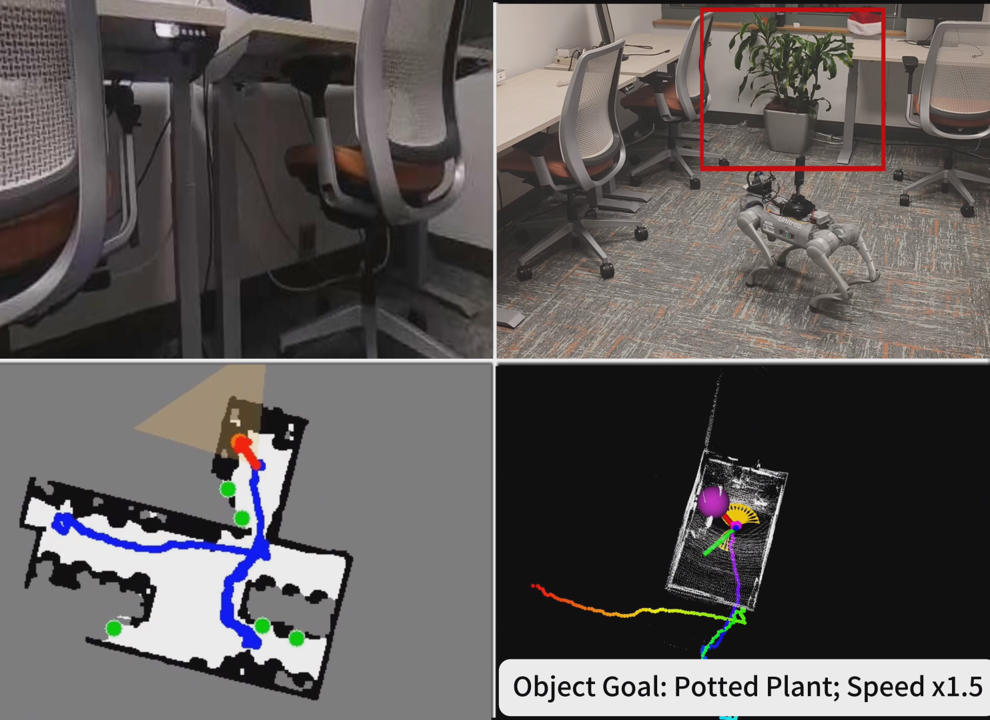
Figure 6: Quadruped robot searching for potted plant using structured room-by-room exploration.
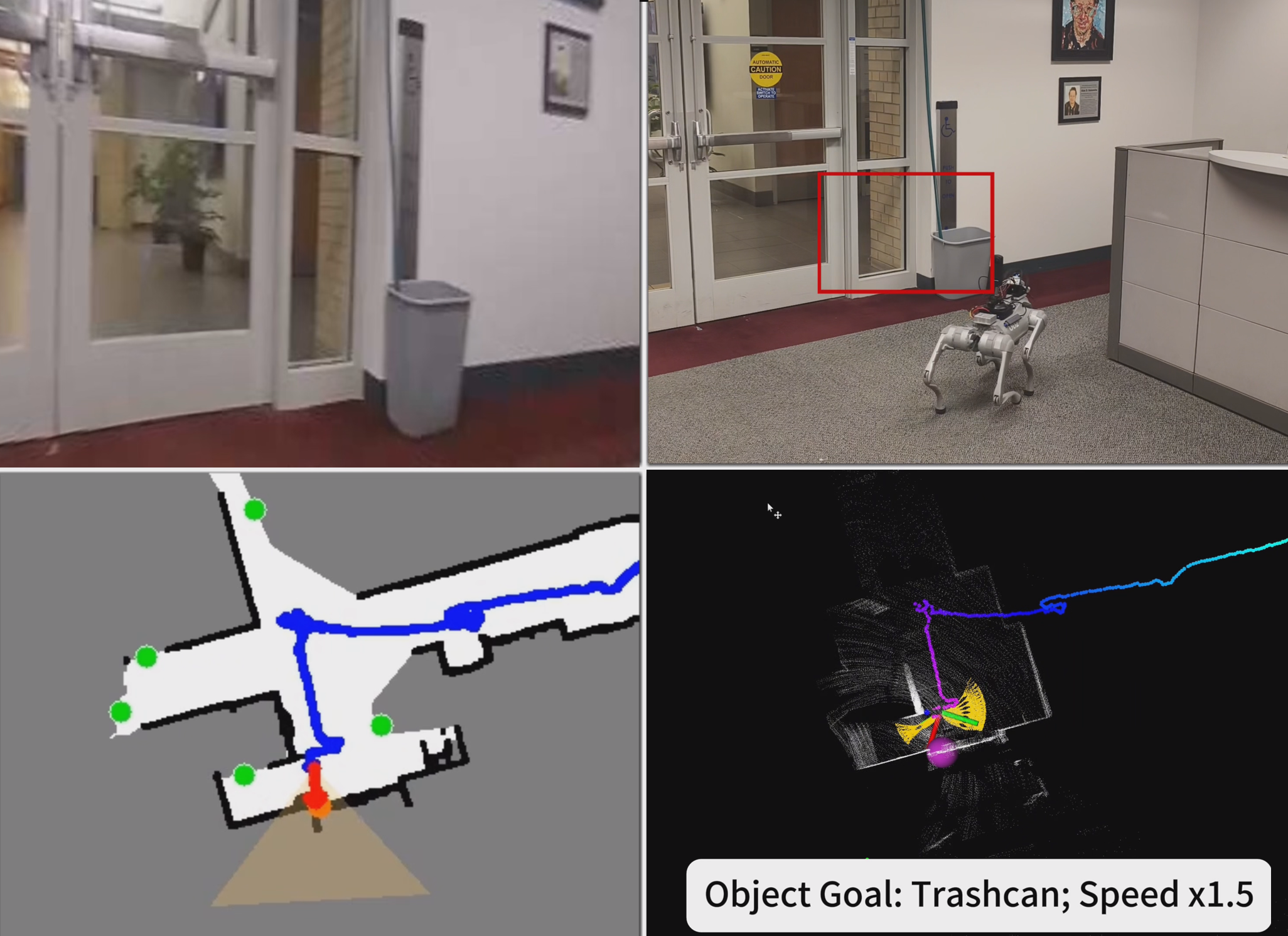
Figure 7: Quadruped robot trajectory spanning large environments, driven by local BEV abstraction.
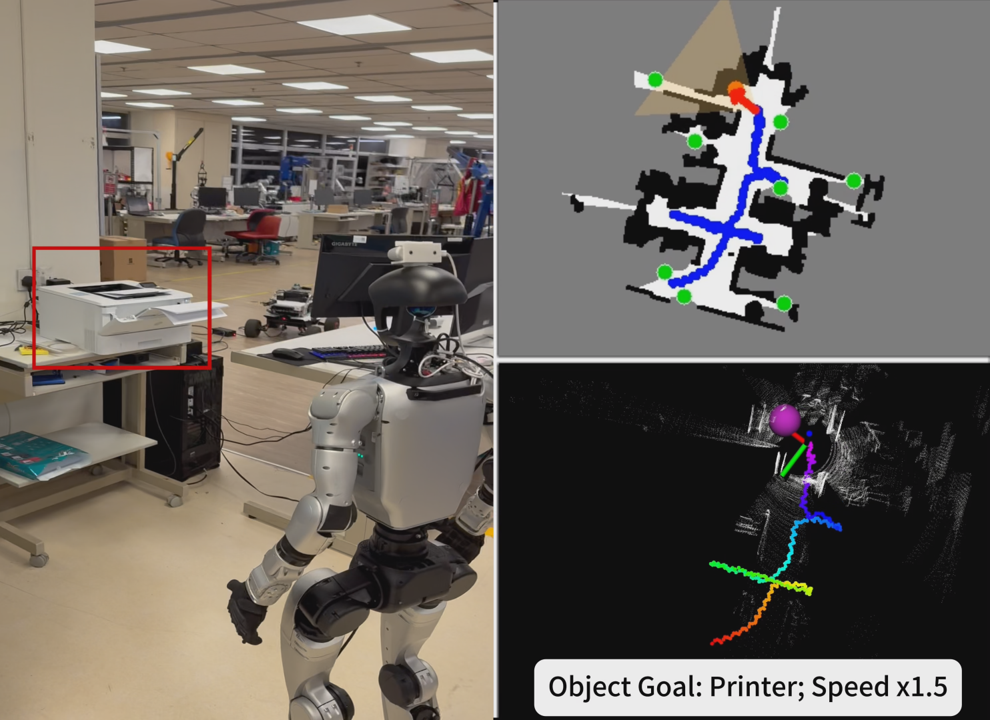
Figure 8: Humanoid robot conducting systematic search in an office, probing side corridors before target commitment.
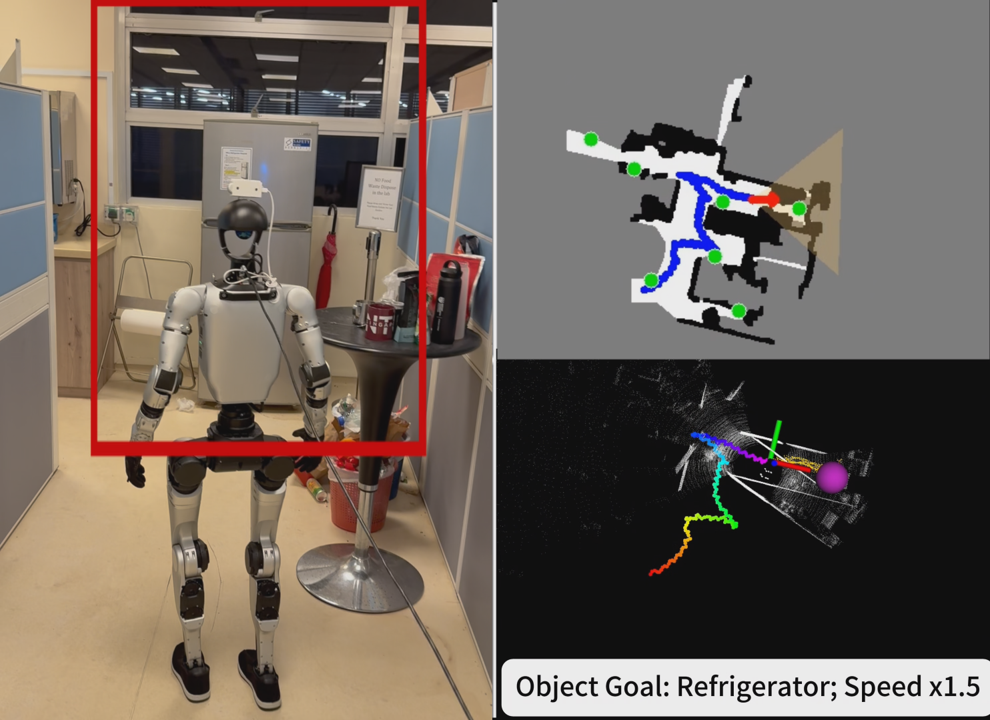
Figure 9: Humanoid robot exhibiting human-like systematic surveying and immediate commitment upon confirming target.
Implications and Future Directions
IntentNav demonstrates that spatial-visual candidate-level imitation from human demonstrations yields robust, generalizable ObjectNav policies. The unified BEV interface and intent-aligned supervision framework facilitate efficient, long-horizon search and effective zero-shot cross-platform transfer. Practical implications include scalable real-world deployment and reduction of hand-designed heuristics for embodied navigation. Theoretically, the work motivates further investigation into spatial-visual grounding, structured memory representations, and intent modeling in VLM-driven navigation. Open challenges remain in handling dynamic scenes, integrating high-level and low-level decision feedback, and improving semantic detection robustness.
Conclusion
IntentNav establishes a new paradigm for spatial-visual ObjectNav by learning human-like search intent in a candidate-level BEV space, supported by robust quantitative evidence and qualitative deployment across heterogeneous robot platforms. The method achieves strong performance, efficient exploration, and decisive target commitment, advancing the capabilities of imitation-driven embodied navigation (2606.08029).

