- The paper introduces RecurGuard, a framework that uses semantic signals like recurrence rate, volume growth, and task-conditioned progress to detect and halt token consumption attacks.
- It processes reasoning traces in fixed-size chunks with empirically calibrated thresholds to trigger early termination, achieving high detection rates on key attacks.
- The system demonstrates practical cost savings and low false-positive rates while adapting to both open reasoning trace and closed-API deployments.
RecurGuard: Runtime Monitoring for Reasoning-Token Consumption Attacks
Motivation and Threat Model
LLMs specialized for reasoning generate extended intermediate traces before yielding final answers. This increased reasoning capability introduces new risks: adversaries can inject decoy tasks through any context-bearing channel (prompt, retrieved documents, tool outputs) and induce the model to consume its generation budget on irrelevant computation. This results in denial of service (user receives no answer) and denial of wallet (excess output tokens billed), with amplification exceeding 20× relative to clean queries.
Existing defenses—input-side classifiers, length-based filters, and post-hoc semantic monitors—are inadequate. Input classifiers miss syntactically benign decoys; length filters yield high FPR on legitimate long-form outputs; output monitors cannot halt generation early and confuse legitimate off-query summarization with attack behavior. The threat model studied here assumes the attacker has context-channel control but no access to model internals. Defender visibility is divided into regimes: full reasoning trace (open models), summarised blocks (partially exposed), hidden traces (final-output-only APIs).
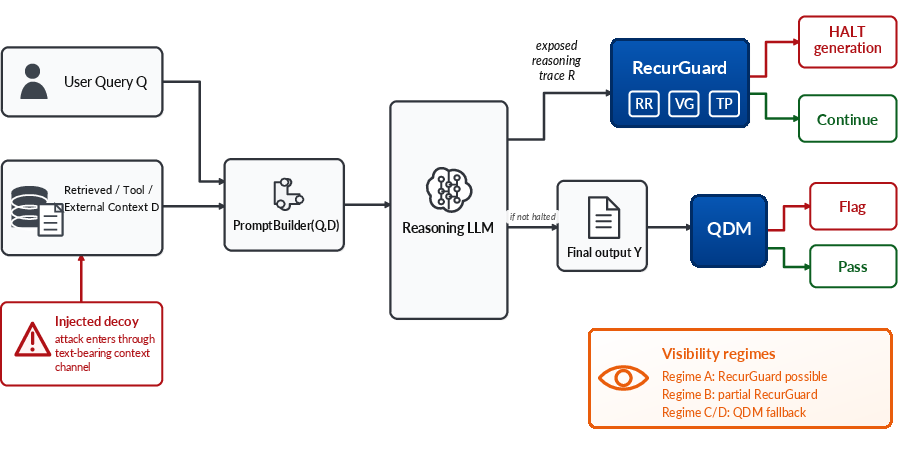
Figure 1: Threat model and monitor placement. Decoy tasks enter via text context; RecurGuard monitors reasoning traces online and can halt generation, while QDM provides post-hoc fallback.
RecurGuard Framework
RecurGuard provides online monitoring by processing exposed reasoning traces in fixed-size chunks during generation. It tracks three analytic signals:
- Recurrence Rate (RR): Fraction of current chunk embeddings similar to prior window chunks (sim>0.70). High RR indicates semantic repetition.
- Volume Growth (VG): Difference in cloud mean pairwise distance pre-/post-chunk. Negative or near-zero VG indicates collapse into repetitive reasoning space.
- Task-Conditioned Progress (TP): Difference between chunk similarity to user query and maximum similarity to prior chunks. TP is strongly negative when reasoning is self-recurrent and off-task.
A sustained alarm is triggered if all three signals remain anomalous for S=3 consecutive chunks (chunk size k=64, window W=20) with empirically calibrated thresholds. Early termination prevents further token expenditure.
For closed APIs lacking reasoning traces, QDM computes mean chunk-query similarity over final output, flagging responses with drift below $0.318$. QDM is strictly post-hoc and cannot halt generation.
Theoretical Analysis
RecurGuard leverages trajectory geometry in embedding space. Under clean reasoning, chunks progress to task-relevant regions; under attack, semantic collapse manifests as recursive off-task traces. The sustained-alarm conjunction exponentially suppresses false positives (p0S). Task-conditioned progress is dominant: TP-only ablation achieves near-perfect TPR and zero FPR on primary attacks.
Adaptive attacks confirm the evasion-alignment tradeoff: full evasion reduces amplification sharply. In C4 (task-aligned filler), attack amplification drops from 22.8× to 2.2×, validating that semantic alignment forces convergence to an answer instead of looping.
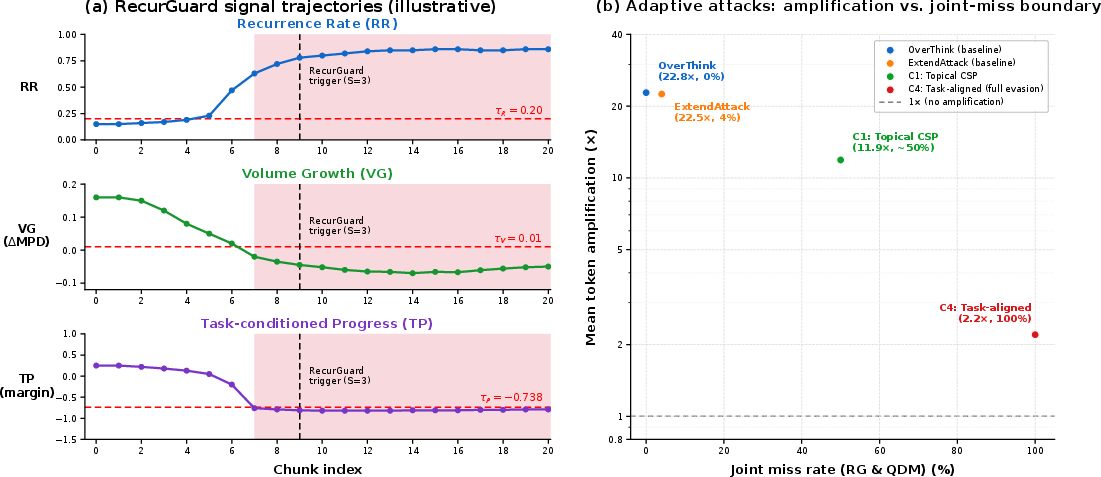
Figure 2: Combined detector view. Left: signal trajectories showing RR growth, VG collapse, and negative TP pre-alarm; right: amplification versus joint miss rate illustrates the adaptive boundary.
Experimental Evaluation
Models and Datasets
Evaluation spans open-weight reasoning models (DS-R1-Qwen-7B, DS-R1-Llama-8B, Qwen3-8B) and closed-API deployments (Sonnet~4.5, Opus~4.7). Main dataset is SQuAD (with role-specific splits), supplemented by HumanEval, GSM8K, CNN/DailyMail and TriviaQA for clean workload and cross-validation.
Attack Mechanisms
Two primary attacks are reproduced:
- OverThink: Unrelated decoy task (Sudoku constraints) injected with instruction to solve before answering.
- ExtendAttack: User query obfuscated and model prompted to sequentially decode before answering.
Adaptive variants probe semantic detection boundaries:
- C1: Topical context decoy (higher query similarity).
- C4: Task-aligned filler (full semantic alignment, minimal amplification).
- C2 and C3 serve as negative controls, producing negligible amplification.
Results: Amplification, Detection, and False Positives
Primary attacks achieve $22$–sim>0.700 token amplification and over sim>0.701 liveness failure across reasoning-specialist models. RecurGuard detects 99\% of OverThink and 92\% of ExtendAttack instances on DS-R1-Qwen-7B, maintaining sim>0.702 FPR on clean QA, code, math, and summarization. Baseline length-based detectors produce unacceptable FPRs on code (B1: 69\%, B4: 80\%), showing poor suitability for mixed workloads.
Adaptive variants reveal partial evasion:
- C1 achieves sim>0.703 amplification and approximately 50\% joint miss rate.
- C4 achieves full evasion (0\% TPR) only at sim>0.704 amplification.
Closed-API tests show QDM is reliable post-hoc (100\% TPR, 0\% FPR), while RecurGuard performance is degraded in summarised, hidden regimes.
Practical Implications
RecurGuard's runtime monitoring is effective in deployments exposing reasoning traces and permitting generation cancellation. Early stopping realizes immediate token cost reductions (sim>0.705 savings per detected attack). In closed APIs, only output-side QDM is available, offering detection but no prevention of wasteful generation.
RecurGuard's clean-task FPR profile enables trustworthy operation in heterogeneous workloads. The security boundary is defined by adaptive semantic attacks: full evasion trades amplification for answer convergence, making catastrophic denial-of-wallet infeasible under sustained task-alignment. C1 remains an open boundary for further anchor-aware monitoring research.
Limitations and Future Directions
RecurGuard is structurally inapplicable in deployments without reasoning visibility. Provider-summarised traces diminish detection sensitivity. Adaptive attacks tested only on DS-R1-Qwen-7B; broader model applicability and RAG pipeline integration are open directions. No evaluation against white-box gradient-based attacks (outside threat model). Compression ratio is a proxy for repetitiveness, not true perplexity.
Future research should extend to document-anchored semantic monitors, entropy-based signals, and end-to-end RAG deployments.
Conclusion
RecurGuard provides robust, low-FPR online detection for reasoning-chain consumption attacks when intermediate traces are visible, enabling early termination and substantial cost savings. Detection is anchored in task-conditioned semantic collapse, validated by strong empirical results across open-weight reasoning LLMs. QDM is a necessary companion for closed-API settings. The theoretical and experimental boundary defines a clear tradeoff: semantic evasion reduces amplification, confining the attack's harm. Topical C1 remains as an unresolved boundary for detection, motivating further research in semantic monitor anchoring and adaptive attack resilience.
For artifacts and code, see https://github.com/abidaziz1/recurguard.