- The paper’s main contribution is developing affine filtering measurements that filter affine subspaces to efficiently decode quantum channels.
- It leverages group covariance and an LP formulation to simplify the original SDP, enabling practical decoder design for structured codes like LDPC.
- Numerical results demonstrate improved decoding thresholds and robust performance across varying channel parameters and code structures.
Affine Filtering Measurements for Quantum Decoding: A Detailed Summary
Introduction and Context
The paper "Affine Filtering Measurements and Their Applications to Quantum Decoding" (2606.07852) develops a rigorous theory and practical algorithms for affine filtering measurements—a structured form of quantum measurement for decoding linear error-correcting codes over classical-quantum (CQ) channels, particularly pure-state channels (PSCs). The motivation arises from the fundamental roadblock in implementing collective measurements required for optimal decoding over quantum channels, especially in physically relevant settings such as optical communication and quantum-enhanced optimization frameworks. Previous work has explored belief-propagation with quantum messages (BPQM) and unambiguous state discrimination (USD); this work proposes affine filtering as a novel, efficient, and code-structure-aware alternative.
An affine filtering measurement does not aim to identify the transmitted codeword exactly (unlike maximum likelihood or full USD), but instead filters an affine subspace guaranteed to contain the codeword—optimally balancing information gain and complexity. By exploiting group covariance and code symmetries, the authors translate the originally intractable semidefinite programming (SDP) formulation for optimal measurement construction to a highly efficient linear program (LP). This result enables direct design of practical quantum decoders for large structured codes, notably regular low-density parity-check (LDPC) codes.
Affine Filtering Measurement Construction
Affine filtering measurements generalize USD to leverage the affine linear structure of codes. For each codeword-indexed family of symmetric pure states, a POVM is constructed with elements corresponding to affine subspaces of the code (rather than singleton codewords). Mathematically, for code .
The optimization criterion is expressed via a reward function R(V) associated with each subspace, typically chosen as R(V)=dim()−dim(V), quantifying the number of new independent linear equations obtained upon a conclusive outcome. The primal problem is:
MaximizeE[linear info]=∣C∣1c∈C∑V,s∑Tr(ΠV,s∣ψc⟩⟨ψc∣)R(V)
subject to constraints encoding unambiguity (no false inclusion outside labeled subspaces), completeness, and positivity.
By applying group character theory and exploiting the circulant structure of the codeword Gram matrix, the authors prove that the feasible POVMs can always be symmetrized and diagonalized in the character basis, significantly reducing dimensionality. An LP is then formulated over variables θV(Vm) attributing "weight" to projectors onto cosets of the code's dual group, with constraints arising from operator positivity and normalization.
The main technical achievement is the reduction of the SDP—originally over exponentially many operators—to a tractable LP whose variables and constraints scale far more favorably. The final LP maximizes the expected number of linear equations, with convex constraints that mirror the positivity of the erasure measurement outcome for all characters of the code's symmetry group. The dual program minimizes a sum over non-negative variables yχ (indexed by group characters), subject to explicit bounds derived from the code structure and measurement design.
This LP characterization offers two crucial benefits:
- Scalability: For small local codes (e.g., SPCs of moderate degree), optimum affine filtering measurements can be directly computed—enabling explicit construction of physical measurement circuits.
- Interpretability: The dual variables and constraints admit an information-theoretic interpretation as bounds on resource allocation among different symmetry sectors.
Application to Quantum Decoding of LDPC Codes
A central focus is the use of affine filtering measurements as a component of decoders for large global codes, e.g., regular LDPC codes. The approach is as follows:
- Local Affine Filtering: For each local constraint (typically a single parity-check, SPC), apply the optimal affine filtering measurement derived from the LP. Each conclusive outcome yields an affine subspace (set of equations) restricting the local codeword, or otherwise an erasure.
- Aggregation and Gaussian Elimination: The linear information from all local measurements is concatenated with the global parity-check equations. Gaussian elimination is then performed to recover the most likely codeword.
This architecture is naturally compatible with qudit channels (arbitrary q), makes practical use of coherent quantum measurements for structured codes, and can be efficiently simulated when the code and local neighborhood sizes are moderate.

Figure 1: Performance Comparison for (3,4) Regular LDPC Codes on F2, contrasting affine filtering+GE with qudit-USD+GE and qudit-PGM+BP decoders.
Numerical Results and Comparative Analysis
The paper presents extensive simulation results for LDPC codes over both binary and higher-order fields, reporting block, word, and symbol error rates, as well as decoding thresholds as a function of channel parameters. Key findings are:
- Improved Thresholds: For most (k,D) regular LDPC codes, the affine filtering+GE decoder achieves higher decoding thresholds than both symbol-wise USD+GE and symbol-wise PGM+BP decoders, and frequently outperforms BPQM thresholds obtained from density evolution.
- Tightness to Upper Bounds: For well-chosen local codes, the simulated decoder performance closely tracks the theoretical LP upper bound (see Figure 1, Figure 2, Figure 3, Figure 4).
- Robustness to Alphabet Size and Channel Parameters: The technique remains effective for q>2 and with various probabilistic channel models.

Figure 2: Performance Comparison for (4,5) Regular LDPC Codes on R(V)0, highlighting efficacy of affine filtering+GE.
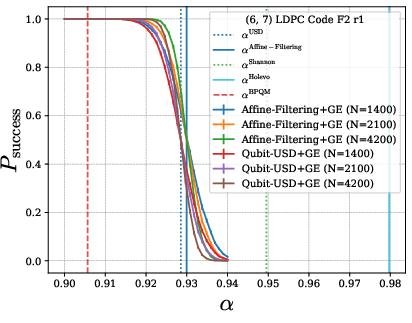
Figure 5: Direct performance contrast between affine-filtering+GE and qubit USD+GE for (6,7) regular LDPC codes.
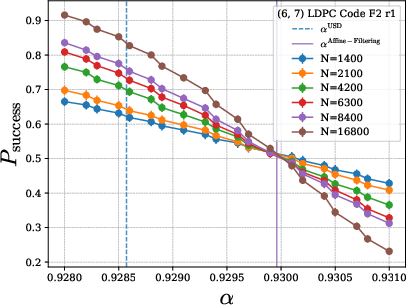
Figure 6: Threshold plot for affine-filtering+GE decoding for (6,7) regular LDPC codes, illustrating near-coincidence with theoretical optimum.

Figure 3: Performance comparison for (3,4) Regular LDPC Codes on R(V)1, showing superior performance of affine filtering+GE.

Figure 4: Performance comparison for (4,5) Regular LDPC Codes on R(V)2.
Theoretical Implications
The affine filtering measurement framework provides several analytical insights:
- Equivalence to Fine-Grained USD in the SPC Setting: The affine filtering measurement is shown to specialize to "codeword filtering" (i.e., FGUM from [shutty2026lqd]) for certain quantum state configurations, thereby unifying existing measurement paradigms.
- LP Generalizes Beyond SPCs: While SPC local codes are central, the LP applies equally well for more general (non-SPC) local codes, suggesting a broader class of structured code-aware quantum measurements.
- Connections to Quantum Algorithms for Optimization: The methods resonate with DQI [jordan2025optimization] and related lines where structured quantum measurements yield superpolynomial speedups for algebraic optimization framed in terms of decoding.
Practical Implications and Future Directions
The reduction to LP enables the practical computation of measurement operators for a wide class of local codes, making the approach highly relevant for hardware-constrained quantum receivers—especially in optical or superconducting systems where implementation of arbitrary measurements is infeasible, but group-covariant operations are tractable.
Potential future research directions stemming from this work include:
- Extension to Non-symmetric and Non-linear Codes: Adapting affine filtering to asymmetric state families or nonlinear code ensembles.
- Physical Realization: Explicit circuit compilation for affine filtering measurements, evaluating overheads in realistic experimental platforms.
- Integration with Quantum Belief Propagation: Hybridization of affine filtering and BPQM could approach quantum channel capacity under practical constraints.
- Further Applications to Quantum-Enhanced Optimization: Utilizing affine filtering measurements as subroutines in quantum algorithms for average-case optimization, lattice, and cryptographic problems.
Conclusion
This work provides a comprehensive framework for efficient quantum decoding of structured codes, grounded in the geometry of affine filtering measurements and made algorithmically tractable via analytic reduction from SDP to LP. The approach achieves strong numerical performance, surpasses existing decoders in many regimes, and establishes a general methodology for principled design of quantum measurement-based inference in code-aware contexts—profoundly impacting both quantum communication and quantum-enhanced optimization tasks.