- The paper demonstrates a real-time, feedback-controlled protocol achieving near-deterministic single-atom loading on photonic integrated circuits.
- It employs precision optical conveyor-belt transport with Raman sideband cooling to achieve subwavelength localization with ~4 nm reproducibility.
- The experiment attains high single-atom trapping fidelity and strong atom-photon coupling, paving the way for scalable quantum photonic platforms.
Near-Deterministic Single-Atom Loading on a Photonic Integrated Circuit
Overview
The integration of neutral atoms as quantum emitters with photonic integrated circuits (PICs) constitutes a significant challenge in scalable quantum-logic devices and photonic quantum information processing. The work "Near-deterministic single-atom loading on a photonic integrated circuit" (2606.07800) demonstrates a protocol for the near-deterministic delivery and trapping of single atoms at designated locations on a functional PIC, reaching strong atom-photon coupling in cavity quantum electrodynamics (QED). The approach combines precision optical conveyor-belt transport, ultra-stable feedback control, and real-time detection, achieving high probabilities for single-atom loading and facilitating scalable neutral-atom–PIC integration.
The core experimental system is a silicon-nitride microring resonator circuit, accessed with high-numerical-aperture free-space optics under vacuum. Atoms are initially cooled and guided toward the PIC using a combination of optical tweezers and a bottom-illuminated beam, which forms a one-dimensional moving optical lattice or "conveyor belt" for atom transport (Figure 1). The circuit is designed such that photonic resonance can be tuned to match atomic transitions for efficient atom-photon coupling.
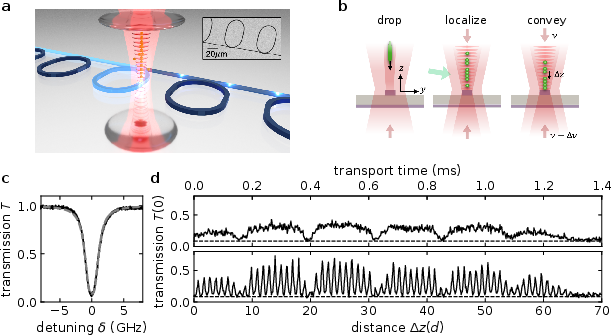
Figure 1: Conveyor-belt atom transport onto a microring resonator, with time-sequenced steps for cooling, localization, and conveyor movement. Light transmission through the resonator reveals site-resolved transparency pulses aligned with lattice positions.
Upon delivery, the atoms are cooled via degenerate Raman sideband cooling (dRSC), achieving temperatures ≲20μK, and loaded into optical lattice sites with subwavelength localization. The conveyor belt delivers the atoms with position reproducibility of ∼4 nm, and the atom-induced transparency in the microring provides a direct, site-resolved probe of atomic locations and loading.
Atom-Photon Coupling Characterization and Site-Resolved Detection
Numerical modeling and experiments reveal the evolution of the atom-cavity coupling during transport as atoms approach the microring surface (Figure 2). The resonator's transmission properties are acutely sensitive to both the number of atoms and their spatial configuration.
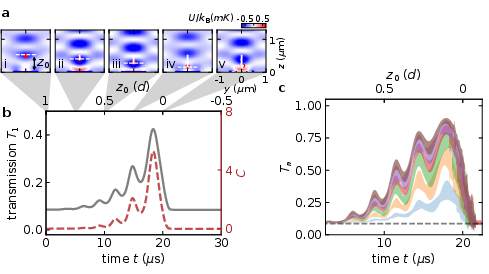
Figure 2: Simulated atom-photon coupling, atomic trajectories, concurrent time-resolved transmission for various site occupancies, and evolution of atom-cavity cooperativity during transport.
Transmission peaks correlate with atomic occupation of individual lattice sites, and the observed transmission can be fitted with a Poissonian atom-number model to extract mean site occupancy. In this experiment, a mean occupancy of $1.5$ per site is realized, with the majority of sites loaded with either one or two atoms.
High-precision reconstruction of the conveyor-belt phase enables realignment of sequential experiments, compensating for phase drifts and enabling robust, site-resolved feedback. Time-resolved detector counts demonstrate the ability to resolve arrival times and positions of atoms within 4 nm and 160 ns uncertainty (Figure 3).
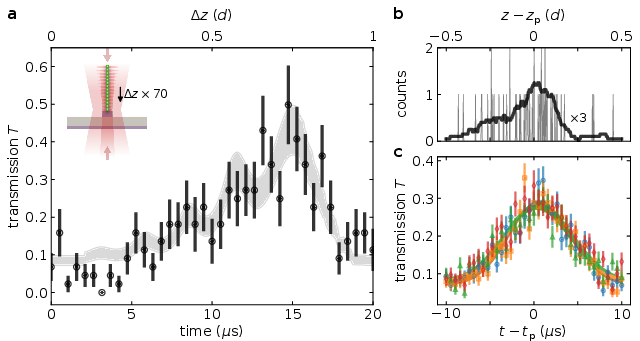
Figure 3: Site-resolved measurements of transmission, time-aligned arrival pulses, and synchronization across repetitive conveyor operations, yielding quantitative site occupancy estimates.
Feedback-Controlled Near-Deterministic Loading
A critical component for deterministic loading is the implementation of real-time feedback. An FPGA monitors atom-induced transmission using an avalanche photodiode (APD) during slow conveyor-belt operation. When the transmission exceeds a calibrated threshold, the FPGA triggers a rapid halting of the conveyor and ramps up the trapping potential, transferring the atom(s) into a stationary trap near the microring surface (Figure 4).
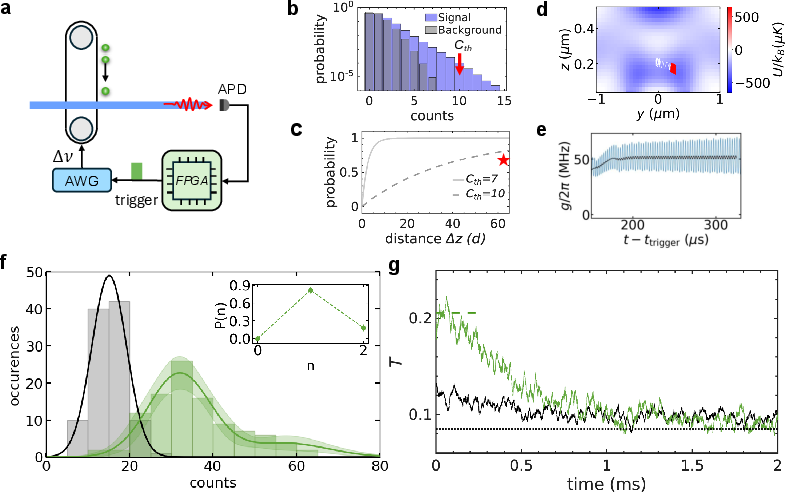
Figure 4: Schematic of FPGA-based feedback for real-time triggering, triggering statistics, simulation and measurement of atom transfer, and post-transfer count histograms—demonstrating high-fidelity single-atom trapping.
Numerical simulations and experiments jointly indicate a trap transfer success rate exceeding 97%, with single-atom (two-atom) loading probabilities of 82% (18%). The measured single atom-photon coupling rate of g=2π×48(1) MHz and cooperativity parameter C=4g2/(κΓ)≈1.04 confirm operation in the strong coupling regime. Post-transfer resonance fluorescence and Hanbury Brown–Twiss correlation measurements yield g(2)(0)<0.5 when isolated atoms are loaded, directly demonstrating single-atom occupancy.
Cooling and Trapping Techniques
The scheme employs degenerate Raman sideband cooling (dRSC) in the Lamb-Dicke regime using a 5° polarized optical pumping beam, suppressing motional heating during the transfer and yielding atoms in the lowest vibrational state (Figure 5).
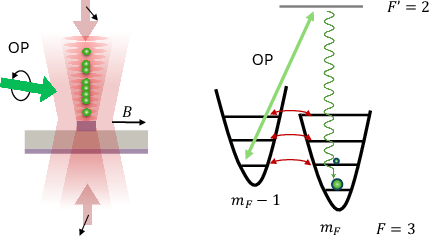
Figure 5: Diagram of the dRSC mechanism, showing the geometry for optical pumping and Raman transitions used to achieve ground-state cooling.
Trap Lifetime and Stability
The stationary trap lifetime, measured via resonance fluorescence, reaches ∼160 ms in the absence of resonant probe-induced heating (Figure 6). Even under continuous probing, trapping persists over ∼0, well-suited for deterministic gate operations and photon-mediated interactions relevant to quantum information applications.
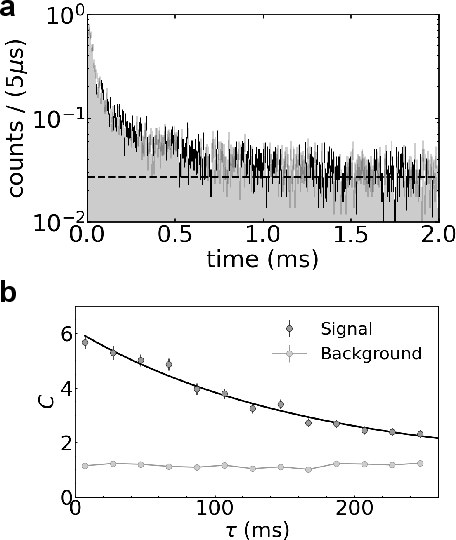
Figure 6: Resonance fluorescence decay and extraction of stationary trap lifetimes, contrasting probe-induced heating timescales and dark-storage times.
Quantum Nature of the Loaded Emitters
Photon correlation measurements confirm the quantum single-emitter regime via antibunching in the resonance fluorescence (∼1), consistent with single-atom emission and large Purcell enhancement (Figure 7).
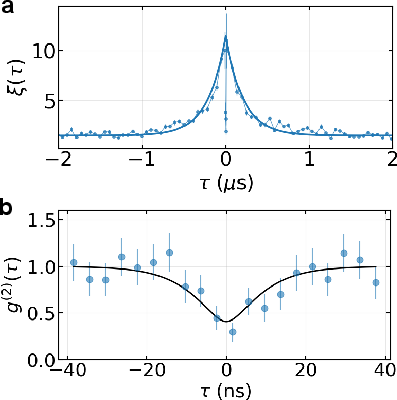
Figure 7: Cross-correlation and zero-time-delay ∼2 photon statistics, providing quantitative validation of single-particle loading and emission dynamics.
Theoretical and Practical Implications
This experimental protocol demonstrates a pathway toward deterministic, position-controlled assembly of neutral atom arrays on PICs. The approach overcomes prior limitations set by probabilistic loading in tight surface traps and opens the door to scalable integration of large atomic ensembles—a requisite for on-chip quantum networks, programmable photonic quantum logic, and many-body photonic-atom quantum simulation architectures. The demonstrated precision in site positioning and loading efficiency is also highly relevant for error-corrected photonic quantum computing requirements, where identical, controllably coupled emitters are essential.
Conclusion
This work establishes a robust and experimentally efficient methodology for near-deterministic single-atom loading onto photonic integrated circuits, achieving strong cavity QED coupling and high-fidelity site-resolved control. Real-time feedback and conveyor-based delivery circumvent both mechanical and phase-noise limitations, providing nanometer-scale spatial accuracy. Extension of these techniques to optical tweezer arrays and multi-emitter configurations will facilitate scalable, programmable quantum hardware, directly advancing the capabilities of hybrid atom–PIC technology (2606.07800).
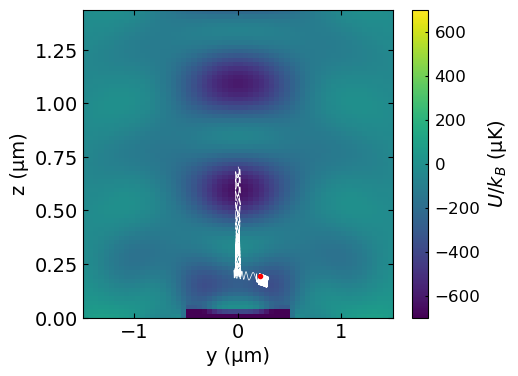
Figure 8: Simulated atomic trajectory subject to feedback-triggered trapping, visualizing the localization process within the stationary potential landscape near the PIC surface.