- The paper demonstrates a deterministic single-atom loading protocol via evanescent fields, achieving a 32% trapping probability at optimal conditions.
- It employs a novel single-stroke loading method using tailored Sisyphus cooling without requiring continuous laser feedback.
- Experimental results reveal Purcell enhancement and high cooperativity, underpinning scalable integrated quantum photonic architectures.
Single-Atom Trapping in the Evanescent Field of an Integrated Photonic Resonator
Introduction and Context
This work demonstrates deterministic trapping of a single ultracold rubidium atom in the evanescent field of a planar, CMOS-compatible silicon-nitride microring resonator at subwavelength distances (150–200 nm) from a photonic integrated circuit (PIC) surface. The primary technical challenge addressed is realizing robust atom trapping at such extreme proximity to a planar chip, thus achieving strong, near-unity coupling to the photonic guided mode, critical for scalable quantum photonic and atom-photon platforms. The solution is a novel single-stroke loading (SSL) protocol—distinct from prior nano-optical and nanophotonic hybrid approaches—that exploits a tailored evanescent Sisyphus-like cooling process to achieve efficient single-atom capture, while maintaining compatibility with planar photonic chips lacking suspended or one-dimensional topologies.
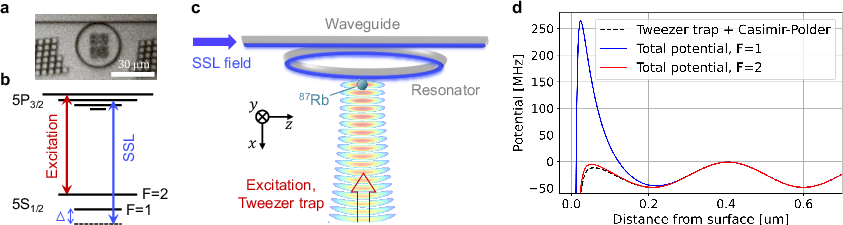
Figure 1: Schematic layout of the PIC, atomic energy-level structure, and loading sequence, illustrating the interplay between evanescent optical fields and the standing-wave tweezer trap.
Single-Stroke Loading Protocol and Experimental Implementation
The experimental sequence begins with laser-cooling 87Rb atoms in a magneto-optical trap, followed by an atomic fountain launch towards the chip. Atoms are initially in the F=1 ground state and encounter an evanescent blue-detuned optical potential—the SSL field—emanating from the microring resonator. As they approach, the atoms are decelerated in the potential landscape. A single position-dependent photon-scattering event can irreversibly project the atom into the F=2 manifold, resulting in a drastically reduced (far-detuned) light shift and a rapid drop in optical potential energy. This dissipative event enables the atom to be captured in a tightly confined standing-wave trap formed by an optical tweezer reflected from the chip. Crucially, this protocol does not require either continuous laser cooling or rapid feedback, and, unlike "sudden turn-on" methods, is efficient over a wide range of atomic kinetic energies.
The PIC is realized on a commercial silicon-nitride platform with a 30 μm ring resonator and Q-factor F∼300, supporting strong transverse-magnetic (TM) modes at 780 nm. The evanescent decay length is Λ=86 nm, providing both the repulsive "crash-cushion" for SSL and a tightly integrated interface for near-field atom-photon coupling.
Loading Efficiency and Single-Atom Statistics
To characterize atom capture, the experimenters monitor on-chip fluorescence using SNSPDs following an SSL pulse. The SSL protocol yields robust single-atom trapping signals only for blue detuning (0<Δ≤300 MHz), with a peak trapping probability of 32% per SSL attempt at 250 MHz detuning and 400 nW of input optical power. Power- and detuning-dependent loading maps exhibit an optimal regime where neither premature scattering nor surface collision dominate, in excellent agreement with semi-classical simulations.
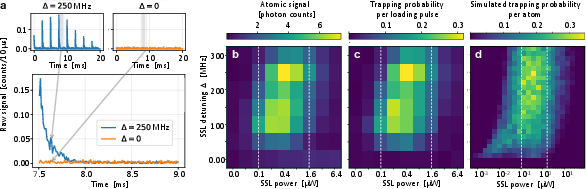
Figure 2: Trapping probability and photon count histograms as functions of SSL detuning and input power, with semi-classical simulation results overlayed.
Photon counting statistics in the trap-confirmed regime are highly non-Poissonian. The measured intensity autocorrelation g(2)(τ) yields a pronounced antibunching dip g(2)(0)=0.33±0.08, unequivocally confirming single-atom occupancy. The observed photon number distribution for trapped atoms is exponential, further consistent with a broad distribution of initial energies following SSL capture.
Atom-Resonator Coupling, Purcell Enhancement, and Trap Stability
Characterization of the atom-photon interface leverages time-resolved pulsed excitation. The excited-state decay is markedly shortened relative to free-space (16.3±0.4 ns vs 26.2 ns), corresponding to a Purcell-enhancement and a measured single-atom cooperativity of F=10 at F=11 nm. By tuning the tweezer wavelength, the atom can be trapped at varying subwavelength distances (150–200 nm), leading to a maximal measured coupling rate F=12 MHz and cooperativity F=13 at the smallest separations.
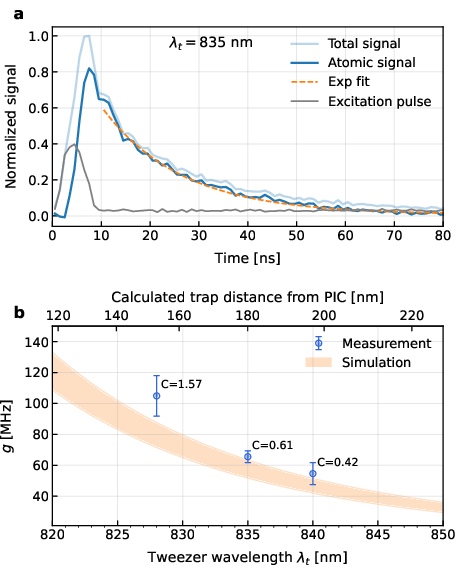
Figure 3: Measured time-resolved fluorescence and extracted Purcell-enhanced lifetimes; atomic cooperativity as a function of trap distance.
The atom-trap lifetime exhibits broad, logarithmic statistics, with rare events persisting up to 1 second. Decay kinetics are consistent with quantum tunneling loss through the chip-proximal barrier, set by the Casimir-Polder potential. Lifetime increases with trap depth and is sharply sensitive to the atom-surface separation, consistent with WKB tunneling estimates and the observed initial energy distribution.
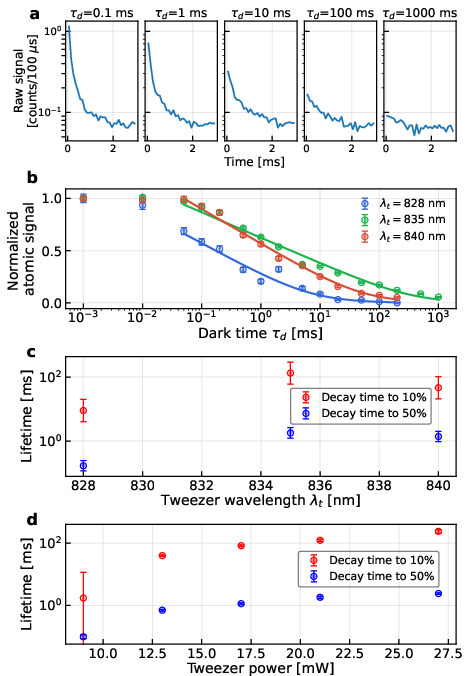
Figure 4: Trap survival probabilities as a function of dark time and tweezer wavelength, highlighting logarithmic relaxation and tunneling-induced lifetimes.
Simulations and Mechanistic Validation
Extensive semi-classical modeling supports the interpretation of SSL loading as an irreversible, efficiently dissipative process. One-dimensional simulations incorporating state-dependent potentials, photon recoil, Casimir-Polder interaction, and realistic surface and optical parameters reproduce the experimentally observed dependence of loading efficiency on detuning, power, and atomic velocity. The optimal regime yields robust capture without requiring fine-tuning of initial atomic kinetic energies—an essential criterion for scalability in photonic-integrated settings.
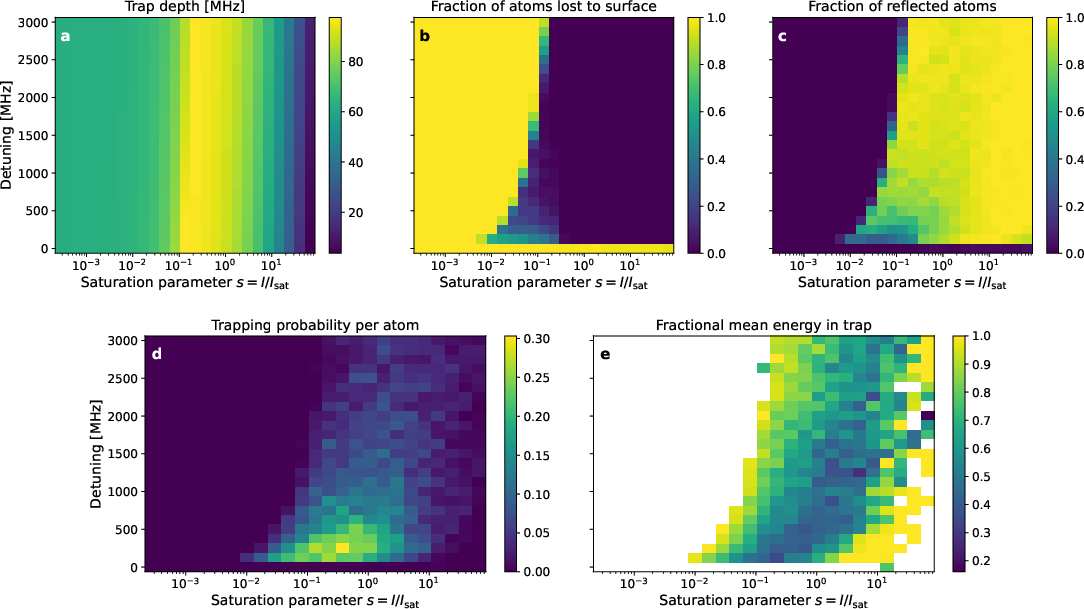
Figure 5: Semi-classical simulation of SSL: trapping efficiency as a function of detuning and intensity, with loss channels and typical potential depths.
Practical and Theoretical Implications, and Perspectives
This experiment demonstrates high-fidelity deterministic single-atom loading and high-cooperativity atom-photon interface at a chip surface, with full compatibility for photonic circuit integration and networked architectures. The single-shot capture, Purcell enhancement, and non-Poissonian quantum features (antibunching) position this platform for deterministic quantum nonlinear optics, scalable quantum gates, and modular graph-state photonics.
Improvements in chip design and fabrication (pulley-style coupling, waveguide planarization, and cross-section optimization) already yield a four-fold reduction in intrinsic loss, with further prospects for reduced sidewall scattering (via next-generation lithography) and photonic crystal-mode engineering. Achieving F=14 is technically feasible, reaching the regime for error-corrected photonic logical operations with threshold-exceeding fidelity.
From a theoretical perspective, the demonstrated insensitivity of SSL capture to velocity and its robustness to surface-induced heating mechanisms enables practical single-atom deterministic loading—a long-standing challenge for miniaturized atom-photon platforms. Logarithmic trap lifetime statistics represent a new dynamical regime in nano-photonic atom trapping, governed by a distribution of initial energies and tunneling rates, and may bear implications for developing quantum memories and studying near-field surface interactions.
Conclusion
The work establishes a robust, efficient, and chip-compatible protocol for trapping and interfacing single atoms at subwavelength proximity to planar photonic integrated circuits. The results provide a foundation for scalable quantum photonic architectures by directly addressing the central challenges posed by strong atom–photon coupling, deterministic single-atom control, and technical compatibility with large-scale integrated photonics. The demonstrated protocol, together with improvements in PIC platforms, paves the way towards deterministic logic operations, photonic quantum networks, and fault-tolerant quantum information processing using hybrid atom–photon systems.
(2605.09532)