- The paper presents the first complete JWST/MIRI F1500W secondary eclipse dataset, establishing a fiducial eclipse depth of 118 ± 22 ppm for GJ 3929 b.
- It applies Frame-Normalized Principal Component Analysis to effectively mitigate instrumental systematics, outperforming traditional polynomial detrending methods.
- The study reveals that while GJ 3929 b likely lacks a thick secondary atmosphere, it cannot fully exclude the presence of a thin atmosphere.
GJ 3929 b as the First Complete Rocky Worlds DDT Data Set
Introduction and Scientific Motivation
This study leverages the first complete four-visit JWST/MIRI F1500W secondary eclipse dataset from the Rocky Worlds Director’s Discretionary Time (DDT) survey, critically advancing the population-level characterization of close-in rocky exoplanets around M dwarfs. Determining the atmospheric retention of such planets, particularly in the K and M dwarf regime, is central to testing the empirical "cosmic shoreline" hypothesis, which postulates a boundary in incident flux–escape velocity space separating atmosphere-hosting from atmosphere-stripped rocky worlds. The system, GJ 3929 b, is a warm, Earth-sized exoplanet orbiting the M3.5V star GJ 3929, with parameters (Mp=1.75−0.45+0.44M⊕, Rp=1.09±0.04R⊕, instellation 17.3±0.7 S⊕). Prior radial velocity and transit analyses suggested that it lies in the region of parameter space where atmospheric retention is uncertain.
Observations, Data Reduction, and Detrending Methodology
The JWST/MIRI F1500W secondary-eclipse observations span four visits with a total of five time-series (visit 4 split due to scheduling). The raw photometric sequences display significant instrumental systematics, dominated by a multi-hour detector settling "ramp", discontinuities from splitting, and transient events—necessitating advanced detrending strategies beyond polynomial fitting.
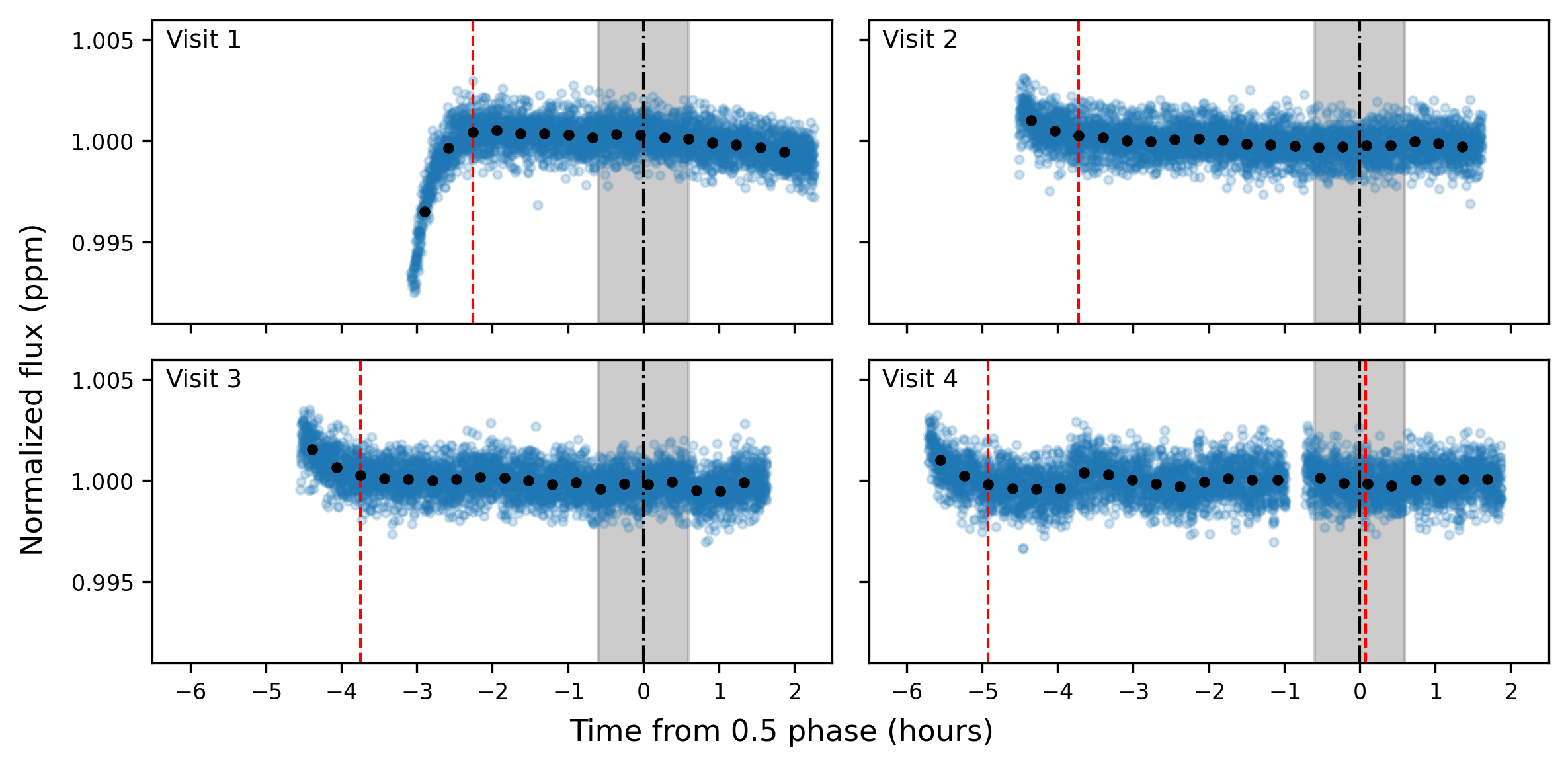
Figure 1: Raw MIRI F1500W light curves for the four GJ\,3929\,b eclipse visits, highlighting sharp settling ramps, discontinuity in visit 4, and systematic deviations coinciding with anomalous instrument or spacecraft events.
The pipeline employs Frame-Normalized Principal Component Analysis (FN-PCA) to decompose pixel/time-series into orthogonal components, limiting the influence of spatially correlated systematics. A critical technical refinement is trimming the initial 500–1500 integrations to remove the non-linear, aperture-dependent detector settling ramp—particularly acute in visit 1 and parts of visit 4.
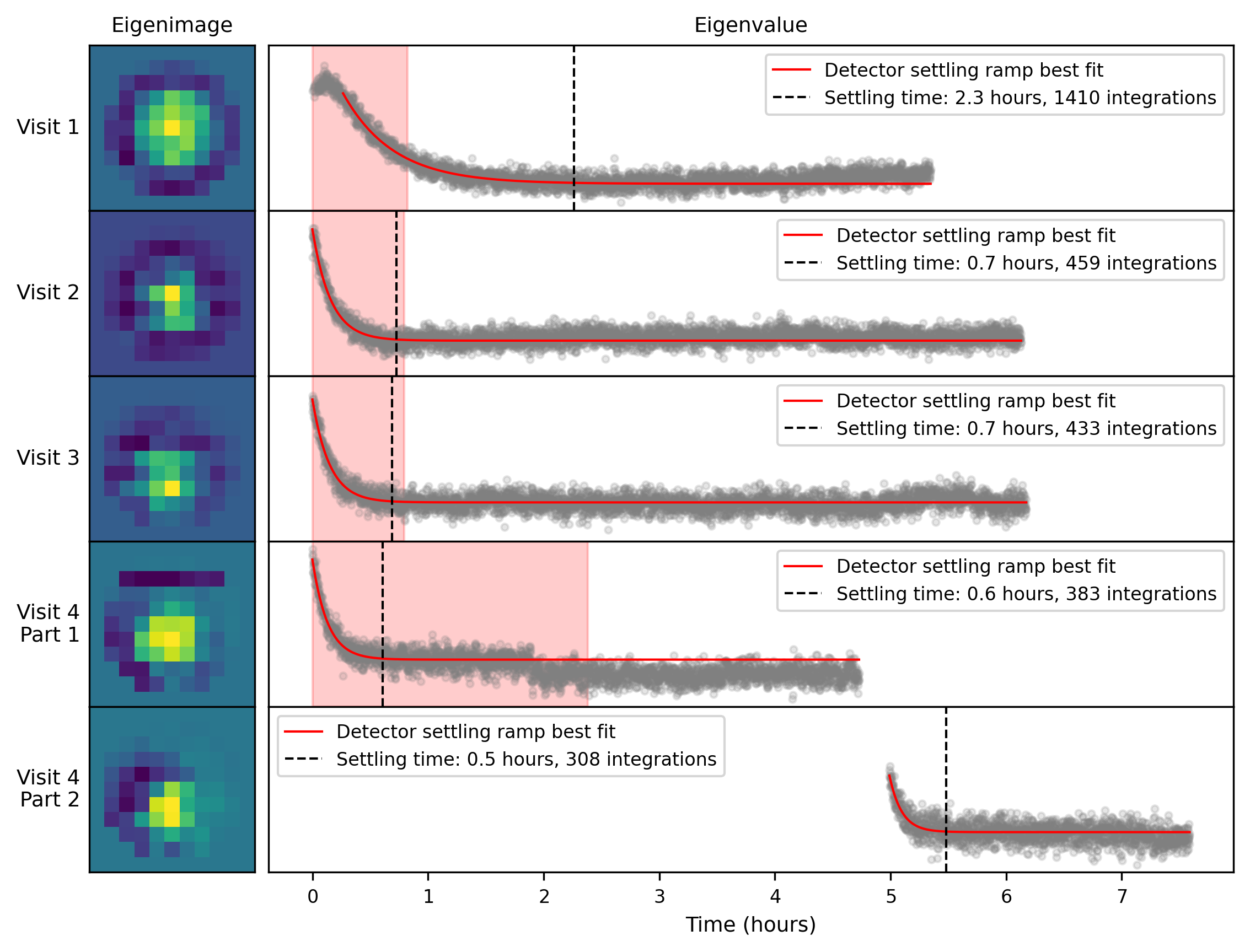
Figure 2: FN-PCA eigenimages and eigenvalue time series for detector-settling-dominated principal components, illustrating both trimming boundaries and transient features degenerately affecting traditional ramp-exponential models.
Markov Chain Monte Carlo modelling, with robust prior incorporation from previous RV and transit studies, underpins both individual and phase-folded joint fits, with systematic and astrophysical parameters modeled simultaneously. Eclipse timing is allowed to float within the constraints of orbital solutions to accommodate potential eccentricity-induced offsets.
Eclipse Depth Results and Variability
The FN-PCA-based joint analysis yields a fiducial eclipse depth of 118±22 ppm, corresponding to a dayside brightness temperature of 641−64+59 K, and places the measured eclipse center 51±2.4 minutes earlier than mid-orbit phase—implying significant ecosω.
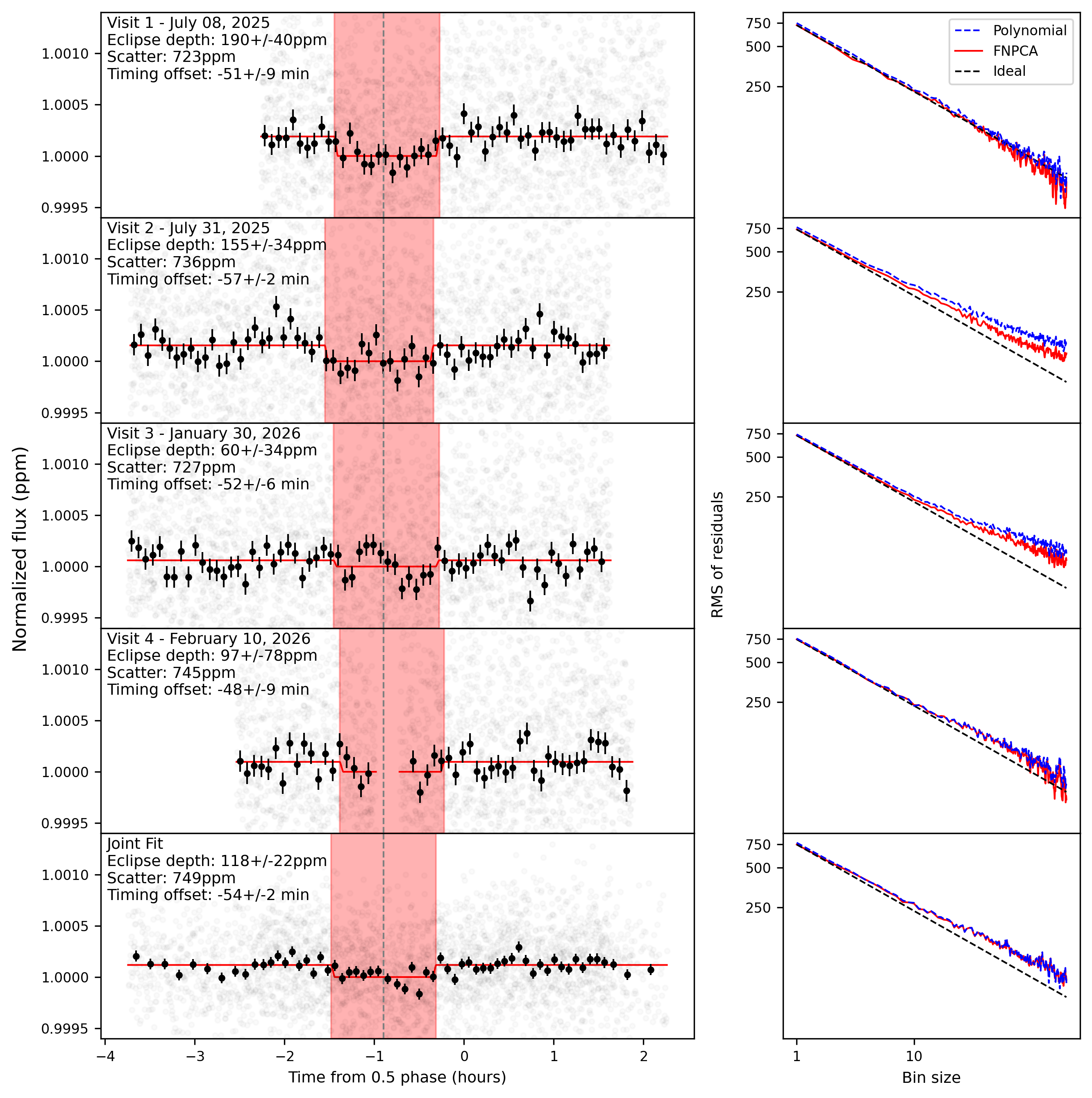
Figure 3: Detrended light curves and joint fit results, with individual visit fits exhibiting substantial scatter (60–190 ppm range), and the global joint-fit solution at 118±22 ppm.
Comparison with previous partial data analyses (first two visits only) shows that the inclusion of additional visits slightly reduces both the mean eclipse depth and the confidence in ruling out atmospheric scenarios. Individual visit-to-visit eclipse depths vary at the 2.5σ level, reminiscent of variability seen in prior LHS 1478 b and 55 Cnc e studies.
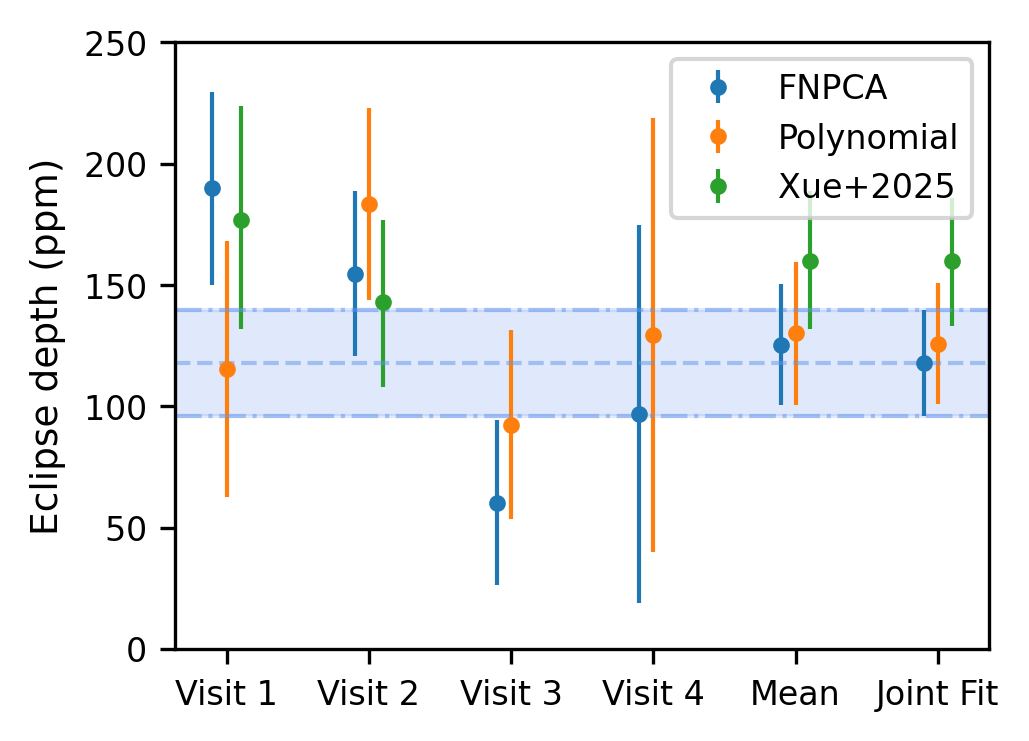
Figure 4: Comparison of FN-PCA vs. polynomial detrending results across visits, with previous preliminary analyses overlaid. The FN-PCA approach achieves more consistent results with reduced systematic scatter.
Instrumental Systematics: Settling, Aperture Effects, and Pre-Observation Protocols
Instrumental systematics, especially the detector settling ramp, are analyzed quantitatively in the FN-PCA framework. Measured settling times (0.5–2.3 hr, visit-dependent) broadly follow empirical trends derived from MIRI observations of similar-magnitude targets, except for visit 1, which deviates due to reduced pre-flash dwell time in calibration filter P750L.
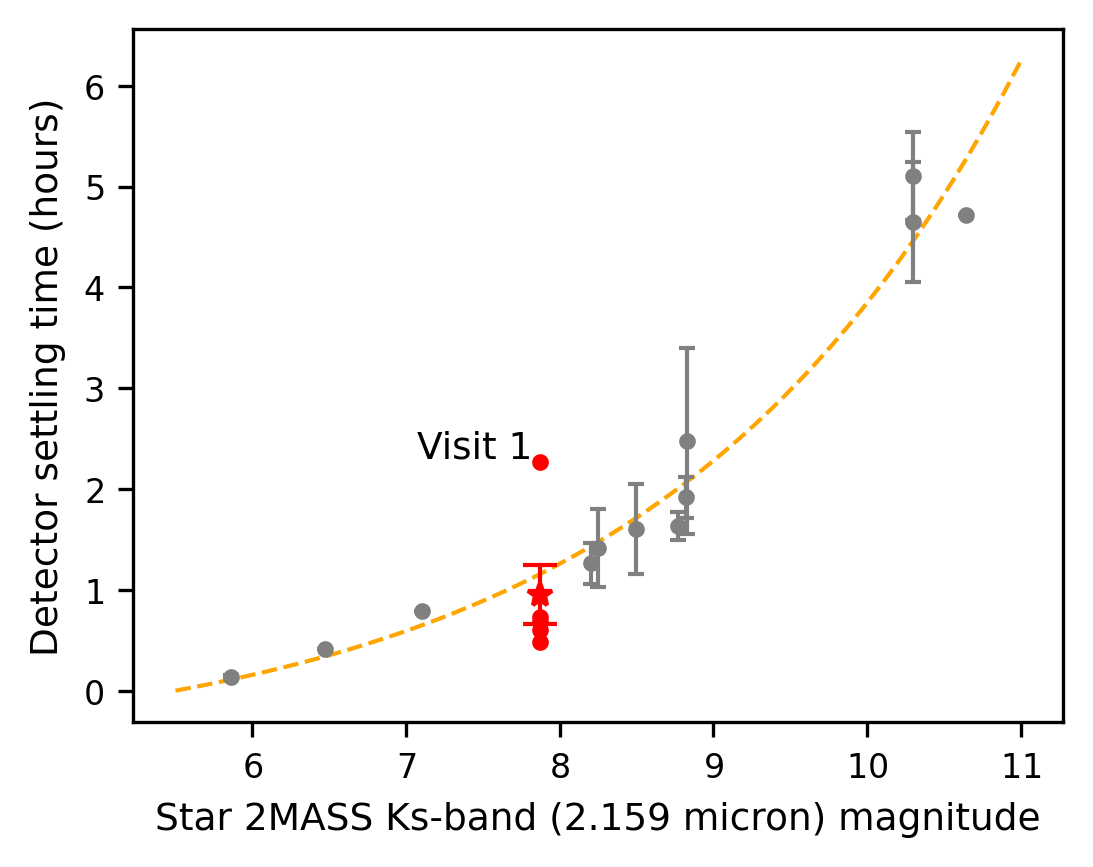
Figure 5: Detector settling times for each observation mapped against empirical magnitude settling trends, underscoring the anomalous behavior of visit 1.
Aperture photometry choices significantly influence measured eclipse depth, particularly for polynomial detrending, where the depth declines monotonically with increasing aperture size. The FN-PCA method minimizes this bias, with depths relatively stable across plausible apertures for radii ≥5 px.
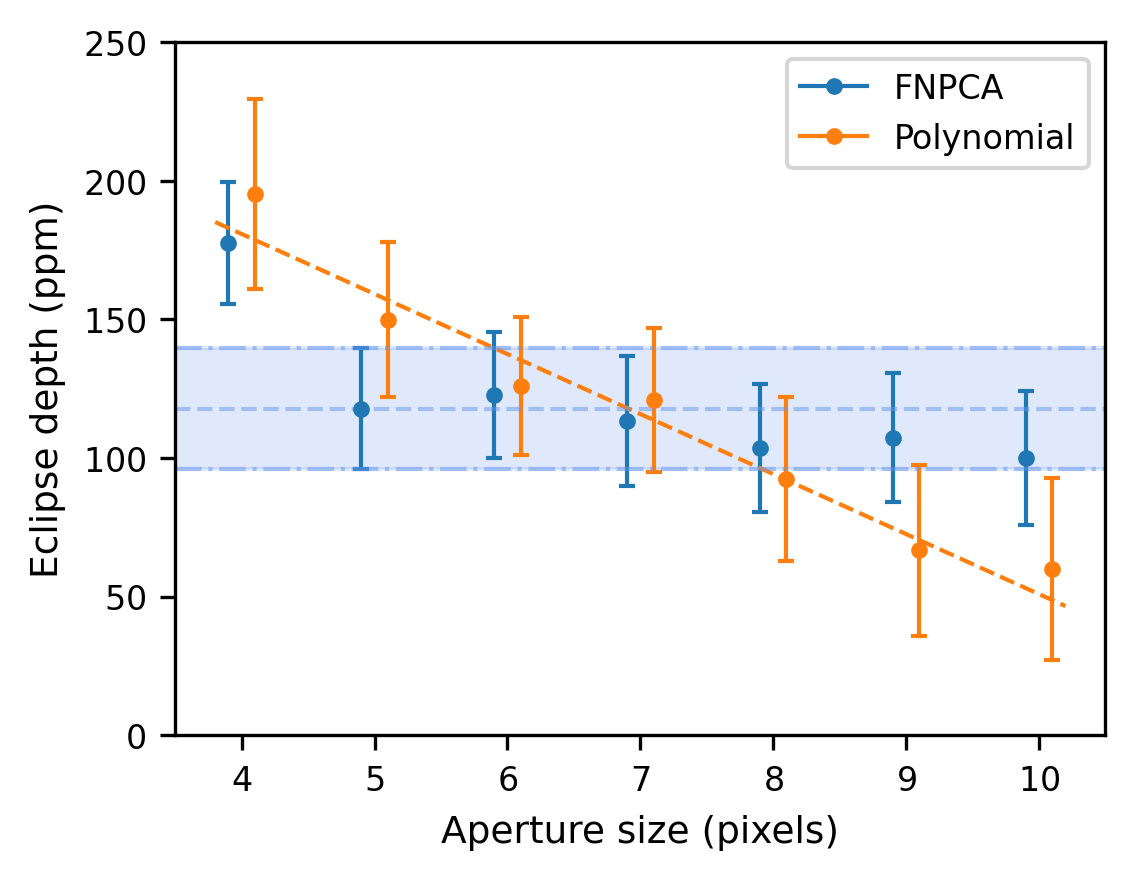
Figure 6: Eclipse depth dependence on aperture size for both detrending methods, demonstrating strong robustness for FN-PCA and pronounced instability in polynomial fits.
Additionally, the observatory employed "pre-flash" experiments using the P750L filter before each science sequence to condition the detector, with the time spent in this state correlating with ramp severity and overall light curve stability.
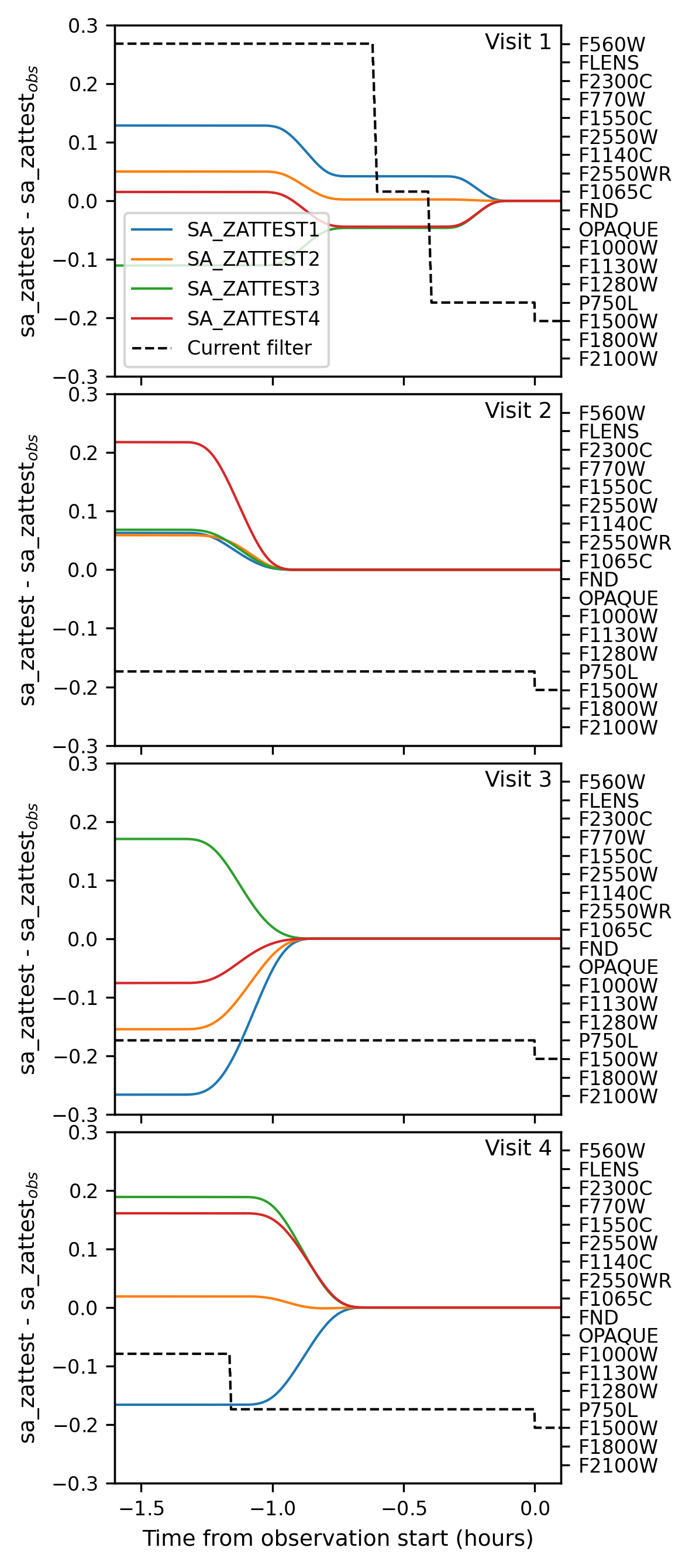
Figure 7: Spacecraft engineering mnemonics for the four visits reveal visit 1’s anomalously short pre-flash period, explaining its dominant ramp and reduced data quality.
Atmospheric and Surface Composition Inferences
The measured eclipse depth is interpreted through detailed forward models using SCARLET (atmospheres) and JESTER (bare rocks) frameworks, incorporating the latest laboratory and theoretical opacities. Models span bare rock surfaces (variable albedo/composition), thin CORp=1.09±0.04R⊕0-ORp=1.09±0.04R⊕1 atmospheres with incomplete heat redistribution, and thick CORp=1.09±0.04R⊕2-dominated cases with full redistribution.
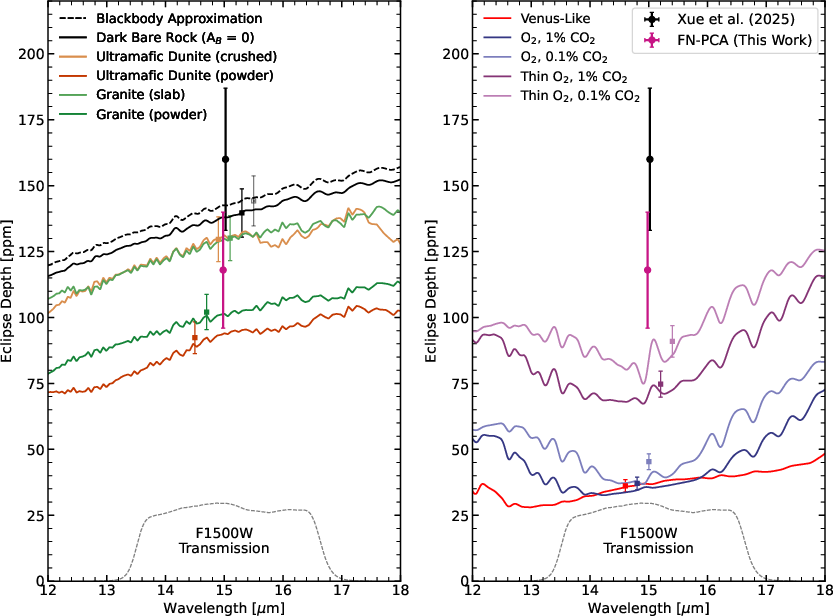
Figure 8: Simulated emission spectra for an array of surface and atmospheric scenarios overlay the measured eclipse depths. The observational error band overlaps both high-albedo bare rock and thin-atmosphere models.
The measured depth is fully consistent with a bare-rock, moderate-albedo surface but cannot exclude thin (Rp=1.09±0.04R⊕3 30 mbar) atmospheres at high confidence. Only thick (100 mbar level) CORp=1.09±0.04R⊕4-dominated atmospheres with strong redistribution are ruled out at Rp=1.09±0.04R⊕5.
Planetary Context on the Cosmic Shoreline
Placing GJ 3929 b in the broader context of M-dwarf rocky planet atmospheric retention, the paper corroborates the empirical cosmic shoreline: planets below the predicted escape velocity vs. irradiation threshold do not exhibit thick atmospheres, matching the trend from recent MIRI observations of TRAPPIST-1 b/c, LHS 1140 c, TOI-1468 b, and others.
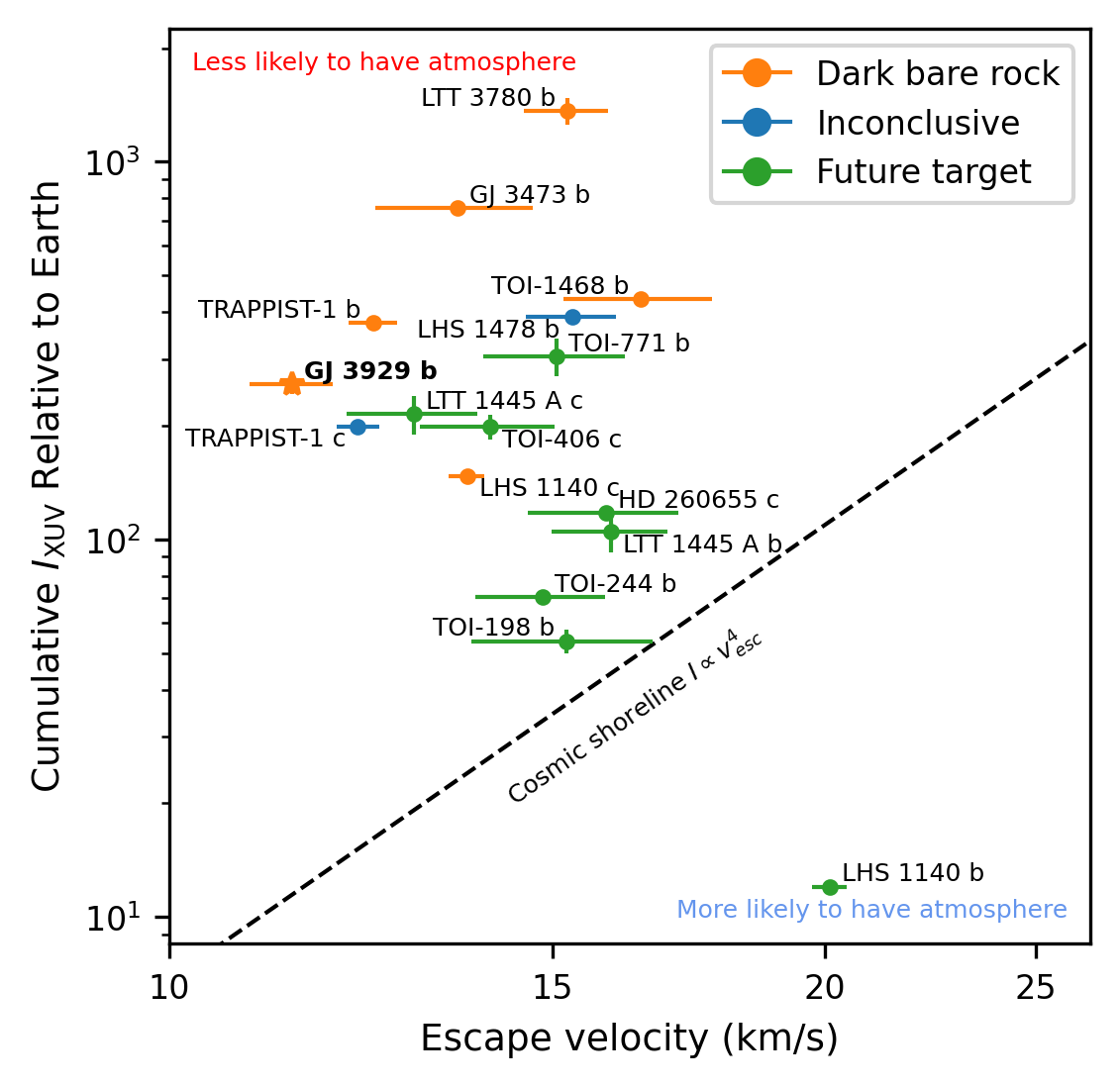
Figure 9: Location of GJ 3929 b in cosmic shoreline parameter space alongside other MIRI-observed rocky exoplanets. The planet lies in a regime where atmospheric escape is expected to dominate, matching its observationally inferred bare-rock status.
Technical and Methodological Implications
This analysis sharply highlights:
- The crucial importance of robust, physically-motivated systematics correction (FN-PCA) for high-precision eclipse photometry. Simple polynomial models are systematically aperture-biased, potentially producing misleading compositional inferences.
- The inadequacy of single-band eclipse photometry for unambiguously ruling out thin atmospheres or constraining detailed surface composition given current SNR and degeneracy with albedo.
- The limitation introduced by both instrumental scheduling (gaps/discontinuities) and incomplete stabilization of the detector in highly precise time-series work.
- The necessity for complementary phase curve, transmission spectroscopy, or multi-band emission data—without which atmospheric retrieval will remain degenerate for many high-albedo bare rock vs. thin-atmosphere cases.
Conclusion
GJ 3929 b, as the initial complete dataset from the Rocky Worlds DDT program, exemplifies the observational, methodological, and astrophysical challenges of exoplanet atmosphere detection at the sub-100 ppm eclipse depth regime. The results confirm that high-side escape boundary planets predominantly lack thick secondary atmospheres, in line with theoretical predictions for atmospheric loss. However, distinguishing high-albedo bare rocks from thin atmospheres remains nontrivial with single-band eclipse photometry alone.
The study sets a methodological precedent for future JWST/MIRI analyses, with FN-PCA established as the preferred approach to mitigating complex, aperture/cadence/systematically-varying detector systematics in ultra-precise secondary eclipse time series. The observed variability between visits, potentially arising from both instrumental and astrophysical effects, underscores the value of multi-epoch datasets to assess both data reduction robustness and possible intrinsic exoplanet variability. As further data from the DDT program and other cycle allocations accrue, coordinated, cross-pipeline analyses will be essential to standardize statistical and systematic uncertainty across the nascent field of terrestrial exoplanet atmospheric retrieval.