- The paper introduces a two-stage zero-shot pipeline that generates synthetic production history from metadata and meteorological data for cold-start PV forecasting.
- The proposed OPAQUE generator, a deterministic physics-based model, achieves fidelity comparable to the established PVGIS model across diverse climates.
- The study benchmarks multiple time-series foundation models, showing that covariate-aware architectures outperform classical baselines in various feedback regimes.
Physics-Informed Synthetic Context Enables Zero-Shot Cold-Start PV Forecasting
Problem Formulation and Cold-Start Context Construction
The paper "Time series Foundation Models based on Physics-Informed Synthetic Histories for Cold-Start Photovoltaic Forecasting" (2606.07457) addresses the operational challenge posed by cold-start forecasting in distributed photovoltaic (PV) assets. At commissioning time, PV operators must forecast production without target-site historical observations, precluding data-driven supervised approaches. The proposed solution is a two-stage, zero-shot pipeline: a synthetic production history is generated from plant metadata and meteorological covariates, supplying temporal context to downstream time-series foundation models (TSFMs) for inference-time conditioning.
The pipeline is schematized as follows:
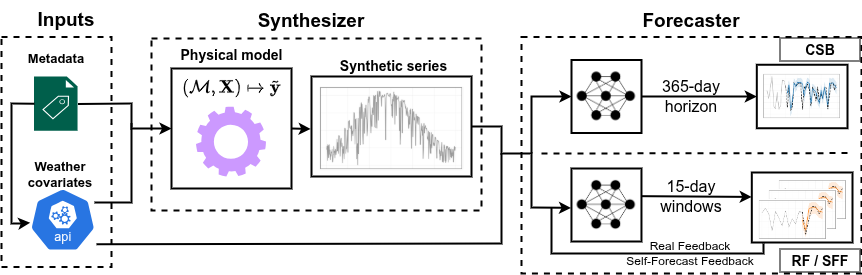
Figure 1: Synthetic history generation and forecasting pipeline: metadata and meteorological covariates are transformed into a site-specific surrogate production history, which anchors the TSFM.
Two synthetic-history generators are compared: PVGIS, an established satellite-informed modeling chain, and OPAQUE, a deterministic physics-based, satellite-free generator introduced in this work. Both provide capacity-normalized daily PV yield, capturing climatological seasonality and site-specific metadata-driven scaling. OPAQUE’s architecture and physics chain are detailed in the following figure:
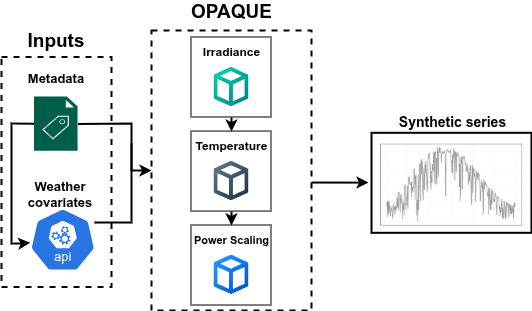
Figure 2: OPAQUE generator: sequential stages from meteorological input, irradiance transposition, thermal derating, and DC-AC conversion yield synthetic yield.
OPAQUE achieves fidelity comparable to PVGIS across diverse climates, as evidenced by cohort-level WAPE and MAE results:
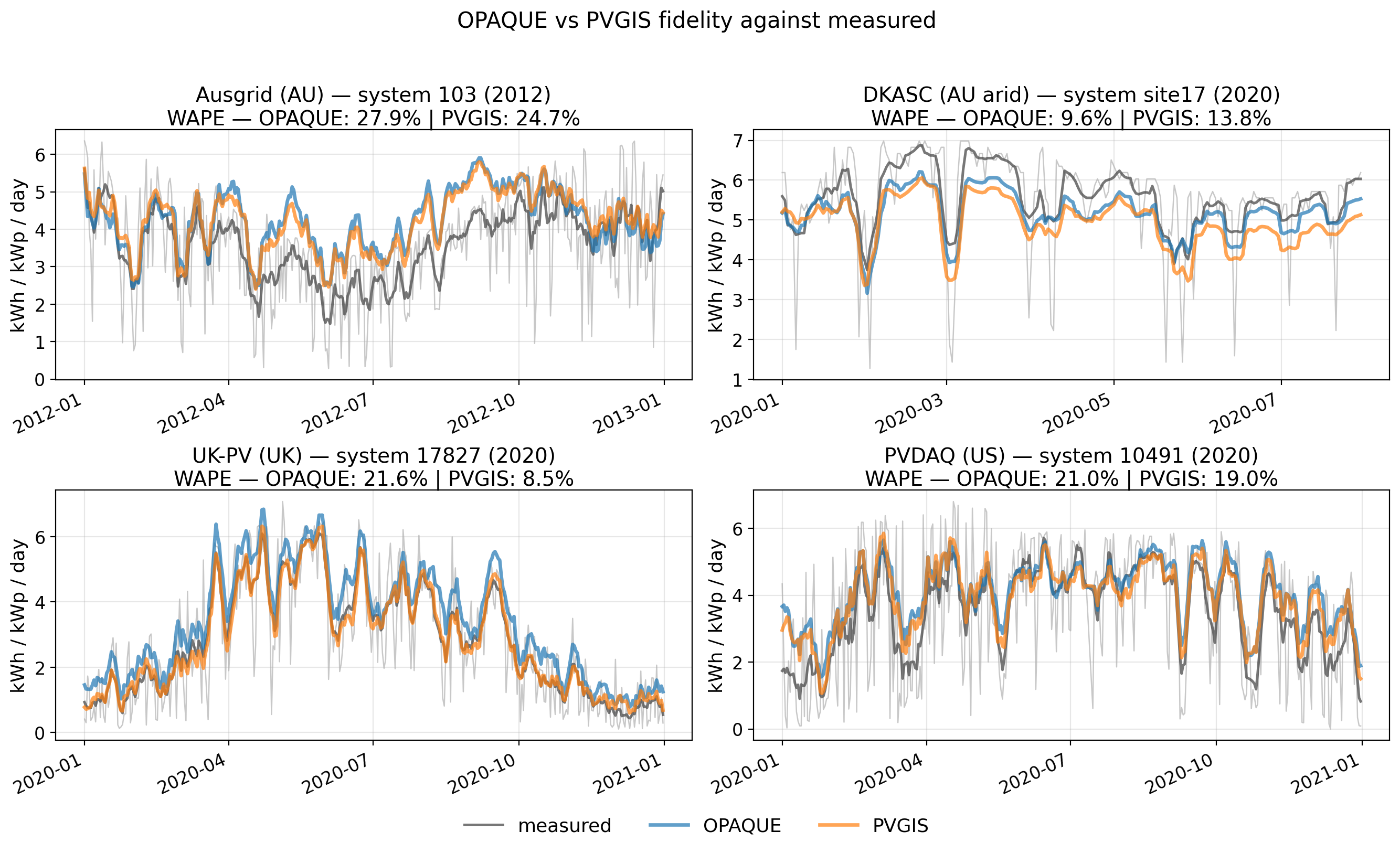
Figure 3: OPAQUE and PVGIS median-WAPE traces over measured production; both match annual seasonality, with OPAQUE within a few percent of PVGIS without satellite input.
Benchmarking TSFMs: Architecture and Covariate Regimes
Five TSFMs (Chronos-2, Moirai 2.0, TimesFM 2.5, TiRex, TabPFN-TS) are evaluated alongside classical baselines (naive, seasonal-naive, Prophet). The TSFMs differ in their handling of covariates and static metadata: Chronos-2 and TabPFN-TS perform joint target-covariate modeling; TimesFM 2.5 uses an auxiliary regressor; Moirai 2.0 and TiRex are strictly univariate. All foundation models operate strictly in a zero-shot regime—no per-site or per-cohort training, only inference-time conditioning.
Evaluation Framework: Context Strategies
Three context strategies probe the models under varying information regimes:
- Cold-Start Baseline (CSB): Models are conditioned solely on synthetic history; no measured production is ever provided.
- Real Feedback (RF): Observed production becomes available during the evaluation year, augmenting context progressively.
- Self-Forecast Feedback (SFF): Only model-generated forecasts are recursively fed back as context; no measured data.
This structure enables precise breakdown of TSFM robustness under strict cold-start (CSB), semi-supervised autoregressive feedback (SFF), and post-commissioning (RF) settings. Daily traces for each strategy illustrate performance envelopes, as shown below for Chronos-2:
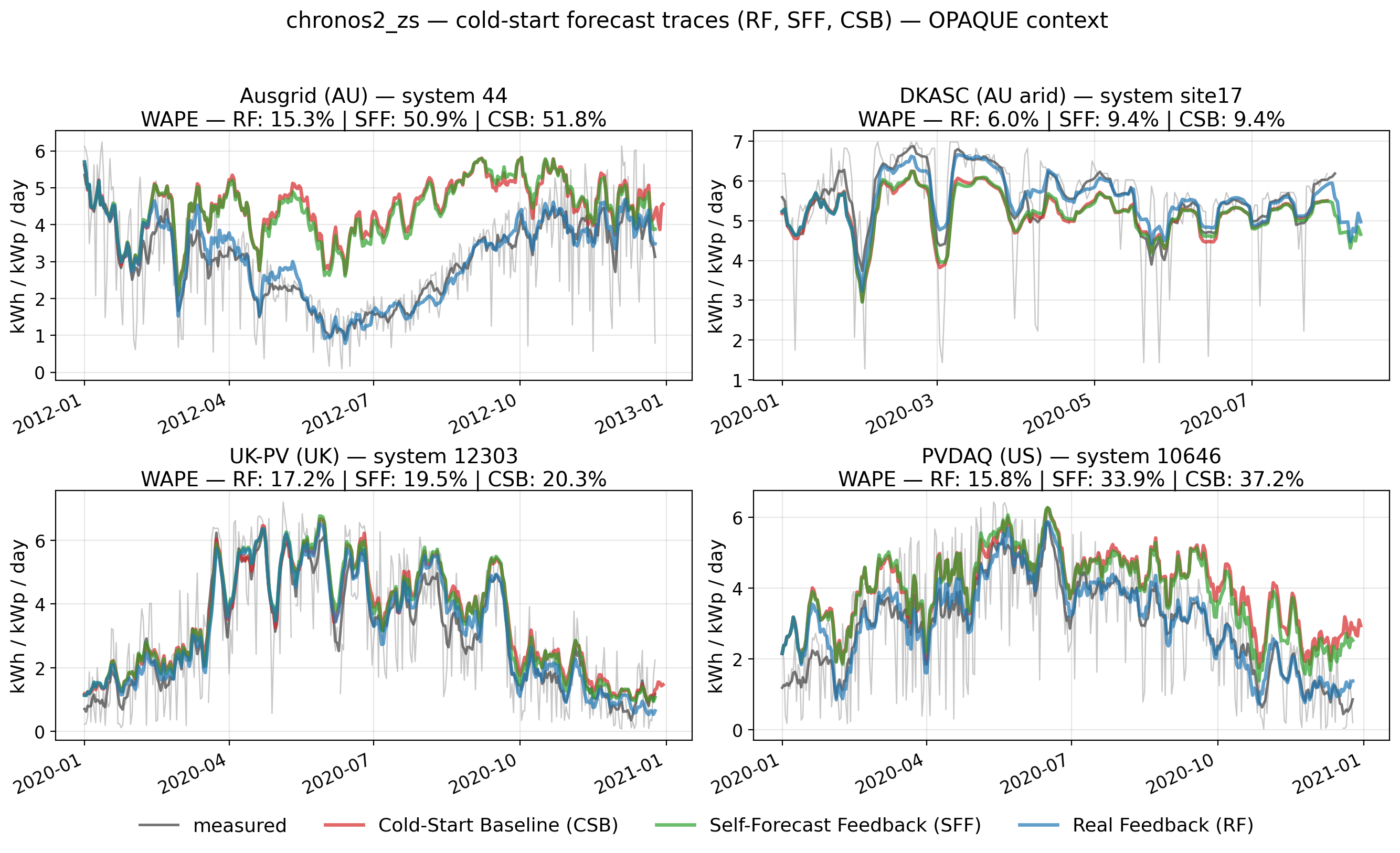
Figure 4: Chronos-2 daily traces on OPAQUE context: RF tracks measured seasonality; SFF/CSB revert toward synthetic mean.
Quantitative Results: Error Metrics and Leaderboard
The evaluation covers 440 PV sites across four continents, with MAE, RMSE, and dimensionless WAPE as primary metrics. All results are capacity-normalized for comparability.
Strong numerical results:
- Under Real Feedback, foundation models (TabPFN-TS, Chronos-2, TimesFM 2.5) achieve 1.7–2× lower error than Prophet (TabPFN-TS: MAE 0.514, RMSE 0.721 OPAQUE; Prophet: MAE 1.006, RMSE 1.221 OPAQUE). Architectures with covariate-awareness are dominant in this regime.
- Under Strict CSB, Prophet leads marginally on OPAQUE (MAE 1.006, RMSE 1.221), whereas Chronos-2 leads on PVGIS (MAE 0.907, RMSE 1.114).
- Under SFF, Chronos-2 achieves the lowest error and demonstrates superior robustness to recursive conditioning bias; Moirai 2.0 exhibits minimal autoregressive penalty relative to competing TSFMs.
Representative traces for TabPFN-TS in CSB corroborate its stability:
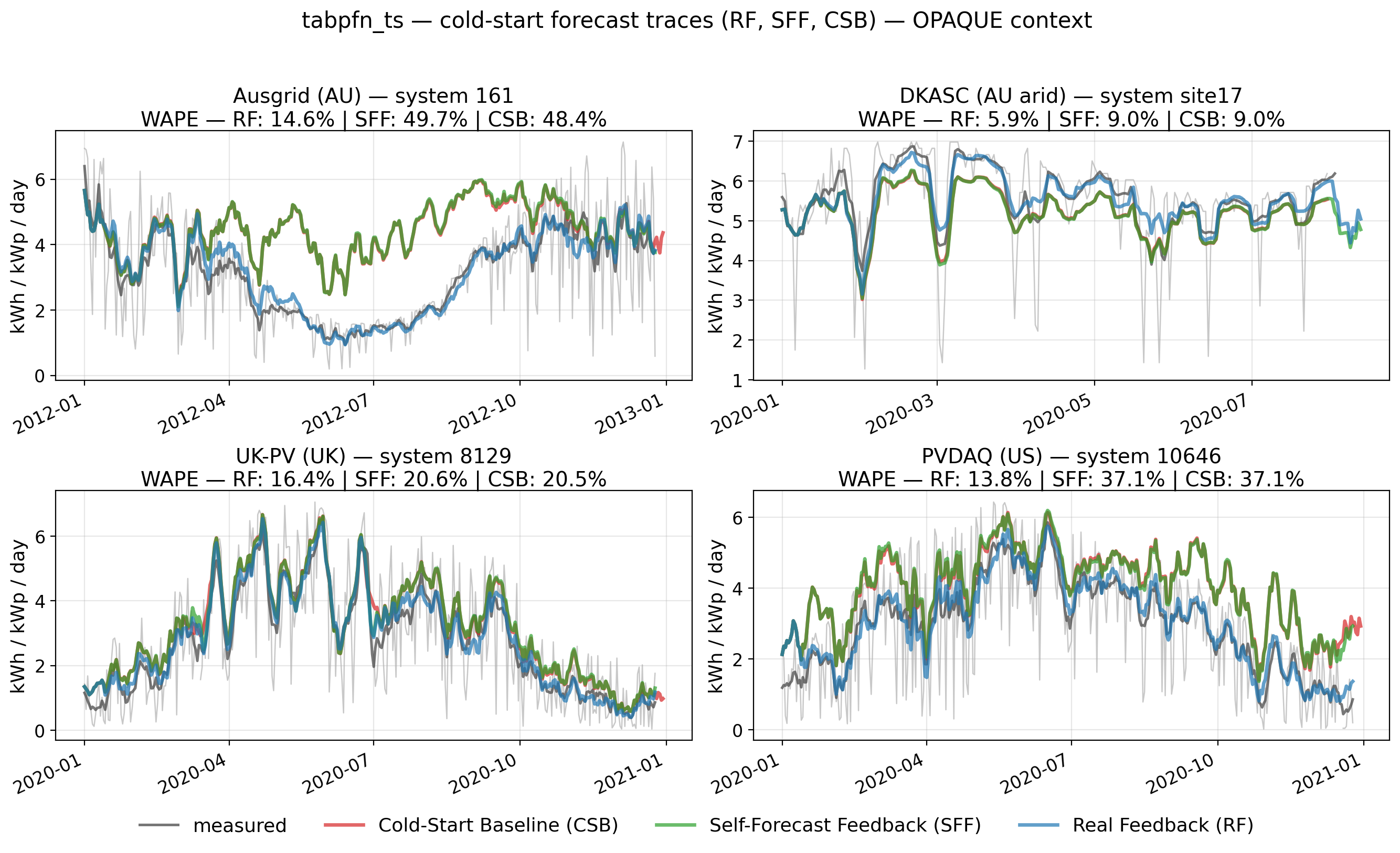
Figure 5: TabPFN-TS trace under OPAQUE context in CSB: model prediction stays closest to measured envelope among TSFMs.
Robustness and Covariate Consumption
Performance is largely insensitive to the synthetic history source; all foundation models respond primarily to the presence of plausible temporal context, not to the fine-grained fidelity of the generator. Cohort-level errors remain stable within a few percentage points when switching from OPAQUE to PVGIS.
Architectural distinctions in covariate consumption are pronounced:
- Multivariate joint modeling (Chronos-2, TabPFN-TS): Greatest adaptability and lowest errors under feedback strategies.
- Univariate-only (TiRex, Moirai 2.0): Best stability in strict zero-context regimes; TiRex is most vulnerable to autoregressive drift.
- Auxiliary regression (TimesFM 2.5): Intermediate robustness; leverages horizon covariates but is less sensitive to target context.
Daily traces in feedback regimes evidence seasonality tracking and response to context distribution shift:
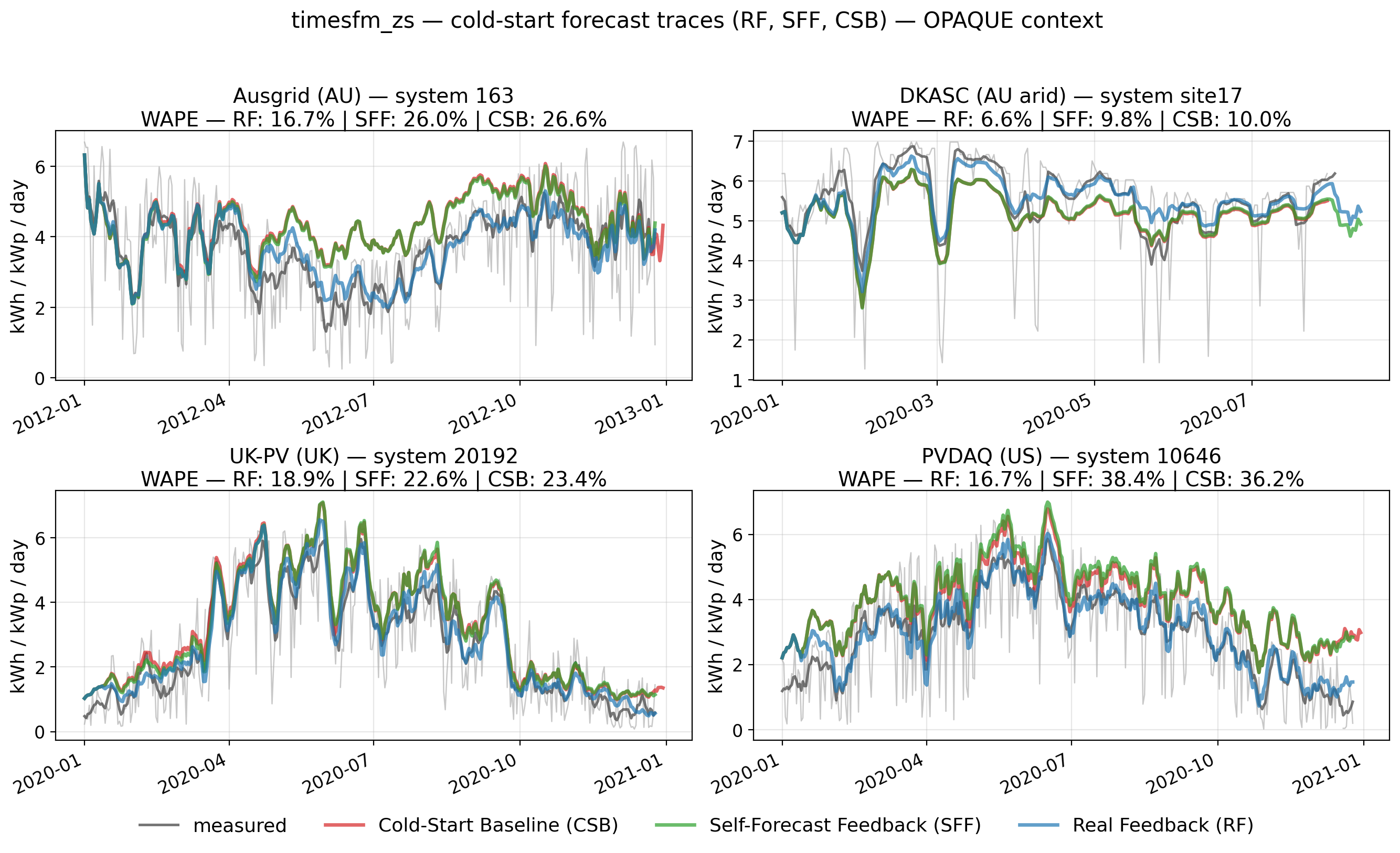
Figure 6: TimesFM 2.5 forecast under OPAQUE context: causal decoder retains seasonal envelope with horizon covariates.
Implications and Future Directions
This work establishes that physics-informed synthetic histories enable high-fidelity zero-shot forecasting for distributed PV assets, bypassing reliance on target-site real telemetry or expensive satellite streams. Foundation models with rich covariate support can generalize across diverse climates and asset classes under cold-start conditions.
Practical implications include scalable grid integration and asset management for newly commissioned PV sites, with immediate forecasting capability.
Theoretical implications suggest that the utility ceiling in strict zero-shot regimes is governed by the information content of the synthetic temporal context, not by generator accuracy, and that covariate-aware TSFM architectures are superior for heterogeneous asset cohorts.
Future research directions include:
- Synthetic-data-driven fine-tuning to extend zero-shot generalization and mitigate generator-induced bias.
- Assessment of TSFM robustness under noisier, lower-fidelity meteorological covariates representative of operational weather forecast inputs.
- Exploration of hybrid architectures blending physical generators, foundation models, and dynamic transfer learning.
Conclusion
In conclusion, physics-based synthetic histories are sufficient for providing temporal context to time-series foundation models in cold-start PV forecasting. Covariate-aware TSFMs decisively outperform classical baselines and univariate architectures. The error is largely robust to generator choice, emphasizing the role of plausible context over precise surrogate fidelity. These findings support practical, scalable deployment of zero-shot foundation model forecasting in distributed energy systems, and motivate continued advances in foundation model adaptation for operational time-series forecasting.