- The paper introduces a human-inspired taxonomy ('watch, remember, reason') that reorganizes video MLLM design around perception, memory, and inference.
- It details diverse methodologies including fine-grained visual evidence acquisition, adaptive memory modeling, and grounded reasoning to enhance accuracy and reduce hallucinations.
- The findings emphasize practical tradeoffs and system innovations such as agentic pipelines and efficient memory control for scalable, long-form video analysis.
Watch, Remember, Reason: A Functional Taxonomy for MLLM-Based Video Understanding
Abstract and Survey Scope
"Watch, Remember, Reason: Human-View Video Understanding with MLLMs" (2606.07433) offers a systematic survey centered around a human-inspired functional taxonomy for multimodal LLM (MLLM) video understanding. It reframes the design and analysis of video MLLMs along three core axes—perception ("watch"), memory ("remember"), and inference ("reason")—thereby structuring a diverse landscape of contemporary techniques, data organization, and evaluation for scalable, efficient, and evidence-grounded video intelligence. The work addresses key issues in handling long, multimodal, and knowledge-intensive video scenarios, ranging from query-aware evidence selection to streaming inference, grounded reasoning, and domain-specific applications.
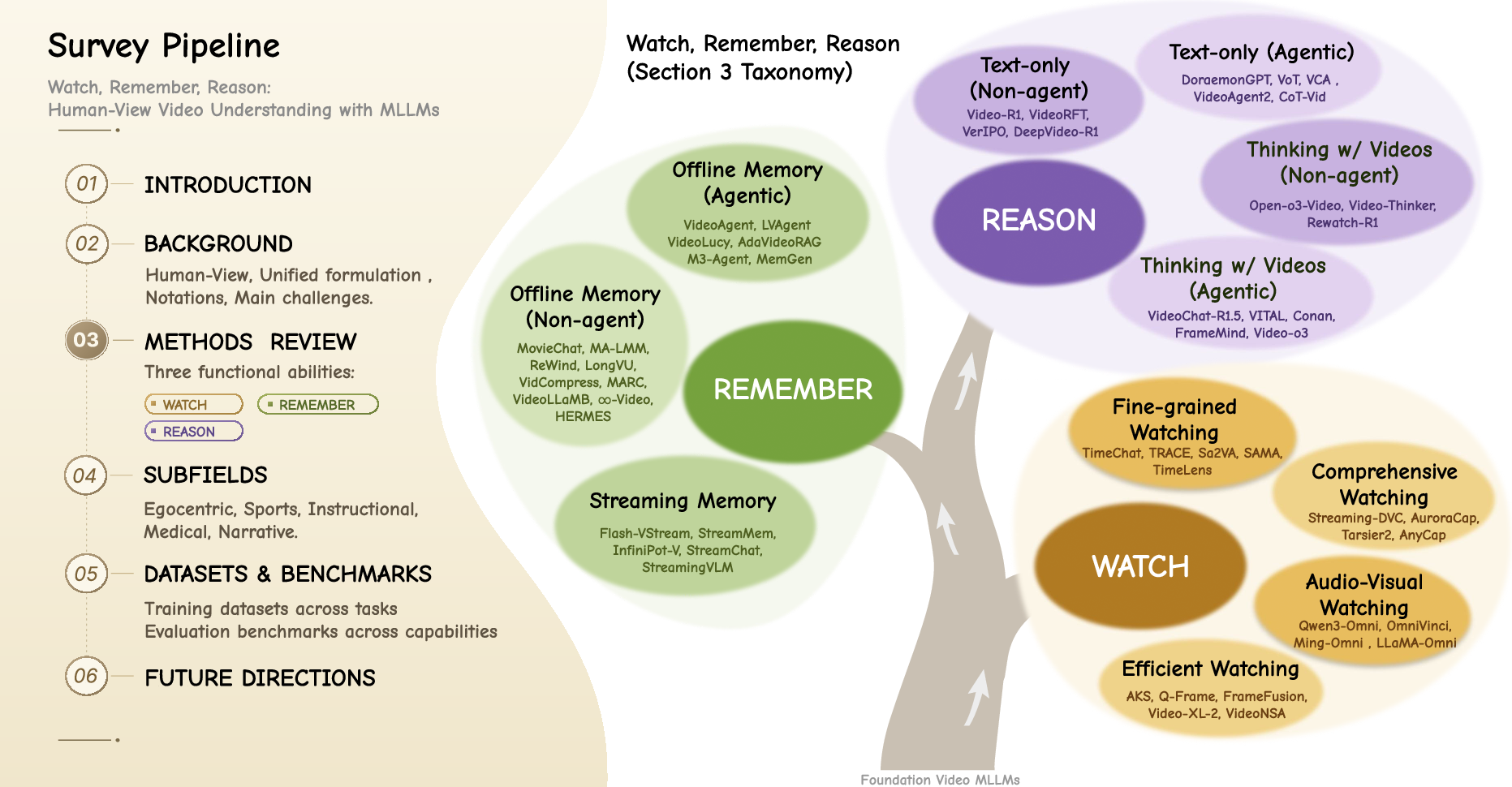
Figure 1: Survey pipeline and Watch--Remember--Reason taxonomy, covering fine-grained grounding, efficient processing, memory mechanisms, and agentic/grounded reasoning.
Unified Functional Decomposition: Watch, Remember, Reason
The survey argues that traditional task- or architecture-centric perspectives are insufficient for real-world, long-form video scenarios, where evidence is sparse, distributed, and multi-modal. Instead, it advocates organizing progress and challenges through three human-analogue functional lenses:
- Watching—selective multimodal perception, including spatio-temporal, auditory, and scene abstraction, while minimizing redundancy.
- Remembering—construction and adaptive retrieval of multi-scale memory representations, enabling long-range dependencies and cross-event reasoning under restricted computational budgets.
- Reasoning—grounded, interpretable inference, including both text-centric chains-of-thought (CoT) and agentic, evidence-seeking processes.
This functional decomposition serves as a scaffold for formulating system design tradeoffs, current algorithmic solutions, and open research challenges in video MLLMs.
Methods and Technical Design: Functional Analysis
1. How to Watch? Perceptual Evidence Acquisition
The review systematically categorizes perceptual approaches:
- Fine-grained watching: Models move beyond naive frame sampling, using timestamp-aware encoders, query-conditioned frame selection, and explicit spatio-temporal grounding. Recent architectures encode time as a first-class token, incorporate multi-scale encoders, and deploy RL-based verifiable reward post-training for precise temporal boundaries.
- Comprehensive watching: Advances in captioning extend from whole-video summaries to event-dense, region-level, and script-like hierarchical descriptions. Large recaptioned corpora and preference-optimized MLLMs enable high-coverage, fine-grained semantic supervision, while control methods allow user-conditioned generation.
- Audio-visual watching: Omni-modal architectures align vision and audio streams via explicit temporal tokenization (e.g., TMRoPE), Mixture-of-Experts routers, and contrastive/CTC-based feature supervision. These enable both offline analysis and low-latency, real-time human–computer interaction.
- Efficient watching: To scale for long videos, methods aggressively prune redundancy through query-aware frame selection, token compression, and adaptive model computation on both the frame- and token-level—coupled with model-side innovations like sparse attention and KV cache optimization.
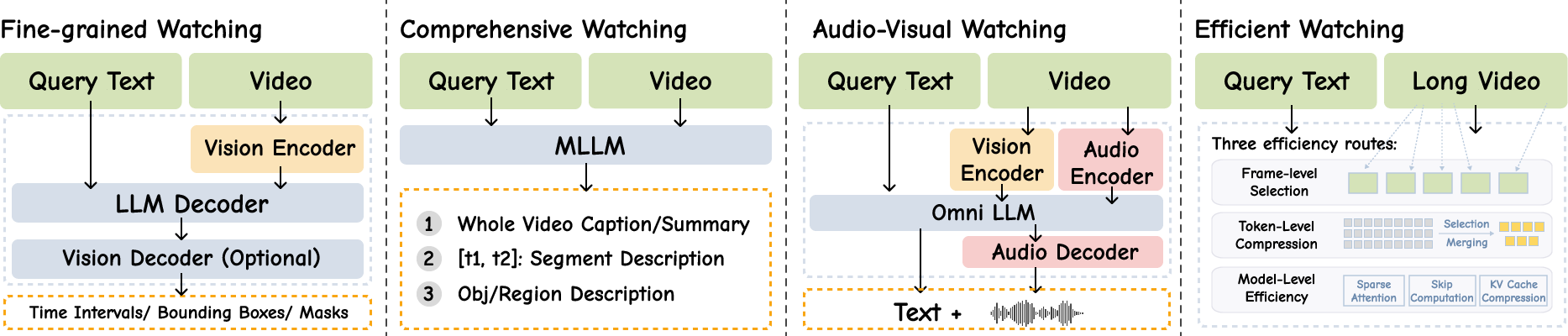
Figure 2: Diverse perceptual strategies: fine-grained watching grounds events, comprehensive watching enables abstraction, audio-visual watching aligns modalities, and efficiency modules reduce input size.
2. How to Remember? Memory Modeling
The memory section delineates between offline and streaming regimes:
- Offline memory: The spectrum runs from agentic, tool-augmented external memory and adaptive retrieval to non-agentic staged pipelines (dynamic selection/compression, hierarchical memory, event graphs). Agentic paradigms exhibit flexible planning but high overhead, while non-agentic models emphasize deterministic, single-pass efficiency.
- Streaming memory: This regime targets unbounded video via rolling short-term/long-term memory banks, hierarchical event consolidation, and KV cache pruning. Hybrid architectures maintain constant or sublinear memory usage, with real-time updates and hierarchical retrieval to support both recency and long-range recall.
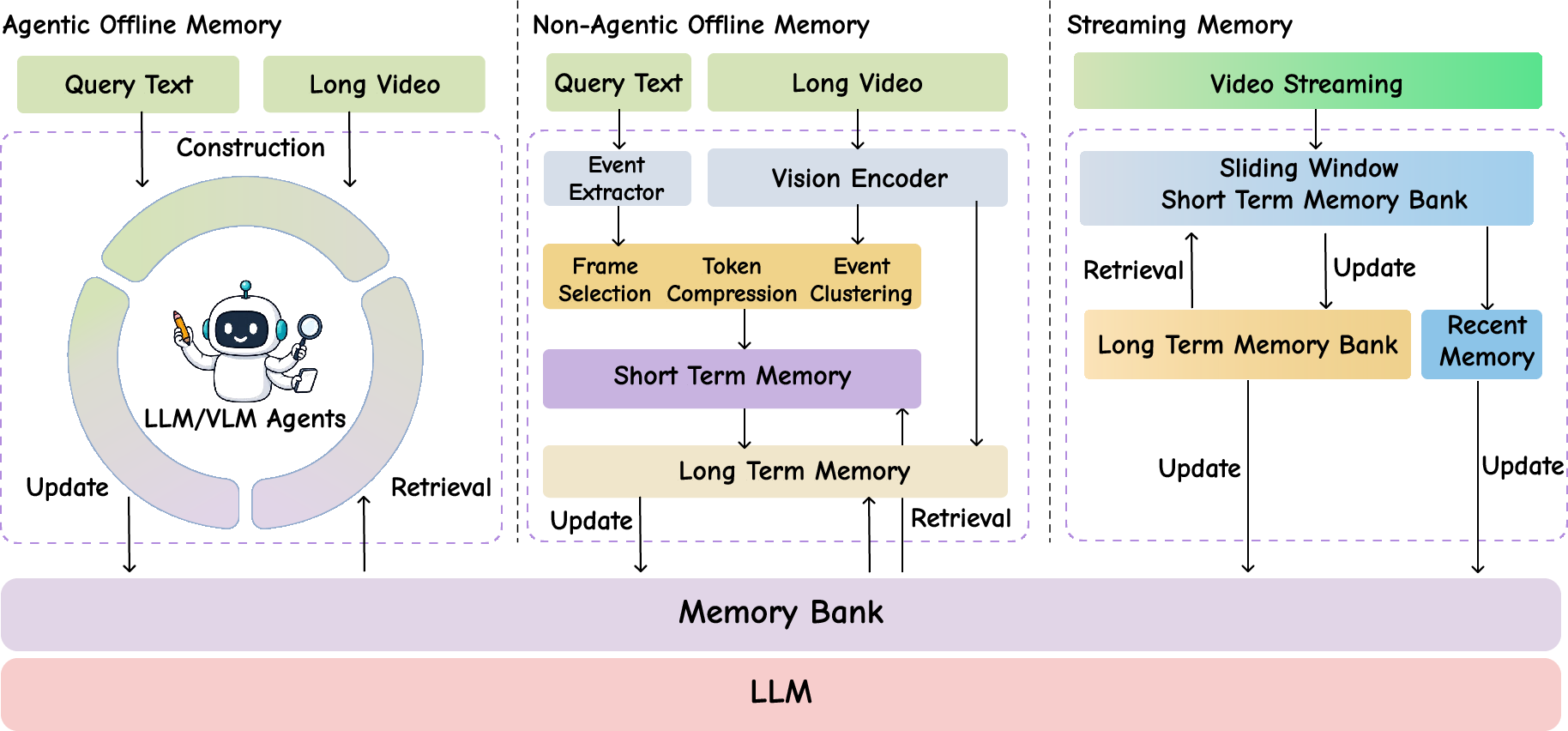
Figure 3: Agentic offline memory (LLM-controlled), non-agentic structured memory, and streaming memory (sliding windows, hierarchical storage) pipelines.
3. How to Reason? Grounded Inference Paradigms
The reasoning landscape is broken into:
- Text-only reasoning: Early methods rely on autoregressive CoT in language space, with subsequent reinforcement learning and preference optimization to enhance temporal/spatial robustness and reduce hallucination. GRPO-style RL and hierarchical DPO optimize both answer and reasoning trace quality.
- Thinking with videos: Inspired by OpenAI's o3, models increasingly interleave reasoning with explicit evidence gathering—both via agentic (tool-use, active zoom, hierarchical search) and non-agentic (structured, verifiable trace with timestamps/boxes) paradigms. These approaches exhibit improved faithfulness, traceability, and allow more interpretable multi-step visual reasoning.
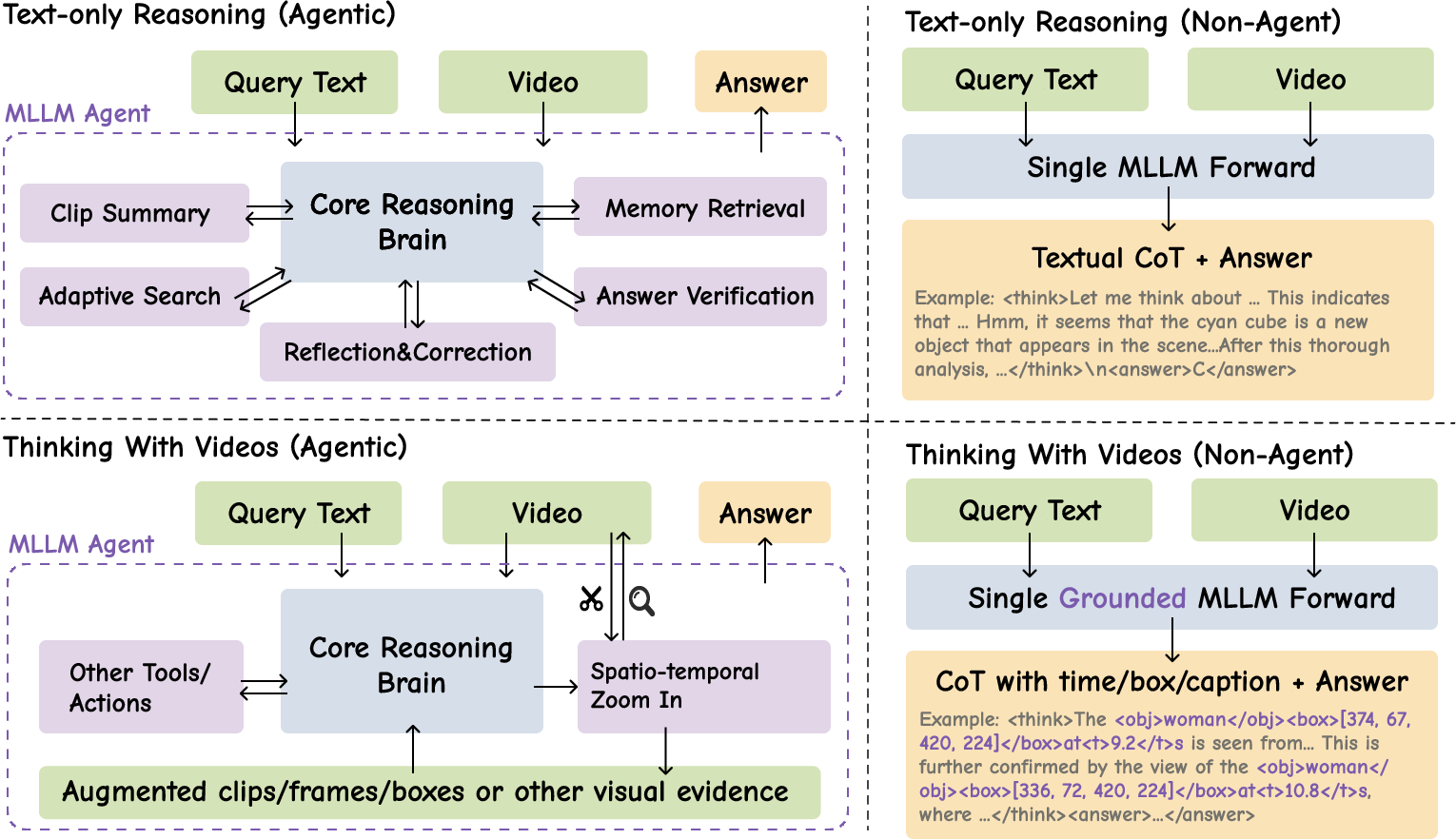
Figure 4: Agentic reasoning (modular step decompositions, memory/tool use) versus non-agentic pipelines (single-pass, CoT-like), and agentic/non-agentic grounded reasoning where models directly interact with or reference visual evidence.
Domain-Specific Subfields and Data Infrastructure
The taxonomy is extended to specialized domains:
- Egocentric, sports, instructional, and medical video understanding demand varying configurations of perception (fine-grained, knowledge-intensive), memory persistence, and reasoning complexity.
- Training data and benchmarks: There is an explosion in scale and diversity—datasets now cover instruction tuning, chain-of-thought, multi-modal scripts, explicit event grounding, long-context streaming, and domain-specific annotations.
- Benchmarks now not only assess accuracy but test interpretability, faithfulness, evidence grounding, and long-context generalization.
Implications, Strong Claims, and Open Directions
- Strong numerical outcomes: RL-based post-training and agentic pipelines consistently outperform SFT-only models on benchmarks with verifiable evidence (temporal IoU, grounded multi-step QA). E.g., agentic and grounded reasoning systematically reduce hallucination rates and improve temporal/spatial localization—often with significant sample efficiency improvements over prior approaches.
- Bold/contradictory claims: The survey asserts that simple scaling of context or model size is insufficient for robust, long-horizon video understanding; explicit memory control and evidence-centric reasoning are mandatory for further progress.
- Practical implications: Real-time video agents (assistants, autonomous agents) and hour-long streaming scenarios become feasible only with compact, hierarchical, agentic memory and grounded reasoning.
- Theoretical implications: Separating perception, memory, and reasoning clarifies the decomposition of cognitive video understanding, exposing roles for system-level control (agentic retrievers) and hierarchical abstraction.
Future Research Directions
The work identifies open problems and future research avenues:
- Spatial reasoning: Bridging the gap between fine-grained object tracking and holistic scene modeling remains unsolved; deeper geometric and object-level temporal memory and explicit scene representations are required.
- Multi-segment/multi-video grounding: Real-world settings require cross-segment, set-based retrieval and edit-aware reasoning, where temporal and narrative boundaries are ambiguous or non-contiguous.
- Hour-scale video with structured memory: Scalable, evidence-pointer-based multi-level memory will be necessary for tasks demanding both needle-in-haystack recovery and extended narrative or procedural recall.
- Verifiable, efficient reasoning: Future systems must optimize not only answer accuracy but also evidence trace compactness and relative informativeness, pushing toward uncertainty-aware and budgeted evidence acquisition as first-class objectives.
- Streaming/embodied scenarios: Stateful, goal-conditioned streaming memory with proactive retrieval and event-triggered writing are essential for interactive and embodied cognition.
Conclusion
This survey establishes the "Watch, Remember, Reason" taxonomy as the primary analytical framework for MLLM-based video understanding. By emphasizing the co-design of perception, memory, and grounded, interpretable reasoning, it details the transition from monolithic end-to-end models to modular, human-centric video intelligence—outlining both practical recipes and theoretical challenges which will shape future developments in truly capable, evidence-grounded video MLLMs.

