- The paper introduces a preconditioning strategy using a Helmholtz regularized operator to stabilize and accelerate EFIE solutions under dense discretization and high-frequency regimes.
- It employs a left- and right-multiplicative preconditioning approach with pseudo-inversion of the shifted Helmholtz operator to ensure mesh-independent convergence.
- Numerical tests on unit-sphere meshes confirm reduced GMRES iterations and controlled condition numbers across challenging high-frequency and dense-discretization regimes.
Preconditioning Helmholtz-regularized Electromagnetic Integral Equations: Theory and Numerical Validation
Introduction
Electromagnetic scattering problems involving perfectly electrically conducting (PEC) objects are frequently addressed using the Electric Field Integral Equation (EFIE), discretized via the Boundary Element Method (BEM). The resulting dense linear systems are notoriously ill-conditioned, especially in three critical regimes: (i) low frequency, (ii) dense discretization, and (iii) high frequency. Classical iterative solvers such as GMRES struggle in these regimes, incurring high iteration counts and computation times. This paper develops a preconditioning strategy for the shifted Helmholtz operator that directly targets these bottlenecks and presents a framework for its efficient quasi-linear complexity pseudo-inversion, thus accelerating the full EFIE solution (2606.07427).
The core challenge of BEM-applied EFIEs lies in regularizing the system matrix
T=−jkTs−(−jk)−1Th,
where Ts and Th are matrix representations of operators with different spectral properties. Of particular concern is the non-solenoidal (quasi-irrotational) component, which is addressed by pseudo-inverting a discretized, shifted Helmholtz operator
H=ΔΓ+km2I,
with ΔΓ the surface Laplacian and km a complex-shifted wavenumber.
Standard pseudo-inversion techniques have proven inadequate for controlling the condition number in regimes (ii) and (iii). The proposed solution employs a left- and right-multiplicative preconditioning strategy:
HS,prec=SGλ~p−1HS(Gλ~p−1)TS,
where S is the matrix of the single-layer operator with a complex-wavenumber kernel, and Gλ~p is a mixed Gram matrix bridging dual pyramid and patch basis spaces.
This operator composition exploits the pseudo-differential order of the involved operators to yield a system whose spectrum is tightly clustered, thus rendering the condition number mesh-independent and robust against high frequency. Specifically, the product
SkmHSkm
has pseudo-differential order zero, a key property in operator theory signaling favorable conditioning.
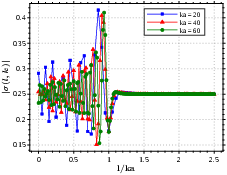
Figure 1: A comparison of the spectra of the Ts0 operator evaluated for different Ts1 values via Spherical Harmonics, illustrating bounded spectral behavior across frequency.
Spherical harmonics analysis over canonical geometries such as the sphere confirms the absence of frequency- or mesh-refinement-dependent spectral collapse in the preconditioned operator’s spectrum. As Ts2, the system naturally converges to a well-conditioned form, consistent with surface integral equation theory.
Numerical Validation
Numerical experiments were conducted on a unit-sphere mesh, with RHS orthogonalization against the Laplacian null space to enforce consistency. GMRES with a stringent residual tolerance was used to quantify solver iteration counts and system condition numbers across both the dense-discretization and high-frequency regimes.
For regime (ii), mesh refinement at fixed frequency revealed that while the unpreconditioned shifted Helmholtz operator exhibits a condition number growing as Ts3, the preconditioned system maintains a constant condition number and near-constant iteration count:
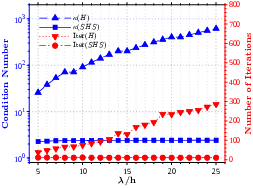
Figure 2: Condition number and GMRES iterations as functions of mesh density Ts4; preconditioning results in mesh-independent conditioning and iterations.
In regime (iii), fixed Ts5 and varying wavenumber Ts6 produced a similar dichotomy: the unpreconditioned system's condition number and iteration count grew rapidly with frequency, while the preconditioned system remained stable:
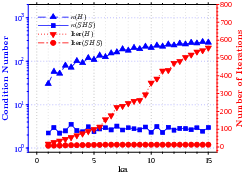
Figure 3: Condition number and GMRES iterations versus electrical size Ts7; the preconditioner mitigates the high-frequency breakdown and prevents spurious resonances.
These empirics strongly corroborate the spectral analysis and reinforce the claim that the proposed preconditioning method eliminates both dense-discretization and high-frequency breakdowns in the shifted Helmholtz operator pseudo-inversion.
Implications and Future Directions
The decomposition, operator-regularization, and preconditioning framework outlined decisively stabilizes the Helmholtz system within EFIE discretization, broadening the practical applicability of iterative solvers for large-scale 3D scattering. The approach is theoretically extensible to smooth convex geometries beyond the sphere and, due to the favorable pseudo-differential composition, can be paired with acceleration strategies (e.g., FMM) for genuine quasi-linear complexity.
Potential impact areas include large-scale electromagnetic (EM) compatibility analysis, radar cross-section computations, and fast EM field simulations in engineering applications. The guarantee against spurious resonances and breakdowns increases robustness for multiphysics and industrial EM solvers.
Future work should focus on extending numerical validation to non-canonical geometries, analyzing the influence on resource consumption for practical mesh sizes, and fully integrating the method with hierarchical fast algorithms. The framework provides fertile ground for investigating preconditioning in other boundary operators arising in full-wave and quasi-static formulations.
Conclusion
This work delivers a theoretically grounded and numerically validated preconditioning strategy for the pseudo-inversion of Helmholtz operators within electromagnetic BEM formulations. The spectral and convergence stability across critical regimes directly addresses a long-standing challenge in numerical electromagnetics, paving the way for tractable, large-scale, frequency-robust simulations. The operator-regularization methodology, combined with mesh-independent conditioning, provides a strong foundation for practical implementation in next-generation fast integral equation solvers.