- The paper derives closed-form expressions for the partition function in a 1D noninteracting model, enabling tracking of Lee-Yang zeros as temperature varies.
- The paper employs polynomial factorization and numerical analysis to map the evolution of zeros, highlighting their role in free energy nonanalyticity.
- The paper proposes a two-step extrapolation strategy to overcome analytic continuation failures inherent to the low-temperature fermion sign problem.
Finite Temperature Structure of Lee-Yang Zeros and the Fermion Sign Problem in a Solvable 1D Model
Introduction and Analytical Model
The paper "Fermion sign problem and the structure of Lee-Yang zeros. II. Finite temperature results for a model system without interactions" (2606.07415) presents a rigorous finite-temperature study of the distribution and dynamics of Lee-Yang (LY) zeros of a polynomial partition function in a model system of noninteracting indistinguishable particles on a one-dimensional ring. The approach leverages the parameter ξ, which interpolates between Bose (ξ=1), Fermi (ξ=−1), and distinguishable (ξ=0) statistics, and extends ξ to the complex plane, encompassing anyonic and fractional exclusion statistics.
Building on preceding zero-temperature results, the paper establishes full analytic forms for the partition function Z(N,β,ξ) for N=1–$5$ particles, expressed as a polynomial in ξ whose roots—the LY zeros—dictate the analytic structure. At T=0, the zeros are universal and independent of dynamics or interaction: ξ=10 for ξ=11. At finite ξ=12, closed-form expressions enable tracking the trajectories of LY zeros in the complex plane, exposing the explicit dependence on thermodynamic parameters.
Temperature Evolution of LY Zeros and Analyticity
The finite-temperature evolution of LY zeros is numerically tracked and visualized for ξ=13 (Figure 1, Figure 2). At low ξ=14, all zeros remain on the real axis between ξ=15 and ξ=16; as ξ=17 increases, most zeros pair and depart into the complex plane as conjugate pairs, except for the zero originating from ξ=18, which persists near ξ=19 at low ξ=−10:
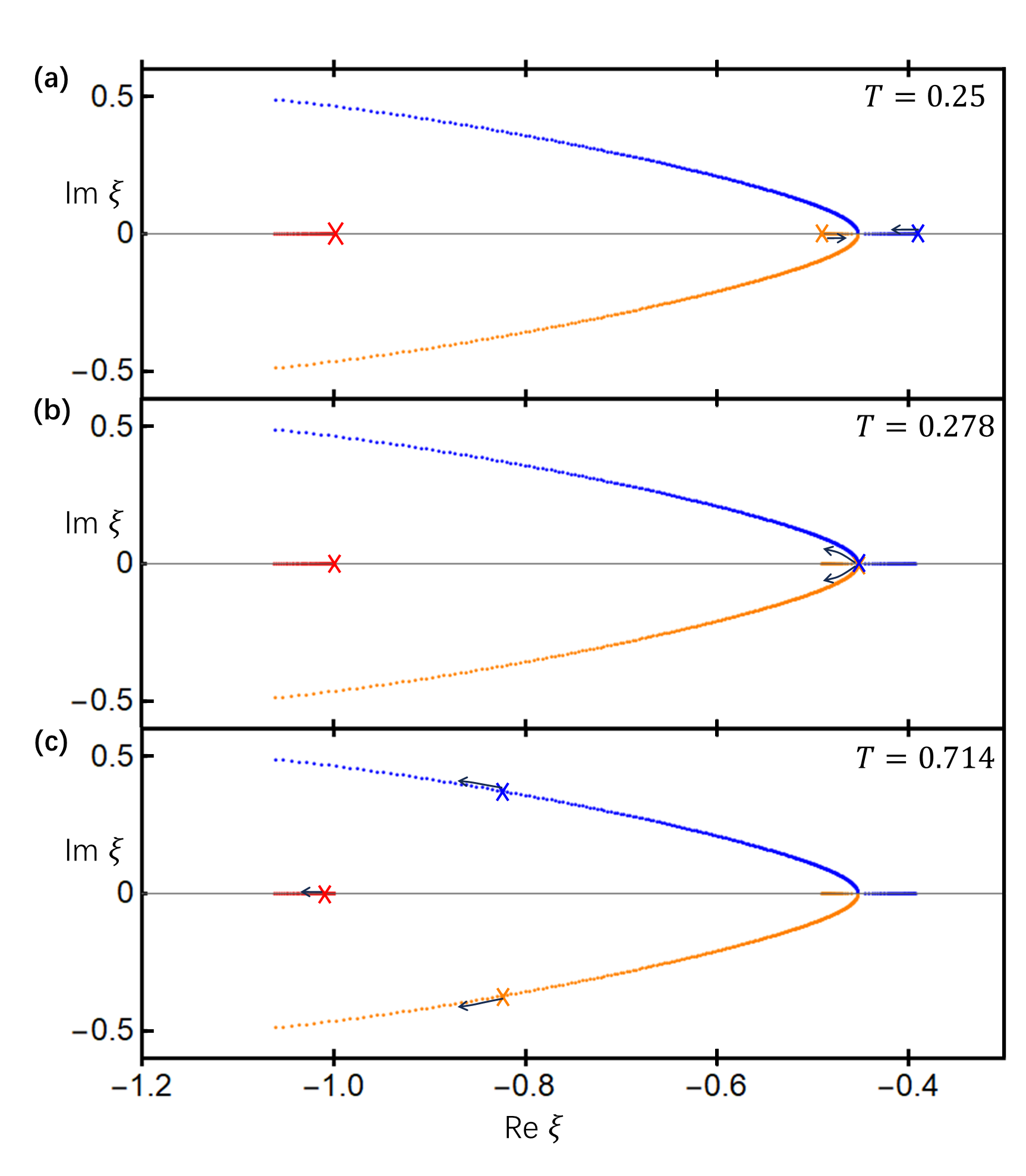
Figure 1: The trajectories of LY zeros of ξ=−11 for ξ=−12 on a 1D ring across temperatures, with ξ=−13 remaining near ξ=−14 at low ξ=−15.
This temperature-dependent movement of zeros reshapes the region of analyticity for thermodynamic quantities as functions of ξ=−16. Real LY zeros correspond to nonanalytic points for observables; their proximity to ξ=−17 at low ξ=−18 obstructs analytic continuation from sampled (bosonic or anyonic) data to fermionic statistics, elucidating the persistent challenge of the fermion sign problem (FSP) at low temperature.
Partition Function Structure and Thermodynamic Implications
The polynomial nature of ξ=−19 allows a factorization in terms of its zeros:
ξ=00
where ξ=01 are the LY zeros ordered by their ξ=02 positions. The free energy and sign factor are then
ξ=03
ξ=04
When a LY zero resides on the real axis, the free energy diverges, and near the axis, it remains strongly nonanalytic, impeding statistical estimators reliant on analytic continuation. As ξ=05 rises, zeros leave the real axis, and the analytic domain expands, supporting reliable extrapolation from sign-problem-free data (Figure 3, Figure 4, Figure 5).
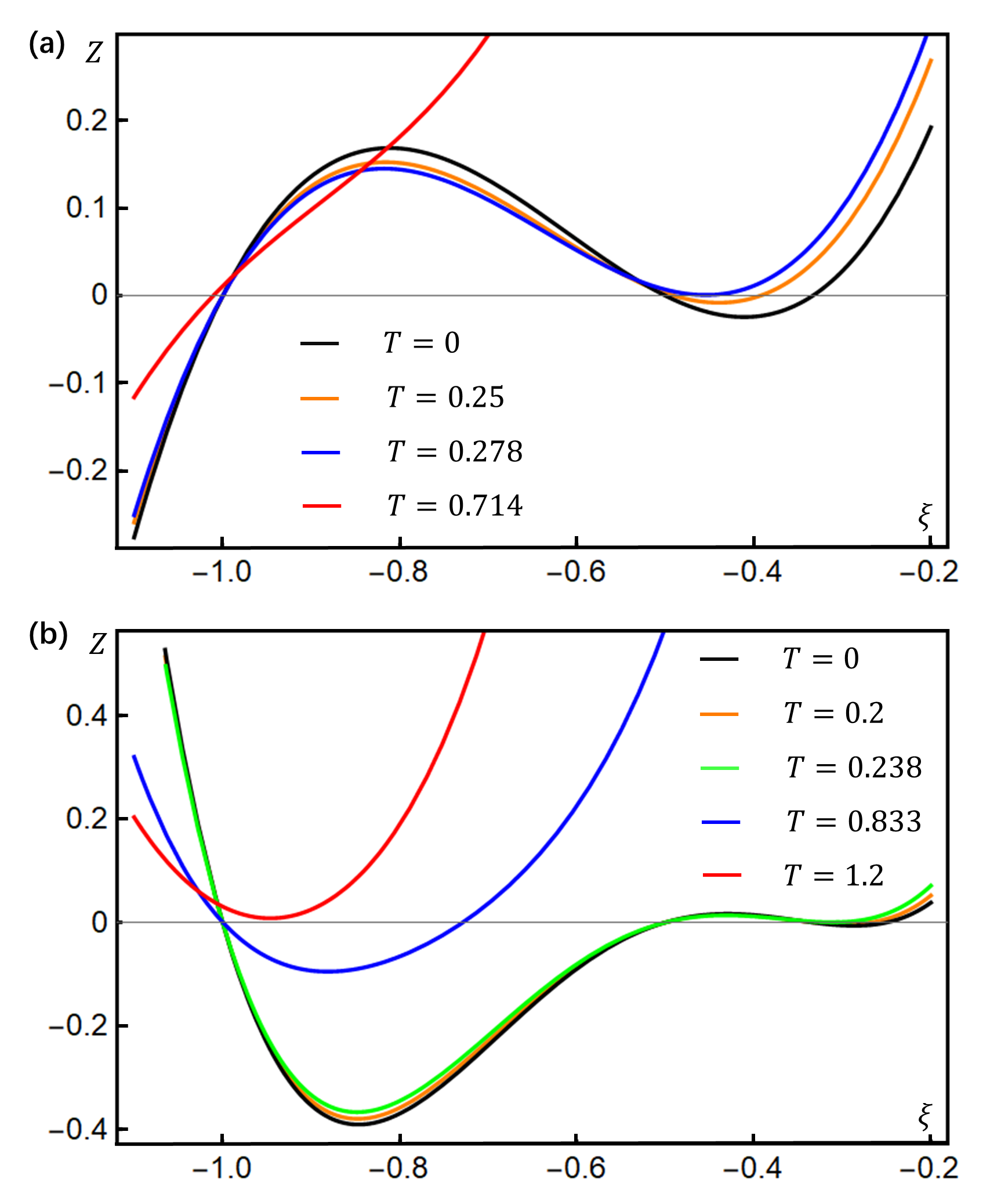
Figure 3: Curves of ξ=06 on the real ξ=07 axis for ξ=08 (a) and ξ=09 (b); intersections with ξ0 are the LY zeros.
The log of the sign factor is dominated by the smallest ξ1, confirming its exponential smallness at low temperature: the bottleneck underlying the FSP.
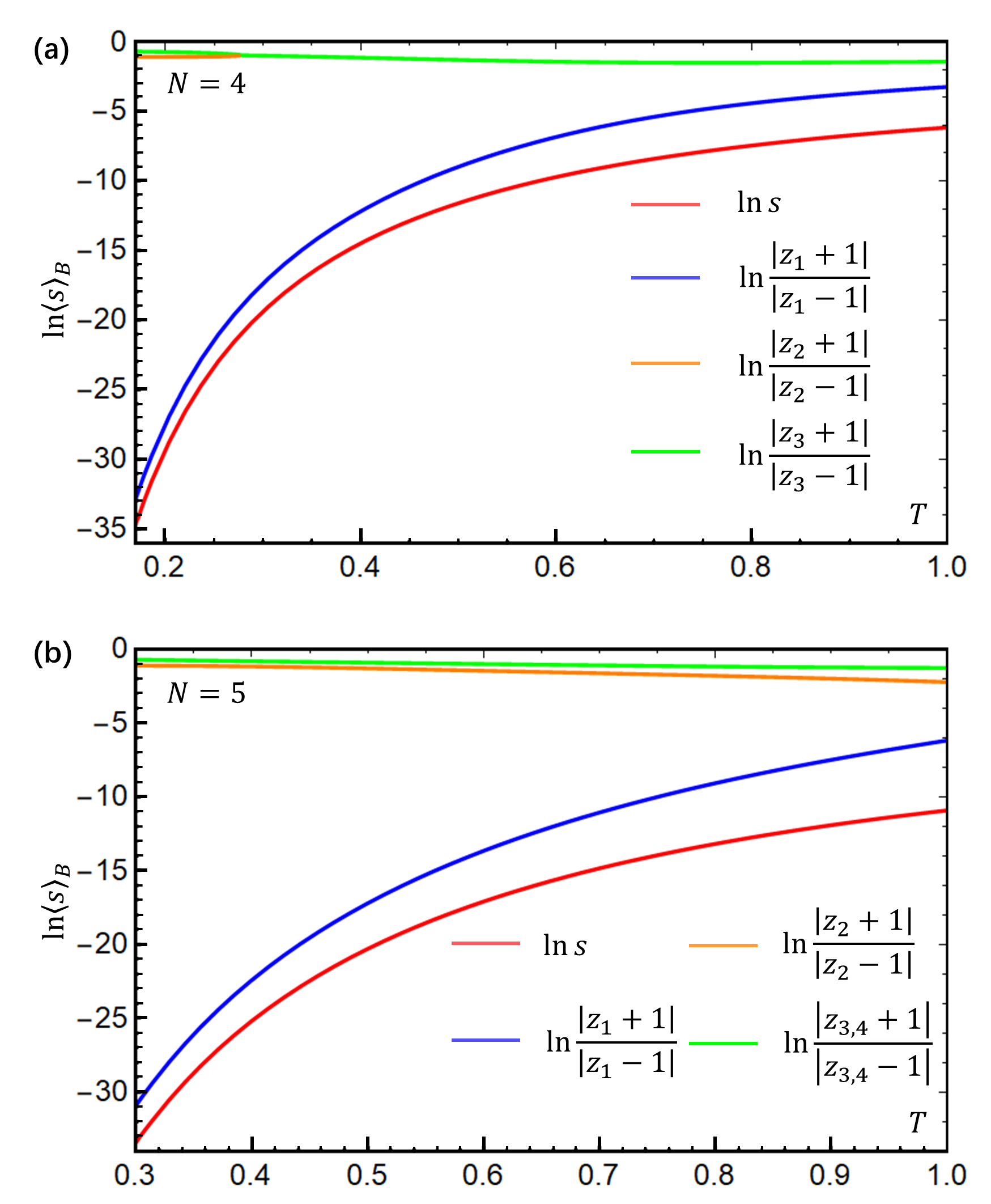
Figure 5: Comparison of the log sign factor and the contribution of the nearest LY zero ξ2 for different ξ3 as a function of temperature.
Failure of Analytic Continuation and Constant-Energy Contour Fitting
Extrapolation methods previously proposed for circumventing the FSP—both direct analytic continuation in ξ4 and implicit extrapolations such as constant-energy contour fitting (e.g., Xiong et al.'s scheme)—are explicitly shown to fail at low ξ5, where the analytic domain is pinched by LY zeros near ξ6. Contours in the ξ7-ξ8 plane are strongly distorted adjacent to real LY zero trajectories (Figure 6), and high-order polynomial fits remain unreliable for low temperatures.
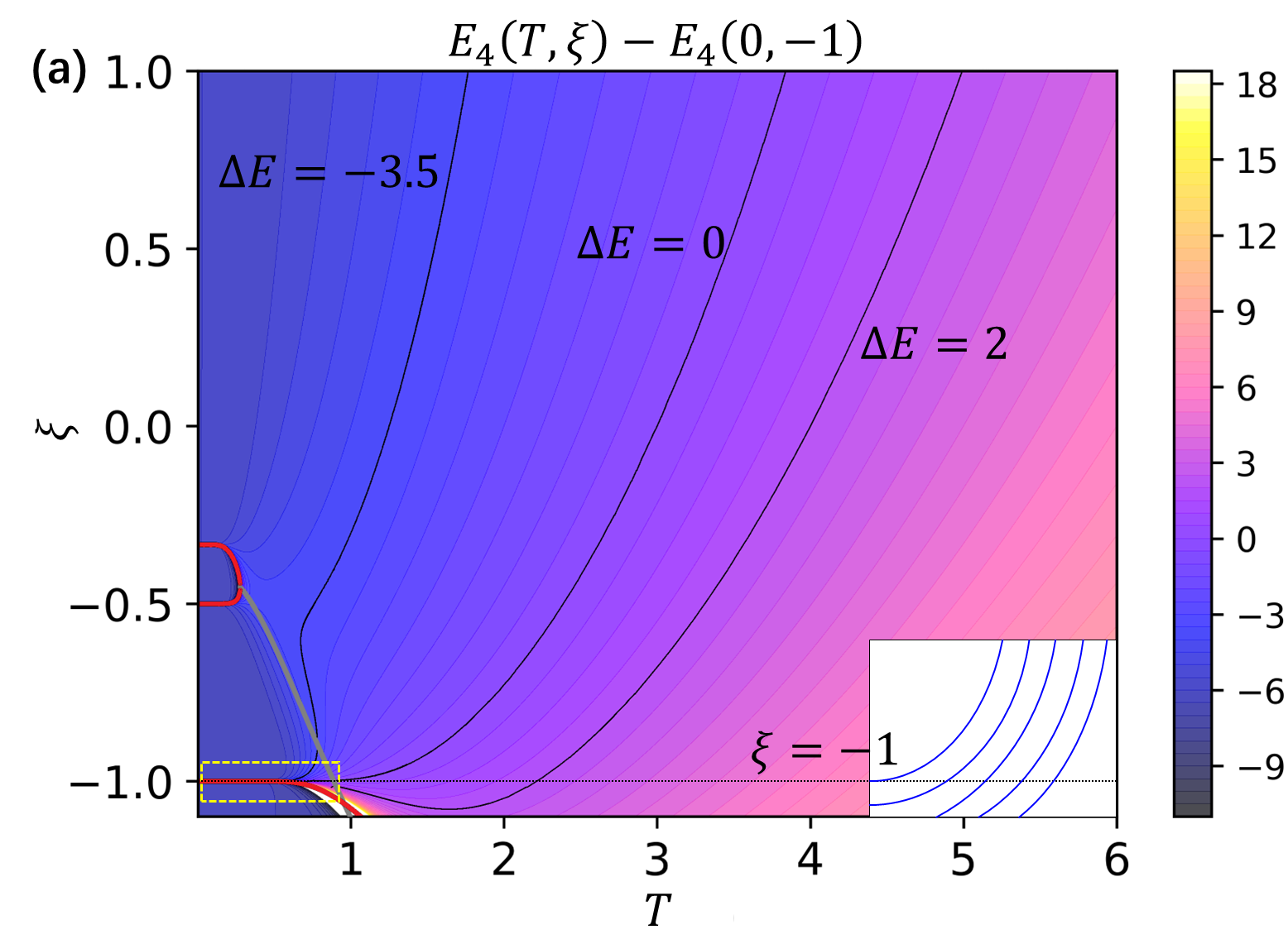
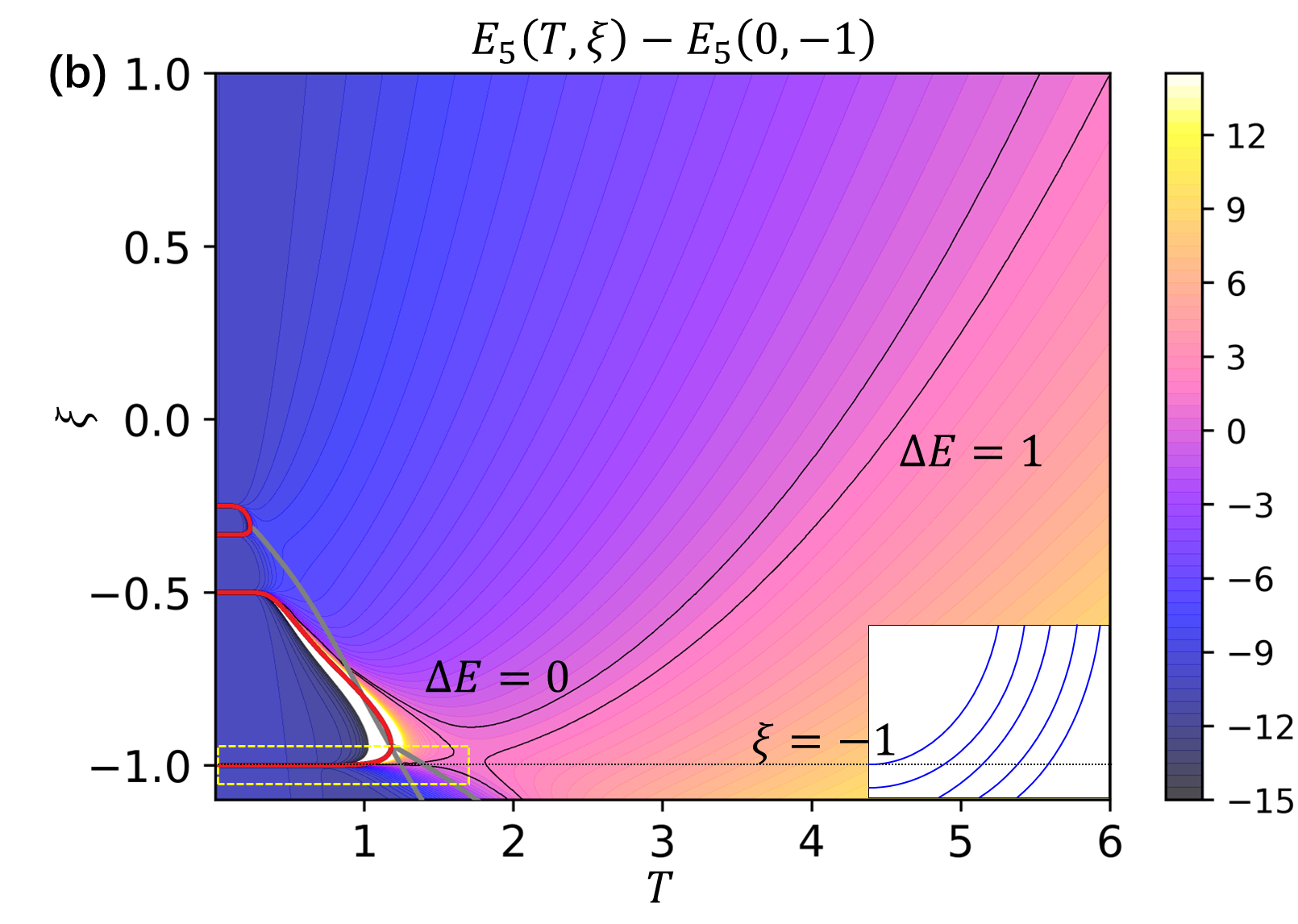
Figure 6: Constant-energy contours in the ξ9-Z(N,β,ξ)0 plane; thick red curves are real-axis LY-zero trajectories where analytic continuation fails.
This rigorously demonstrates that contour-based fitting cannot evade the fundamental limitations set by LY-zero topology.
Partition Function Decomposition and a Two-Step Fitting Strategy
The partition function can be explicitly decomposed:
Z(N,β,ξ)1
where Z(N,β,ξ)2 is the Z(N,β,ξ)3-independent remainder and equals the fermionic partition function at Z(N,β,ξ)4: Z(N,β,ξ)5. At low Z(N,β,ξ)6, Z(N,β,ξ)7 is exponentially suppressed, complicating numerical estimation.
This analysis motivates a two-step practical strategy for extracting low-Z(N,β,ξ)8 fermionic properties:
- High-Z(N,β,ξ)9 extrapolation in N=10: Use sign-problem-free simulations at N=11 for moderate/high N=12, where analytic continuation to N=13 is accurate.
- Low-N=14 extrapolation in N=15: Fit the resulting high-N=16 fermionic quantities (such as energy or N=17) in N=18 with appropriate fitting forms (e.g., exponential or polynomial in N=19), and extrapolate to lower $5$0 domains.
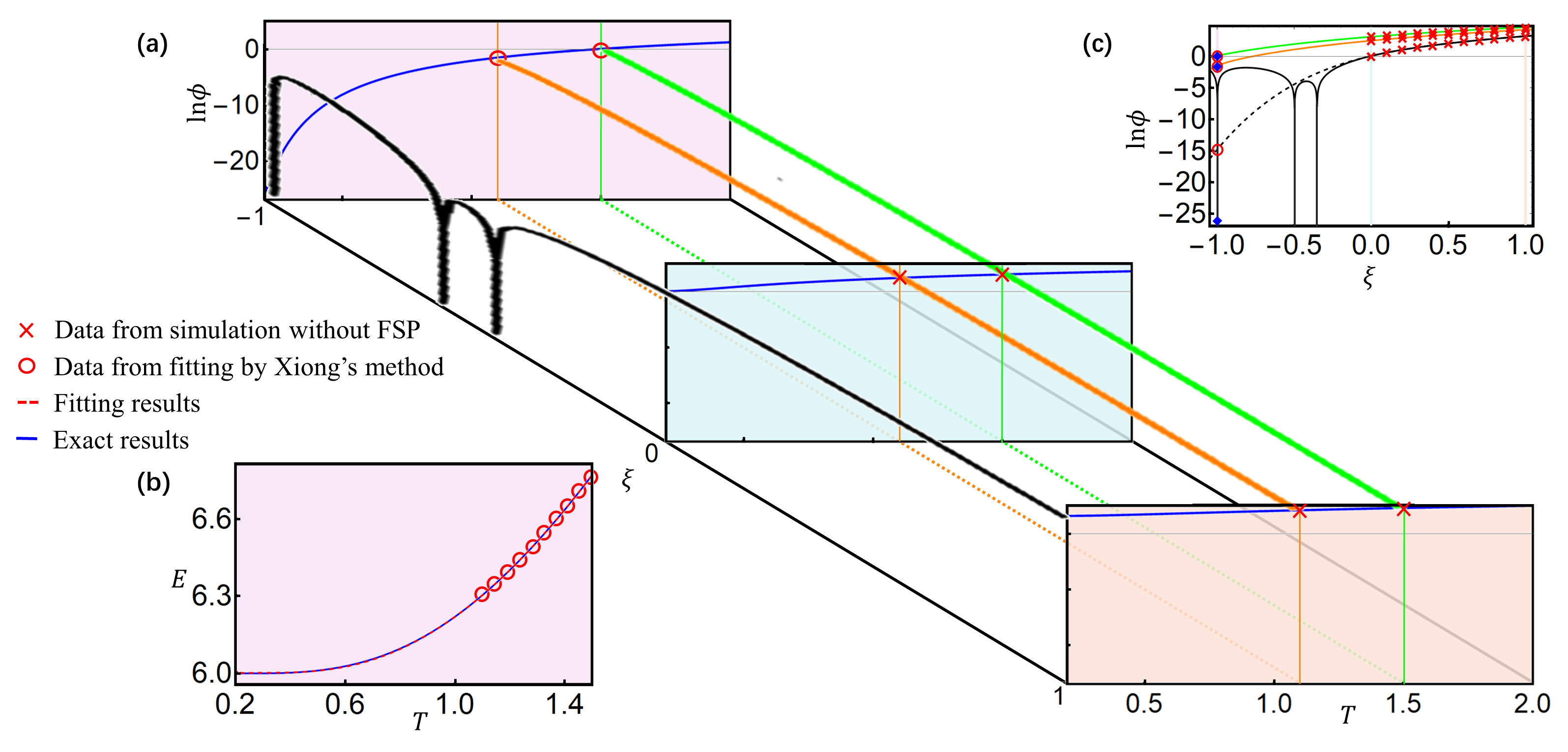
Figure 7: The two-step strategy—high-$5$1 $5$2-extrapolation (a, c) and low-$5$3 $5$4-fitting (b)—demonstrated for the $5$5 system.
This method is operational whenever the analytic domain in $5$6 is not pinched by LY zeros at the target $5$7, providing a robust route for obtaining low-temperature fermionic properties wherever phase transitions are absent and the relevant region remains analytic.
Implications and Perspectives
This work offers a quantitative, model-exact clarification of the fundamental connection between LY-zero structure (in the statistics parameter) and the FSP at finite temperature, solidifying the conditions under which analytic continuation schemes are guaranteed—or provably fail.
The implications for computational many-body physics are significant:
- Analytic continuation in a statistics variable is reliable only above a $5$8 threshold where zeros have receded from $5$9.
- Polynomial fitting or contour-based schemes are insufficient to bypass this analytic obstruction.
- The two-step ξ0-then-ξ1 extrapolation protocol may furnish a viable tool for FSP mitigation in realistic systems, motivating application in current ab initio path-integral simulations (e.g., for dense hydrogen, quantum dots, or electronic structure in warm dense matter [dornheim2025a], [xiong2025b]).
- These insights conceptualize the FSP not merely as a numerical challenge but as a direct manifestation of analytic structure in the thermodynamic manifold, potentially guiding new algorithmic strategies and informing the design of future quantum simulation methods.
Conclusion
The detailed analytic and topological study of LY zeros in the canonical statistics-interpolating partition function establishes the precise relation between temperature, analytic continuation, and the severity of the fermion sign problem. The findings compellingly demonstrate the necessity of inspecting the local analytic landscape—via LY-zero analysis—before relying on extrapolation schemes in quantum Monte Carlo and related approaches. The two-step protocol and the decomposition of the partition function underpin both a new conceptual understanding and a concrete algorithmic route for future sign-problem research across quantum statistical mechanics and condensed matter theory.

