- The paper introduces an ML-driven subproblem selection mechanism that cuts over 52% of unnecessary Benders evaluations, achieving a 9.9% reduction in solve time.
- It leverages an online logistic regression model with dynamic stopping criteria to score failure scenarios, balancing computational cost and solution quality.
- Empirical results on 135 synthetic instances show significant improvements, including a 14.3% reduction in primal-dual integrals and enhanced convergence compared to standard methods.
Adaptive Subproblem Selection in Benders Decomposition for Survivable Network Design Problems
Introduction and Motivation
This work addresses the computational inefficiency inherent in conventional Benders decomposition when applied to large-scale scenario-based optimization, with a primary focus on the Survivable Network Design (SND) problem. In traditional settings, Benders decomposition iteratively solves all subproblems in every round, which is intractable for networks with many failure scenarios due to the computational burden. This study empirically documents that a significant portion of subproblem solves (over 52%) are unnecessary—that is, they generate neither feasibility cuts nor are essential for progression—highlighting a substantial opportunity for computational savings through adaptive subproblem selection.
The paper formalizes SND as a two-stage robust network design problem. The first stage involves capacity installation (with modularity constraints), while the second stage addresses demand routing under a set of failure scenarios, specifically N-1 reliability (single-edge failures). The second-stage subproblem for each scenario is a multicommodity flow LP, and infeasibility leads to the addition of Benders feasibility cuts (derived from dual ray unboundedness) to the master problem. The combinatorial growth in the number of scenarios, and the sparsity of useful cut-yielding subproblems in each Benders iteration, are identified as the principal bottlenecks in scalability.
Adaptive Subproblem Selection Mechanism
The core contribution is a fully computational, learning-driven method for selective subproblem evaluation in Benders decomposition. The pipeline operates as follows: after each master iteration, features are extracted from the incumbent network solution and subproblem history; each scenario is scored for its likelihood of yielding a violated cut; scenarios are sorted by score, and only a subset are solved, subject to multiple stopping criteria designed to balance coverage and efficiency. Upon solving each subproblem, an online logistic regression model is updated, providing continuous adaptation to the instance and solution trajectory.
(Figure 1)
Figure 1: Time breakdown across n=108 instances. Master time (black), cut-generating subproblems (blue), feasibility-proving subproblems in cut-free iterations (grey) represent necessary computation; unrequired subproblems (orange) represent wasted computation.
Feature Engineering and Machine Learning Scoring
The scoring function combines scenario-specific historical information (cut generation frequency, cut contribution share, violation magnitude, recency/staleness) with topological features extracted from the master solution (capacity, utilization, base flow, and betweenness centrality on the failed edge). The online learning model (logistic regression) updates weights per-observation via stochastic gradient descent, with L2 regularization to control variance. This approach enables rapid, iteration-level adaptation at minimal computational overhead, obviating the need for offline training and manual parameter selection.
(Figure 2)
Figure 2: Distribution of learned feature weights across instances, illustrating high variance and dynamic relevance of features across solving phases.
Stopping Criteria and Stabilization
Subproblem solves are terminated via dynamic criteria: an absolute cut count, a proportion of scenarios, a threshold on predictive score, consecutive non-yielding solves, and wall-clock time. This hybrid multi-criteria regime is shown to outperform simpler policies by more effectively suppressing redundant subproblem solves while preserving solution quality. Periodic “stabilization” rounds—full enumeration—prevent persistent omission of potentially critical scenarios.
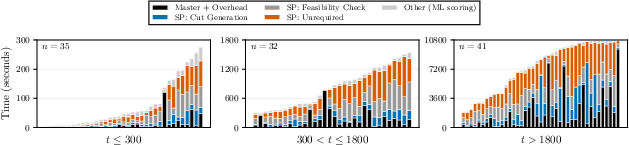
Figure 3: Distribution of minimum parameter values required to capture all cuts per iteration during ML training, supporting selection of robust stopping thresholds.
Computational Results and Empirical Analysis
On a corpus of 135 synthetic SND test instances (ranging up to 229 scenarios and 82 edges), the computational results are conclusive:
- The oracle, which only solves cut-generating subproblems, suggests that 34.4% of all computational effort in baseline Benders is wasted. The best ML configuration achieves a 9.9% reduction in shifted geometric mean solve time over standard Benders (270.8s vs. 300.5s, p=0.0081), significantly narrowing the gap to the oracle.
- All ML-based methods consistently outperform random selection, which can degrade performance significantly.
- The best method achieves 14.3% reduction in primal-dual integrals, indicating not only improved speed but also superior convergence quality.
- Hit quality (cuts found per subproblem solved) and adjusted subproblem times further corroborate the efficiency gains.
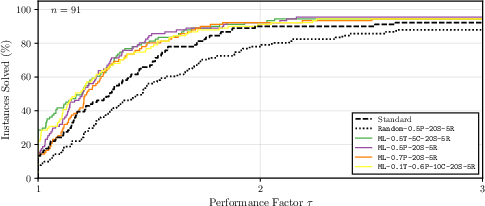
Figure 4: Performance profile over n=91 instances; regression-based selection consistently dominates random and standard Benders, improving the fraction of instances within a small factor of the best.

Figure 5: Distribution of hit quality (cuts found / subproblems examined) across all methods, with ML-based policies yielding improved efficiency in subproblem prioritization.
However, the ML model's F1-score plateaus at 45%, with precision at 33% and recall at 71%, indicating room for improvement in cut-prediction accuracy. The main limitations are the expressivity of the feature set and the shift in important predictors during successive iterations.
Implications and Theoretical Discussion
The results demonstrate that data-driven adaptive subproblem selection leads to statistically significant reductions in runtime and improvements in convergence trajectory for Benders decomposition on SND problems. Unlike scenario reduction or master reformulation, the proposed approach preserves the original problem structure, lending itself to modular integration with branch-and-Benders-cut MIP solvers. Importantly, the analysis quantifies the realizable gap between current practice and the theoretical lower bound of “perfect” scenario selection, providing a performance target for future developments.
Theoretically, the work highlights the challenge of reliable online prediction in the presence of evolving solution landscapes, suggesting that static scoring or pre-trained feature weights are insufficient. The heterogeneity in feature importance across instances further motivates more expressive models, potentially incorporating graph neural networks, temporal feature aggregation, or hybrid methods leveraging dual information and combinatorial topology.
Future Directions
The authors enumerate several technical avenues for improving subproblem selection:
- Deploying more sophisticated ML models (e.g., GNNs) to encode higher-order topological context.
- Adaptive stopping criteria that evolve throughout the solve to balance the shifting cost/benefit of exploration.
- Stage-aware feature ablation that dynamically restricts the scoring model to high-signal predictors.
- Hybrid methods combining full enumeration in early rounds with selective solving as the cut-yield declines.
- Augmenting data-driven approaches with problem-specific optimizations (e.g., min-cut or separator-based predictors).
Conclusion
This work establishes that ML-driven, adaptive subproblem selection confers statistically significant improvements for Benders decomposition in SND applications, reducing computational waste and accelerating convergence without sacrificing solution quality. While there is substantial headroom to reach the predicted optimal (oracle) performance, especially through improved cut-prediction precision, the empirical advances validate the viability of online learning as a mechanism for resource-aware scalability in decomposition algorithms. The open question of generalization to other two-stage problem classes remains, as does the challenge of architecting robust, high-precision predictors for broad combinatorial settings.