- The paper introduces a measurement circuit ansatz comparing Naimark extensions with QNN-based circuits, highlighting trade-offs between optimality and resource efficiency.
- It details a circuit construction for general POVMs via unitary dynamics, quantifying resource scaling and optimization challenges through numerical and experimental benchmarks.
- The study shows that QNN circuits converge faster and scale better on noisy hardware, offering practical alternatives for quantum state discrimination despite minor precision trade-offs.
Measurement Circuit Ansatz: Naimark Versus Quantum Neural-Network Measurements
Introduction
This paper systematically investigates quantum circuit architectures for realizing general quantum measurements (POVMs) on near-term quantum devices, addressing both theoretical constructions and practical resource constraints (2606.07376). The authors first formalize Naimark-type quantum measurement circuits based on the well-known Naimark extension, which relies on unitary dynamics between system and ancillary qubits to implement arbitrary POVMs. They then provide a detailed circuit ansatz that exposes the gate structure and parameter dependencies, enabling classical parameter optimization for arbitrary measurement tasks, such as quantum state discrimination. Recognizing the limitations of the Naimark paradigm—particularly its computational hardness and resource overhead—they introduce architectures based on parameterized quantum neural-network (QNN) circuits, including hybrid and fully QNN-based measurement circuits. The comparative study elucidates the trade-offs in optimization efficiency, resource scaling, and measurement precision, substantiated via numerical and experimental results on both noisy and noiseless hardware.
Naimark Measurement Circuit Construction
The Naimark extension is employed to realize general POVMs within the quantum circuit model. For a system state ∣ψ⟩, an ancillary register undergoes a unitary USA, with projective measurement outcomes on ancilla determining Kraus operators Ki corresponding to POVM elements. The explicit circuit construction decomposes USA into sequences of CNOT and single-qubit rotation gates, parameterized via binary modules and collective CNOTs CX(x), allowing systematic scaling to arbitrary l-outcome measurements (Figures 1, 2).
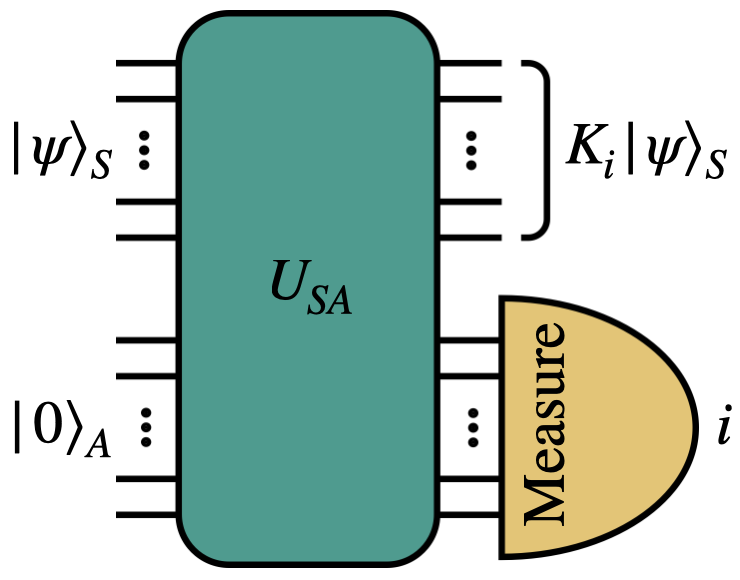
Figure 1: A general measurement can be implemented in a quantum circuit via the Naimark extension with a unitary USA coupling system and ancillary qubits.
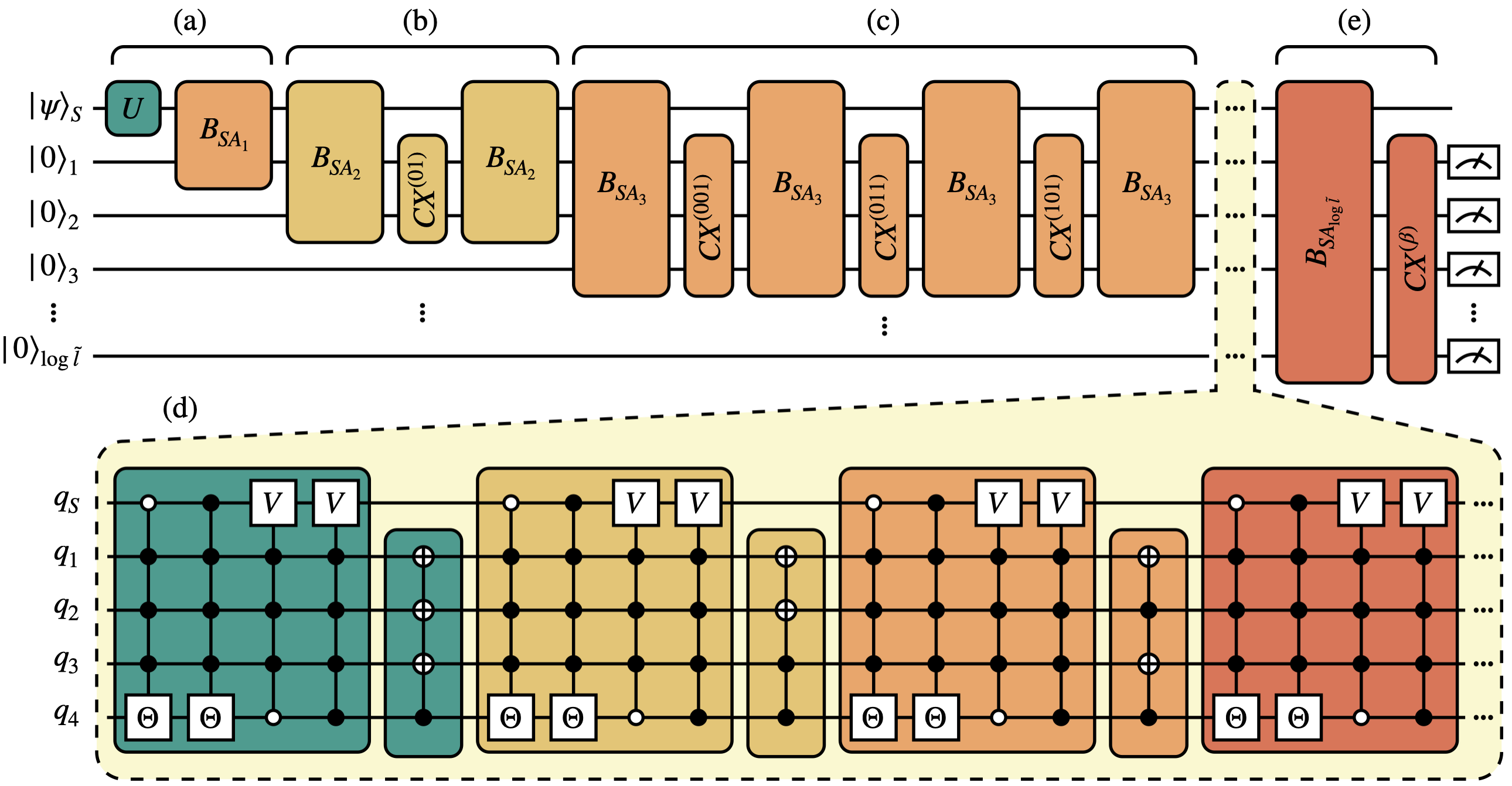
Figure 2: Sequential construction of l-outcome POVM elements for measurement circuits using binary modules and collective CNOT gates.
This architecture is further generalized to multi-qubit systems, replacing single-qubit unitaries with multi-qubit gates, maintaining circuit modularity while preserving scalability (Figure 3).
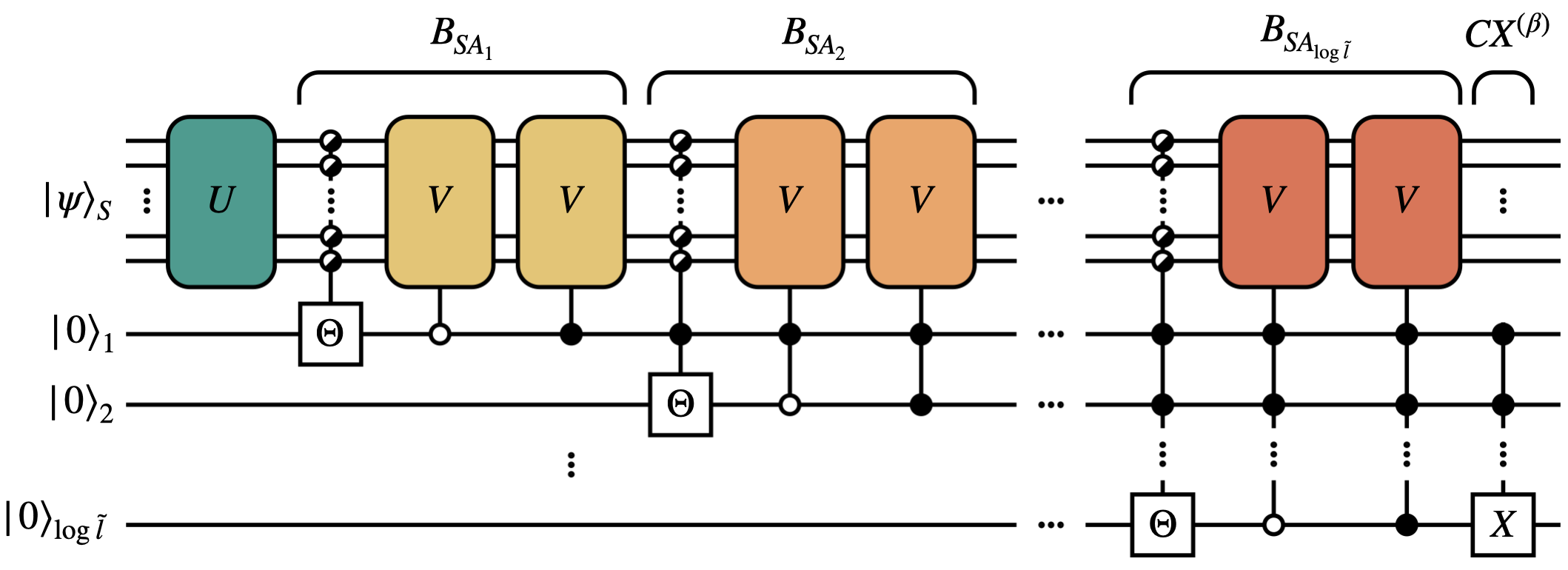
Figure 3: Generalization of single-qubit POVM circuits to multi-qubit systems via uniformly controlled rotations and structured CNOTs.
Theoretical analysis reveals that the underlying structure of Naimark circuits embeds ZZ-type interactions, sharing features with QAOA landscapes for QUBO problems—classically NP-hard—which induces a complex nonconvex optimization landscape for classical parameter search.
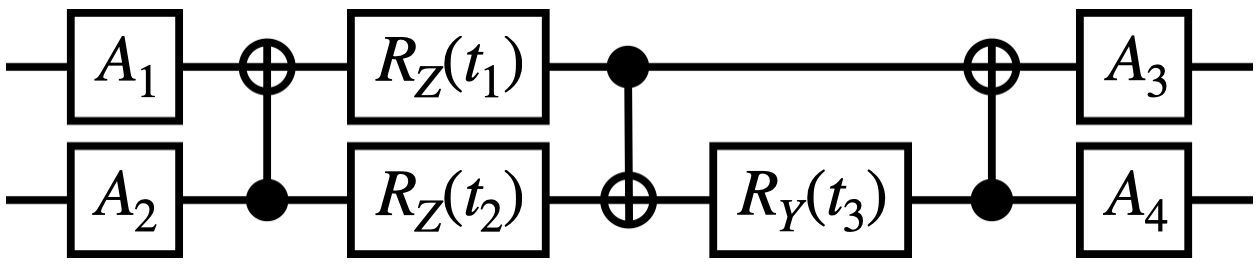
Figure 4: Canonical decomposition of a general two-qubit gate into rotations and CNOT gates, highlighting nonlocal entangling operations essential for Naimark circuits.
Quantum Neural-Network Measurements
To circumvent the computational bottlenecks and resource-intensive nature of exact Naimark constructions, the paper introduces QNN measurement circuits based on PQC architectures. Hybrid schemes replace only ZZ-interacting blocks with PQCs (Figure 5), while fully QNN circuits omit the Naimark structure altogether, reducing CNOT gate complexity and facilitating shallow circuit designs.
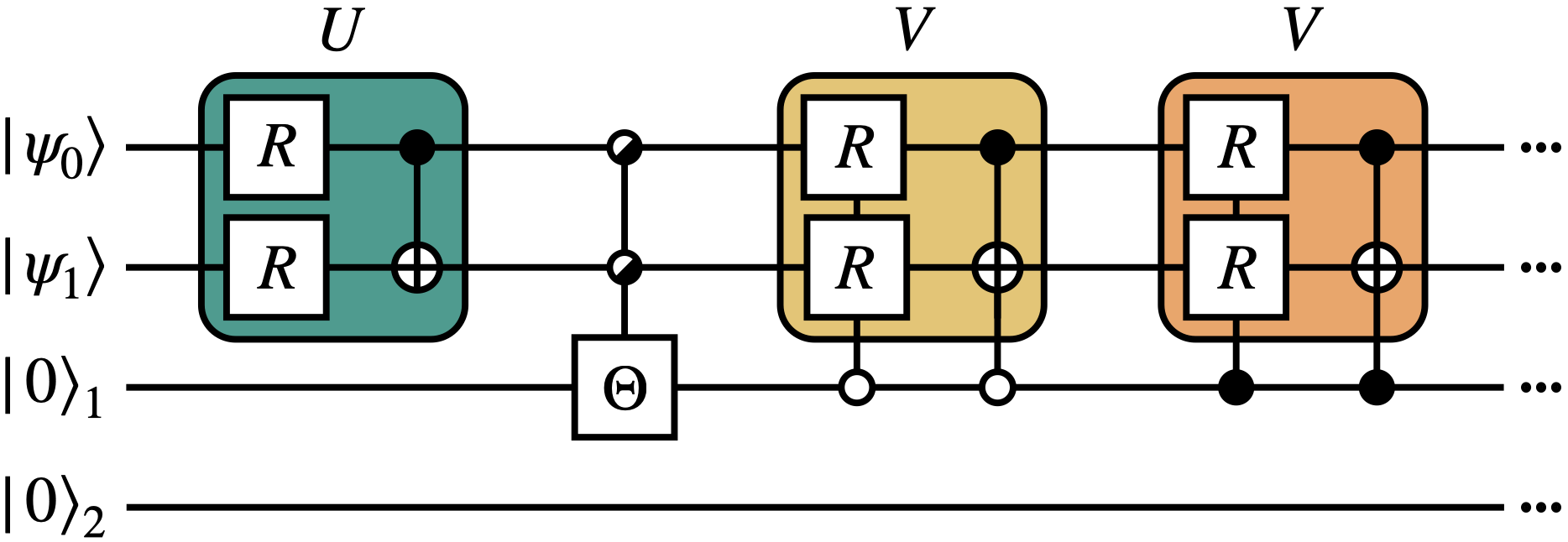
Figure 5: Hybrid Naimark-QNN measurement circuit for two-qubit states, where PQC blocks substitute universal multi-qubit gates in the Naimark structure.
The QNN layers are based either on the hardware-efficient ansatz (HEA) or a circuit-block (CB) configuration, with HEA prioritizing nearest-neighbor connectivity and CB adding long-range entangling gates (Figure 6).
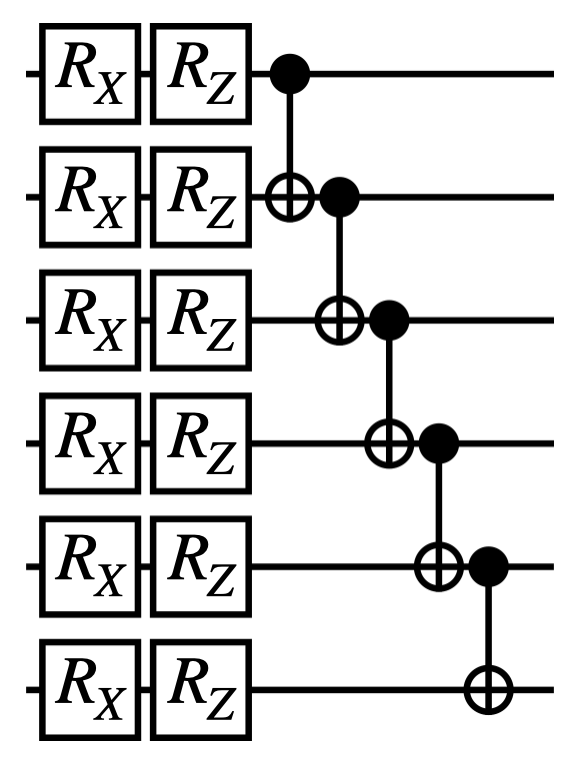
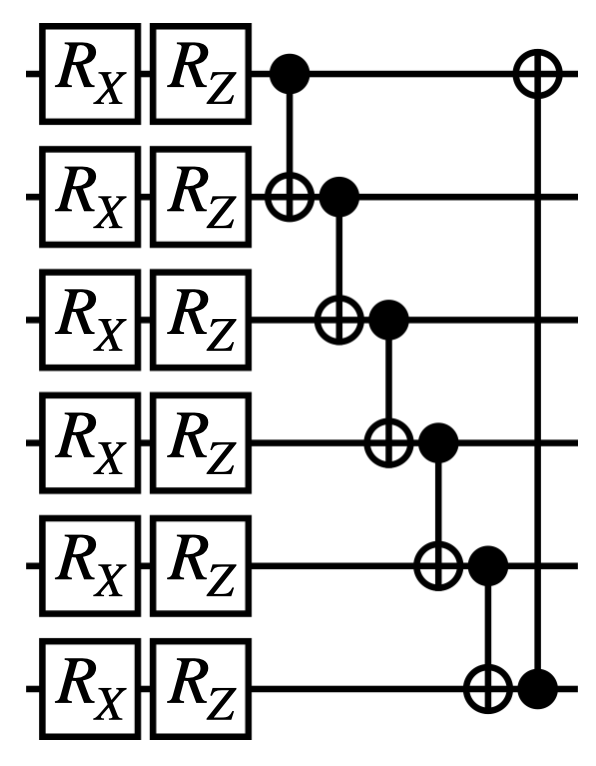
Figure 6: PQC architectures for QNN measurements: (a) HEA with nearest-neighbor CNOTs; (b) CB with enhanced connectivity.
Fully QNN measurement circuits enable l-outcome discrimination by exploiting ancillary qubits and applying multiple QNN layers to boost expressibility (Figure 7).
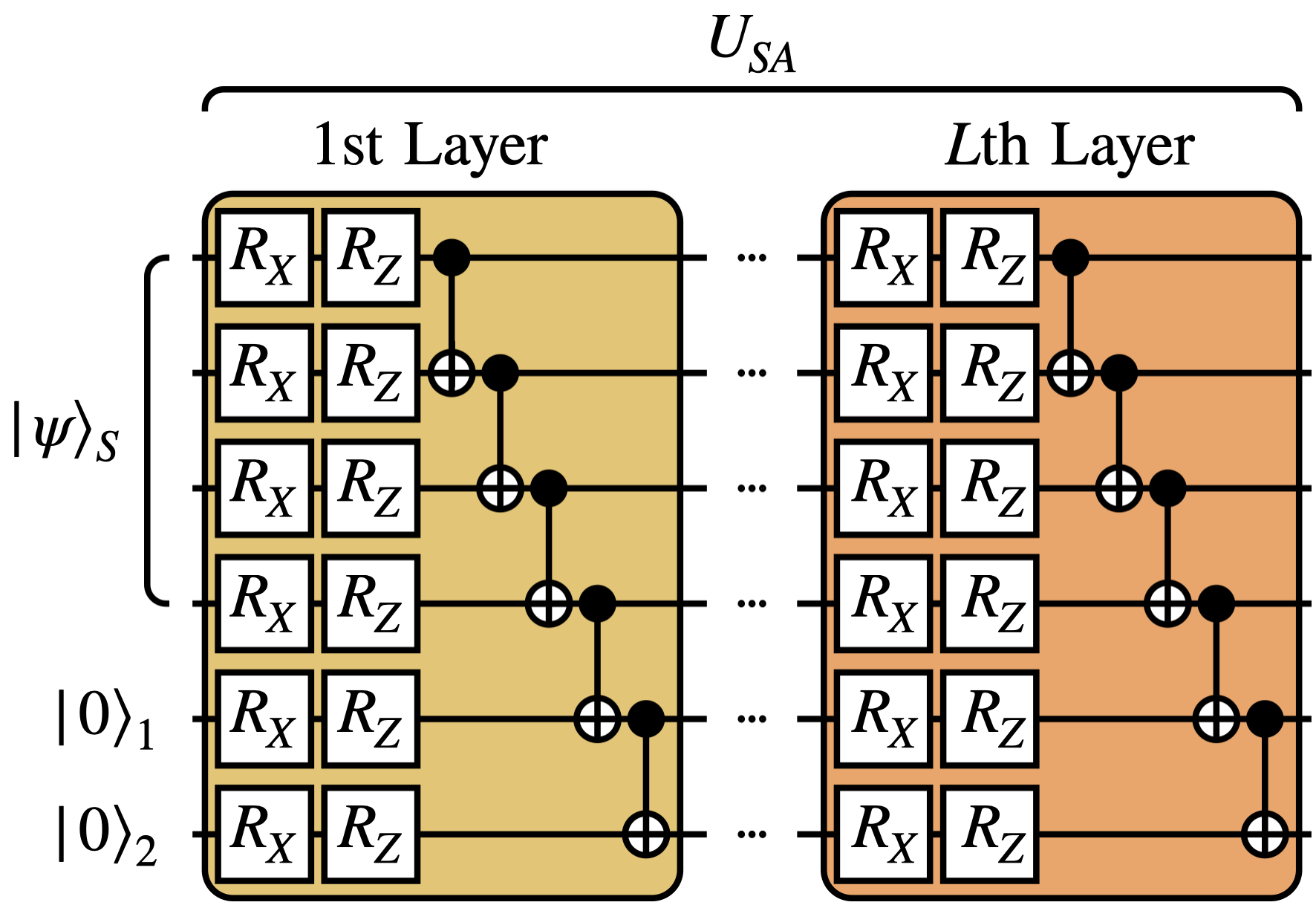
Figure 7: Fully QNN quantum measurement circuit composed of HEA layers, with tunable parameters per layer.
Application to Quantum State Discrimination
The practical efficacy of these measurement circuits is demonstrated through fundamental state discrimination tasks, employing both minimum-error (ME) and maximum-confidence (MC) measurement strategies. The constructed circuits are tested on illustrative ensembles (e.g., trine states and multicopy variants) with classical optimization of parameters, comparing Naimark, hybrid, and fully QNN measurement architectures.
Numerical results indicate that classical optimizers require significantly more iterations to converge for Naimark circuits due to their nontrivial parameter landscapes, while QNN circuits (especially HEA-based) exhibit rapid convergence, albeit with slightly suboptimal final measurement performance (Figure 8).
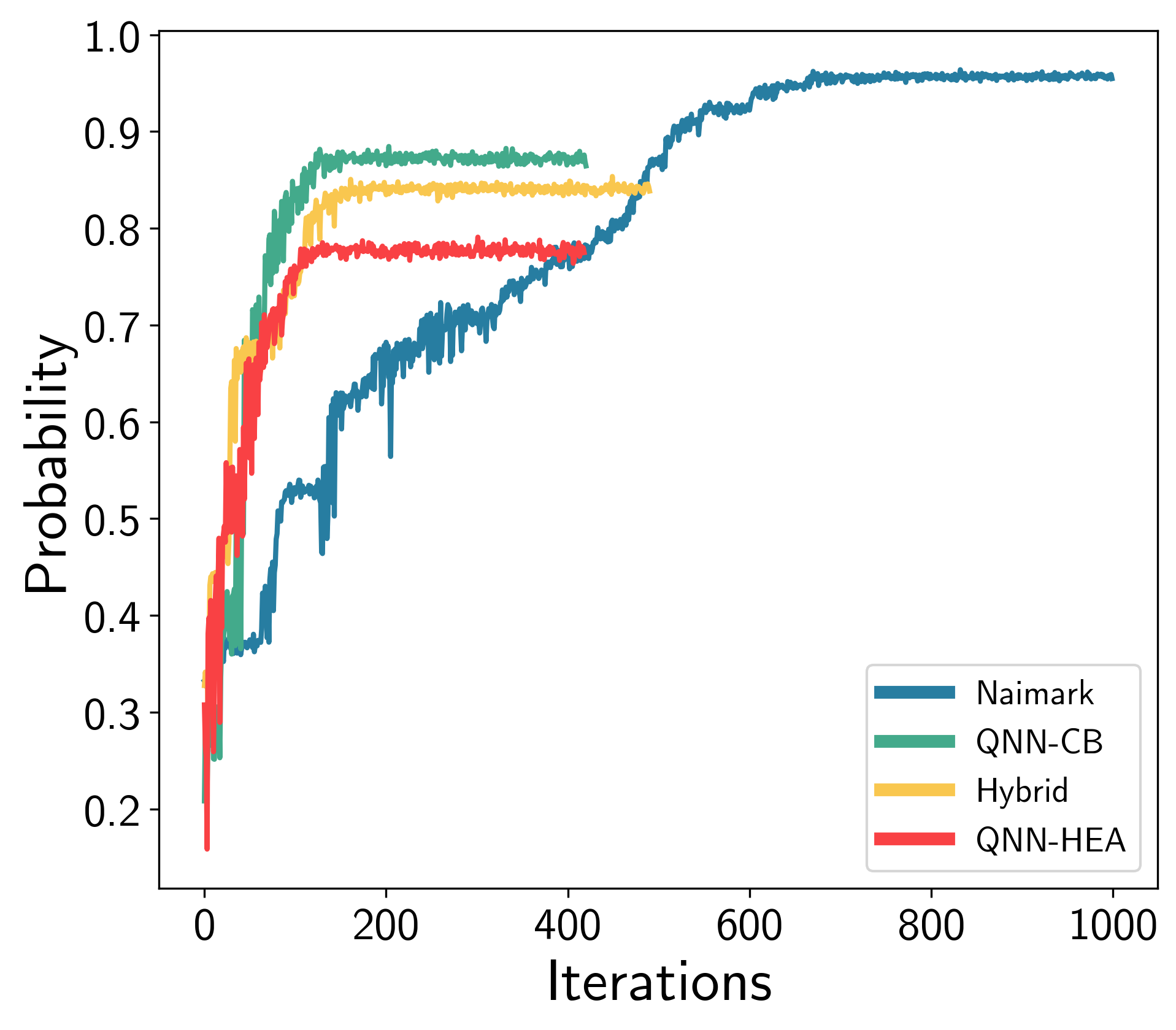
Figure 8: Convergence behavior of classical optimization for ME discrimination; QNN-based circuits converge faster than exact Naimark circuits.
Resource analysis demonstrates that CNOT gate counts scale as USA0 for Naimark circuits, versus linear scaling with the number of qubits for QNN architectures.
Experimental benchmarks on both IBM Q hardware (ibm_strasbourg) and simulator (Qiskit Aer) corroborate these findings: QNN circuits consistently outperform Naimark circuits in training efficiency and robustness to hardware noise, though Naimark measurements remain theoretically optimal when circuit depth and noise are not constraining factors (Figure 9).
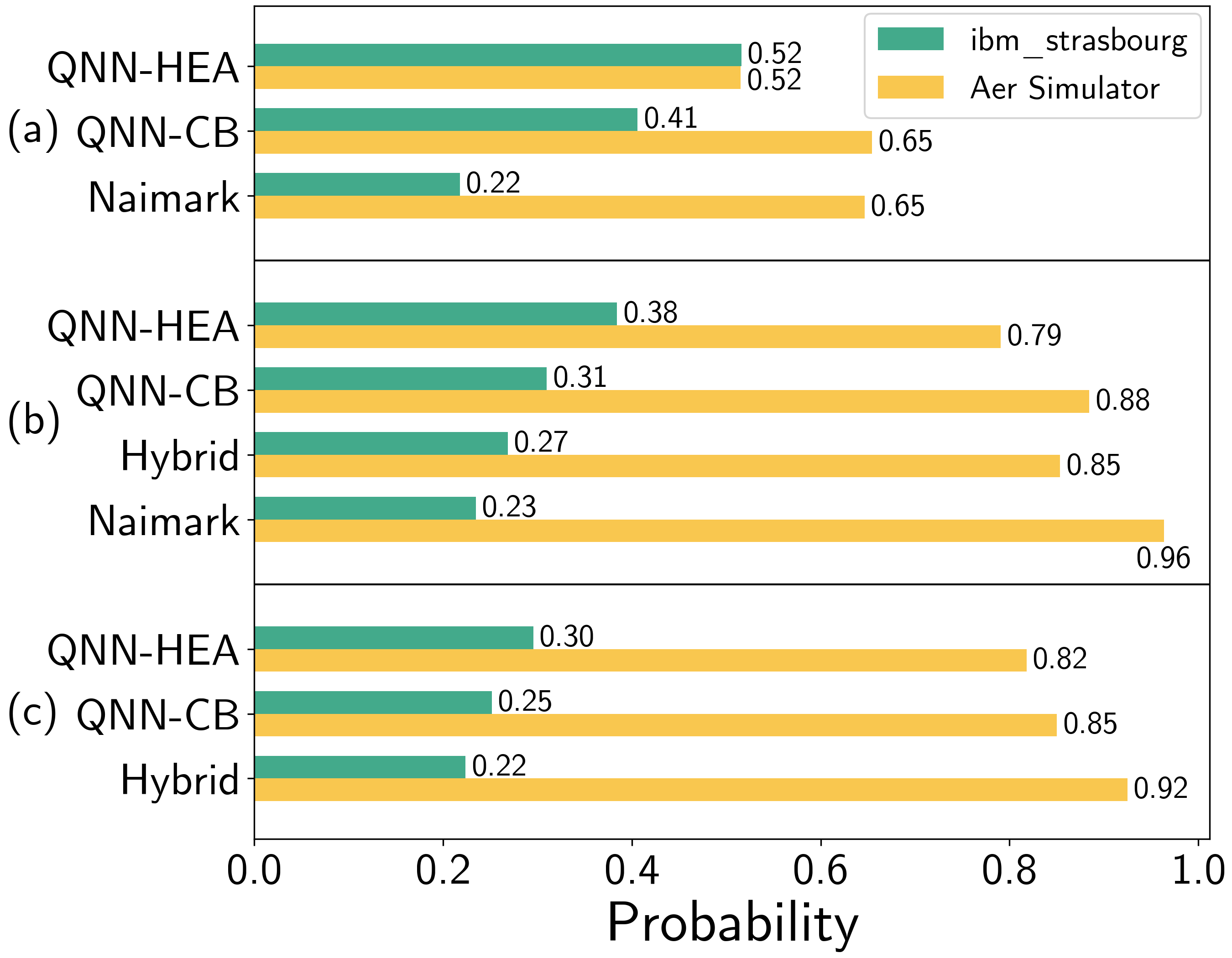
Figure 9: Performance comparison of Naimark and QNN measurement circuits for ME discrimination on real and simulated quantum hardware.
For MC discrimination, block-encoding circuits are constructed to implement USA1 transformations, and unitary parameter optimization is realized via both universal gates and QNN circuits, demonstrating analogous trade-offs (Figures 10, 11, 12, 13).
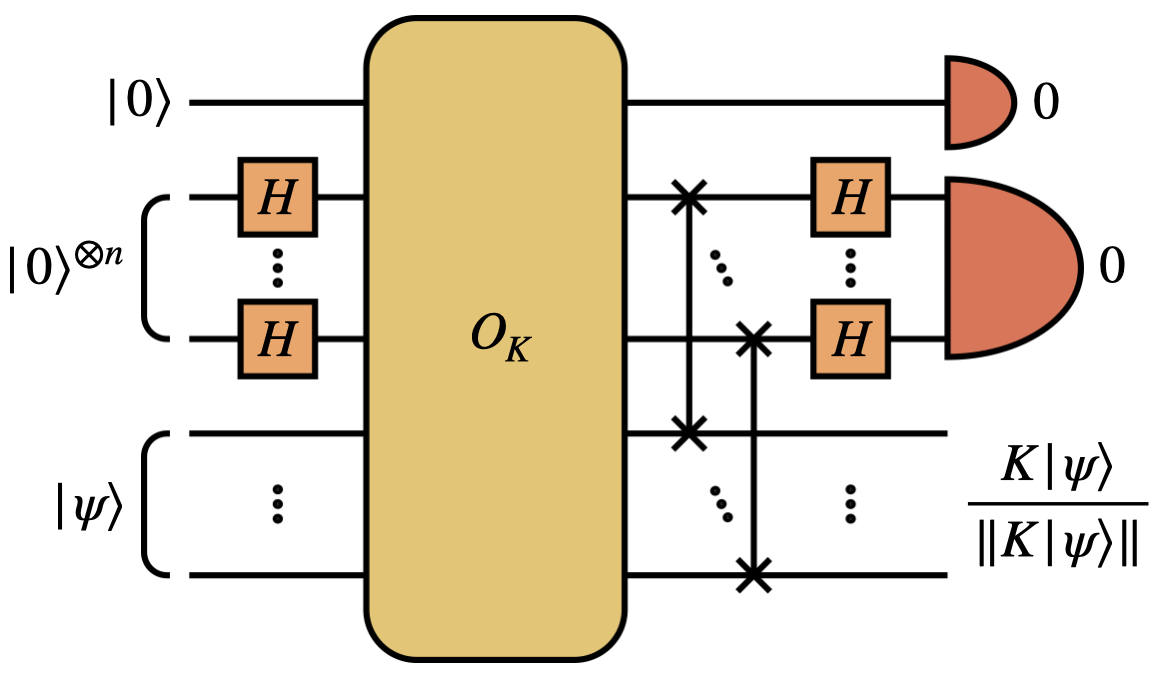
Figure 10: Block-encoding architecture for implementing MC measurement transformations.
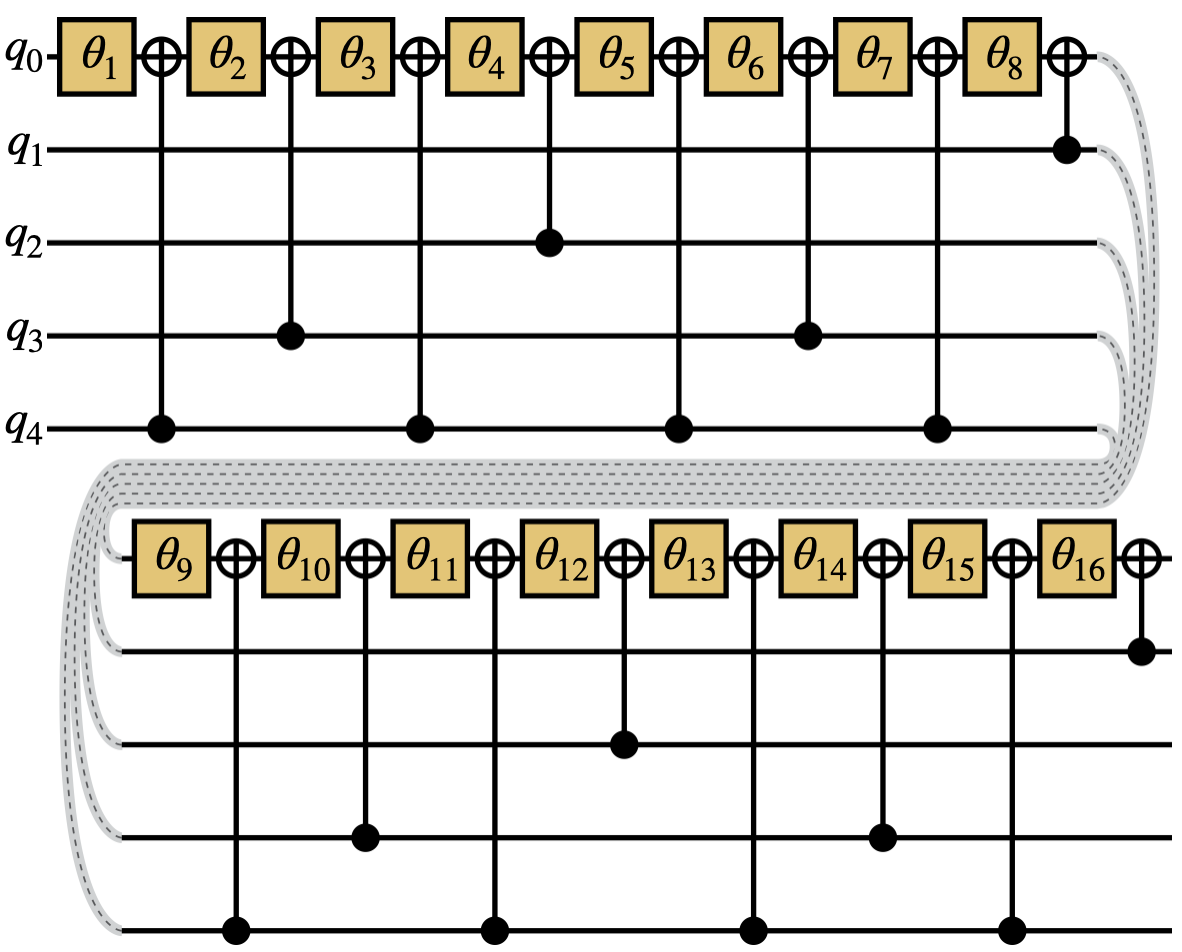
Figure 11: Circuit implementation of unitary block-encoding using Gray code and controlled rotations.
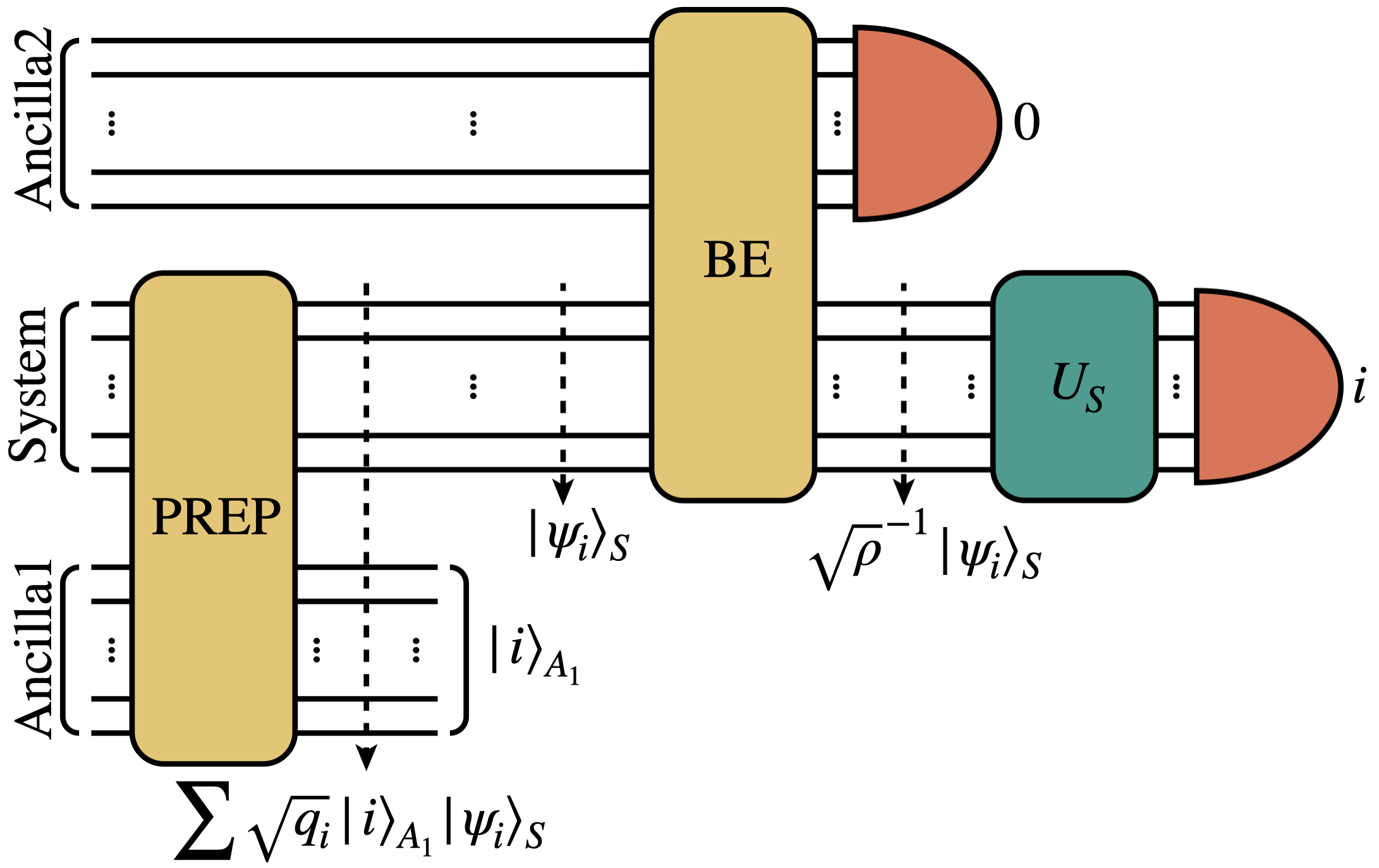
Figure 12: Proof-of-principle circuit for MC discrimination combining state preparation, block encoding, and unitary optimization.
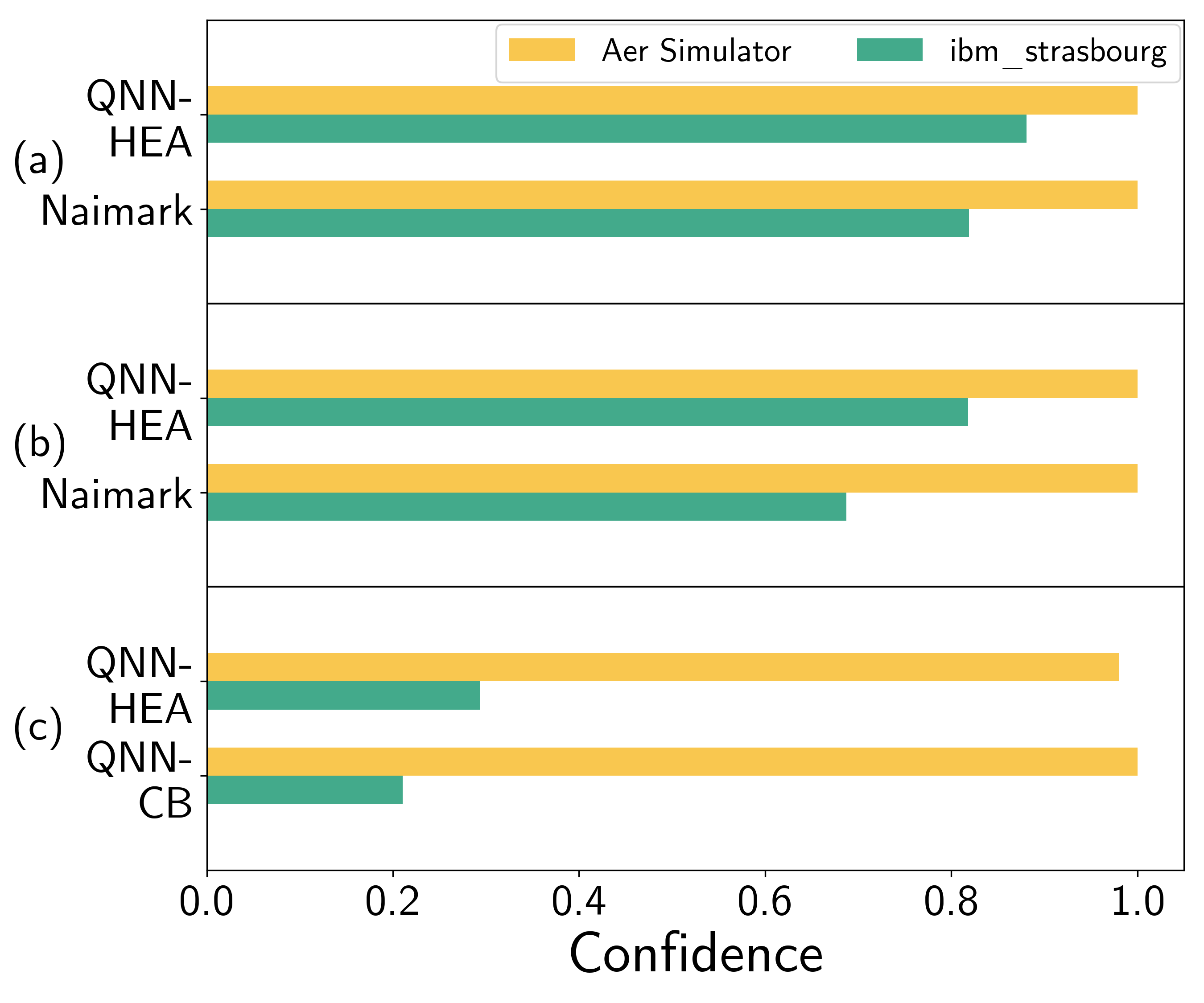
Figure 13: Experimental MC discrimination results on noisy hardware; HEA-based QNN circuits outperform Naimark circuits under noise.
Resource and Optimization Trade-Offs
The strong numerical results can be summarized as follows:
- Optimization efficiency: QNN circuits (especially HEA) require fewer iterations and are more resilient to local minima during classical optimization than Naimark circuits.
- Resource scaling: Naimark circuits scale poorly in CNOT gate count for high USA2 and multi-qubit systems; QNN circuits scale linearly with qubit number.
- Measurement precision: Naimark circuits can, in principle, achieve exactly optimal measurements for ME and MC discrimination, but QNN circuits can efficiently approximate optimal measurements within practical constraints on noisy hardware.
- Hardware suitability: QNN circuits are more compatible with current superconducting qubit architectures (nearest-neighbor connectivity, shallow circuit depth).
Implications and Future Directions
The presented architectures bridge rigorous measurement-theoretic circuit design and practical quantum algorithm engineering for the NISQ era. QNN-based measurement circuits offer scalable, resource-efficient alternatives to universal Naimark constructions and are particularly advantageous on noisy, present-day hardware. The trade-off between optimization efficiency and ultimate measurement fidelity is quantitatively established. Theoretical contributions include connections between measurement circuit optimization and QAOA-inspired complexity landscapes.
Future avenues for research include:
- Development of hybrid measurement circuits that optimally balance shallow depth and expressibility, potentially leveraging error mitigation techniques [Kim_2025, Hicks2022activereadout].
- Investigation into the resilience of measurement circuits to mid-circuit errors and crosstalk [Hothem2025, Sarovar2020detectingcrosstalk].
- Exploration of error-robust measurement certification and design protocols for adaptive state discrimination tasks in larger Hilbert spaces.
Conclusion
This work rigorously formalizes the construction and optimization of measurement circuit ansatzs based on the Naimark theorem and quantum neural network principles, comparing their resource requirements, optimization performance, and applicability to quantum state discrimination. The findings demonstrate that QNN circuits enable efficient, scalable implementation of general measurements on noisy quantum hardware, at the cost of small deviations from theoretical optimality, while exact Naimark circuits remain computationally challenging and impractical for large systems. The architecture landscape charted herein provides crucial guidance for designing measurement protocols in quantum algorithms and information processing for both near-term and future quantum devices.