- The paper identifies six critical open questions in MLIP foundation models, highlighting challenges in definitions, scalability, and benchmarking.
- The paper details innovative methodologies like E(3)-equivariant GNNs and hybrid physics-driven augmentations to improve long-range interaction capture and data efficiency.
- The paper demonstrates that coordinated improvements in model design, data diversity, and computational efficiency are essential for scalable and reliable atomistic simulations.
Six Open Questions in Machine-Learned Interatomic Potential Foundation Models
Introduction
This work rigorously surveys the critical open questions in the rapidly developing field of machine-learned interatomic potentials (MLIPs), with a focus on foundation models designed for generalizable and scalable atomistic simulations. MLIPs play a pivotal role in bridging scales between quantum accuracy and molecular dynamics feasibility by leveraging deep learning models trained on extensive quantum mechanical datasets. With the surge in universal or foundation MLIPs—those trained over diverse chemistries and intended for flexible downstream application—persistent fundamental uncertainties remain concerning definitions, scaling, data requirements, physical fidelity, transferability, long-range interactions, and benchmarking.
Defining Atomistic Foundation Models
A foundational MLIP is interpreted through a lens adopted from broader machine learning, aligning with five central features: expressivity, scalability, memorization, multimodality (here adapted to multi-fidelity), and compositionality. These axes offer a structural taxonomy for evaluating and comparing candidate MLIPs. While classical force fields are highly specialized and depend on manually crafted functional forms, MLIPs instead aspire to be expressive and general across chemical domains without bespoke re-parameterization.
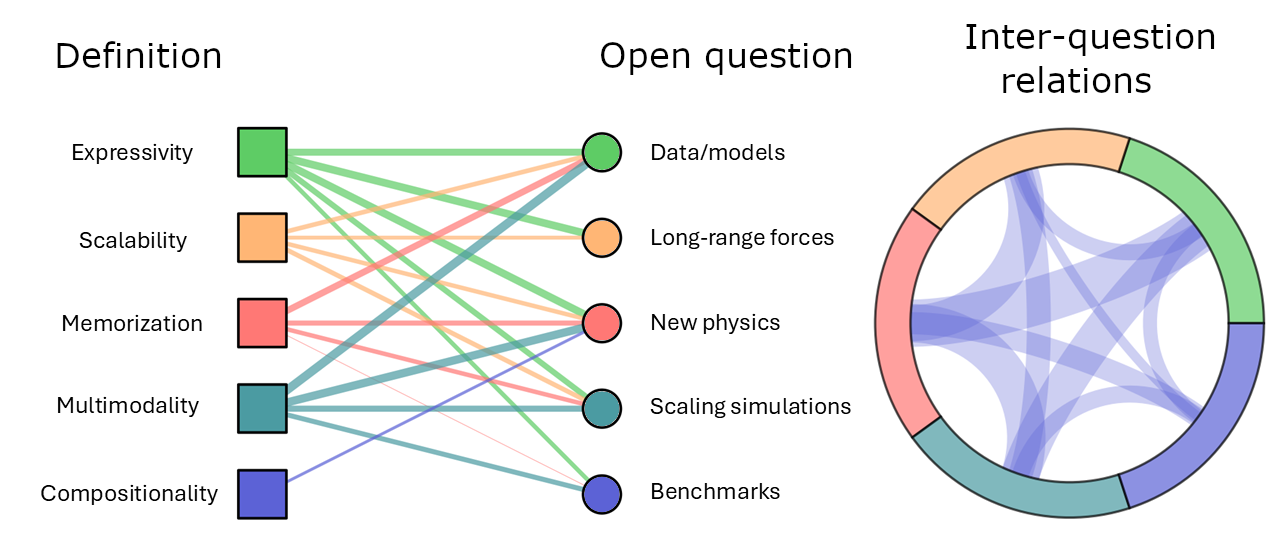
Figure 1: Graphic analysis mapping the five foundation model criteria onto the six open questions for MLIPs and visualizing interrelation among questions and criteria using textual embedding similarity.
Expressivity in MLIPs maps to their ability to represent complex physical phenomena, such as higher-order and long-range interactions, through choices in message-passing schemes, equivariant architectures, and incorporation of inductive biases. Scalability is addressed by empirical scaling laws linking improvement to expanded dataset size, model capacity, and computational resources. Multi-fidelity and compositionality challenge the model to assemble local features into global representations while capturing increasing physical diversity. The field has yet to reach consensus as to which combination of these criteria is necessary or sufficient for a model to be truly “foundational.”
Data and Model: What Limits Progress?
The "better data or better models" dichotomy that famously characterizes AI research is acutely manifest in MLIPs. Empirical evidence points toward non-trivial tradeoffs:
- Model Architecture: Advances such as E(3)-equivariant GNNs, higher-body message-passing, and transformer-based attention architectures have improved sample efficiency and generalization, but must be balanced with computational expense.
- Data Scaling: While increasing dataset size improves generalization, saturation is observed without corresponding increases in model complexity. Over-parameterization can benefit generalization, a phenomenon aligned with deep double descent observed in core ML research.
- Data Quality: High-throughput datasets like those from the Materials Project accelerate progress but suffer from systematic noise, inconsistent fidelity, and overrepresentation of near-equilibrium structures. Methods leveraging multi-fidelity or actively sampled diverse datasets have demonstrated reduced need for expensive high-fidelity labels, and models trained on curated small datasets with diversity-targeted sampling (e.g., MatPES) can match or surpass models trained on orders-of-magnitude more data.
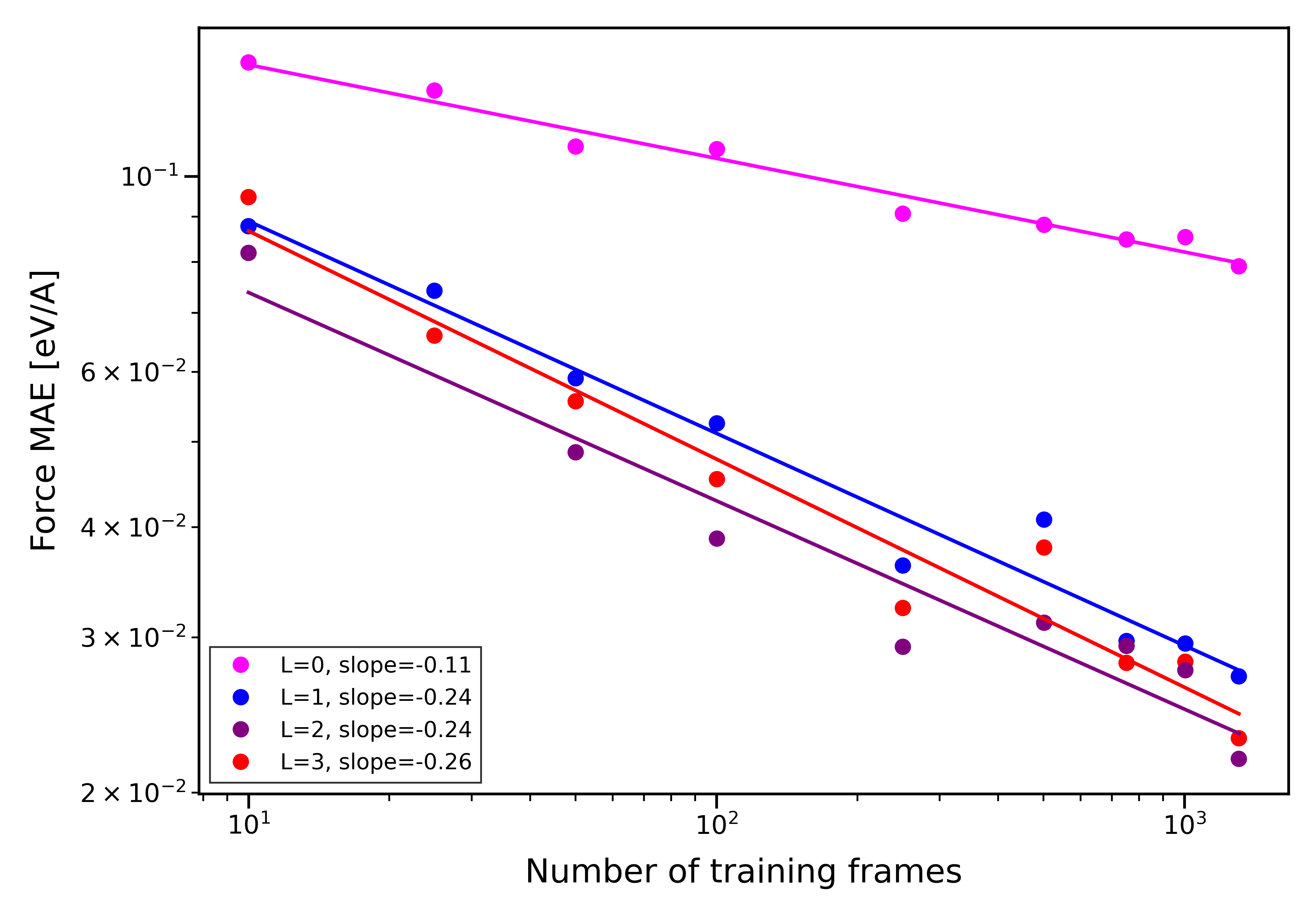
Figure 2: Scaling of predictive force error with training set size for NequIP on water, showing enhanced data efficiency and lower error as equivariant order is increased.
In synthesis, optimal progress in MLIPs will likely require coordinated enhancement of all axes—model architectures incorporating explicit physics priors, diverse and representative high-fidelity data, and efficient training and inference pipelines—not brute-force scaling of any one aspect.
Long-Range Interactions: Limits and Remedies
A central challenge is whether MLIPs can accurately describe long-range physical interactions, including electrostatics, dispersion, and electronic delocalization. While message-passing neural networks (MPNNs) inherit strong locality biases, critical for linear scaling but limiting for systems where perturbations propagate over large distances or through low-dimensional topologies, several mitigation pathways are under development:
- Architectural Innovations: Graph rewiring, introduction of supernodes, hierarchical coarse-graining, and attention mechanisms seek to increase the effective receptive field, mitigating over-smoothing and over-squashing.
- Physics-Informed Augmentation: Hybrid schemes add explicit long-range terms, e.g., Ewald summations, latent charge models, and non-local functionals, to local MLIP frameworks, achieving physical accuracy for electrostatics in periodic and non-periodic systems.
- Data-Driven Insights: It is debated whether explicit induction of long-range components is necessary, or whether sufficiently expressive architectures can capture this physics implicitly, given adequate and appropriately constructed training sets.
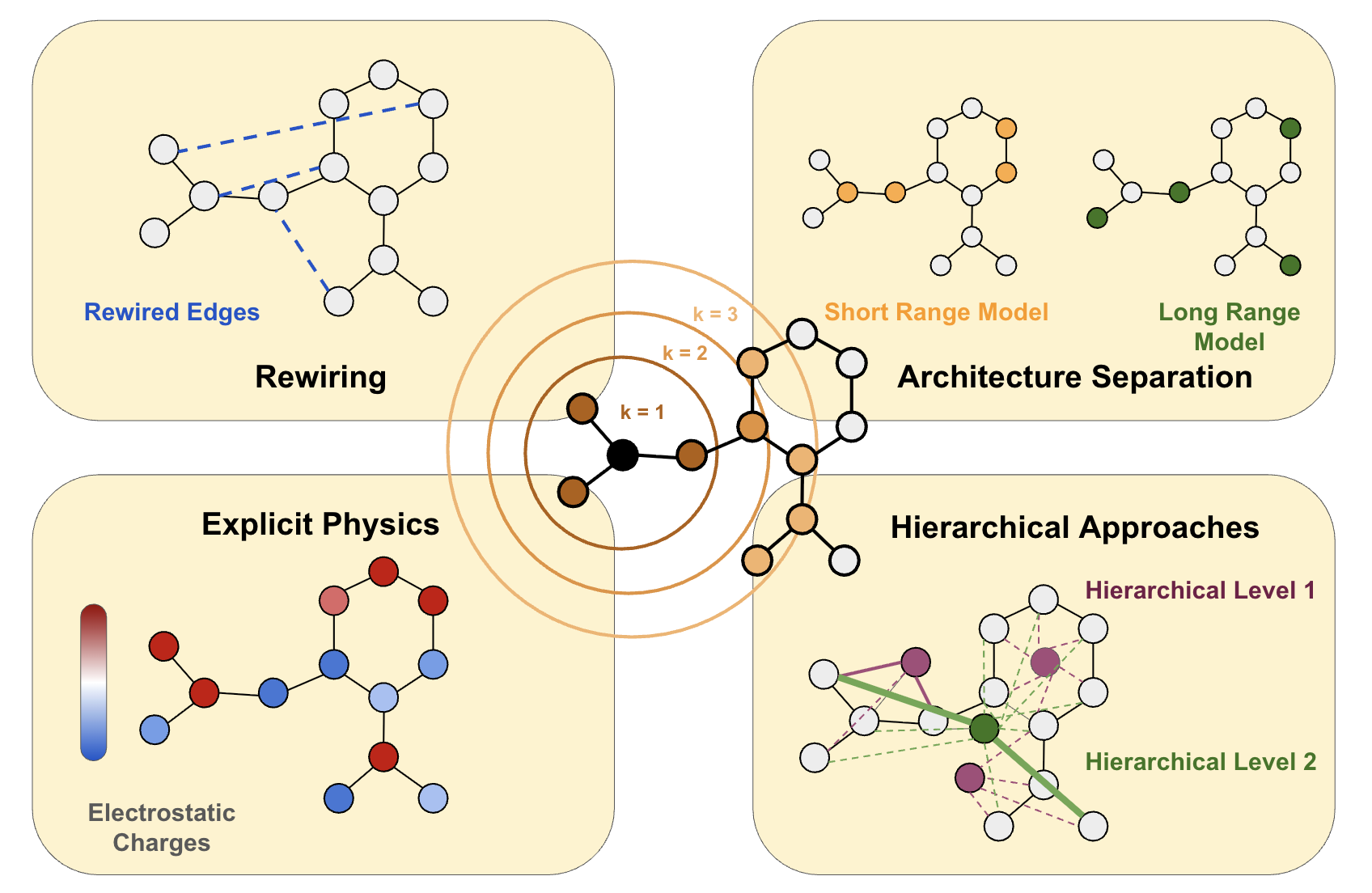
Figure 3: Taxonomy of conceptual and architectural strategies to enable accurate capture of long-range interactions in GNN-based MLIPs.
Despite dramatic progress, there is as yet no unified theoretical framework for long-range MLIPs analogous to ACE for short-range models, and systematized benchmarks are lacking to rigorously compare approaches.
Transferability and the Discovery of New Physics
A hallmark ambition of foundation MLIPs is the ability to discover genuinely new physics—either by revealing previously unseen mechanisms (generalization beyond the training domain) or by yielding interpretable internal representations connectable to physical law. In practice, models excel when interpolating within the domain defined by the training set, but rare-event and high-energy processes such as defect migration barriers or chemical reactivity pose obstacles due to data imbalance and strong inductive biases toward equilibrium. Standard loss metrics, such as RMSE, often fail to capture catastrophic failures in these regions.
Recent studies suggest that in some cases, models trained only on crystal equilibrium data can still facilitate stable liquid simulations, a form of emergent behavior; nonetheless, consistent extrapolative ability—crucial for discovery—is lacking. Interpretability remains an open field, with nascent efforts aiming to extract physically meaningful features using explainable AI tools. Integration of uncertainty quantification, multimodal training (e.g., fusion with experimental data), and active on-the-fly learning workflows enhance applicability but have yet to realize fully autonomous discovery.
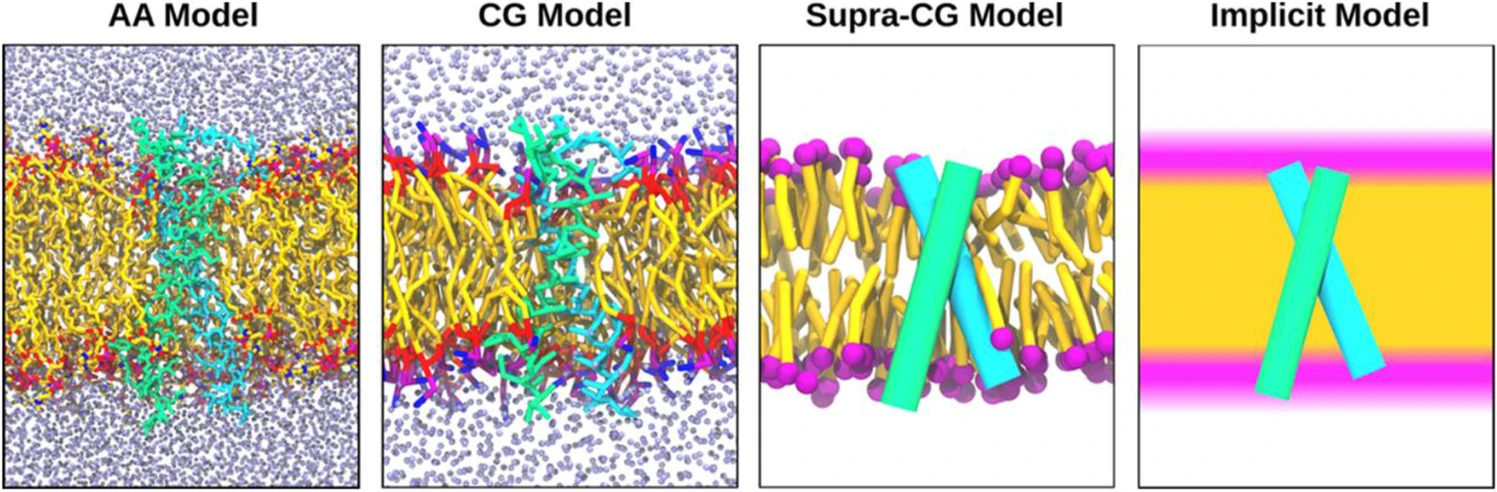
Figure 4: Schematic depicting different molecular resolutions in membrane simulation, illustrating the unresolved scaling challenges in biophysical MLIP modeling.
Scalability and Efficiency for Large-Scale Simulation
Despite their superior accuracy, foundation MLIPs remain computationally expensive—in both inference and memory footprint—relative to classical force fields and sometimes even to moderately sized ab initio calculations. This bottleneck challenges applicability for large system sizes, long MD timescales, and high-throughput studies. Solutions under active development include:
- Efficient Model Designs: Lightweight or distilled models (from large, over-parameterized teachers to compact students) can yield significant acceleration with minimal degradation of accuracy, making million-atom simulation feasible.
- Hardware Integration: High-performance implementations (cuEquivariance, OpenEquivariance) unlock scaling on advanced GPUs, with further speedups from parallel simulation tools like LAMMPS-KOKKOS.
- Architectural and Algorithmic Innovations: Sparse Mixture-of-Experts, quantization, and optimization for batching and data distribution further expand feasible simulation domains.
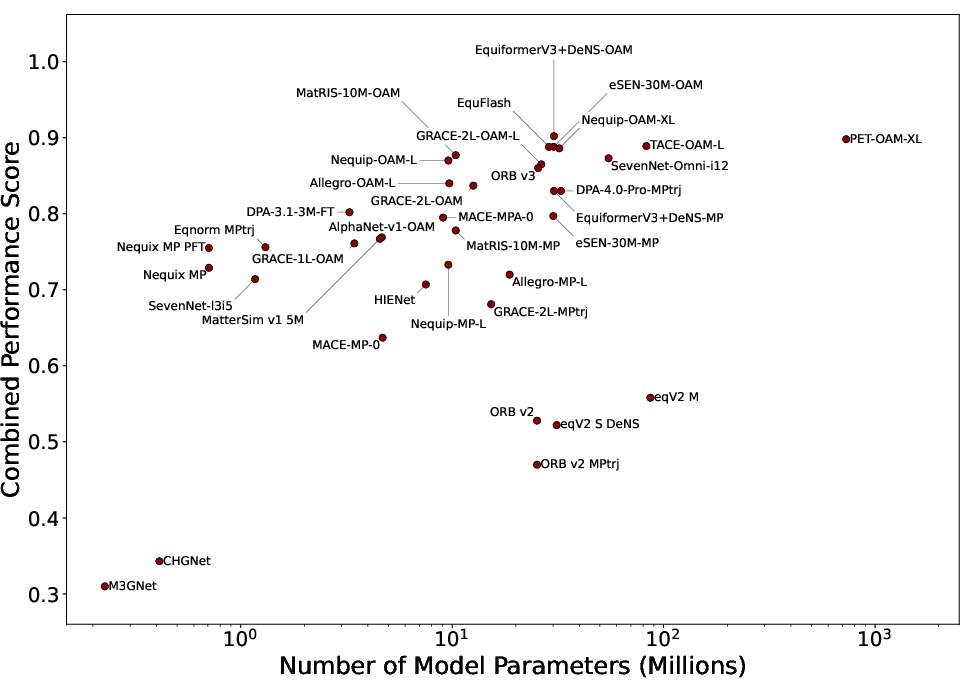
Figure 5: Combined performance score vs. model parameter count across foundation MLIPs, demonstrating accuracy scaling and computational cost on Matbench Discovery.
Open reporting and benchmarking of inference efficiency (not just accuracy) are necessary for fair comparison and for practical decision-making on suitable models for specific simulation workflows.
Benchmarking: Assessing Practical Utility
Benchmarking in the MLIP field has transitioned from purely representational (i.e., RMSE on test sets) to pragmatic and physically relevant evaluations—how long a model can stably propagate an MD simulation, ability to generalize to new compositions, or to accurately predict properties beyond energies and forces. The Matbench Discovery framework combines various metrics into a leaderboard, revealing a saturation of leading models on general-purpose metrics, while new specialized benchmarks (MLIP-Arena, OMol25, matPES) target physical fidelity, generalization, and extreme condition robustness.
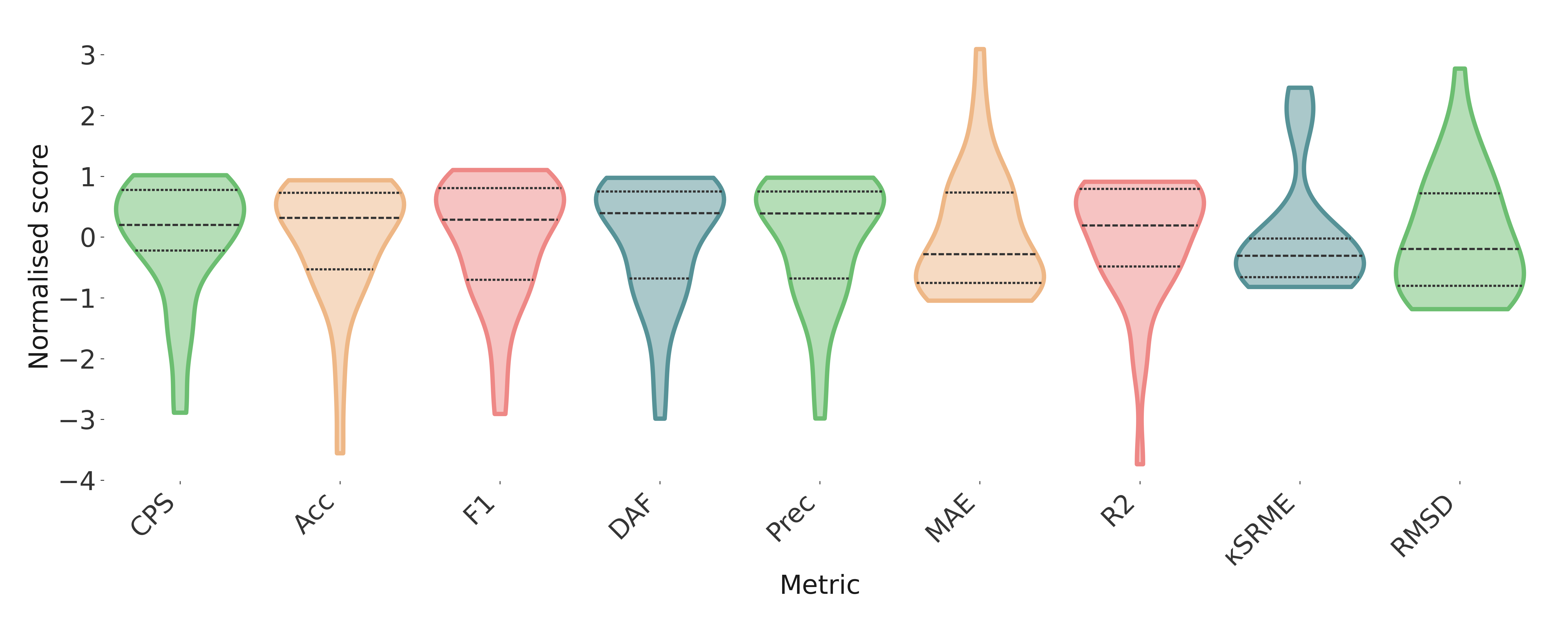
Figure 6: Distribution of performance metric rankings for foundation MLIPs on Matbench Discovery, illustrating tightly clustered scores among top models.
Transparently documented limitations and avoidance of metric over-optimization (Goodhart's Law, McNamara fallacy) are emphasized as critical for faithful progress and comparison.
Conclusion
The development of foundation MLIPs is accelerating the reach of atomistic simulation, enabling access to regimes previously considered infeasible. Notwithstanding impressive numerical results and growing ecosystem diversity, systematic open questions persist regarding definitions, scaling laws, required data diversity and fidelity, proper incorporation of long-range physics, transferability to new domains, computational scalability, and benchmarking best practices. The synthesis of innovations in model architecture, dataset design, scalable computation, and interpretability will be decisive in realizing the full scientific utility of foundation MLIPs. As the field coalesces around robust standards for evaluation and transparent reporting, it stands poised to advance toward true bottom-up materials and molecular design.
References
For referenced numerical results, benchmarks, and architectural advances see the original article "Six Open Questions in Machine-Learned Interatomic Potential Foundation Models" (2606.07327), as well as the most recent updates via Matbench Discovery and the evolving literature cited therein.