- The paper demonstrates that even with complete past data, forecasting error scales as εh^(k+1) due to inherent temporal extrapolation limits.
- It quantifies spatial estimation error, showing that finite sample size M imposes a minimax rate of M^(-γ_d) with γ_d = min(1/d, 1/2), highlighting the curse of dimensionality.
- A unified bound is derived by combining temporal and spatial errors, offering a framework for principled forecasting of distribution-valued dynamical systems.
Minimax Forecastability for Smoothly-Varying Distributions in Wasserstein Space
Problem Motivation and Framework
The paper addresses the fundamental question of the predictive limits for an evolving probability measure-valued process t↦μt in Wasserstein-2 space P: given finitely many noisy samples from past distributions, how accurately can one predict a future distribution at time tn+h? This problem arises in econometrics, population dynamics, and time series analysis where distributions, not just point states, evolve—examples include financial returns, cell populations, and developmental gene expression.
A key technical challenge is the interplay between temporal regularity—formalized as a bound on the k-th covariant derivative ∥∇tkv∥≤ε of the velocity in Wasserstein space—and statistical estimation—the curse of dimensionality intrinsic to the Wasserstein distance over distributions on Rd. The regularity assumption defines a "slowly-varying" or adiabatic class C akin to scalar function extrapolation, allowing for increasingly smooth curves as k increases.
Minimax Lower Bounds: Temporal and Statistical Floors
The authors first establish two types of irreducible forecast errors, which are always present, regardless of estimator.
The first is a dimension-free temporal floor: even with complete knowledge of the entire past trajectory, the error from forecasting h units ahead scales as εhk+1, reflecting the Taylor/geodesic extrapolation remainder. Neither infinite past data nor sample size can improve on this floor (Figure 1).
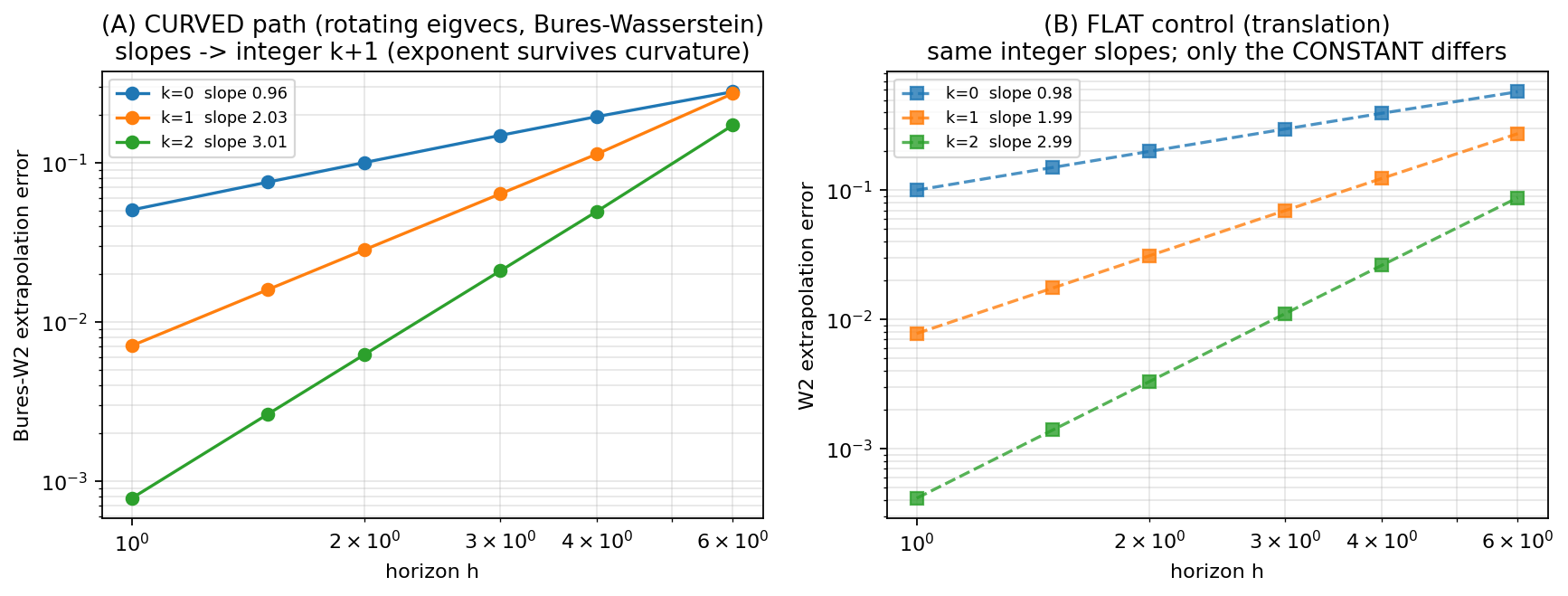
Figure 1: Horizon exponent survives curvature—integer-order Taylor/geodesic extrapolation errors are preserved under nontrivial Wasserstein manifold curvature.
Sample-Limited Statistical Floors
The second floor is imposed by finite sample size P0: when estimating a P1-dimensional measure in Wasserstein-2, the minimax rate is P2, P3. For large P4, this rate degrades dramatically, reflecting the curse of dimensionality. These two limits—temporal extrapolation and spatial estimation—act independently (Figure 2, Figure 3).
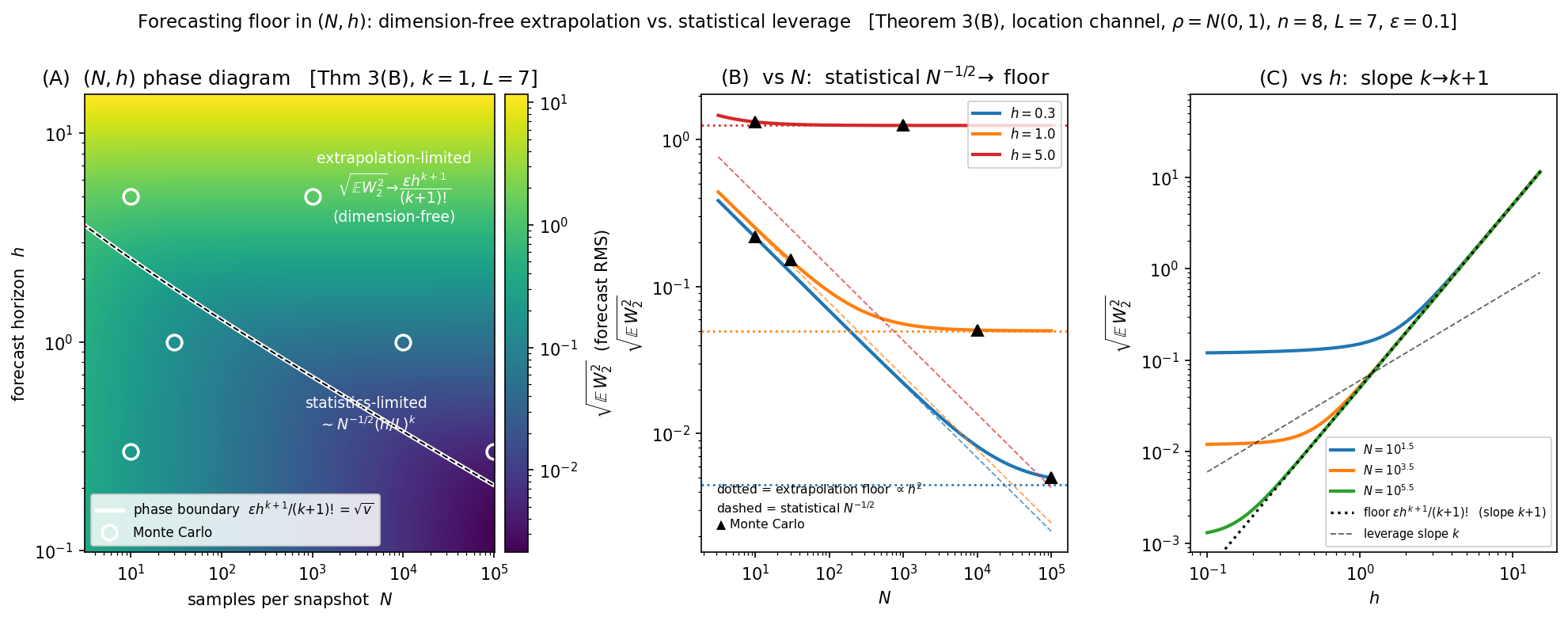
Figure 2: P5 phase diagram—shows the division between extrapolation-limited and statistics-limited regimes; the white curve delineates the two.
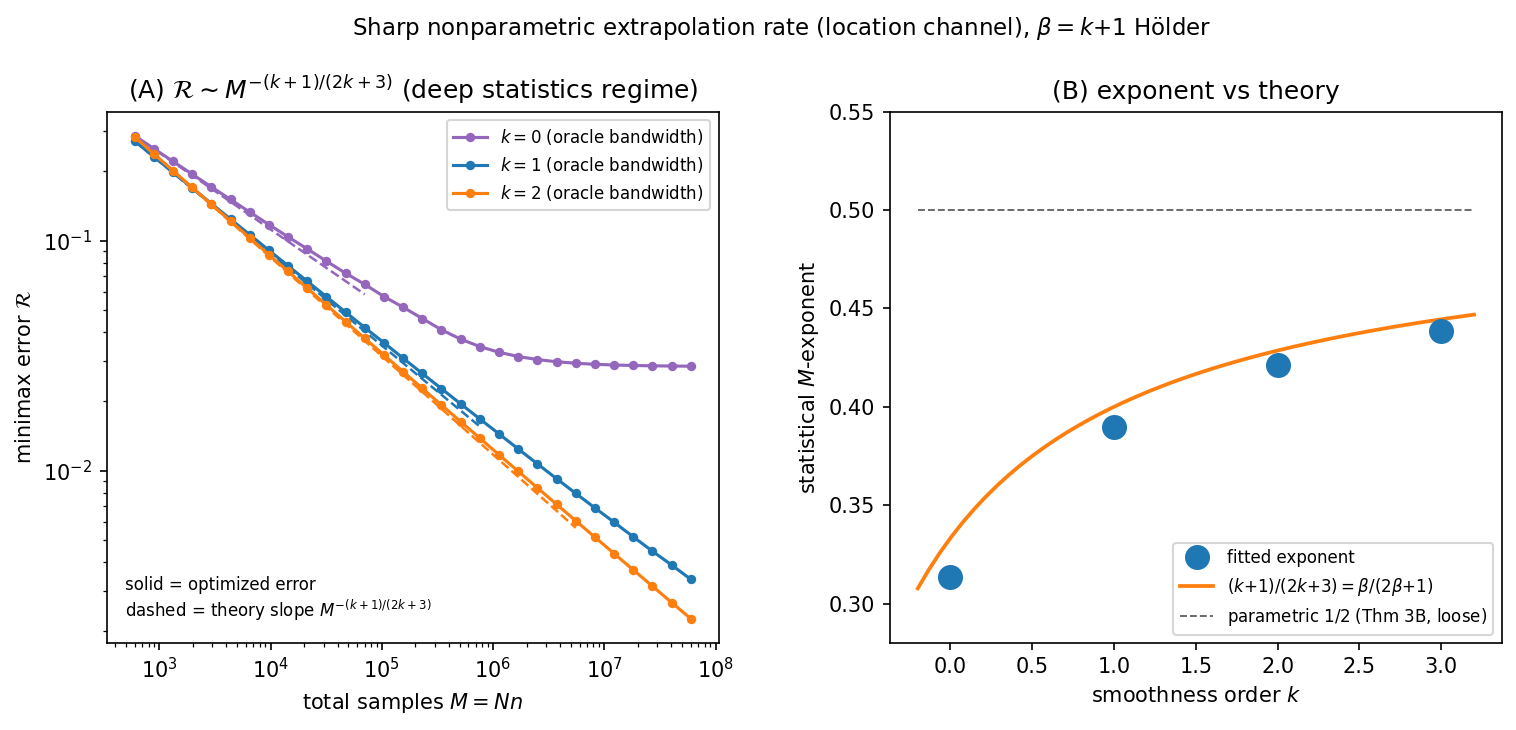
Figure 3: Sharp nonparametric extrapolation rate—optimal bandwidth balancing gives the P6 rate, generalizing H\"older nonparametric estimation to the forecasting domain.
Unified Temporal–Spatial Minimax Rates
The central technical result is a unified lower bound, rigorously derived via a temporal-to-spatial reduction (Lemma~\ref{lem:reach}): the class P7 of curves is exploited to embed a "packing" of measures into a reachable Wasserstein ball along the time axis, and the sample information is controlled using Fano and Le Cam inequalities (Appendix~\ref{app:reduction}). This yields, for regular, locally transport-rich Wasserstein subclasses, the minimax forecast rate:
P8
where P9. As tn+h0, the spatial estimation rate tn+h1 is recovered, i.e., static density estimation, and as tn+h2 decreases or tn+h3 increases, the rate improves (Figure 4).
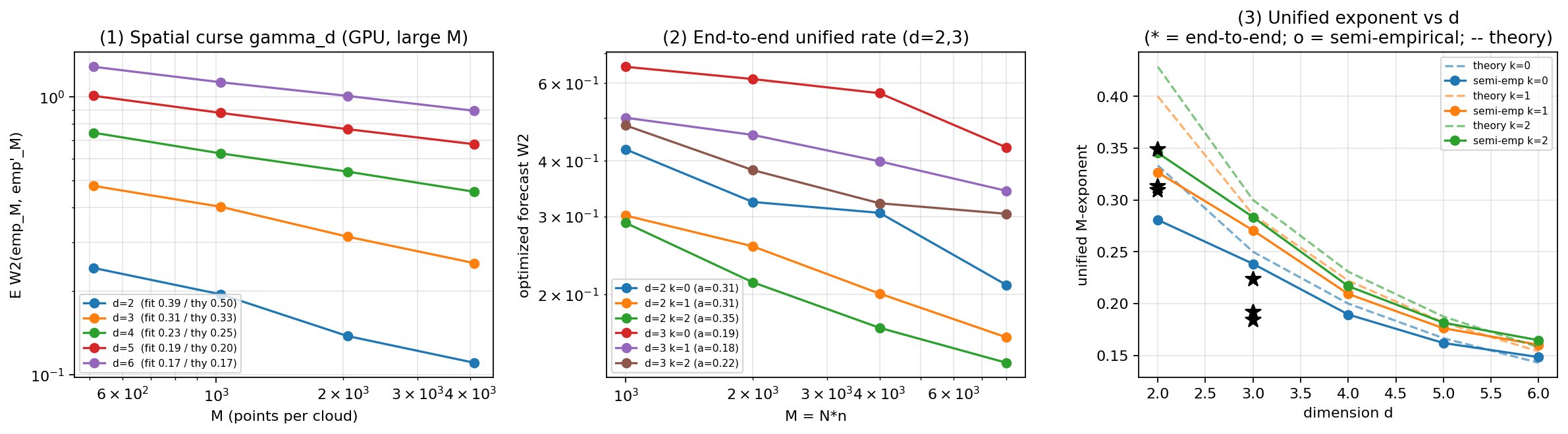
Figure 4: Unified rate over tn+h4—the observed tn+h5-exponent closely tracks the theoretical prediction, with sharp regime transitions due to sampling and temporal smoothness.
Sample Design and Theoretical Phase Structure
A detailed analysis in the translation (location) model yields an analog of minimax H\"older rates: tn+h6, matching classical nonparametric boundary estimation—this showcases how the forecasting problem generalizes nonparametric theory (Figure 3).
The authors formalize the statistical leverage achieved by pooling samples within an "optimal" backward-looking time window tn+h7 preceding tn+h8, optimizing the bias-variance trade-off via the effective sample size allocated by the observation design.
The theory predicts a sharp phase structure: if the forecast horizon tn+h9 is small, statistical limits dominate, and temporal smoothness plays little role. For large k0, extrapolation errors dominate and the estimation cost saturates at the irreducible future uncertainty. This is evidenced both in synthetic and real-data experiments (Figure 5, Figure 6).
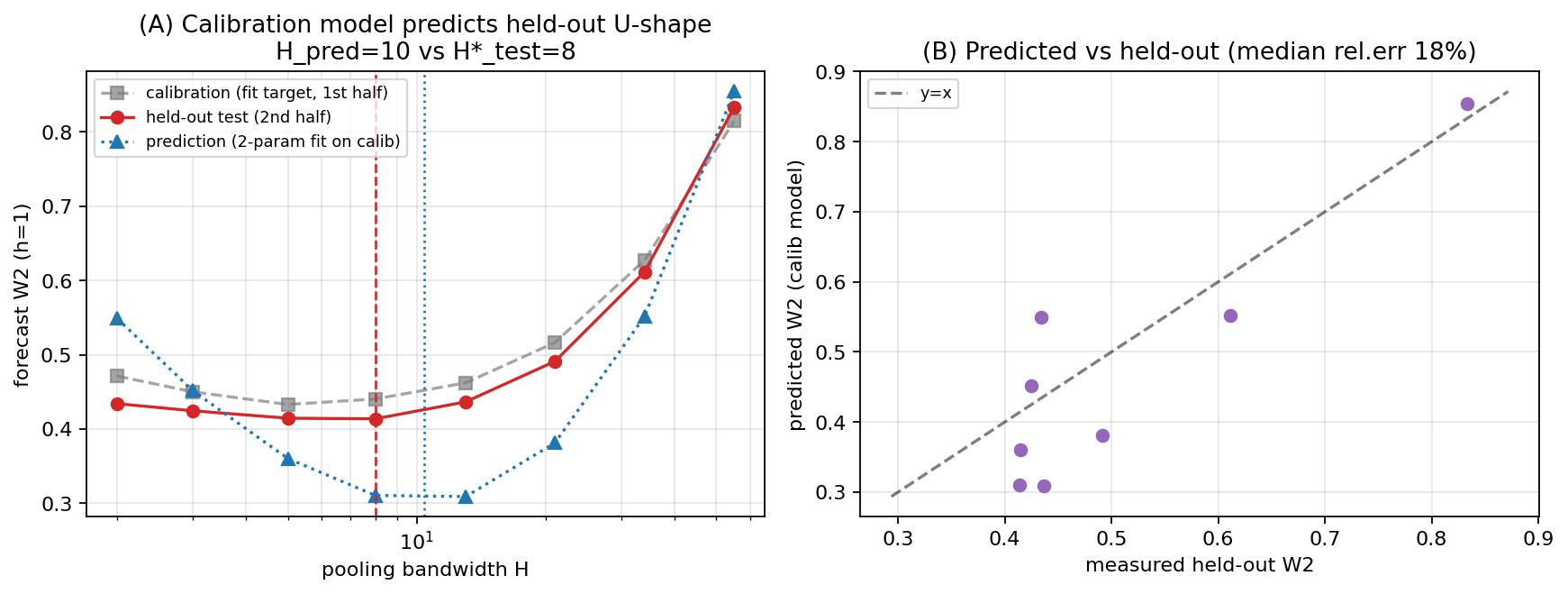
Figure 5: Held-out predictive validation—a bias–variance model calibrated on training data successfully predicts the out-of-sample error minimum.
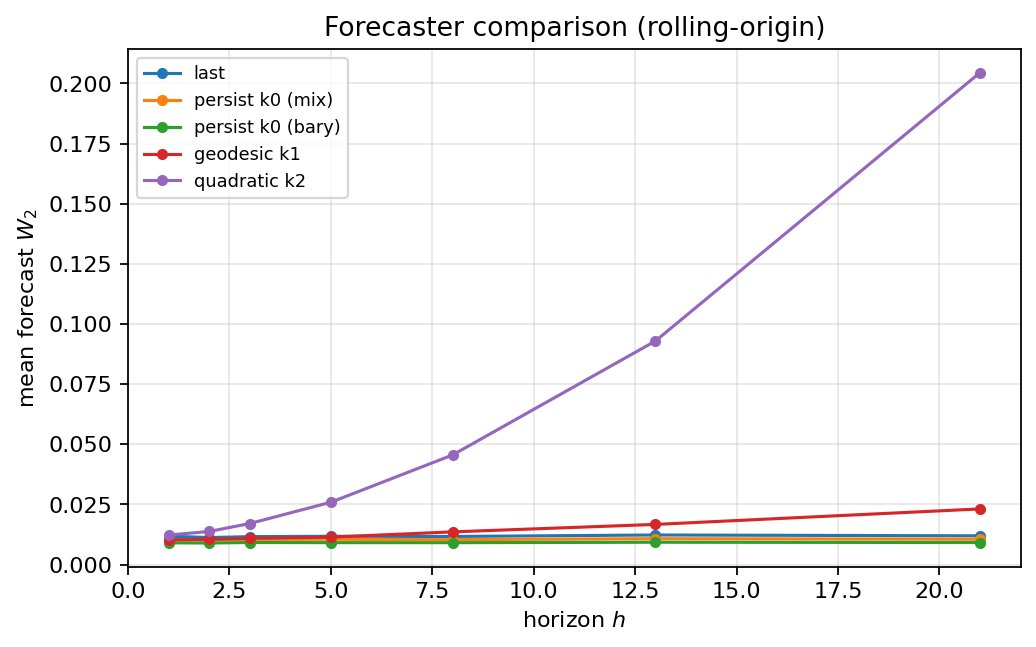
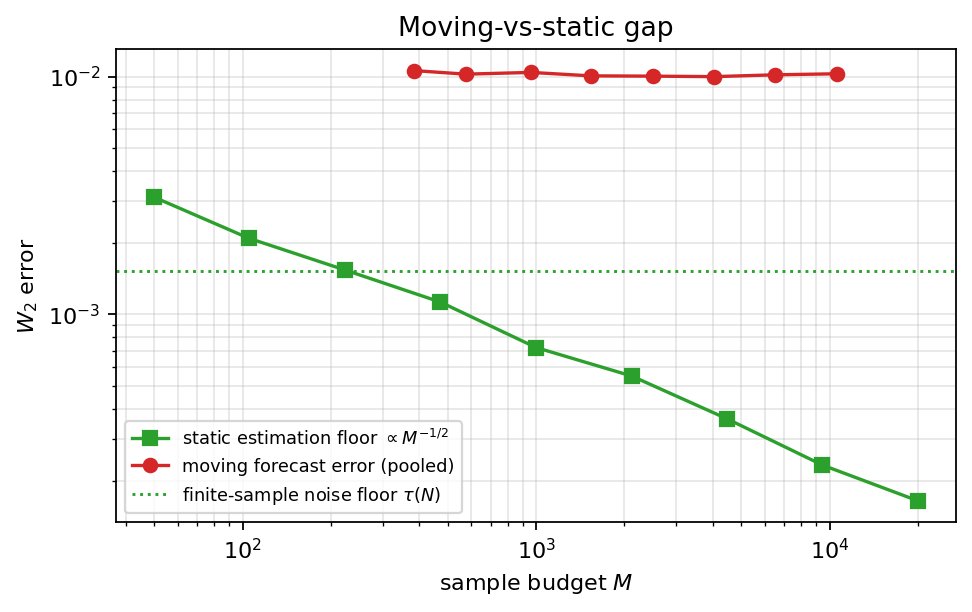
Figure 6: Real-data S&P 500 experiment—degree-0 (persistence) outperforms higher-degree forecasters due to high noise; the moving forecast floor lies well above the finite-sample noise level.
Achievability and Remaining Open Problems
For k1, a pooled-persistence estimator—empirically measuring the target using all samples taken within the optimal window—attains the lower bound. For k2, similar upper bounds are shown in translation/Gaussian submodels using local polynomial geodesic regression; however, the fully general case remains open except conditionally (Figure 7). The technical obstruction is the bias analysis in curved Wasserstein geometry, requiring strong regularity and curvature control.
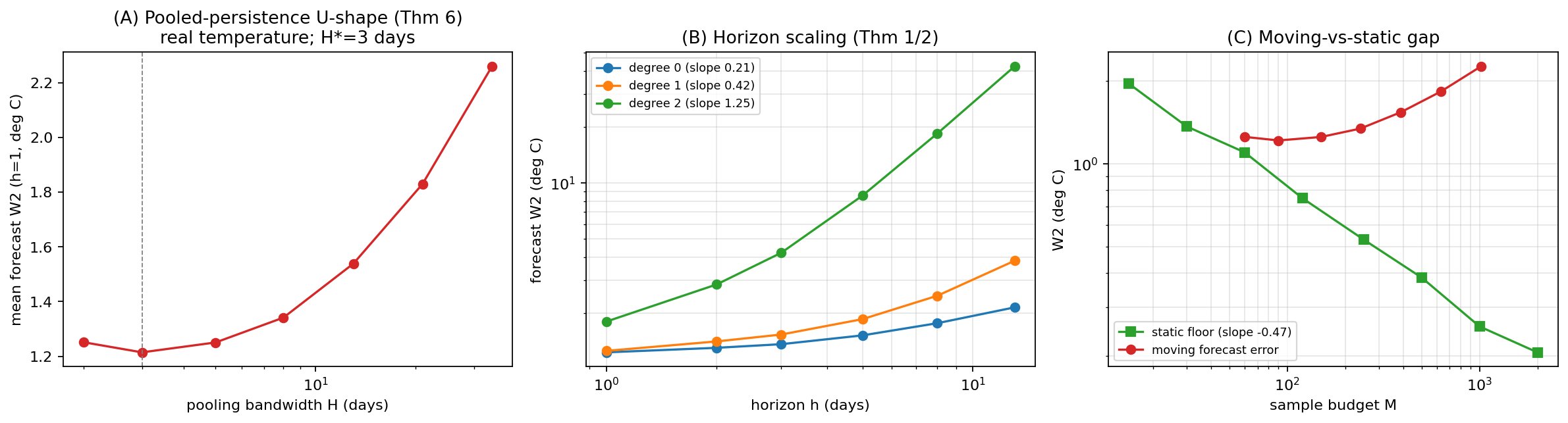
Figure 7: Strongly-drifting temperature field—distinct optimal bandwidth denotes true drift; fitted exponents clearly distinguish between smooth (temperature) and noisy (S&P) regimes.
Conditional Upper Bounds and Open Directions
Matching upper bounds for general k3 rely on two conditional estimates: a comparison-geometry bias control, and a minimax-optimal map-estimation rate for the statistical term. These are accessible on flat submanifolds or with smooth densities, but not established for the full class of locally transport-rich Wasserstein curves, due to the complexities of second-order Otto calculus and curvature behavior.
Notably, the minimax lower bound is unconditional and relies only on elementary packing and probabilistic arguments. The match between lower and upper rates for k4 and for all k5 on translation/Gaussian submodels is numerically confirmed (Figure 4).
Implications, Practical Recommendations, and Future Directions
The results delimit, for the first time, the precise interplay between smoothness-driven extrapolation and finite-sample estimation error for distributional time series in Wasserstein space. In practical terms:
- For high-dimensional (k6) or weakly regular (k7 small) problems, sample size offers little statistical improvement beyond a short forecast horizon;
- For strongly regular dynamics or low dimension, significant pooling is justified and longer-horizon distributional prediction is feasible if smoothness can be certified empirically;
- The effective optimal forecasting order is data-dependent and can be adaptively selected based on observed hold-out behavior (Figure 5, Figure 6, Figure 7);
- Applying higher-order (e.g., geodesic/spline) extrapolation without evidence of strong smoothness can amplify sampling noise and degrade performance on real data (Figure 6).
Theoretical and Methodological Impact
The paper rigorously extends nonparametric minimax theory and temporal extrapolation into the infinite-dimensional, geometrically nontrivial setting of Wasserstein space. It develops considerable technical machinery sharpened to disentangle time and space limitations, providing a natural framework for future analyses of statistical learning in distribution-valued dynamical systems.
Outstanding open problems include establishing curvature-stable, unconditional upper bounds in general Wasserstein submanifolds, understanding minimax-optimal transport map estimation rates for complex support, and developing computationally feasible procedures that can adapt to unknown smoothness, dimension, and memory constraints.
Conclusion
This work establishes a sharp, unified minimax rate for the statistical forecast of slowly-varying distributions in Wasserstein-2 space, separating the irreducible limits imposed by temporal smoothness from those arising out of finite-sample spatial estimation. Both theoretical analysis and empirical evidence confirm the presence and tight interaction of these regimes, offering a blueprint for principled forecasting—and for understanding the fundamental limitations—when the objects of inference are distributions that move in time. The open technical questions about curvature, statistical estimation of transport maps, and fully adaptive methods present promising directions for future theoretical and computational advances.