- The paper demonstrates that RR quantum mechanics yields physically robust and real observables in non-Hermitian XY models despite the complexity of the spectrum.
- It reveals that quantum criticality and phase transitions depend on the choice of reference state, contrasting minimal energy states and steady states under different protocols.
- Analytical tools like Jordan-Wigner transformations and Fisher-Hartwig theory are employed to derive precise characterizations of energy density, magnetization, and correlation decay.
Introduction
Non-Hermitian many-body systems, especially those within the framework of open quantum systems, challenge conventional understandings of phase transitions, observable definitions, and ground state selection. The paper "Quantum critical properties of non-Hermitian XY models with magnetic field" (2606.07275) provides a detailed analytical and numerical investigation of two non-Hermitian XY spin-1/2 chains subject to anisotropy and a complex magnetic field, establishing a comprehensive paradigm for quantum criticality in such settings. The study addresses the ambiguities surrounding the choice of quantum mechanical formalism (standard vs. biorthogonal) and the physically meaningful selection of reference states for criticality in models with complex spectra.
The analysis explicitly compares standard (right-right, RR) and biorthogonal (left-right, LR) quantum mechanics for expectation values and observables in non-Hermitian systems. The RR formalism uses the standard quantum mechanical expectation value ⟨O⟩=⟨ψ∣O∣ψ⟩/⟨ψ∣ψ⟩, ensuring observables are physically interpretable and typically real for Hermitian operators. In contrast, the LR approach employs distinct left and right eigenstates, leading to expectation values of the form ⟨E~∣O∣E⟩/⟨E~∣E⟩, which can yield complex values or even ill-defined results for physical observables.
The paper presents strong numerical and analytic evidence that the RR formalism is physically robust for open quantum systems with non-Hermitian Hamiltonians, whereas LR results can become unphysical, notably yielding complex magnetization and pathological behavior in correlation functions near criticality.
Ground (Reference) State Selection and Protocol Dependence
A central conceptual difficulty in non-Hermitian systems is the absence of a canonical ground state due to the complex eigenvalue spectrum. The analysis systematically investigates two natural reference states for critical property analysis:
- The minimal energy state: the eigenstate with minimal real part of energy, analogous to the ground state in Hermitian systems.
- The steady state: the eigenstate with maximal imaginary part of energy, dominating observables in the long-time limit under non-unitary evolution.
The physical realization of these states is shown to depend on the specific experimental preparation and evolution protocol, especially in quantum trajectories governed by a non-Hermitian effective Hamiltonian under continuous measurement (post-selection, no-jump trajectories). The resulting phase diagrams and critical properties demonstrate a strong dependence on this choice.
Model Definitions and Analytical Solution
Both non-Hermitian XY models are mapped onto quadratic fermion models via Jordan-Wigner and Bogoliubov transformations. Analytical expressions for energy density, magnetization, and two-point correlation functions are derived for both formalisms:
- The complex-λ XY model, with λ∈C and real γ, yields a non-Hermitian extension able to interpolate between Hermitian and various non-Hermitian regimes by tuning Re(λ), Im(λ), and γ.
- The imaginary-γ XY model, with purely imaginary anisotropy and real magnetic field, exhibits an antiunitary symmetry (RK symmetry), leading to well-defined regions with real and complex spectra.
The asymptotic behavior of spin-spin correlation functions is computed using Pfaffian and Toeplitz determinant representations, enabling precise analysis of long-distance critical exponents and correlation lengths.
Phase Diagrams and Quantum Criticality
Complex-⟨E~∣O∣E⟩/⟨E~∣E⟩0 XY Model: Phase Structure
Critical points are determined via non-analyticities in the energy density and its derivatives. For the minimal energy state, three phases—FM (ferromagnetic), LL (Luttinger liquid), and PM (paramagnetic)—are identified, demarcated by analytic boundaries in the ⟨E~∣O∣E⟩/⟨E~∣E⟩1 space.
The FM phase is characterized by long-range order in the ⟨E~∣O∣E⟩/⟨E~∣E⟩2- and ⟨E~∣O∣E⟩/⟨E~∣E⟩3- correlation functions, with LL corresponding to quasi-long-range (power-law) order and PM exhibiting exponential decay.
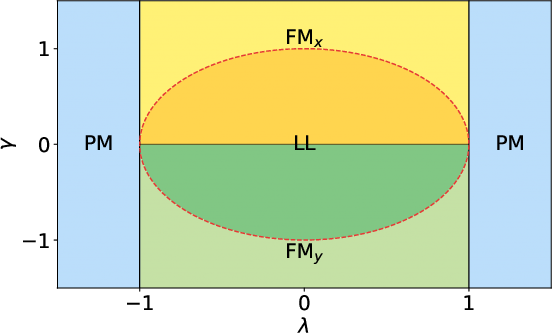
Figure 1: Ground state phase diagram of the Hermitian XY model in the ⟨E~∣O∣E⟩/⟨E~∣E⟩4 plane, also delineating transition lines relevant to non-Hermitian extensions.
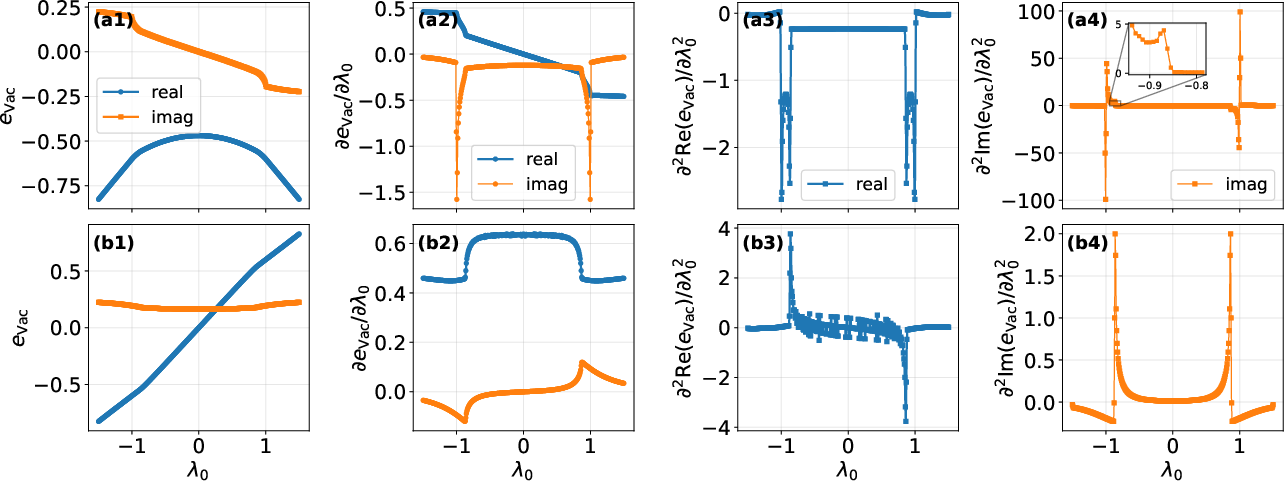
Figure 2: Energy density and its derivatives as a function of ⟨E~∣O∣E⟩/⟨E~∣E⟩5 at fixed ⟨E~∣O∣E⟩/⟨E~∣E⟩6 and ⟨E~∣O∣E⟩/⟨E~∣E⟩7, highlighting critical points for minimal energy and steady states.
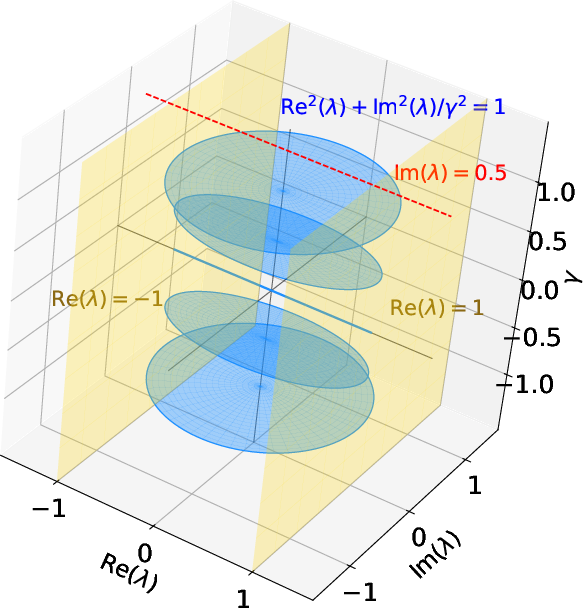
Figure 3: Three-dimensional phase diagram of the complex-⟨E~∣O∣E⟩/⟨E~∣E⟩8 XY model for the minimal energy state, with surfaces and sheets identifying FM, LL, and PM regions.
For the steady state, only LL and PM phases persist; the FM phase is absent due to the analytical structure of the imaginary part of the spectrum.
Imaginary-⟨E~∣O∣E⟩/⟨E~∣E⟩9 XY Model: λ0-Symmetry Breaking
The phase diagram now also resolves regions of unbroken/broken antiunitary symmetry, in direct analogy to PT-symmetric quantum systems. The transition between real and complex spectra overlays additional structure onto the magnetic phase diagram, and correlators exhibit nontrivial critical exponents across the λ1 symmetry-breaking line.
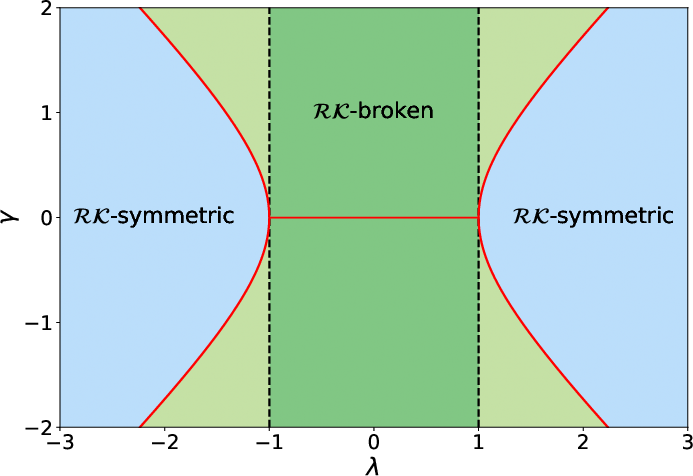
Figure 4: Phase diagram of the imaginary-λ2 XY model, showing λ3 symmetry-breaking lines and magnetic phase boundaries at λ4.
Correlation Functions and Critical Exponents
Precise asymptotic analysis, including use of Fisher-Hartwig theory for Toeplitz determinants, reveals the critical exponents for correlator decay as a function of parameters and reference state. The authors provide closed-form analytical and extensive numerical results for both RR and LR correlations.
Strong numerical evidence is presented for:
- Power-law decay with non-universal exponents in LL phases (RR, minimal energy), universal λ5 exponent in LL phases for LR (biorthogonal).
- Exponential decay in PM phases with analytically determined correlation lengths, governed by complex poles of the excitation spectrum.
- Distinct, sometimes ill-defined, LR (biorthogonal) correlators, especially near certain critical boundaries.
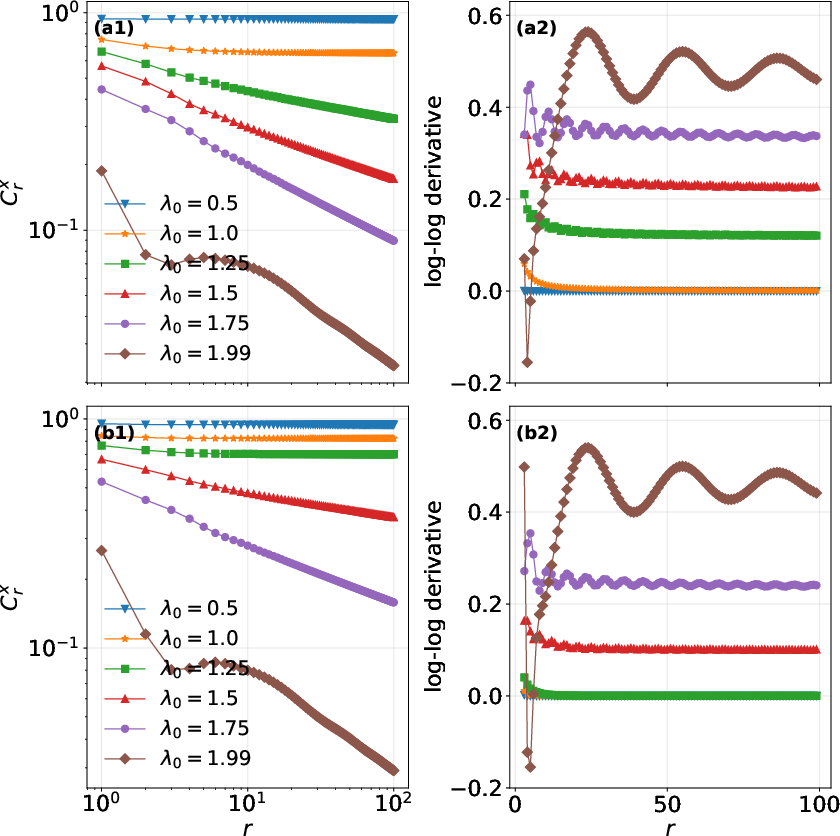
Figure 5: λ6-dependence of the RR λ7-correlation function for varying λ8 and λ9 values, demonstrating transition from constant behavior (FM) to power-law decay (LL).
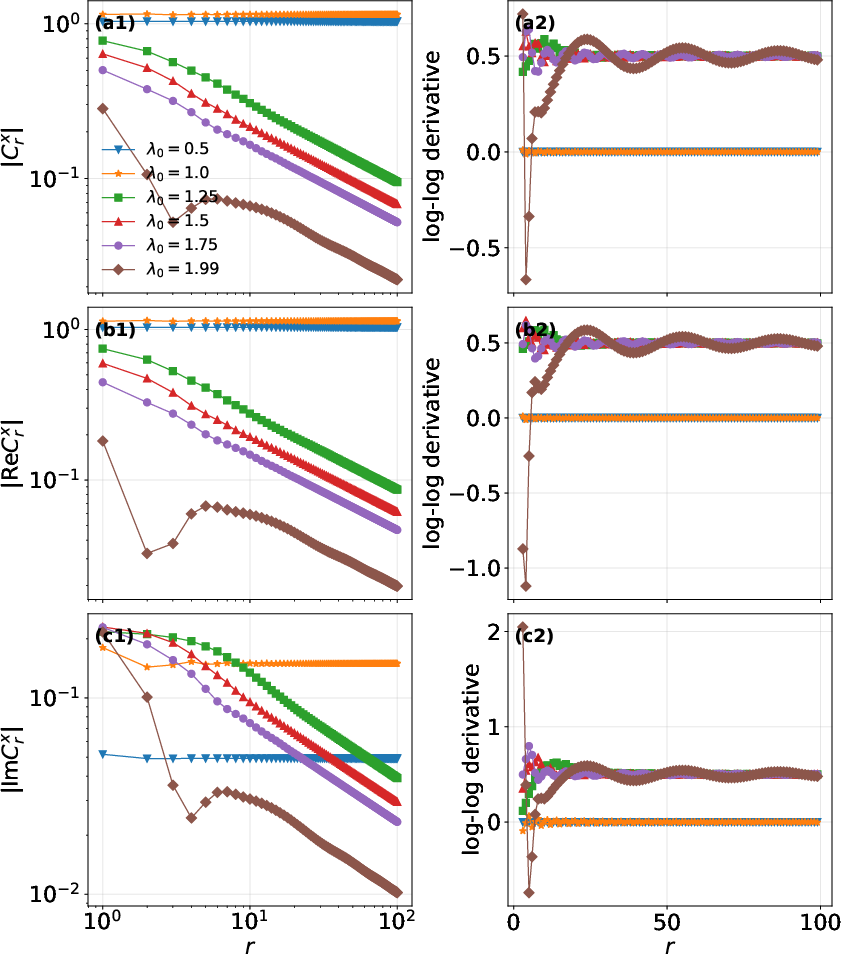
Figure 6: λ∈C0-dependence of the LR λ∈C1-correlation function showing qualitative agreement in FM and PM phases but differing exponents in the LL phase.
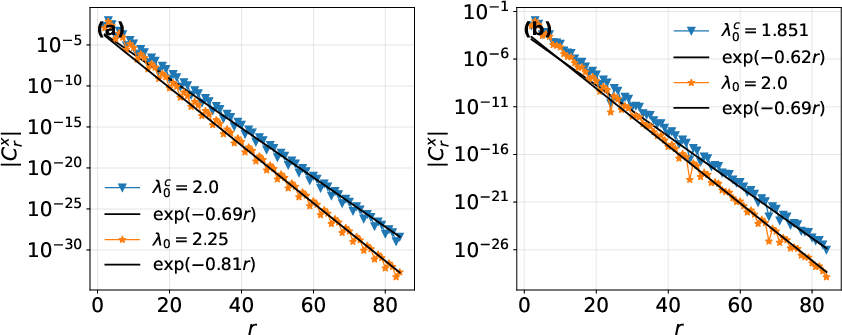
Figure 7: RR λ∈C2-correlation function in the PM phase exhibits oscillatory exponential decay, with oscillation frequencies linked to argument of λ∈C3.
The systematic comparison of RR and LR expectation values yields controlled evidence that while LR results may analytically continue those from Hermitian systems, only RR formalism yields physically robust, real, and experimentally relevant observables—particularly for open quantum systems under continuous measurement protocols. LR formalism can yield spurious or ill-defined behavior, e.g., complex magnetization or non-integrable correlators at symmetry-breaking boundaries.
Tables in the paper succinctly summarize the asymptotic decay of λ∈C4 for both RR and LR formalisms, highlighting universality and non-universality of exponents and decay forms across phases and state choices.
Theoretical and Practical Implications
The findings have impactful consequences for both theory and experiment:
- State Preparation and Protocol Dependence: Experimental probing of quantum criticality in engineered non-Hermitian spin systems must carefully consider post-selection, continuous monitoring, and initial state preparation. The observable critical features are nonuniversal and depend explicitly on the reference state realized by the protocol.
- Observable Definition: Only standard (RR) quantum mechanics yields physically meaningful results for most observables in open-system non-Hermitian spin chains. Analyses using biorthogonal (LR) formalism should be interpreted cautiously.
- Non-Hermitian Universality: The paper clarifies and extends the classification of quantum criticality in non-Hermitian many-body chains, connecting symmetry-breaking transitions (e.g., λ∈C5), emergent long-range order, and the complexification of correlation function exponents.
- Analytical Tools: The techniques employed—Jordan-Wigner–Bogoliubov solvability, Toeplitz and Pfaffian analysis, and Fisher-Hartwig theory—constitute a toolkit readily extensible to other classes of integrable non-Hermitian models.
Future developments may involve the investigation of dynamically prepared states, symmetry-protected or topological non-Hermitian phases, and the design of realistic measurement protocols for non-Hermitian quantum simulators. The methodological clarity on formalism and state selection outlined in this study will remain central.
Conclusion
This work provides a rigorous, unified framework for analyzing quantum critical properties of non-Hermitian XY spin chains, elucidating the crucial roles of observable definition (standard vs. biorthogonal quantum mechanics) and quantum reference state (minimal energy vs. steady state). It establishes that phase diagrams, critical exponents, and even the physical meaning of observables are protocol-dependent in non-Hermitian many-body systems. These results have broad relevance for both theory and experiment, setting methodological standards for future investigations in non-Hermitian quantum criticality.

