Oscillatory-nonnormal decomposition of dissipation in Ornstein-Uhlenbeck processes
Published 5 Jun 2026 in cond-mat.stat-mech | (2606.07263v1)
Abstract: We provide a decomposition of the steady-state entropy production rate associated with an Ornstein-Uhlenbeck process into two contributions: one associated with oscillatory behavior and one associated with nonnormality. We also show that each contribution is associated with a different fundamental trade-off. The oscillatory contribution leads to the dissipation-coherence trade-off for noise-induced oscillations, which bounds the entropy production per oscillatory period by the number of oscillations within one correlation time. Notably, the trade-off is twice as strict as those conjectured or derived for other systems. The nonnormal contribution leads to a trade-off between entropy production and acceleration of relaxation. We also demonstrate the decomposition using a simple bead-spring model.
The paper establishes an exact decomposition of the steady-state entropy production rate into oscillatory and nonnormal contributions via Schur decomposition.
It quantifies the enhanced thermodynamic cost and the dissipation–coherence trade-off in noise-induced coherent oscillations for multidimensional OU processes.
A bead-spring model numerically validates the framework, linking nonequilibrium driving, spectral properties, and relaxation speedup.
Oscillatory-Nonnormal Decomposition of Dissipation in Ornstein-Uhlenbeck Processes
Introduction
This paper establishes an exact decomposition of the steady-state entropy production rate (EPR) in multidimensional Ornstein-Uhlenbeck (OU) processes into two non-negative components: an "oscillatory" contribution related to complex eigenvalues (spectral properties), and a "nonnormal" contribution associated with the nonnormality of the drift matrix. This decomposition enables systematic analysis of nonequilibrium dissipation, quantifies the enhanced thermodynamic cost due to nonnormality, and proves a stringent lower bound on the dissipation required to maintain noise-induced coherent oscillations.
Theoretical Framework
OU Process Setup and Nonequilibrium Measures
The paper considers the stochastic differential equation
dxt=−Kxtdt+2DdWt,
with drift matrix K (all eigenvalues with positive real part), and positive-definite D. The associated Fokker-Planck equation yields a unique steady-state Gaussian with covariance solving a Lyapunov equation.
Entropy production rate in the steady state is written as
σst=tr(K~−⊤K~+−1K~−),
where the drift and diffusion are mapped to "whitened" coordinates with K~=V−1/2KV1/2, K~+=(K~+K~⊤)/2, and K~−=(K~−K~⊤)/2. Detailed balance holds (equilibrium) iff K~ is normal and has only real eigenvalues.
Both complex eigenvalues and nonnormality break detailed balance but have distinct dynamical and thermodynamic consequences. The EPR in the steady state quantitatively characterizes the irreversibility enforced by these two mechanisms.
Oscillatory-Nonnormal Decomposition
Applying the Schur decomposition to K~, the authors uniquely decompose the EPR into
σst=σosc+σnn,
where
K0
is the oscillatory contribution determined by the eigenvalues K1 of K2, and
K3
is the nonnormal contribution, i.e., the squared distance (in an inner product induced by the positive-definite Hermitian part K4) of the skew-Hermitian part K5 from the subspace of matrices spanned by K6 and diagonal matrices.
This formalism rigorously distinguishes dissipation due to coherent circulatory currents (oscillatory) from that due to nonorthogonal eigenmodes (nonnormal), with K7 vanishing if and only if the drift is normal.
Trade-offs and Implications
Dissipation–Coherence Trade-off (DCT)
The oscillatory contribution K8 yields a strictly tighter lower bound (by a factor of 2) on the dissipation cost per coherent oscillation period for noise-induced oscillations in OU systems than previous DCTs established for nonlinear or discrete Markov systems: K9
with D0 being the number of oscillations per correlation time. This demonstrates the fundamentally higher thermodynamic inefficiency of linear, noise-induced coherent oscillations as compared to deterministic or limit-cycle oscillators.
Relaxation Speedup by Nonnormality
By comparing to a reference equilibrium process with the same stationary distribution, it is shown that nonequilibrium driving can only accelerate relaxation (i.e., reduce correlation time) via nonnormality, which incurs a minimal additional entropy production D1. The nonnormal dissipation quantifies the necessary excess cost to achieve a prescribed relaxation speedup. This result links spectral gap engineering, nonequilibrium driving, and thermodynamic cost, with direct applications to thermodynamically-efficient stochastic computation.
Eigenmode Decomposition and Enhanced Dissipation
For normal drift, the oscillatory-nonnormal decomposition reduces to an eigenvalue-based sum. For nonnormal drift, the nonnormal term captures not only the enhancement due to eigenmode nonorthogonality but also dissipative mixing between modes, which cannot be interpreted solely in terms of single-mode oscillations.
Numerical Illustration
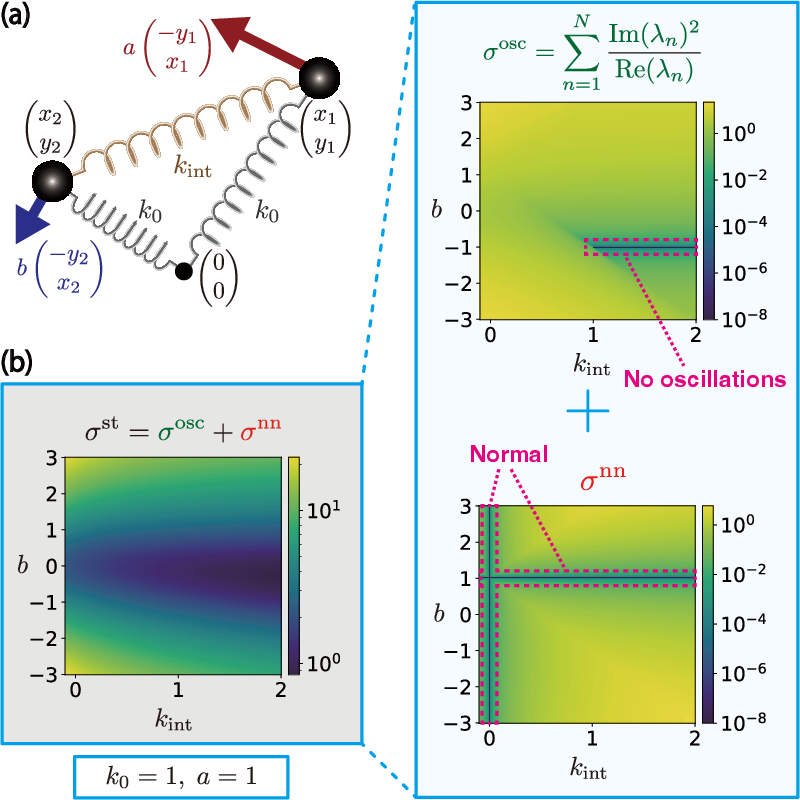
A bead-spring model with two coupled Brownian particles subjected to rotational and spring forces demonstrates the decomposition's practical computation and interpretability. Varying the coupling and asymmetry, the paper shows clear separation of parameter regimes where dissipation is purely oscillatory, purely nonnormal, or both.
Figure 1: Numerical demonstration of the oscillatory-nonnormal decomposition for a two-bead system with varying coupling, showing regimes of vanishing oscillatory and/or nonnormal dissipation.
Broader Impact, Generalizations, and Future Directions
The decomposition clarifies that neither spectral localization nor nonnormality alone captures all mechanisms of nonequilibrium thermodynamics in linear systems. The formalism provides a systematic route to analyze the cost of dynamical speedup, coherent phenomena, and their trade-offs—a foundational result for stochastic thermodynamics, sampling algorithms, and neural/physical information processing.
Key open questions addressed include:
Formal proof and quantitative separation of dissipation due to rapid relaxation (nonnormality) vs. oscillatory coherence (complex eigenvalues).
Maximum possible speedup and minimum thermodynamic cost achievable through nonequilibrium control.
The results suggest a path to analogous decompositions and trade-off relations for nonlinear Langevin dynamics and discrete-state Markov processes, potentially impacting the design and thermodynamic evaluation of efficient stochastic samplers and synthetic biological clocks, as well as offering insights into the fundamental limits of physical-time flows for sampling and inference.
Conclusion
This work provides a mathematically rigorous, physically interpretable additive decomposition of the steady-state entropy production rate in multidimensional OU processes into oscillatory and nonnormal contributions. The results settle long-standing conjectures regarding the role of nonnormality in nonequilibrium dissipation, establish a stringent and previously unattainable DCT for Gaussian diffusive systems, and quantify the irreducible cost of relaxation speedup. The theoretical framework introduced offers general tools for the analysis, design, and benchmarking of nonequilibrium stochastic systems across statistical physics, biomolecular networks, and thermodynamic computing (2606.07263).