- The paper introduces a dissipation-coherence tradeoff by deriving a localization-corrected lower bound on entropy production using a mode-uniformity factor.
- It develops practical estimators from low-dimensional time-series data and validates the bound across various Markov process ensembles including translation-invariant rings.
- The study generalizes previous thermodynamic uncertainty principles, emphasizing the critical role of eigenvector structure in maintaining coherent stochastic oscillations.
Dissipation-Coherence Tradeoff for Stochastic Oscillations: An Expert Overview
Introduction and Context
Autonomous stochastic oscillations are a hallmark of biochemical, biophysical, and mesoscopic systems, notable for their absence of deterministic limit cycles and susceptibility to noise-induced phase diffusion. The quantification of energetic cost per oscillatory cycle, particularly the minimal entropy production necessary to sustain coherent stochastic oscillations, has been a long-standing problem in nonequilibrium statistical physics. The conjecture of Oberreiter, Barato, and Seifert (OBS) postulated a universal lower bound for entropy produced per oscillation period, parameterized solely by the coherence number (i.e., the ratio of oscillation frequency to damping rate of the slowest oscillatory mode) of the dominant complex eigenvalue. However, previous work left open the question of whether a spectral bound based solely on eigenvalues is universally valid, or if eigenvector structure must be incorporated.
Main Theoretical Results
Rigorous Localization-Corrected Lower Bound
This work derives a rigorous lower bound on entropy production per oscillatory period that extends, clarifies, and partially resolves the OBS conjecture. The main result is the inequality: ΔS≥4π2ηN
where ΔS is the entropy produced per period, N is the coherence number of the dominant oscillatory mode, and η∈(0,1] is a mode-uniformity factor quantifying the delocalization of the corresponding right eigenvector in the stationary inner product. This factor captures how uniformly the eigenvector's amplitude is distributed across system states; a value of η close to one indicates complete delocalization, while small η reflects strong localization.
The bound demonstrates that relying on eigenvalue-only spectral data is insufficient in general: when the dominant oscillatory mode is localized, the energetic cost of maintaining coherence can be parametrically lower than would be predicted using eigenvalues alone. However, for symmetry-protected cases such as translation-invariant Markov jump processes on a ring, η=1 holds and the OBS conjectured form is exactly recovered.
Practical Estimators and Eigenvector-Free Corollary
The paper develops a constructive route for estimating the mode-uniformity factor η from low-dimensional time series measurements, leveraging dynamic mode decomposition approaches inspired by Koopman operator theory. This is particularly relevant in settings where state-level or generator-level information is inaccessible, and only observable projections are measurable.
Additionally, the paper establishes a robust eigenvector-independent lower bound: ΔS≥4π2πminN
where πmin is the smallest stationary probability. While this bound is generally less tight than one using the full ΔS0, it is experimentally accessible and invariant to eigenvector structure.
Numerical and Analytical Validation
The theoretical bound is validated across multiple Markov process ensembles: translation-invariant biased rings (maximally delocalized, ΔS1), heterogeneous rings (exposing localization by random disorder), and fully connected networks (demonstrating that high connectivity does not preclude localization).
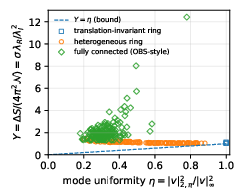
Figure 1: The tightness ratio ΔS2 versus the mode-uniformity factor ΔS3 for various Markov jump process ensembles; the bound ΔS4 is verified, with equality for translation-invariant cases.
Empirically, all samples satisfy ΔS5, with translation-invariant rings saturating the bound. Increasing disorder or heterogeneity leads to mode localization, reduction in ΔS6, and the expected weakening of the rigorous prefactor.
Implications and Connections to Nonequilibrium Thermodynamics
The localization-corrected dissipation-coherence tradeoff rigorously establishes that entropy production bounds, if formulated in terms of spectral coherence, must contain explicit dependence on the geometric distribution of eigenmodes. This insight resolves inconsistencies in prior conjectures and highlights the necessity of symmetry or delocalization for universal eigenvalue-only tradeoffs.
This work also synthesizes and generalizes previous results on thermodynamic uncertainty principles, fluctuation bounds in Markov jump processes, and the spectral analysis of nonequilibrium generators. Notably, the result is achieved without reference to a dual (reversed) or reference process, nor does it depend on particular observables—unlike many earlier approaches.
The symmetry-protected class, characterized by circulant Markov generators (translation-invariant rings), not only saturates the bound but also connects the result with continuum diffusive limits, where the inequality becomes an equality. This affirms the physical realization of the minimal energetic cost of stochastic oscillations in the large-system or continuum limit.
Prospects for Data-Driven Inference and Extensions
The proof-of-principle demonstration for low-dimensional surrogate observables establishes a practical roadmap for inferring thermodynamic bounds from experimental time series, even when the underlying state space or generator is inaccessible. The demonstrated approach via projected dynamic mode decomposition is robust to coarse or incomplete observations under single-mode dominance.
This creates new opportunities for the experimental estimation of dissipation-coherence tradeoffs in synthetic biochemical clocks, oscillatory reaction networks, and molecular machines, subject to sufficient phase resolution and low measurement noise.
Moreover, the eigenvector-free bound facilitates the deployment of dissipation-coherence constraints in high-dimensional or poorly-observed systems, although at a cost of looseness for strongly localized modes.
Potential extensions include systematic characterization of mode-uniformity in physically structured networks, coarse-graining, extension to diffusion processes and more general generators, and rigorous data-driven uncertainty quantification frameworks.
Conclusion
This work rigorously clarifies the thermodynamic cost of coherence in stochastic oscillatory systems, demonstrating that eigenvector localization plays a central role in dissipation-coherence tradeoffs. The theoretical framework both refines and generalizes prior conjectures, offering a unified perspective that encompasses symmetry-protected delocalized regimes and strongly localized systems alike. The practical estimation schemes and accessible corollaries maximize the application space for both theoretical and experimental investigations. Future research should focus on explicit characterization of localization behavior in structured biochemical networks, systematic data-driven inference under realistic noise and sampling constraints, and extensions to broader classes of stochastic dynamics beyond finite-state jump processes.