- The paper introduces MailoHLS, a hybrid framework that integrates LLM-based semantic representations with GNN structural embeddings for directive-level HLS pragma optimization.
- It employs cross-attention fusion and LoRA-based adapters to balance latency and resource usage, demonstrating strong QoR improvements in both seen and unseen kernels.
- Extensive experiments show that MailoHLS outperforms state-of-the-art methods by achieving up to 10.2× speedup while ensuring valid hardware constraints.
Multi-Adapter Hybrid Structural-Semantic Modeling for Pareto-Optimal HLS Pragma Optimization
Introduction
High-Level Synthesis (HLS) is the dominant approach for mapping high-level code (C/C++) to FPGA hardware, but optimal pragma selection for Quality-of-Results (QoR) objectives like latency and resource utilization remains an intractable manual or computation-heavy process. The pragma design space is combinatorially large, with directive dependencies that are highly non-local and program-structure-sensitive. Prior DSE and model-driven approaches suffer from limited generalization, while LLMs capture intent and code semantics but are inherently structure-agnostic and often violate non-functional hardware constraints. The paper introduces MailoHLS, a unified framework for HLS pragma optimization that fuses LLM-based semantic representations with GNN-derived embeddings of program structure via cross-attention, using PEFT with LoRA for efficient multi-objective adapter specialization. MailoHLS reframes HLS optimization into a directive-level structured prediction problem, achieving strong QoR across seen and unseen kernels, with robust objective-conditioned generalization.
Structural and Semantic Reasoning in HLS Optimization
MailoHLS is motivated by the observation that HLS performance optimization is fundamentally a structural reasoning task (Figure 1). Pragmas are not independent: for example, loop unrolling is only performance-optimal when matched with sufficient memory partitioning, else memory bandwidth bottlenecks degrade throughput. Existing GNN-based surrogates encode explicit program structure and dependencies, but lack code semantic abstraction and intent modeling. LLMs provide strong code modeling abilities, but without explicit structure fail to capture hardware-side constraints, resulting in invalid or inefficient pragma assignment, particularly as kernel complexity grows (Figures 2, 4).
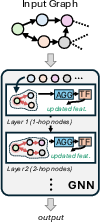
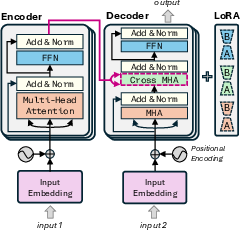
Figure 1: GNNs encode control/data dependencies and program structure via iterative message passing.
Structural reasoning is complemented with semantic embeddings: intents (e.g., minimize latency, minimize BRAM/LUT/DSP area) and higher-level semantic cues in control/data flow must be incorporated for objective-aware trade-offs.

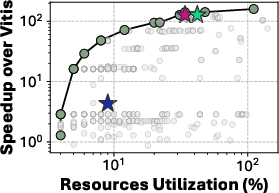
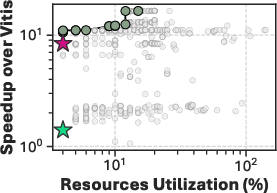
Figure 2: GEMV kernel—pragmas (colored nodes) interact structurally and must be coupled to loop topology and memory accesses for valid partitioning and unrolling.
MailoHLS constructs ProGraML-like hierarchical graphs from LLVM IR, explicitly modeling action points for pragma insertion, array accesses, and loop hierarchy (Figure 3, Figure 4). Auxiliary nodes compress long-range dependencies, critical for resource feasibility and parallelism analysis.
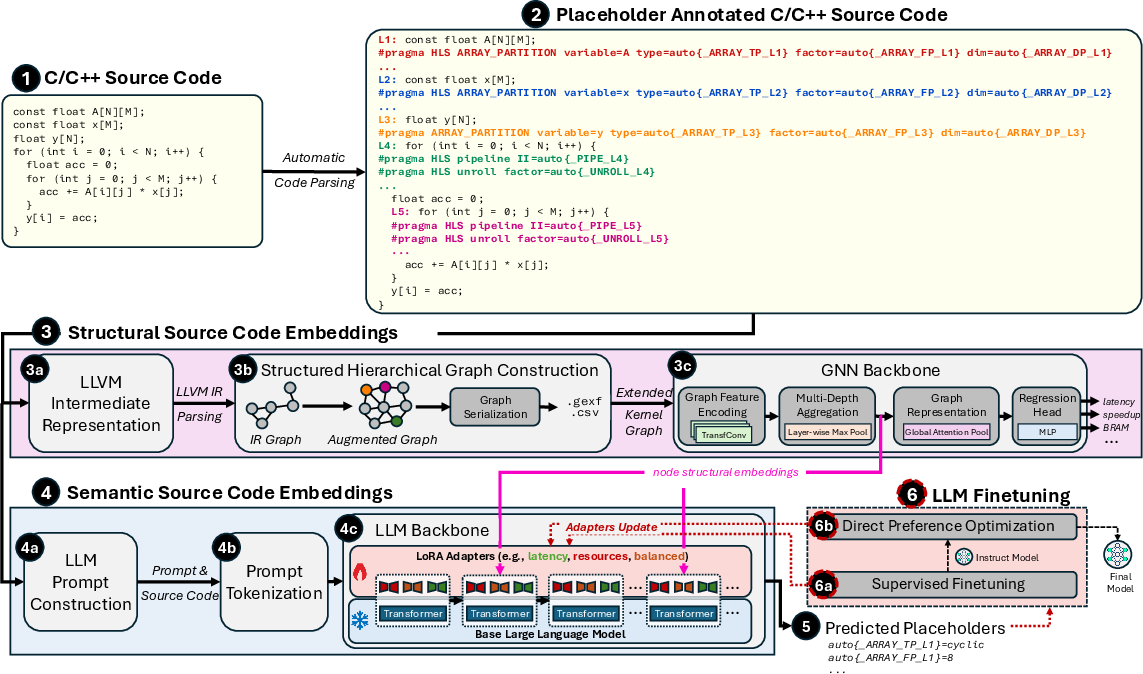
Figure 3: MailoHLS architecture—GNN encodes structural graph, LLM encodes code semantics, cross-attention fuses both with per-objective LoRA adapters.
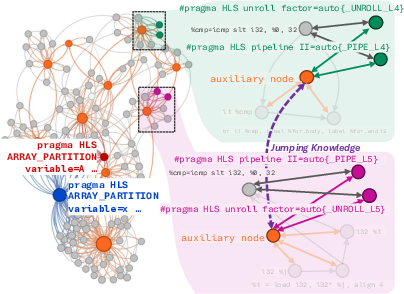
Figure 4: GEMV kernel’s graph representation, showing how structural and optimization nodes are connected.
Hybrid Model Architecture
MailoHLS consists of three main submodules:
- Directive Placeholder Insertion: Code is tokenized and annotated with placeholders marking valid action points for HLS directives.
- Structural Embedding via GNN: A separation-trained GNN encodes IR-derived graphs, learning node embeddings that capture resource pressure, parallelism, and memory access patterns. These intermediate representations are exported as structural memory aligned with the token level.
- Semantic Encoding + Structural Fusion: A decoder-only LLM (e.g., DeepSeekCoder) encodes semantic context and performs directive value prediction. Structural embeddings are fused at selected transformer layers via token-structure cross-attention, gated for relevance, and only for tokens aligned to pragma placeholders. Multiple LoRA adapters enable specialization for latency/resource/balanced objectives.
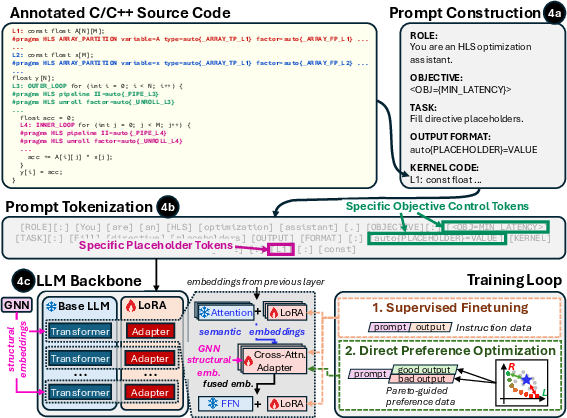
Figure 5: LLM backbone training pipeline with SFT, DPO, and LoRA adapters for objective-conditioned fine-tuning.

Figure 6: MailoHLS performance vs. LLM backbone size—QoR improvement saturates, confirming fusion (not just backbone scale) is essential.
Training Paradigm and Objective-Aware Adapters
Training leverages the GNΩSIS dataset of 219K synthesized design points. For each objective:
- Stage 1: SFT (supervised fine-tuning) on LoRA; train for directive assignment from labeled, evaluated design points.
- Stage 2: Freeze LoRA, enable cross-attention and train only structural fusion (no value head), aligning GNN and LLM representations.
- Stage 3: DPO (Direct Preference Optimization), use Pareto-ranked pairs to bias towards target objective, optimizing only cross-attention and gating.
This pipeline disentangles code meaning, structural logic, and ultimate trade-off requirements, yielding adapters with explicit control over latency-resource-balance regimes.
Evaluation and Ablation
MailoHLS demonstrates:
- Seen Kernels: Geometric mean speedup of 9.48× for latency (vs. 12.42× Pareto ref.), with tight resource usage (9.35% vs. 9.75%); balanced and area objectives also closely match Pareto/knee points.
- Unseen Kernel Families: Robust generalization—latency-optimized adapter achieves 4.97× speedup (with substantially lower resource use than reference designs), balanced adapter retains objective sensitivity.
- Fully Unseen Applications: Up to 10.2× speedup (6.58× geometric mean), outperforming high-end LLMs and prior model/data-driven DSE baselines, which often generate invalid or non-feasible designs.
Figures 8 and 9 (Latency-Optimized Adapters) show MailoHLS objectives: tight Pareto tracking for seen and unseen domains.
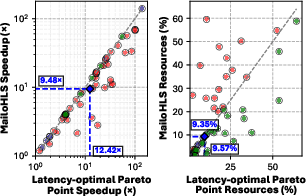
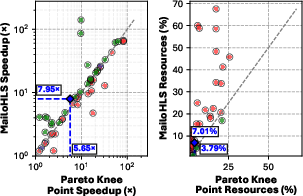
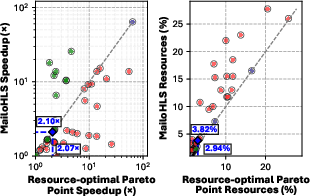
Figure 7: Latency-optimized adapter—MailoHLS approaches Pareto region with explicit resource/speedup trade-off.

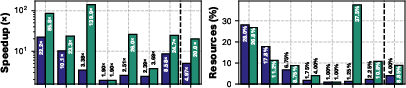
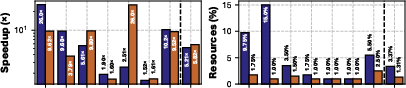
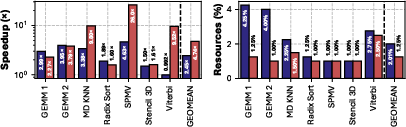
Figure 8: Balanced adapter yields competitive speedup with moderate resource cost, outperforming area-only policies in robustness.
Ablation on the complex Kalman filter kernel indicates: SFT alone yields subpar QoR and often violates resource constraints; adding GNN-based cross-attention achieves the bulk of feasible speedup gains; DPO finalizes objective alignment (Figure 9).



Figure 9: Training ablation on Kalman filter—main QoR improvement is from structural fusion; DPO sharpens objective-alignment.
Comparisons and Implications
Against prior approaches (e.g., CollectiveHLS, LIFT, and recent instruction-prompted LLM methods):
- General-purpose LLMs—incapable of structurally valid and resource-feasible pragma assignment in complex kernels.
- Data-driven DSE—can hit high single-point speedup but often violate area or synthesis constraints.
- LIFT—structurally aware, but lacks MailoHLS' explicit objective adapters and strong per-objective specialization.
- Only MailoHLS generates three explicit operating points per kernel, delivering not just high throughput, but structured, interpretable control of the latency-resource trade-off.
MailoHLS shows that the fusion of structural/semantic models is essential—simply scaling LLMs or “instructing” them with better prompts does not yield reliable, objective-aware, synthesizable solutions in hardware DSE contexts.
Conclusion
MailoHLS defines a new state-of-the-art paradigm for HLS pragma optimization: hybrid GNN-LLM architectures with explicit directive-level prediction, cross-attention fusion, and LoRA-based multi-objective specialization. It reconciles semantic understanding with non-local structural constraints, enables robust Pareto-efficient design synthesis across kernel domains, and provides objective-conditioned adapters that can be selected at inference time. Future research can explore extended objective sets (e.g., power/timing), generalization to full SoC synthesis, or more efficient architecture-agnostic embedding schemes.
MailoHLS demonstrates that systematic multi-modal fusion and adapter-based specialization are necessary and sufficient for advancing the reliability and interpretability of AI-driven HLS design automation. (2606.07246)