- The paper introduces a trajectory-centric waypointing paradigm that replaces discrete node-based waypoints with continuous, executable trajectories.
- It employs a diffusion-based sampling process with TSDF guidance and a hybrid mapping approach to couple semantic instructions with geometric feasibility.
- Experimental results on VLN-CE benchmarks demonstrate improved success rates and collision avoidance, validating its enhanced navigation fidelity.
Trajectory-Centric Waypointing for Vision-Language Navigation
Introduction
The paradigm of navigation in embodied AI systems has typically revolved around discrete, node-centric waypoint prediction, whereby navigation is decomposed into isolated sub-goal selection followed by low-level controller execution. The work "Beyond Waypoints: A Trajectory-Centric Waypointing Paradigm for Vision-Language Navigation" (2606.07244) formulates a decisive shift from this classical methodology towards a generative, trajectory-centric framework. The authors posit that representing intermediate navigation goals as executable continuous trajectories—rather than isolated nodes—substantially improves both geometric feasibility and fidelity between high-level reasoning and executed motion. This essay delineates the architectural advances, quantitative evidence, implications, and future avenues articulated in this work.
Paradigm Shift: From Node-Centric to Trajectory-Centric Waypointing
Conventional VLN-CE methods instantiate navigation as a three-stage hierarchy: prediction of spatial waypoints, selection of an optimal sub-goal, and a controller tasked with local motion. This decoupling engenders two chronic deficiencies: geometric unreachability of predicted waypoints and a planning-control inconsistency, as controllers must adjust to trajectory-level geometry that is not immanent in discrete sub-goals. Training optimizations—strong visual encoders, explicit geometry curation, or occupancy priors—have only partially alleviated these issues.
By replacing node-centric waypoints with direct generation of geometrically valid trajectory candidates, the proposed Trajectory Waypoint (TWP) paradigm renders each sub-goal an executable path by construction, tightly coupling semantic intent and kinematic feasibility. The framework comprises a Trajectory Waypoint Predictor (TWP), which produces diverse, obstacle-avoiding path samples, and a Trajectory-Enhanced Navigator (TEN), which discriminates among these candidates under instruction grounding.
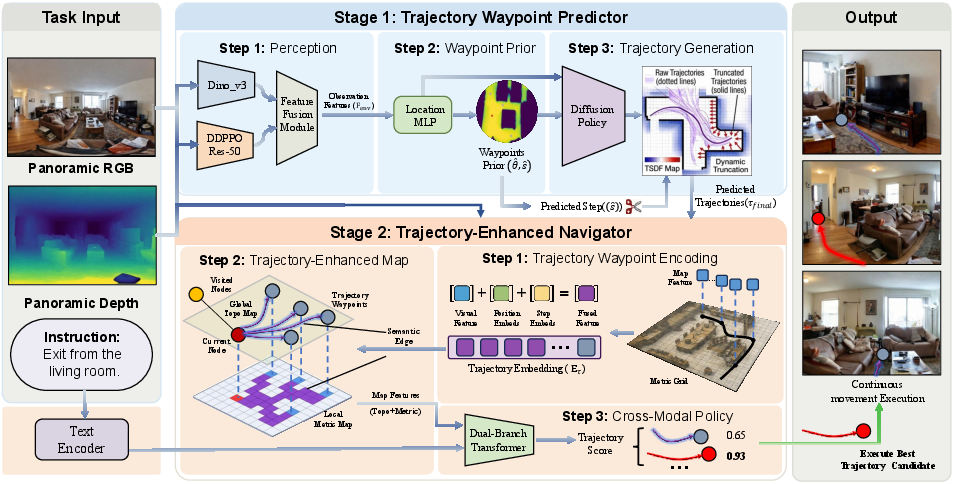
Figure 1: Overview of the Trajectory Waypoint framework, combining trajectory candidate generation with instruction-grounded evaluation.
Trajectory Waypoint Predictor: Diffusion-Based Sampling Under Physical Guidance
The TWP leverages a conditional diffusion process to generate variable-length sequences of displacements, corresponding to physically actionable trajectories. The input is a panoramic RGB-D observation, encoded by a dual-stream visual backbone utilizing DINOv3 and ResNet-50. Multimodal feature fusion via a transformer provides a unified embedding for navigation intent estimation.
Sampling proceeds as follows:
- Intention Prior: Discrete direction and step-count candidates are generated via an MLP-based predictor over the fused feature embedding, anchoring the trajectory diffusion in plausible regions.
- Guided Diffusion: For each prior, a conditional diffusion policy synthesizes a continuous T-step trajectory. To enforce geometric validity, a Truncated Signed Distance Field (TSDF) is maintained from depth data. During each denoising step, the mean is corrected by the gradient of a collision cost, explicitly repelling trajectory samples away from spatial obstacles.
- Adaptive Truncation: The predicted step-count flexibly determines the final trajectory horizon, yielding variable-length, contextually appropriate paths.
Trajectory-Enhanced Navigator: Instruction-Grounded Path Selection
The TEN addresses a critical limitation of legacy frameworks: the inability to reason over trajectory geometry in path selection. Each trajectory candidate is embedded via sampling visual, positional, and temporal cues along its path. This sequence is injected into a topo-metric hybrid map representation, where endpoint features serve as ghost nodes in the topological graph and simultaneously augment spatial grid cells.
Cross-modal planning is achieved by inputting the hybrid map and the language instruction into a dual-branch transformer equipped with Graph-Aware Self-Attention (GASA) for topology and standard self-attention for the metric grid. Navigation candidates are scored jointly by both branches, ensuring selection aligns with both geometric feasibility and linguistic semantics. The selected trajectory is directly executed, eliminating control fragmentation.
Experimental Evidence and Analysis
Performance is comprehensively validated on the VLN-CE/R2R-CE benchmarks. The trajectory-centric predictor achieves a dramatic increase in geometric reachability, with %Open reaching 95.84—a +8.58 pp gain over state-of-the-art waypoint baselines. Chamfer and Hausdorff distances to expert waypoints are significantly minimized, confirming both safety and alignment.
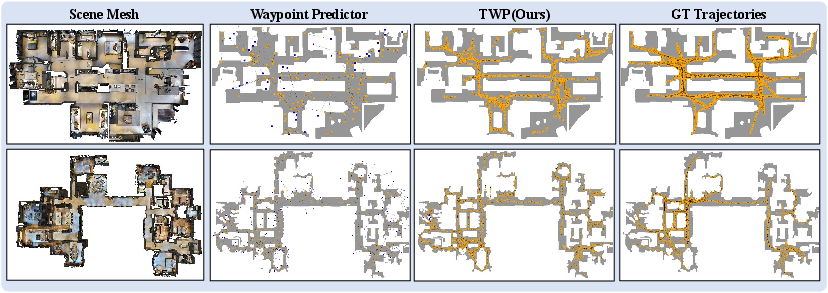
Figure 2: Qualitative outputs illustrating valid (yellow) and invalid (blue) target points; the TWP consistently avoids proposing inaccessible candidates.
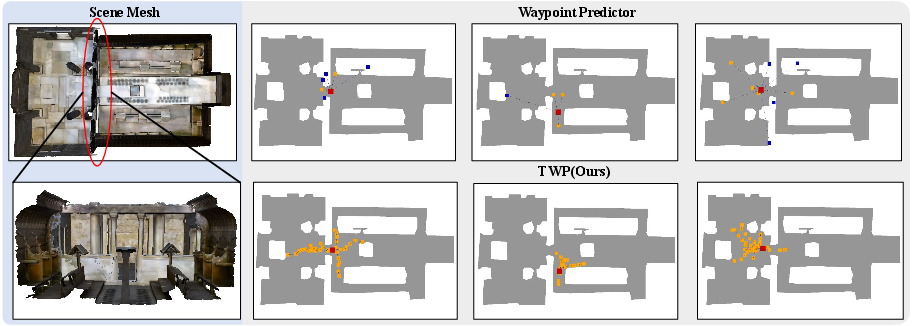
Figure 3: TWP maintains safety under challenging “visible but unreachable” scenarios by relying on TSDF supervision.
Ablation studies confirm the pivotal role of DINOv3 features and TSDF guidance—removal of either causes pronounced degradation in both geometric metrics and downstream navigation success rate (SR), success weighted by path length (SPL), and a marked increase in collision rate.
Compared to traditional and VLM-based models, the TWP framework attains leading results on the R2R-CE Val-Unseen split: SR = 60.3, SPL = 51.4, and OSR = 68.1. Importantly, the TSDF-based denoising guidance is most beneficial when used for a moderate proportion of diffusion steps—over-application reduces the generative diversity and slightly lowers success rates.
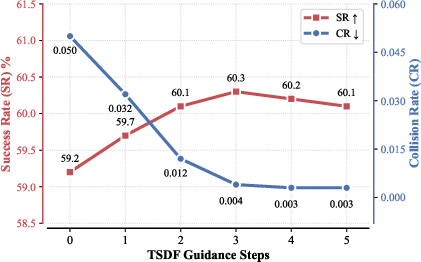
Figure 4: Increasing TSDF guidance reduces collisions but exhibits diminishing returns or even negative effect on overall success beyond the optimum.
Implications and Theoretical Considerations
The advanced results stem not merely from stronger geometric priors, but from reconciling the discretization-induced loss of continuity that plagues node-centric navigation. By internalizing geometric and semantic context in trajectory candidates, the framework enables instruction-informed path selection with execution fidelity. This geometric grounding is an essential prerequisite for embodied AI in unconstrained continuous environments.
Practically, the integration of environment-guided diffusion and hybrid mapping sets a new standard for task execution in challenging settings—especially those riddled with ambiguous or deceptive spatial cues. This has immediate impact on robotics domains requiring aggressive safety margins and adaptable horizon planning.
Theoretically, these findings advocate for direct trajectory policy modeling in all future hierarchical navigation systems, particularly as generative architectures and world models become increasingly dominant. An emerging avenue is full end-to-end trajectory generation incorporating joint scene reconstruction and language grounding at scale.
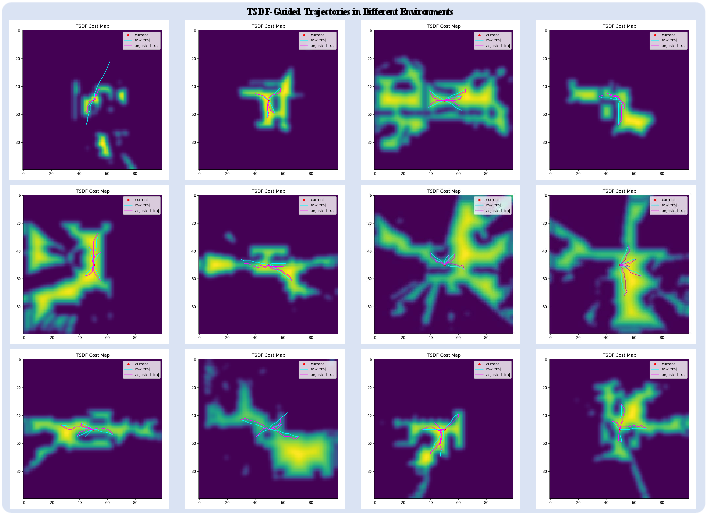
Figure 5: TSDF-guided trajectory refinement: trajectories are smoothly repelled from obstacles while maintaining proximity to desired goals.
Conclusion
This work redefines the atomic planning unit in VLN-CE from node-centric waypoints to continuous, physically instantiated trajectory candidates. The dual-stage architecture—environment-guided diffusion for generation, hybrid map fusion for selection—offers substantial improvements in both trajectory feasibility and semantic-action consistency. The empirical evidence supports widespread adoption of trajectory-centric approaches in embodied navigation, with broad implications for both safety-critical robotics and vision-language research. Future developments will likely extend this paradigm to open-world tasks, enriched world models, and more nuanced language-action couplings.