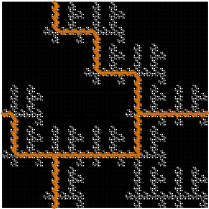
Published 5 Jun 2026 in cond-mat.dis-nn and math-ph | (2606.07241v1)
Abstract: In this paper, the class of randomised mixed labyrinth fractals is introduced. It is a class of finitely ramified Sierpinski carpets that generalize mixed labyrinth fractals. The structures are generated by randomly selected labyrinth patterns with fixed selection probabilities at each iteration level, offering a flexible framework to study fractal topology, arc dimensions, and shortest path properties. Here, the focus lies on analysing how the randomised mixing of patterns - specifically their shape, symmetry, and path geometry - effects arc dimensions, path lengths, and isotropy restoration. The study reveals that isotropy, previously shown for self-similar fractals, extends to the randomised mixed class. Various scaling behaviours of shortest path dimensions with respect to the mixing probability are identified, including linear and nonlinear monotonic trends, as well as transitions with maxima. The approximated path matrix is proposed as an efficient alternative to extensive iterative simulations, reliably reproducing statistical results. The findings highlight the relevance of pattern properties in determining fractal structures and dynamics and suggest applications in physical systems such as diffusion, signal processing, and antenna design.
The paper presents a new framework that introduces a random mixing process over labyrinth fractal patterns, extending classical Sierpinski carpet concepts.
It employs a combined expected path matrix and ensemble averaging to efficiently estimate shortest path dimensions and analyze scaling convergence.
The analysis reveals that despite local anisotropies, statistical homogenization restores isotropy and enables tunable fractal connectivity with practical engineering applications.
Randomised Mixed Labyrinth Fractals: Structure, Arc Dimensions, and Isotropy
Introduction and Context
This work systematically extends the landscape of finitely ramified Sierpinski carpets by introducing and analyzing randomised mixed labyrinth fractals—a generalization beyond classical self-similar and mixed forms. The primary contributions are the formulation of a random mixing process over labyrinth patterns at each construction iteration (with controlled selection probabilities) and a detailed examination of the resulting fractal topology, arc/shortest path dimensions, and the statistical restoration of isotropy. This framework unifies questions of discrete fractal combinatorics, spectral matrix theory, and statistical physics, and also points to potential engineering applications (e.g., diffusion networks, antenna design, and porous media analysis).
Construction Principles and Theoretical Framework
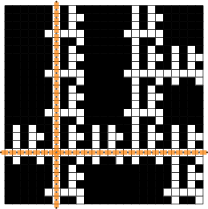
Labyrinth fractals are constructed as dendritic Sierpinski-type carpets, recursively replacing white squares in a unit square subdivision with smaller scaled labyrinth patterns. In the randomised mixed case, at each level a pattern is sampled with fixed selection probabilities from a finite collection, resulting in an object that is statistically self-similar but not strictly deterministic. The topological graph construction enforces tree, exits, and corner properties to guarantee ramification and structure.
Two central mathematical objects underpin the analysis:
The path matrix, whose (i,j)-th entry counts the number of j-type squares in the i-type path between exits in a given pattern or prefractal set.
The shortest path/arc dimension, capturing the scaling of minimal path lengths and box-counting cover numbers between exits as the iteration depth grows.
For randomised constructions, the path matrix over n iterations is a product of random matrices, leading to questions addressed by variants of Kingman’s subadditive ergodic theorem and extensions of Gelfand’s theorem. To efficiently approximate statistical properties otherwise computable only via massive ensemble averages, the authors introduce a combined (expected) path matrix,
M=pM+(1−p)M′
for two candidate patterns, which allows estimation of spectral properties and scaling exponents representative of the system’s typical behavior.
Pattern Classes and Analytic Methodology
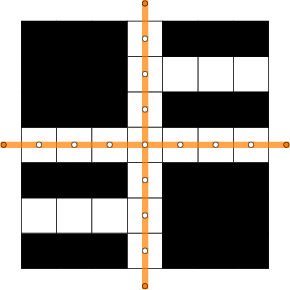
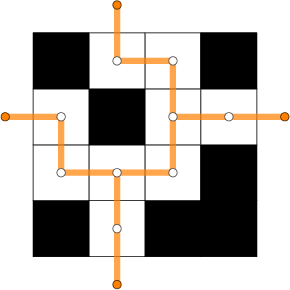
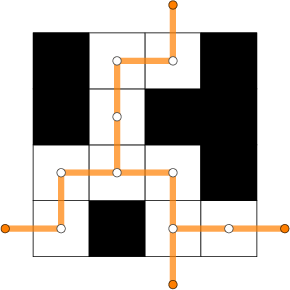
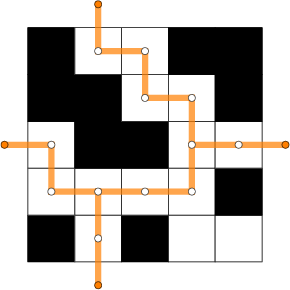
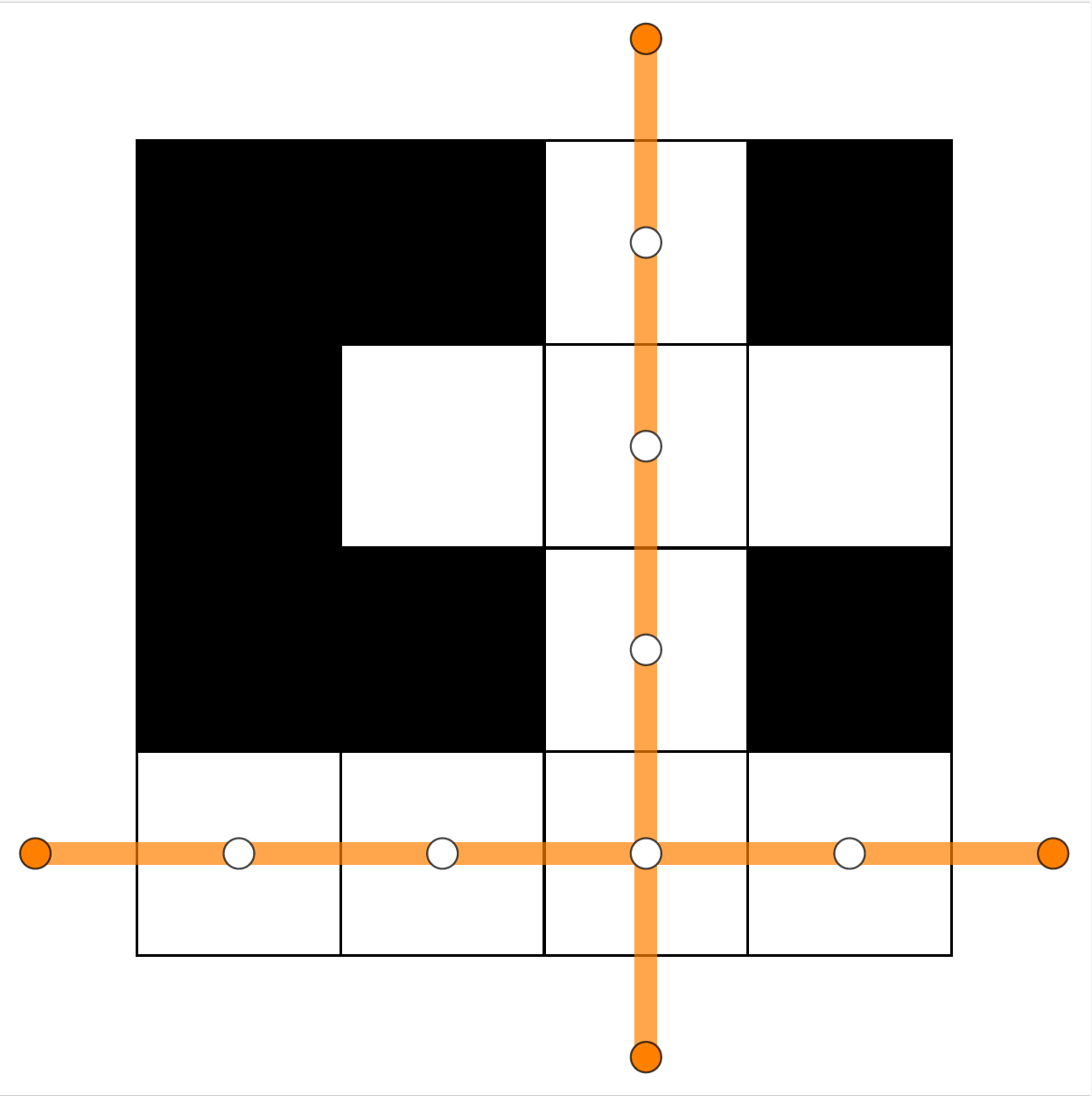
The research analyzes patterns parameterized by blocking structure (non-blocked, horizontal/vertical/totally blocked), symmetry (mirror, point, asymmetric), and path length diversity. The set of patterns and their rotated versions are exhaustively covered for widths m∈{4,5,6,7} with matched mass parameters to isolate the effects of blocking and symmetry.
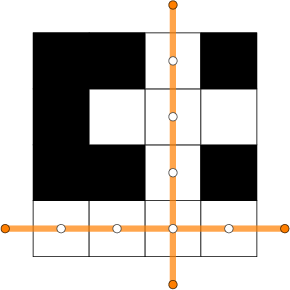
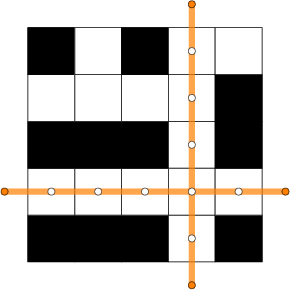
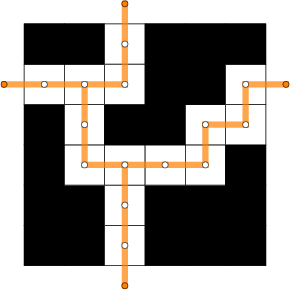
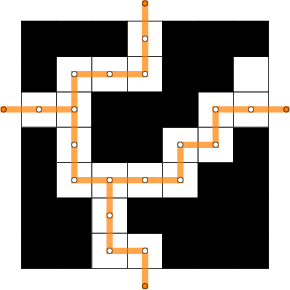
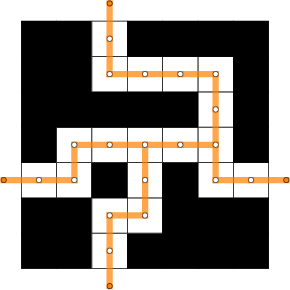
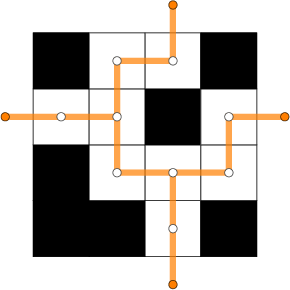
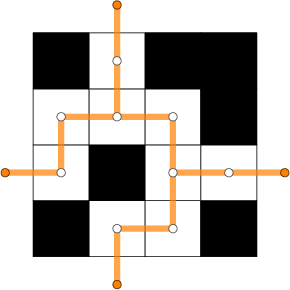
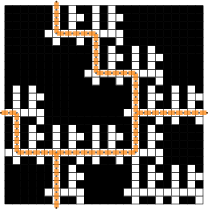
Figure 2: Non-blocked labyrinth patterns of various widths with shortest paths highlighted.
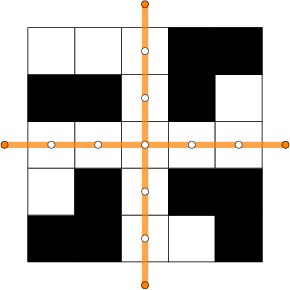
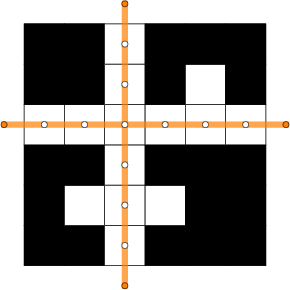
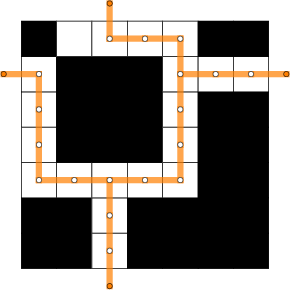
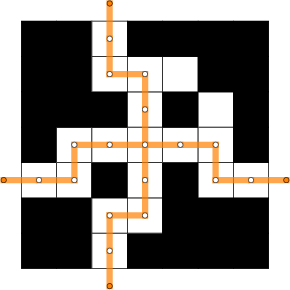
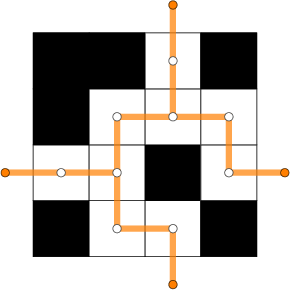
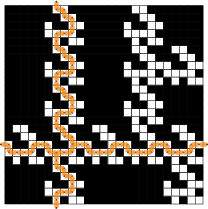
Figure 4: Totally blocked labyrinth patterns of various widths with indicated shortest paths.
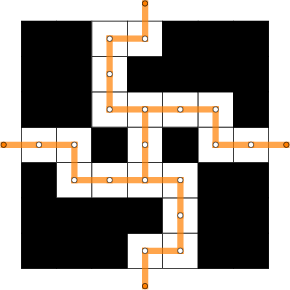
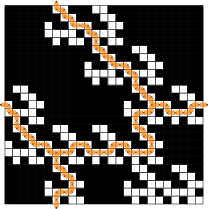
Figure 6: Example of a pattern and its rotated variants, illustrating sensitivity to rotation under mixing.
Both individual pattern properties and their pairwise random mixing are analyzed statistically (via 2n-scale ensemble averaging up to n=1000) and with the combined matrix approach.
Restoration of Isotropy and Scaling Convergence
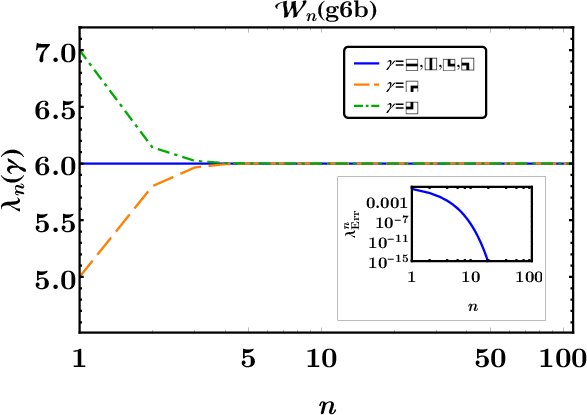
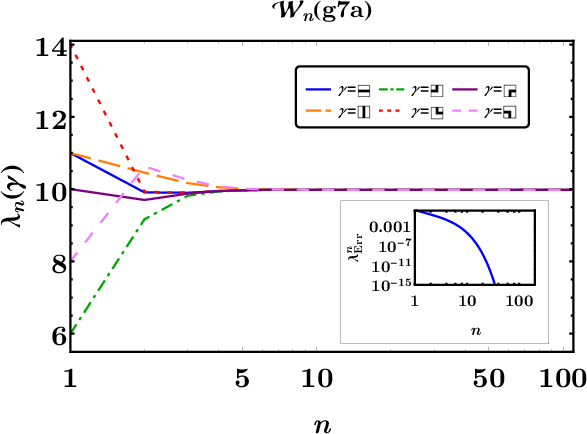
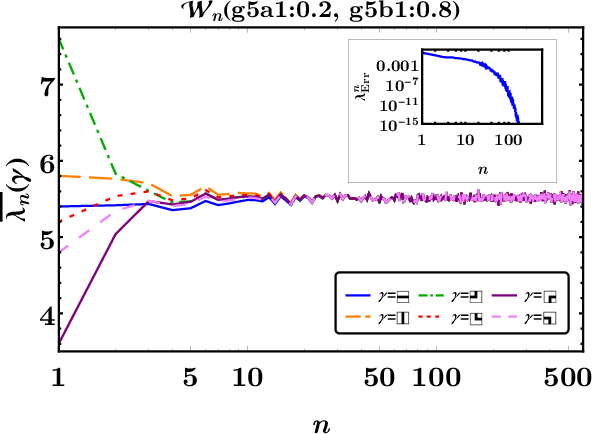
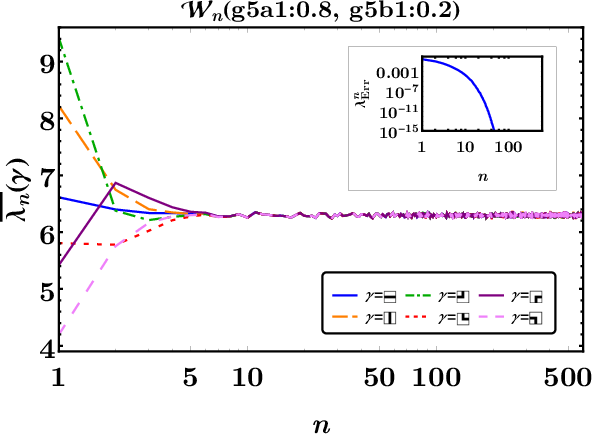
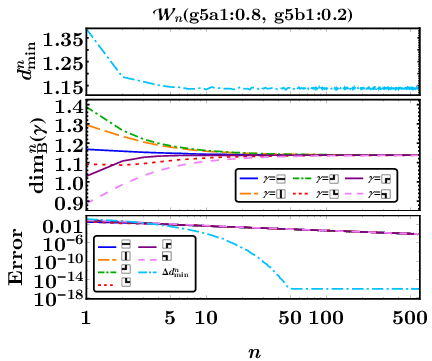
A critical result is that isotropy restoration, previously shown for deterministic self-similar Sierpinski carpets [barlow.m.95.restoration.3042], extends robustly to the randomised mixed case. All path types (connecting various pairs of exits) exhibit convergence of the scaling factor
λn(ρ)(ϵ)=ℓn−1(ρ)(ϵ)ℓn(ρ)(ϵ)
to a unique value for large n, regardless of initial local anisotropies in the selected patterns or their mixing probabilities.
Figure 8: Convergence of path scaling factors j0 in self-similar (non-blocked, left) and totally blocked (right) patterns, showing rapid approach to unique values.
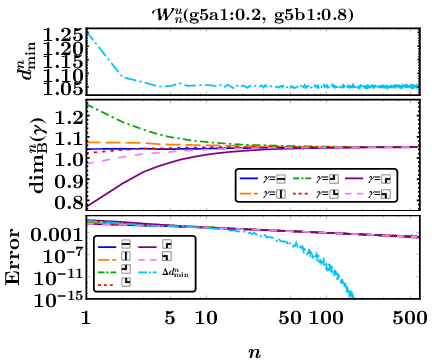
Figure 1: Path scaling convergence in randomised mixed labyrinths at j1 (left) and j2 (right); isotropy converges more slowly but is asymptotically reached.
This statistical homogenization holds despite the local heterogeneity induced by randomised pattern selection and is essentially independent of symmetry and blocking properties.
Shortest Path Dimension and Structural Regimes
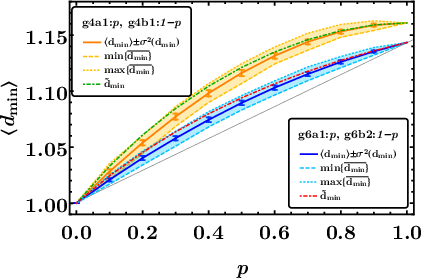
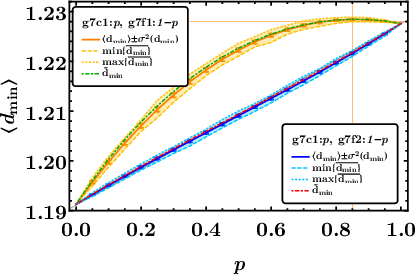
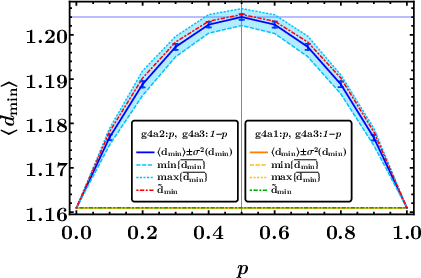
The core of the analysis concerns the dependency of the shortest path dimensionj3 and its numerical estimator j4 (from the combined path matrix) on the mixing probability j5. Several qualitative regimes are observed:
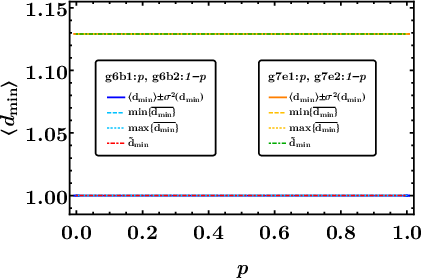
Constant Behavior: When mixing non-blocked or fully symmetric totally blocked patterns, j6 remains constant across j7.
Linear Variation: For certain totally blocked pairs with all path lengths in one exceeding the other, a linear interpolation of j8 vs. j9 arises.
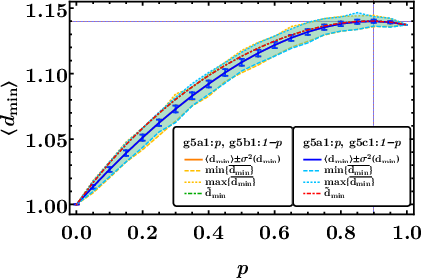
Nonlinear Monotonicity: "Near" monotonic settings—most but not all path lengths satisfy an ordering—display smooth but nonlinear dependencies.
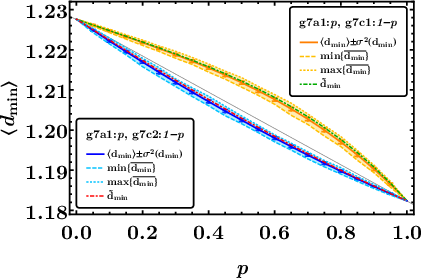
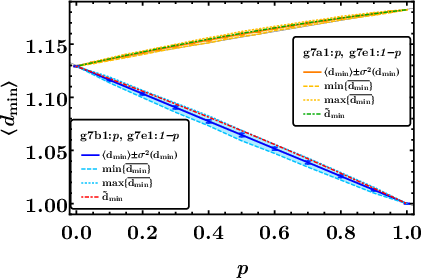
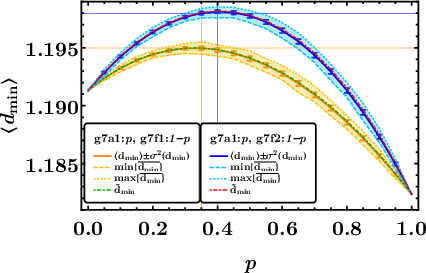
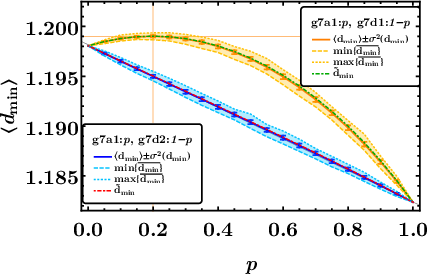
Maximal/Non-monotonic Transitions: Some pattern pairs yield a maximum in i0 as a function of i1; others exhibit regime switches (e.g., from monotonicity to maximum) due to intricate interactions between blocking and rotational asymmetry.
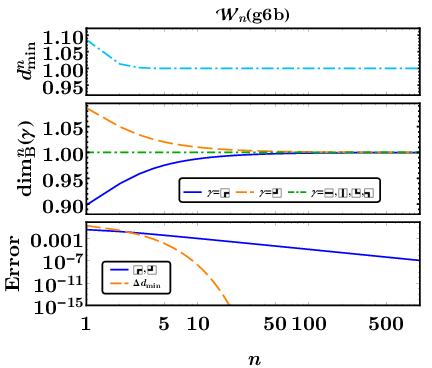
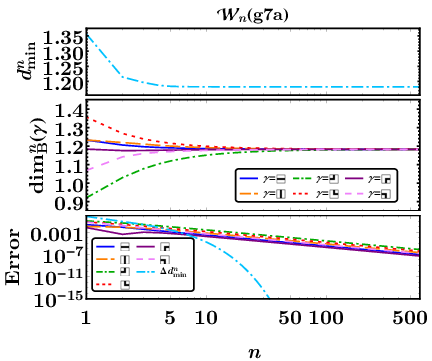
Figure 3: Convergence of the approximate shortest path dimension i2 in the self-similar non-blocked and totally blocked cases.
Figure 5: Path dimension convergence in randomised mixing (i3 and i4 shown); ensemble errors are larger, but statistical convergence is still rapid.
Figure 7: Nonlinear monotonic scaling of i5 with i6 for selected pattern pairs.
Figure 9: Linear and constant behaviors of i7 with i8 for special pattern classes.
Figure 10: Mixing choices resulting in a maximum of i9 as n0 varies, indicating nontrivial optimization points for path complexity.
Figure 11: Examples of regime switching in n1 based on rotation-different pattern pairings.
These results are well captured by the spectral dimension of the combined path matrix, providing a computationally efficient and theoretically justifiable shortcut to large ensemble simulation.
Path Iteration and Statistical Analysis
Close inspection of path scaling at low iteration reveals complex dependencies; for instance, even when combining seemingly similar patterns, the iteration process itself can amplify path-length heterogeneities, manifesting in anomalous scaling (local maxima/minima in n2) at intermediate n3.
Figure 12: Path length statistics over iterative construction, illustrating fluctuations and convergence in low-level mixed labyrinth sets.
This indicates that higher-level statistical behavior is emergent from the combinatorics of the pattern mixing and not easily predictable from a simple pattern-level inspection, except in constant or highly symmetric cases.
Theoretical Implications and Applications
These findings have several significant implications:
Random Walk Scaling and Dynamics: Via the Einstein relation, the shortest-path dimension directly informs the random-walk dimension n4, critical in diffusion and transport studies [franz.a.01.einstein.1411, bunde.a.96.fractals.book].
Structural Optimization: The occurrence of maxima in n5 suggests the possibility of tuning the fractal structure—via pattern mix probability—for optimal or extremal connectivity, relevant in antenna design [anguera.j.20.fractal.4], gas sensor networks [tian.f.21.application.14587], and more.
Statistical Homogenization: The robust restoration of isotropy in highly anisotropic constructions extends the mathematical understanding of disordered fractal media and aligns with predictions for random walks on statistically self-similar graphs [havlin.s.02.diffusion.187, troscheit.s.17.on.257].
Computational Approaches: The use of the combined expected path matrix, justified by subadditive ergodic theory, provides an efficient estimator for physical observables, reducing the computational complexity for future design and analysis.
Future theoretical work includes formal proof of the generality of Gelfand’s theorem for the class of random path matrices used, and extension to more general mixing scenarios (e.g., patterns of variable width and fractal dimension).
Conclusion
Randomised mixed labyrinth fractals embody a rich new class of finitely ramified fractal graphs, revealing nontrivial scaling behaviors and phase-type transitions in shortest path and arc dimension as a function of mixing parameters. Isotropy is statistically restored in the limit, and key fractal observables are efficiently estimated via expected path matrices, supporting both foundational mathematical inquiry and application-driven design. These results open several avenues for exploration of random fractal networks, including new directions in random walks, signal propagation, and statistical geometric analysis.
For detailed scaling curves, convergence plots, and structural exemplars, see Figures 5–16.