- The paper demonstrates that the cluster mass scales as (π/2)L²/ln L, confirming marginal logarithmic fractality under periodic boundary conditions.
- The hull perimeter follows a pure power-law scaling with a fractal dimension of 4/3, aligning with the Brownian frontier and SLE₈/₃ universality.
- The spanning chemical distance scales as L(ln L)^(1/4), indicating highly efficient connectivity and supporting predictions from 2D GFF percolation theory.
Fractal Geometry of Two-Dimensional Simple Random Walks Interrogated via Monte Carlo Analysis
Introduction
The paper "Fractals of Simple Random Walks in Two Dimensions: A Monte Carlo Study" (2604.21341) addresses the geometric and fractal properties of clusters generated by two-dimensional (2D) discrete-time simple random walks (sRW) of L2 steps on a periodic L×L lattice. Leveraging large-scale Monte Carlo simulations, the authors focus on three primary observables: the cluster mass, hull perimeter, and spanning chemical distance. The study delivers precise quantitative insights into marginal fractality, external boundary universality, and the efficiency of connectivity within these clusters, connecting the findings to broad theoretical constructs including Schramm-Loewner Evolution (SLE) and the Gaussian free field (GFF) percolation paradigm.
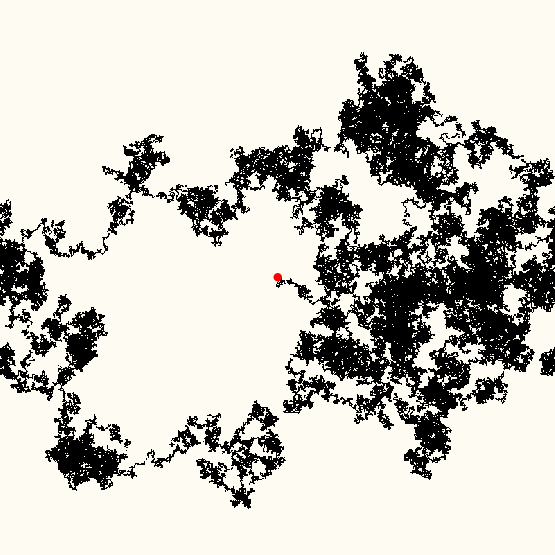
Figure 1: Typical sRW trajectory depicting weakly space-filling trace and hierarchical holes on a L×L periodic lattice with L=800.
Cluster Mass: Marginal Logarithmic Fractality
The mass M (distinct sites visited by the sRW) is confirmed to scale as M∼(π/2)L2/lnL, with the leading coefficient in exact agreement with the Dvoretzky-Erdős theorem. The authors provide strong evidence that under periodic boundary conditions (PBC), the dominant finite-size correction shifts from the expected (lnL)−1 (suggested by infinite-plane analysis) to (lnL)−2, with an amplitude b≈−(π/2)−2.
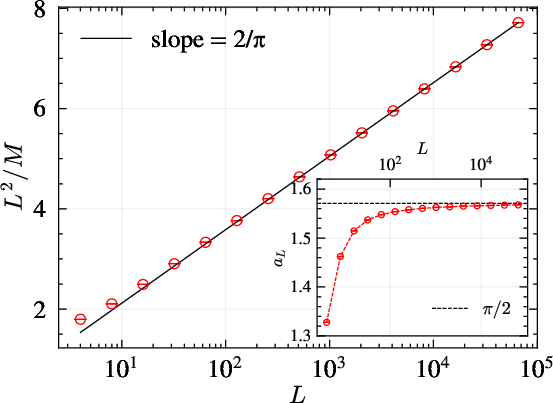
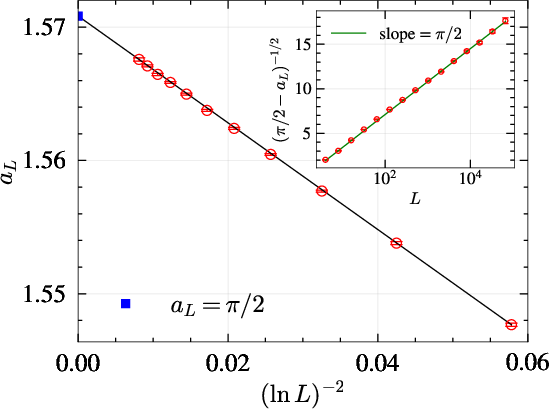
Figure 2: Rescaled cluster mass L2/M vs L×L0, demonstrating convergence to the Dvoretzky-Erdős scaling law and linearity with slope L×L1; inset shows convergence of L×L2 to L×L3.
This marginal fractality highlights an object with effective dimension 2 but suppressed space-filling properties due to logarithmic corrections. The observable is robust to microscopic cluster definitions (bond-cluster vs site-cluster), and PBC predominantly affects the correction structure without modifying the asymptotic scaling.
Hull Perimeter: Brownian Frontier and the SLEL×L4 Universality
Analysis of the hull perimeter L×L5 (external frontier) confirms a pure power-law scaling L×L6, with the fractal dimension fit at L×L7, aligning precisely with the theoretical value L×L8 for the Brownian frontier described by SLEL×L9.
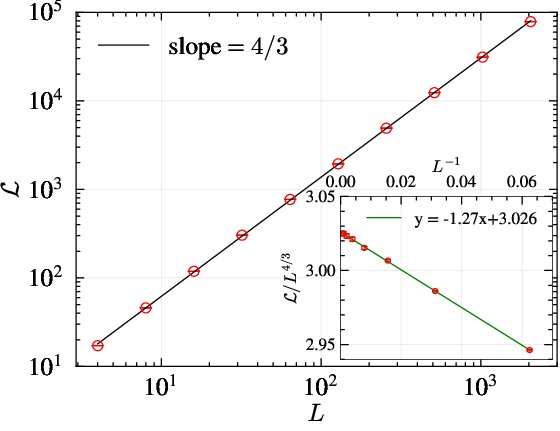
Figure 3: Logarithmic plot of hull perimeter L×L0 versus L×L1, consistent with L×L2; inset: rescaled perimeter L×L3 vs L×L4 evidencing the scaling ansatz.
The hull, unlike the mass, does not exhibit marginal logarithmic scaling, reinforcing its membership in the conformally invariant Brownian frontier universality class. Subleading corrections are primarily L×L5, and PBC influence is restricted to these terms.
Spanning Chemical Distance: Asymptotically Efficient Connectivity
The chemical distance L×L6 (maximal shortest path inside the traced cluster) is observed to scale as L×L7, matching the sharp upper bound proved for level-set clusters in the 2D GFF by Ding and Wirth. The data effectively exclude any significant L×L8 correction, suggesting the tightness of the L×L9 enhancement.
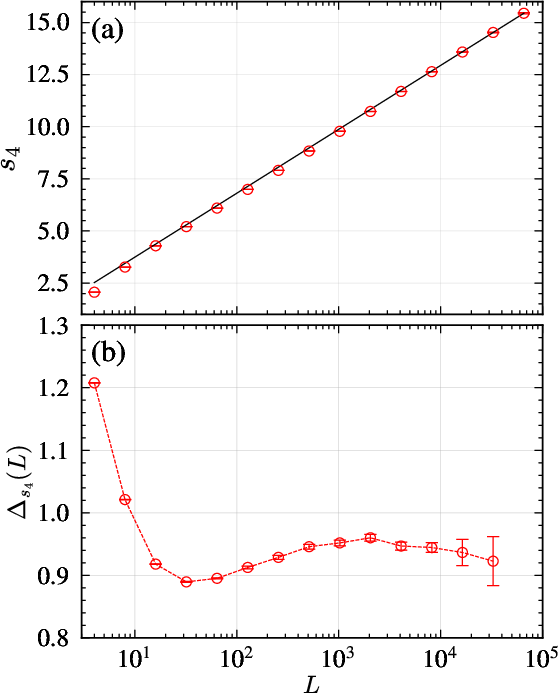
Figure 4: Collapsed scaling of chemical distance and gap function analysis, demonstrating congruence with L=8000 and absence of L=8001 correction.
The linear behavior (modulo a weak logarithmic factor) is remarkable given the highly ramified and perforated structure of the trace, signifying highly efficient internal connectivity. The connection between random walk local times and GFF occupation fields via isomorphism theorems further substantiates the relevance of this scaling across paradigmatic sparse random geometries.
Implications and Perspectives
The findings substantiate several theoretical expectations for 2D sRW clusters under PBC:
- The mass is marginally fractal with leading asymptotic scaling faithfully matching infinite-plane theory, but subleading corrections manifest distinctly under PBC.
- The hull perimeter adheres strictly to Brownian frontier universality, with PBC only impacting finite-size corrections.
- The chemical distance exhibits near-optimal scaling, reinforcing the universality between sRW clusters and GFF percolation level sets, with no empirical evidence for more complex logarithmic enhancements.
These results have practical ramifications for understanding transport and diffusion phenomena in disordered media and set quantitative benchmarks for stochastic geometric models. The efficient internal spanning paths in such ramified clusters suggest utility in mimicking biological search strategies or exploring polymer conformations.
On the theoretical front, the confirmation of SLEL=8002 scaling and the sharpness of the chemical distance bound fortify links between stochastic geometry and conformal invariance. The detailed finite-size analysis provides a template for interrogating the effects of boundary conditions in random geometry, with implications for loop-erased random walks, percolation, and quantum field theoretical constructs.
Future developments may include extending the analysis to different lattice geometries, nontrivial boundary conditions, and exploring the fractal structure of loop-erased and interacting random walk models. Elucidating exact correction structures beyond numerical precision and formalizing the universality of chemical distance scaling across random geometry models remain salient theoretical challenges.
Conclusion
This comprehensive Monte Carlo study decisively characterizes the fractal geometry of 2D simple random walk clusters: marginal fractality in mass, Brownian-frontier conformal invariance at the hull, and highly efficient linear plus logarithmic chemical distance scaling. These results reinforce universality predictions from SLE and GFF theory, clarify the finite-size effects induced by periodic boundaries, and underscore fundamental connections between stochastic process geometry and statistical field theory. The empirical and theoretical frameworks advanced herein chart the direction for further inquiry into random fractal structures and their connectivity properties.