- The paper demonstrates that while both tailored and generic LLM chatbots reduce FoMO, Moodie uniquely enhances conversational empathy and user engagement.
- The study employs a mixed-method approach combining quantitative measures with qualitative interviews to assess Moodie’s impact on emotion regulation and self-esteem.
- Findings imply that dynamic adaptivity and empathetic response personalization may provide sustained benefits in digital mental health interventions.
Moodie: LLM-Based Chatbot Design for Addressing Fear of Missing Out
Introduction and Motivation
The proliferation of social media has exacerbated emotion-driven phenomena such as Fear of Missing Out (FoMO), with negative downstream effects on mental health, self-esteem, and emotional regulation. Existing interventions—ranging from behavioral restrictions on technology use to cognitive-behavioral and emotion regulation frameworks—are either insufficiently interactive or too cognitively taxing for broad, longitudinal engagement. "Moodie: An Early-Stage Design Exploration for Supporting Fear of Missing Out with LLM-based Chatbots" (2606.07231) positions itself at the intersection of affective computing and therapeutic HCI by proposing purpose-driven, LLM-based chatbots to target FoMO in an adaptive, scalable manner.
The formative qualitative study surveyed a pre-screened cohort of 15 individuals with elevated FoMO (mean age 22.73, SD 1.10) and recent LLM-based emotional support experience. Open-ended thematic analysis revealed two persistent requirements:
- Response Style Personalization: Participants ascribed distinct value to responses focused on empathetic validation versus those oriented toward pragmatic, actionable guidance. Preferences shifted as a function of emotional state and context, necessitating explicit user agency over response style.
- Emotion Regulation and Self-Esteem Support: Effective technology-mediated interventions for FoMO must not only surface actionable coping strategies but also reinforce reflective self-awareness and self-esteem, a construct both predictive of and vulnerable to FoMO.
These findings informed the two primary design rationales for Moodie: (1) provision of distinct, switchable response modes (emotional support vs. practical suggestions), and (2) embedding evidence-based emotion regulation/pro-self-esteem interventions, with reflective scaffolding.
System Implementation and Interaction Design
Moodie is instantiated as a Discord-deployed chatbot using GPT-4o as the underlying LLM, selected for its state-of-the-art emotional attunement capabilities. Following White et al.’s Prompt Pattern framework and integrating strategies from the well-validated FoMO-R method, Moodie's persona is crafted as a warm, empathetic psychological counselor. The system pipeline includes dynamic context interpretation, relevant FoMO-R strategy selection, and adaptive response formatting based on live user input.
Switchable response modalities allow users to select either affirming, reflective support or structured, actionable advice. All responses are further adaptive, responding in real time to user requests regarding length, formality, or structure.
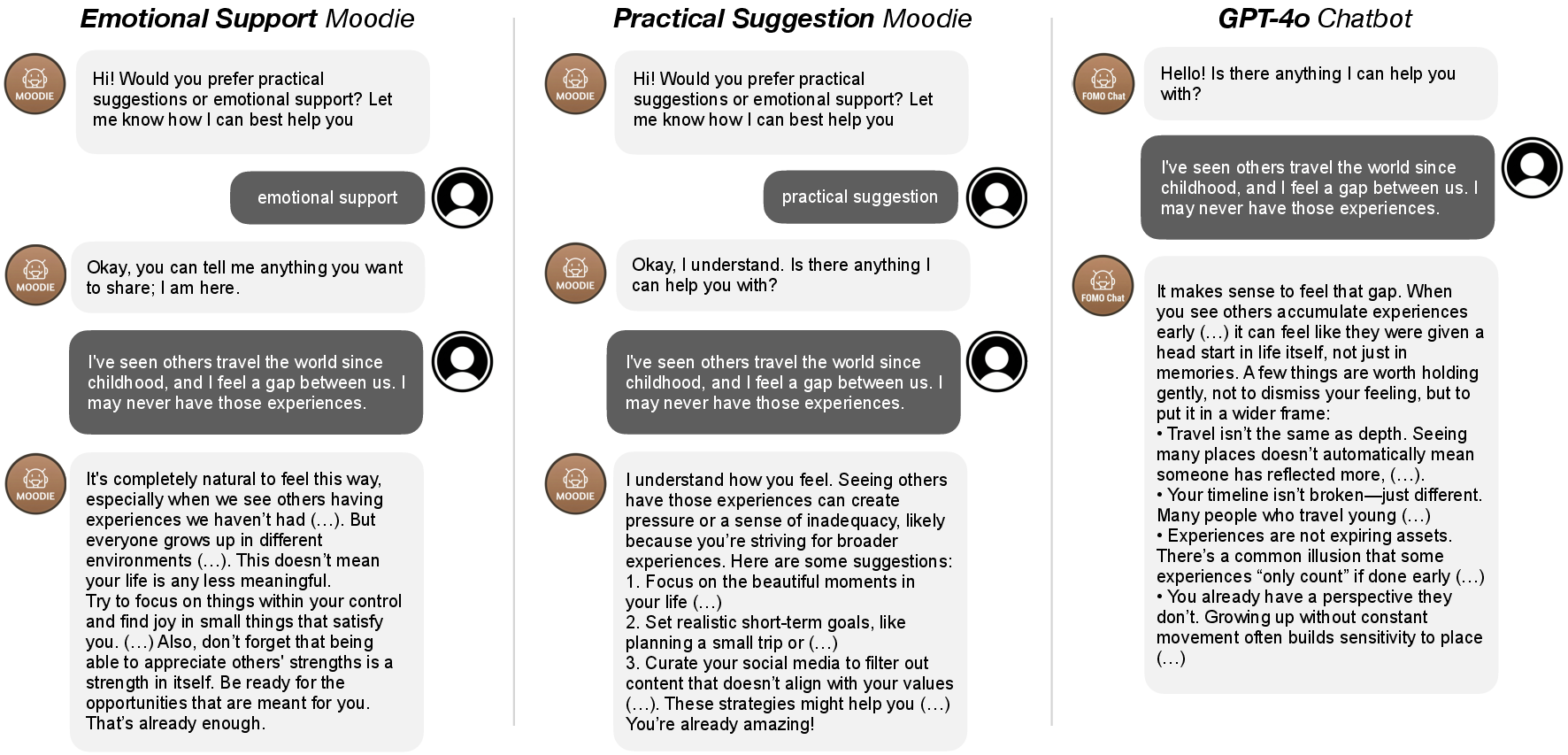
Figure 1: Illustrative conversations showing Moodie's switchable response mechanism (left: emotional support, middle: practical suggestions) and the GPTo-4o baseline (right).
Experimental Setup and Quantitative Results
A one-week, between-subjects field deployment with 21 participants (mean age 21.67, SD 2.69; moderately elevated FoMO; no ongoing psychological interventions) compared Moodie to a baseline (unmodified GPT-4o). Pre-post outcomes included the Przybylski FoMO Scale and the CERQ-short for cognitive emotion regulation.
Key quantitative findings:
- FoMO Decline: Both Moodie and GPT-4o conditions resulted in statistically significant reductions in FoMO over one week (F(1,20)=16.53, p<0.001), with no main effect of condition—i.e., mood-specific tailoring did not outperform generic LLM interaction in primary FoMO reduction.
- Emotion Regulation: Self-blame and rumination also declined (F(1,20)=10.98, p<0.01; F(1,20)=9.13, p<0.01) in both cohorts, with no significant between-group difference.
- Contradictory/Unexpected Result: The specific tailoring of Moodie did not amplify short-term quantitative outcomes over generic, high-performing LLMs. This result tempers assumptions about the necessity of purpose-built mental health LLMs for sociodigital anxieties like FoMO, at least in short-term unsupervised use.
Qualitative Insights and User Perceptions
Thematic analysis of follow-up interviews revealed a divergent phenomenological outcome:
- Engagement and Social Connection: Moodie was consistently described as more conversational, emotionally attuned, and "companion-like," whereas GPT-4o responses were felt to be overly formal, protracted, and lacking in natural dialogue flow.
- Sustained Interaction and Reflective Depth: Users noted that Moodie prompted more self-expression and reflection, which are critical mediators of mental resilience and well-being, aligned with prior research on digital therapeutic expression.
- Preference Patterns: While users appreciated the ability to switch between support and suggestion, the majority gravitated toward the emotional support mode for ongoing engagement, underscoring the importance of perceived empathy even in text-based agents.
- Temporal Scope: Across the board, participants were skeptical of short-term remediation for FoMO and emphasized the need for longer-term, gradual interventions—a sentiment corroborated by the broader digital mental health literature.
Practical and Theoretical Implications
The study destabilizes the assumption that tailored, purpose-built LLM chatbots offer immediate quantitative superiority over leading general-purpose models in affective outcomes where the underlying large models are already sufficiently context-sensitive and empathetic. However, it surfaces significant practical value in user-perceived connection, engagement, and the facilitation of self-disclosure—factors likely to be essential for long-term adherence and effect in real-world settings.
For future AI development, these findings argue for:
- Focus on Engagement and Longitudinal Efficacy: Metrics beyond short-term symptom decline—including sustained user engagement and emotional connection—should become central endpoints for conversational agent evaluation.
- Dynamic Adaptivity: User-driven multimodality (switchable response types) is crucial for acceptability and sustained use, especially for vague and context-dependent mental health constructs like FoMO.
- Evaluation Methods: Larger-scale, longitudinal studies with log-analytic and behavioral endpoints are necessary to deconvolute the causal structure between medium, content tailoring, and mental health outcome.
Conclusion
"Moodie" (2606.07231) provides evidence that while both tailored and general LLM-based chatbots can reduce FoMO and pathological emotion regulation in the short term, only the purpose-built agent reliably induces stronger perceptions of empathy, social connection, and engagement. Such experiential qualities may be determinative for long-term digital well-being interventions. The findings invite a re-examination of mental health chatbot design goals: from short-term quantitative efficacy toward ecological validity, adaptivity, and user engagement—all critical considerations as LLMs become ever more capable and present in digital therapeutic landscapes.

