- The paper presents a joint Dalitz-plot amplitude analysis that disentangles resonant and non-resonant contributions in e⁺e⁻ → J/ψ ππ(KK).
- It implements a dispersive coupled-channel Omnès approach to accurately model scalar ππ/KK final-state interactions.
- Global fits yield precise resonance parameters for Z_c(3900), Y(4220), and Y(4320), highlighting the necessity of including non-resonant backgrounds.
Simultaneous Dalitz-Plot Analysis of e+e−→J/ψππ(KKˉ) with Dispersive Final-State Interactions
Introduction
The structure of the spectrum in hadron spectroscopy above open-charm threshold has manifested complexities that are not accommodated by the conventional quark model. The e+e−→J/ψπ+π− and e+e−→J/ψK+K− reactions in the 4.13-4.36 GeV region showcase the interplay of exotic vector states (Y), charged intermediates (Zc), and strong final-state interactions (FSI). This work (2606.07225) presents a joint Dalitz-plot based amplitude analysis of these processes, treating the scalar ππ/KKˉ FSI via a coupled-channel dispersive (Omnès) approach, with e+e− energy dependence encoded by resonant (Y(4220), Y(4320)) and non-resonant production mechanisms. The comprehensive analysis evaluates differential cross-section data and parameterizes the resonance content, offering quantitative insights into the production and decay dynamics of these multi-body systems.
Theoretical Framework
The amplitude construction follows the Dalitz-plot decomposition (DPD) formalism, as developed in prior works, which allows explicit factorization of the angular and dynamical structure in three-body decays. Each amplitude is represented in terms of partial waves for isobar subchannels in a manner that exactly maps onto field-theoretic (Lagrangian) models. Resonant and non-resonant contributions are separated at the amplitude level, enabling global fits to cross-section data with a restricted set of energy-independent parameters.


Figure 1: Diagrams illustrating the considered contributions to the e+e−→J/ψππ(KKˉ) processes.
The virtual-photon induced three-body system receives contributions from:
- Intermediate vector resonances (e+e−→J/ψπ+π−0, e+e−→J/ψπ+π−1) coupling to the e+e−→J/ψπ+π−2 final states,
- Scalar and tensor resonances in the e+e−→J/ψπ+π−3 and e+e−→J/ψπ+π−4 subchannels (e+e−→J/ψπ+π−5, e+e−→J/ψπ+π−6, e+e−→J/ψπ+π−7),
- The e+e−→J/ψπ+π−8 in e+e−→J/ψπ+π−9 channels,
- Non-resonant (background) amplitudes subject to dispersive FSI.
The energy dependence is implemented by extracting the e+e−→J/ψK+K−0 structure at the production vertex, assigning Breit-Wigner propagators to e+e−→J/ψK+K−1 states, and the e+e−→J/ψK+K−2 dependence for subchannel resonances. The non-resonant components are coupled to FSI via a data-driven coupled-channel Omnès matrix, which incorporates e+e−→J/ψK+K−3 S-wave amplitudes constrained by Roy and Roy-Steiner analyses.
Fit Strategy and Data Reproduction
The data set comprises BESIII measurements of total cross sections and one-dimensional invariant-mass distributions for both e+e−→J/ψK+K−4 and e+e−→J/ψK+K−5 final states. The fits proceed in two stages:
Minimal Fit
Restricting to e+e−→J/ψK+K−6 GeV, only the e+e−→J/ψK+K−7, e+e−→J/ψK+K−8, and the scalar channel are considered, omitting e+e−→J/ψK+K−9 and tensor contributions. The model describes the total and differential cross sections up to moderate energies with Y0, but deviations become significant at higher Y1. Crucially, a purely resonant scenario fails; non-resonant background amplitudes, iterated through Y2 FSI, are necessary for data consistency.
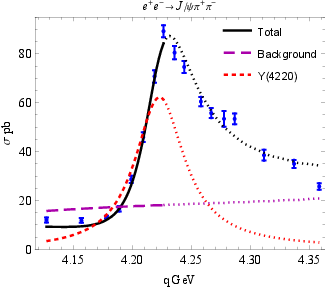
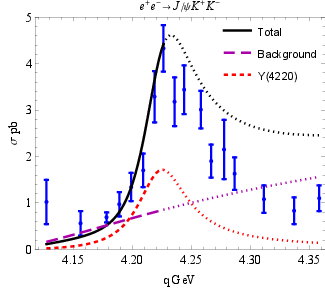
Figure 2: Total cross section of the process Y3 in the minimal fit, showing the necessity of background terms.
Full/Energy-Global Fit
Extending to Y4 GeV, the Y5 and Y6 are added. Here, the best-fit parameters provide a Y7 and yield masses and widths for Y8, Y9, and Zc0, consistent with previous PWA determinations. The non-resonant background is reduced in the full fit but remains essential.
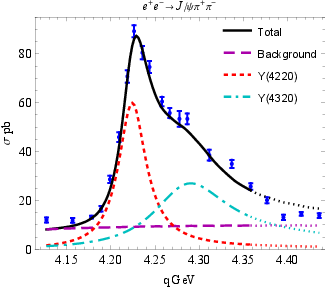
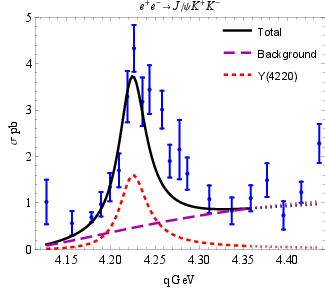
Figure 3: Total cross section illustrating distinct contributions (Zc1, Zc2, background) in the energy-global fit.
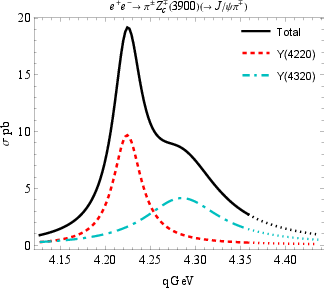
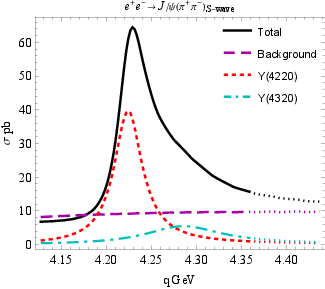
Figure 4: Subprocess cross sections for Zc3, quantifying the Zc4 and scalar contributions' strength and interference.
Analysis of Invariant Mass Distributions
The detailed comparison with one-dimensional invariant-mass distributions at various center-of-mass energies reveals that:
- The Zc5 is required to account for the Zc6 peaks,
- The coupled-channel FSI dynamically generates the Zc7 shape and induces observable Zc8 threshold effects,
- Pronounced interference between background and resonant amplitudes is evident, especially in the scalar channel, making the extraction of resonance parameters highly correlated with the modeling of the non-resonant piece.
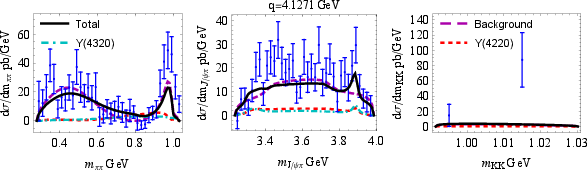
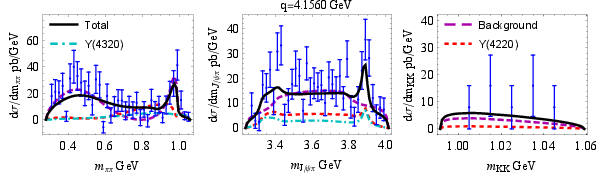
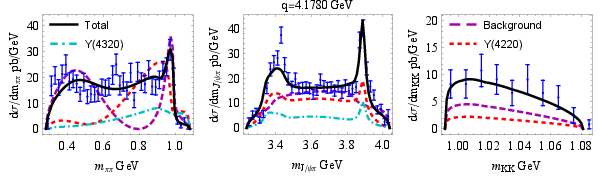
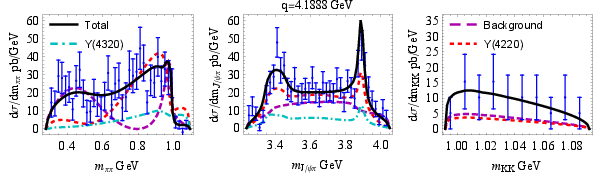
Figure 5: Total fit to the invariant mass distributions at low Zc9 in ππ/KKˉ0. Data and the different theoretical contributions are shown.
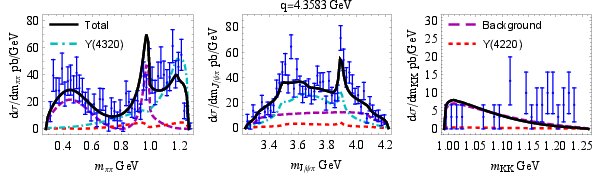
Figure 6: Representative high-energy invariant mass distributions, showing improved fit quality with the inclusion of additional resonances at higher ππ/KKˉ1.
Resonance Parameters and Model Implications
The extracted resonance parameters in the isobar model are as follows:
- ππ/KKˉ2: ππ/KKˉ3 MeV, ππ/KKˉ4 MeV,
- ππ/KKˉ5: ππ/KKˉ6 MeV, ππ/KKˉ7 MeV,
- ππ/KKˉ8: ππ/KKˉ9 MeV, e+e−0 MeV.
These values are compatible with, and in some cases more precise than, previous BESIII PWA extractions for the same processes. The higher-mass vector structure is phenomenological and reflects channel-dependent line shapes rather than a universal PDG mass assignment.
A significant statement from the fit is that a purely resonant treatment of BESIII data fails. The inclusion of non-resonant background, coupled into strong FSI, is mandatory to simultaneously reproduce total and differential cross sections across the full energy regime.
Practical and Theoretical Implications
The analysis underscores the necessity of dispersive coupled-channel techniques when interpreting amplitude structures in three-body production above open charm threshold. Model-independent parameterizations such as the DPD, combined with rigorous FSI treatment, guarantee that resonance parameters extracted are minimally sensitive to ad hoc background assumptions. This framework can be systematically extended to higher energies and other final states as more precise data become available.
The non-resonant component's persistence indicates that the underlying physics includes contributions from non-e+e−1 or non-exotic production mechanisms—possibly, multi-channel meson loops, triangle singularities, or other molecular effects. Future refinements should incorporate explicit open-charm thresholds and explore the analytic properties of background terms in greater detail.
Conclusion
This study provides a simultaneous Dalitz-plot-based amplitude analysis of e+e−2 in the 4.13–4.36 GeV range, with rigorous inclusion of FSI and explicit resonance and background parameterization (2606.07225). The fits yield precise resonance parameters and demonstrate that non-resonant scalar amplitudes are essential for a consistent data description. These results set a benchmark for future multi-body amplitude analyses in hadron spectroscopy and illustrate the utility of dispersive approaches in disentangling exotic and non-resonant contributions in e+e−3 annihilation channels.