- The paper introduces DyCon, a novel adaptive mechanism that models evolving problem difficulty to control reasoning depth and mitigate overthinking.
- It employs a linear regressor on step embeddings to translate latent difficulty signals into dynamic token generation control, enhancing reasoning efficiency.
- Empirical results show up to 52.5% token reduction and significant accuracy gains across benchmarks, highlighting practical benefits for large reasoning models.
Dynamic Reasoning Control via Evolving Difficulty Modeling in Large Reasoning Models
Introduction and Motivation
The paper "DyCon: Dynamic Reasoning Control via Evolving Difficulty Modeling" (2606.07108) introduces a novel mechanism for adaptive reasoning in Large Reasoning Models (LRMs). The proposed method addresses a crucial bottleneck in state-of-the-art LRMs: overthinking during chain-of-thought (CoT) reasoning. Overthinking manifests as redundant exploration and reflection in reasoning traces, especially in tasks that are simple or already solved. Existing attempts to mitigate overthinking—either through static difficulty estimation, rule-based heuristics, or task-specific supervised approaches—fail to capture the dynamic evolution of problem difficulty inherent in multi-step reasoning. This work empirically demonstrates that problem difficulty is a temporally evolving property and that LRMs encode such signals in their latent step-wise embeddings. By estimating evolving difficulty online, DyCon enables adaptive control of reasoning depth, improving both efficiency and answer quality.
Empirical Analysis of Dynamic Difficulty Evolution
A primary contribution of this work is the empirical dissection of how problem difficulty evolves during LRM reasoning. Through step-level model introspection and difficulty self-assessment, the authors show that as reasoning unfolds, the effective problem difficulty tends to decrease for productive chains, while remaining high or even increasing if the chain deviates from the correct path. Step-wise hidden states (embeddings at specific step boundaries) linearly encode this evolving difficulty, which is strongly correlated with the remaining reasoning trajectory length.
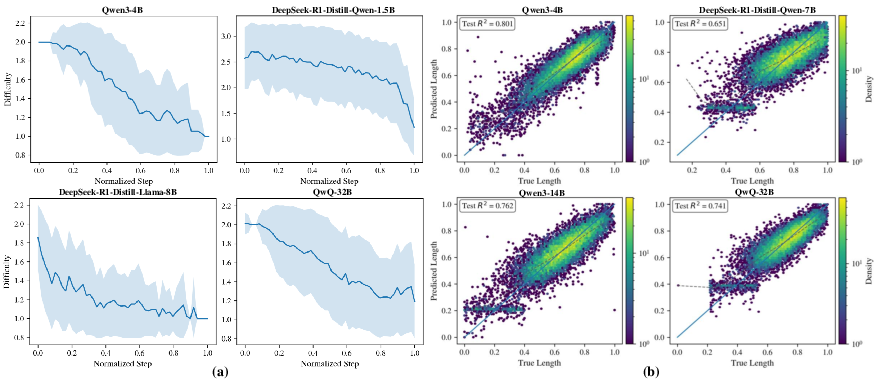
Figure 1: The dynamic decline of self-assessed difficulty across reasoning steps and the linear correlation of predicted difficulty with ground-truth, indicating strong latent difficulty encoding in model representations.
The analysis covers multiple model sizes and architectures, demonstrating the universality of this dynamic phenomenon. The findings also reveal that static or coarse-grained proxies for difficulty are insufficient, motivating fine-grained, temporally resolved estimators for adaptive control.
DyCon Framework: Evolving Difficulty Estimation and Control
DyCon operates via two main stages: explicit modeling of evolving difficulty and difficulty-aware dynamic control of reasoning generation.
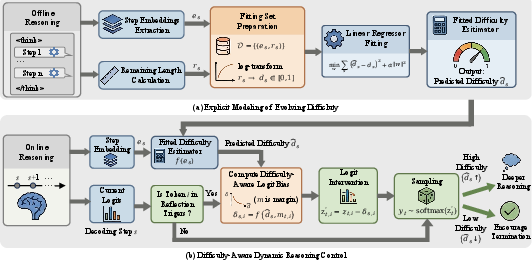
Figure 2: DyCon framework: step embeddings and remaining length signals are used to train a linear regressor for difficulty estimation, which in turn modulates reflection-trigger logits for efficient, dynamic control.
1. Step Embedding Extraction and Difficulty Regression: At each reasoning step, the hidden state of a chosen model layer at the step boundary is extracted to form a step embedding. Ground-truth difficulty is proxied by the (log-normalized) remaining reasoning length from that step to the end of the chain. An efficient ridge regression is fit (training-free, requiring a modest number of labeled trajectories) to map from embeddings to normalized difficulty scores. The linear correlation is robust across architectures and domains, with layer selection and regularization chosen via validation set R2 maximization.
2. Dynamic Token Generation Control: At inference, DyCon uses the estimated difficulty d^s at each step to modulate candidate token probabilities, particularly suppressing reflection-related keywords when the estimated difficulty is low. This is operationalized by subtracting a difficulty-conditioned logit bias from selected tokens, balancing between aggressive suppression (for easy steps) and minimal interference (for hard steps). The effect is a soft, trajectory-aware termination mechanism that adapts step-by-step rather than enforcing hard early exits.
Quantitative and Qualitative Results
Quantitative Gains: Across four LRMs (4B–32B) and twelve benchmarks covering math, coding, QA, and scientific reasoning, DyCon achieves consistent improvements over prior state-of-the-art reasoning efficiency methods. It yields:
- Up to 40.6% reduction in token usage and 6.7% absolute accuracy improvements in math reasoning
- Up to 52.5% fewer tokens and 8.6% higher accuracy on non-mathematical benchmarks
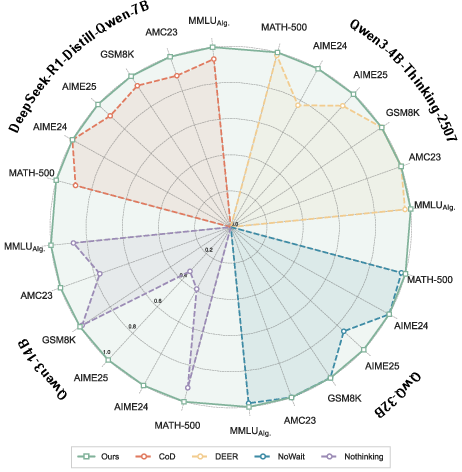
Figure 3: Across architectures and tasks, DyCon consistently outperforms DEER, NoWait, and NoThinking in both efficiency and accuracy.
These results generalize to derivatives of LLaMA and Qwen backbones, and robustness studies show negligible performance degradation under alternative regressor types and vocabulary lists.
Ablations: Systematic ablation studies underscore that static difficulty suppression, output entropy-based classifiers, or rule-based early exits are suboptimal compared to temporally dynamic, fine-grained regression. The linear regressor is sufficient to capture useful latent information, though Elastic Net or MLP regressors offer modest additional gains in certain settings. Aggressive early-exit methods tend to exhibit increased premature stopping and accuracy loss, especially on complex tasks.
Domain and Data Efficiency: The regressor trained solely on math data transfers to scientific, commonsense, and QA tasks, affirming that the temporal pattern of reasoning difficulty is universal across domains. Efficient regressor fitting is feasible with as few as 300–600 samples.
Analysis of Failure Modes and Boundary Cases: The supplementary appendices provide kernel density analysis of step-wise correctness emergence, showing that a substantial fraction of reasoning tokens are indeed generated after the correct answer is first produced—empirically validating the prevalence of overthinking. Case studies visually confirm that DyCon's regressor rapidly declines on simple examples and only relaxes suppression late in complex trajectories upon key insights.

Figure 4: For a hard AIME problem, difficulty remains high across many steps only dropping upon critical problem resolution, illustrating DyCon’s fine-grained adaptability.
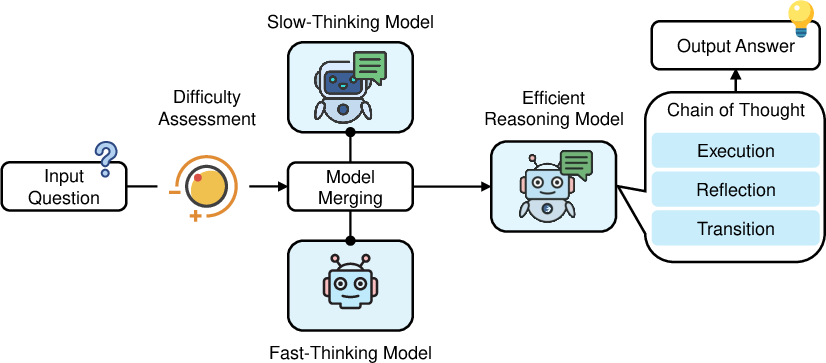
Figure 5: Difficulty-adaptive reasoning conceptualization; models dynamically allocate cognitive mode (System 1 vs. System 2) based on evolving difficulty estimates.
Theoretical and Practical Implications
Model-Dependent and Dynamic Difficulty Perception: The shift from static, dataset-defined difficulty to model-centric and temporally evolving metrics enables fine-grained, individualized reasoning control. This supports future work in meta-reasoning, curriculum learning, and adaptive inference in heterogeneous LLM collections.
Cost Reduction and Accessibility: By removing redundant tokens in easy or already solved tasks, DyCon substantially lowers operational compute and latency for LLM deployments, with direct benefits for resource-constrained inference and embedded reasoning agents.
Self-Calibration and Adaptive Reasoning Depth: The method presages systems that can modulate their cognitive effort online, flexibly switching between shallow and deep processing as per ongoing internal evidence, akin to dual-process theories in cognitive science. This is foundational for real-world applications requiring trust, efficiency, and robustness.
Challenges and Forward Directions: DyCon's effectiveness depends on the quality of difficulty proxies and the stability of the regressor under domain shift and adversarial distributions. Extending these mechanisms to multi-modal, multi-agent, or fine-grained action-selection settings is a natural and promising direction.
Conclusion
DyCon advances the state of efficient reasoning in autoregressive LLMs by showing that latent model representations encode temporally resolved difficulty signals, which can be decoded efficiently to support dynamic, trajectory-aware reasoning control. The approach is training-free, easy to integrate, and empirically robust, providing measurable improvements in reasoning efficiency without trade-offs in accuracy or generalization. The explicit model- and trajectory-aware difficulty modeling paradigm established here may underpin subsequent work in scalable, adaptive, and safety-critical generative AI.

