- The paper introduces a rate-network criterion that quantifies conditions for efficient external-field assisted muon reactivation to minimize alpha sticking.
- It employs detailed kinetic modeling and energy-resolved analysis to determine the critical overlap and transport parameters necessary for optimal muon recycling.
- Benchmark scenarios reveal that optimized field overlap and rapid post-stripping confinement significantly enhance fusion cycle yields.
External-Field-Assisted Muon Reactivation in Muon-Catalyzed Fusion: Rate-Network Analysis and Alpha Sticking Reduction
Introduction
Alpha sticking in deuterium–tritium muon-catalyzed fusion (μCF) remains a primary barrier to maximizing the catalytic cycles per muon, thereby limiting the feasibility of μCF as a practical path to low-temperature fusion energy. The negative muon, upon catalyzing fusion in a dtμ molecular complex, can either be liberated and recycled or become bound to the resulting alpha particle, forming a (αμ)+ ion—an outcome that removes the muon from further catalytic activity unless it is “stripped” and returned to the cycle. Conventional collisional mechanisms for muon reactivation are limited in efficacy, prompting interest in externally driven reactivation protocols utilizing intense photon or electromagnetic fields to directly liberate the muon from the alpha complex.
This work develops a comprehensive rate-network criterion for external-field-assisted muon reactivation and quantitatively identifies the post-stripping transport and overlap requirements for practical alpha-sticking reduction in realistic μCF environments. Detailed kinetic modeling, benchmark scenario analyses, and probability-level no-go conditions are advanced, anchored in established and recent few-body μCF calculations.
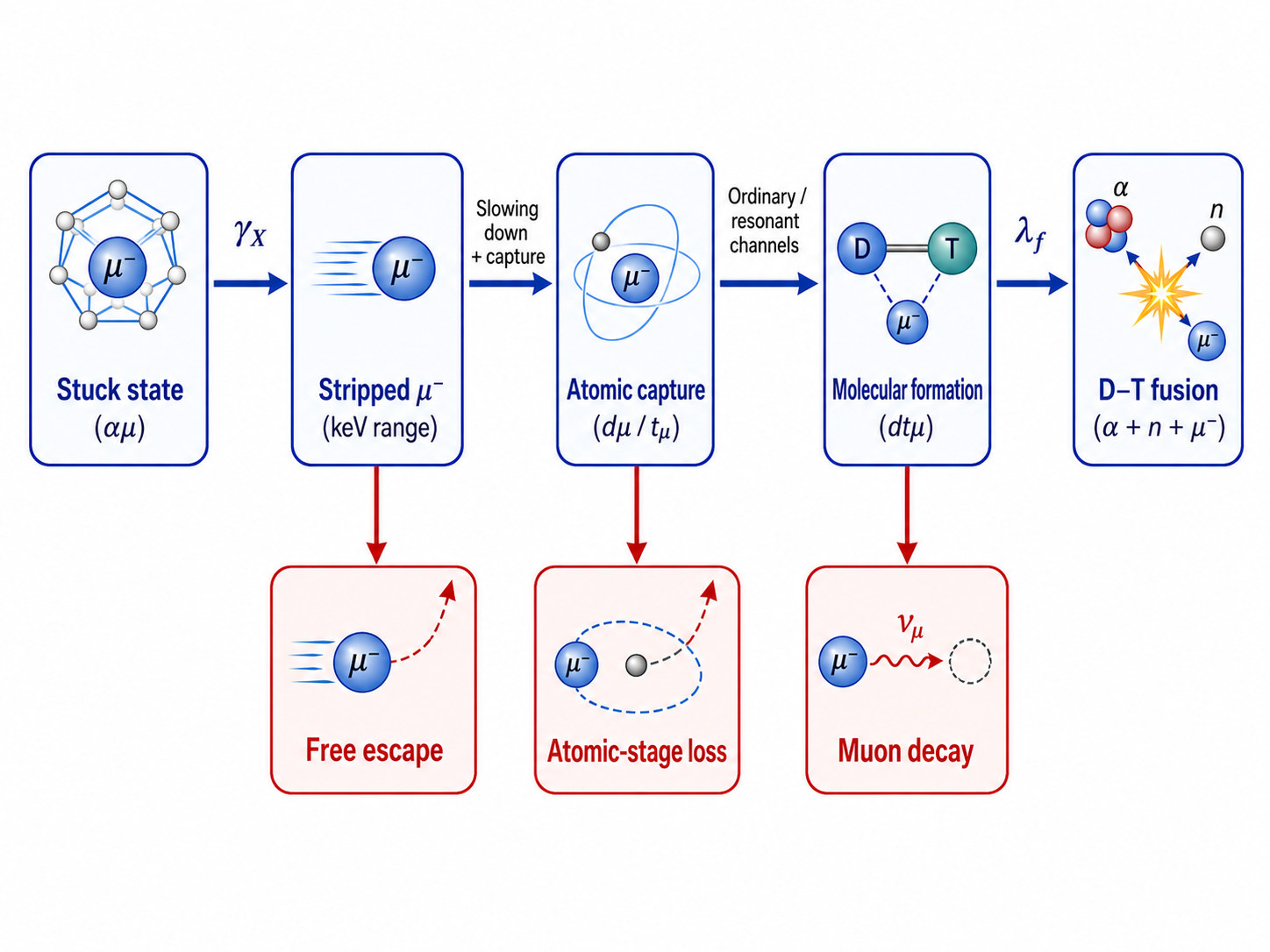
Figure 1: External-field-assisted reactivation pathway; the externally stripped μ− must remain confined and re-enter the catalytic cycle to contribute positively.
Theoretical Framework and Rate-Network Criterion
The total alpha sticking probability is appropriately separated into the initial sticking probability, ωS0, and the net reactivation probability, R; the latter now includes both conventional collisional and external-field-induced stripping pathways. The external mechanism is factored as RX=fXPXηX, where fX represents the space–time overlap of the external field with the residual stuck population, PX is the microscopic (e.g., photostripping) probability, and ηX denotes the probability of full post-stripping recycling back into the fusion cycle before muon escape or decay.
A pivotal outcome is the derivation of a no-go condition: for any target external reactivation probability RXcrit, the required recycling probability (αμ)+0 must respect (αμ)+1. This sets a strict probabilistic upper bound on achievable improvements, independently of detailed kinetic modeling.
The overall cycle yield (αμ)+2, a key figure of merit, is derived from these quantities, and the gain (αμ)+3 is employed as a normalized metric for catalytic enhancement.
Energy-Resolved Rate Network
The post-stripping fate of the muon is determined via an explicit energy-resolved rate network. Upon liberation, the muon's spectrum (αμ)+4 is determined by the characteristics of the external field and the dynamics of the (αμ)+5 system (including Doppler broadening from recoil or in-medium motion). The network tracks the muon as it undergoes slowing via stopping power (αμ)+6, capture into (αμ)+7 or (αμ)+8 atoms (parametrized by (αμ)+9), escape from the active region (via a confinement length μ−0 and geometry factor), and finally either atomic-stage loss, decay, or entry into the molecular μ−1 channel, possibly facilitated by resonant formation.
Absorbing probabilities for each competing pathway (μ−2, μ−3, μ−4, μ−5, μ−6) are explicitly computed for all energy bins, ensuring channel diagnostic and normalization integrity.
Benchmark Scenario Analysis
Benchmark scenarios are constructed to interrogate parameter dependencies and the practical reach of the external reactivation channel. Four principal regimes—conservative, baseline, baseline with resonant molecular formation, and optimistic—are analyzed, with fixed μ−7 and representative photon field, confinement, capture, and stopping parameters (see Table 1 in the paper).
Key results include:
- In the optimistic scenario, nearly all externally stripped muons are recycled, with μ−8, resulting in a cycle gain μ−9 and a cycle yield increase from ωS00 (collisional baseline) to ωS01.
- Resonant molecular formation suppresses atomic-stage loss and broadens regions of high recycling, but cannot mitigate losses due to prompt muon escape if confinement and transport are not optimized.
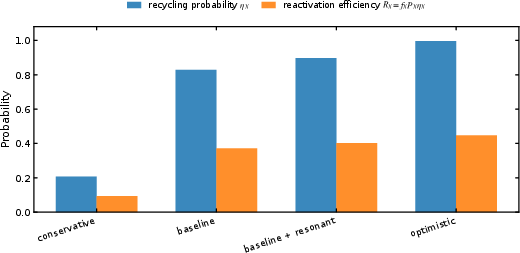
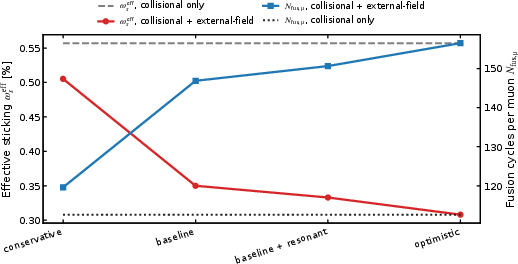
Figure 2: Benchmark scenario metrics for post-stripping recycling probability and corresponding effective sticking/cycle yields.
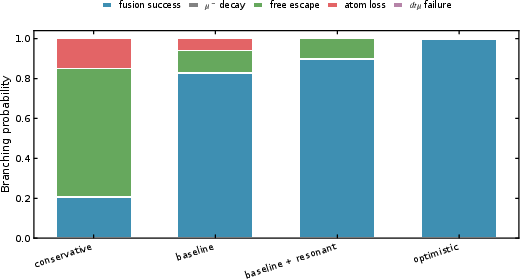
Figure 3: Post-stripping loss budget across benchmarks: escape dominates in the conservative regime, while recycling sharply increases with confinement and molecular resonances.
Transport and Overlap Constraints
A two-parameter scan over capture and stopping amplitudes reveals a sharply defined transport window in which external reactivation is beneficial. Only in regimes of sufficient confinement and quick slowing is the recycling probability ωS02 maximized—otherwise, stripped muons escape before contributing further fusions.
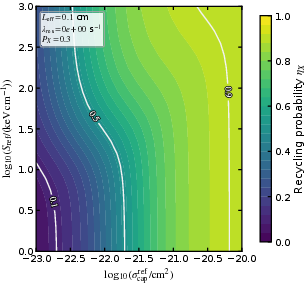
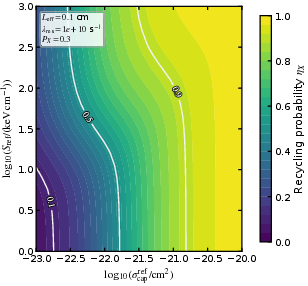
Figure 4: Transport-window map: high values of ωS03 are only attainable for sufficiently large capture and stopping parameters, especially when resonant molecular formation rates are high.
Additionally, the overlap factor ωS04 is essential; even perfect recycling and high microscopic stripping probability are insufficient if the external field samples only a small spatial/temporal fraction of the stuck population. The cycle gain is linearly sensitive to ωS05, as quantified in parameter sweeps.
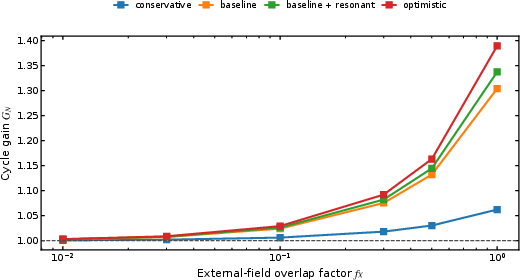
Figure 5: Yield gain ωS06 sensitivity to overlap factor ωS07; significant catalytic improvement occurs only for large ωS08.
The no-go criterion further quantifies that some combinations of ωS09 and R0 simply cannot reach target R1 values due to R2.
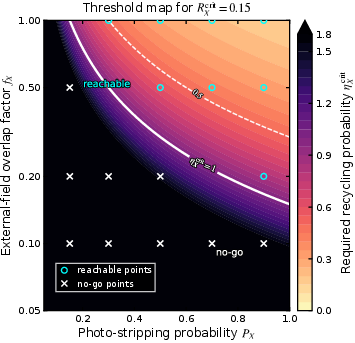
Figure 6: Probability-level no-go thresholds for required recycling R3; regions above unity are unphysical regardless of transport details.
Model Robustness and Diagnostic Scans
Convergence studies confirm numerical stability with respect to energy grid granularity and the assumed spectrum for the stripped muon. The benchmark hierarchy and principal conclusions are robust under broadening in R4 and moderate variations in transport parameters.
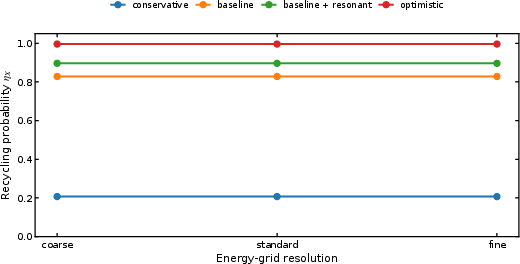
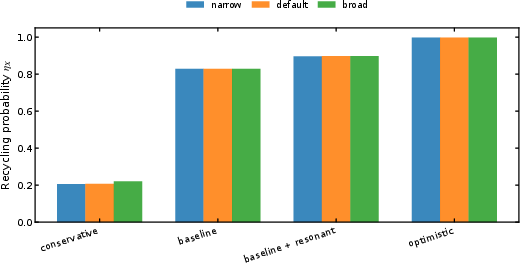
Figure 7: Convergence of R5 with energy grid resolution (a) and insensitivity to stripped-muon spectrum shape (b).
A multi-parameter uncertainty scan across all effective rates and overlap/stripping probabilities demonstrates the monotonic relationship between external reactivation probability R6 and cycle gain R7, substantiating the criterion's predictive power.
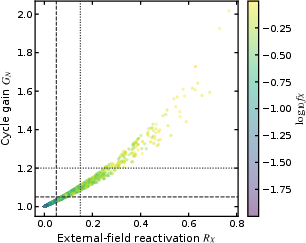
Figure 8: Correlation between external reactivation probability R8 and catalytic-yield gain R9 across multi-parameter uncertainty scan.
Implications and Future Perspectives
The rate-network criterion establishes that post-stripping transport is the decisive bottleneck for external-field-assisted reactivation in μCF. Practical alpha sticking reduction by external fields requires not only engineering strong and well-overlapped fields for efficient photostripping, but also ensuring that stripped muons are rapidly confined and recycled, aided where possible by resonant molecular pathways.
The framework highlights missing microscopic inputs (e.g., high-fidelity RX=fXPXηX0 photostripping cross sections, state-resolved resonant formation rates, and transport coefficients in dense D–T mixtures) as priorities for further few-body and experimental investigations. Emerging muon and photon facilities (J-PARC MUSE, HIAF, European XFEL, SHINE, LCLS-II, ELI) are well positioned for targeted studies of these dynamics, providing avenues for synchronized field-assisted stripping experiments.
On a theoretical level, the factorized probability paradigm and network-based closure should generalize to a range of nonequilibrium catalytic reaction systems with competitive loss/recycling channels, offering a roadmap for systematic optimization under complex external controls.
Conclusion
This work delivers a flexible, quantitative framework for assessing the utility of external-field-assisted muon reactivation in μCF, anchoring practical progress in alpha-sticking reduction to kinetic and probabilistic realities rather than speculative enhancement scenarios. The outlined rate-network formalism, together with strong numerical results, sets the practical and theoretical benchmarks for future studies and experimental program design in the pursuit of viable muon-catalyzed fusion energy systems.