- The paper presents a novel application of the LFQM to evaluate EMT form factors in heavy quarkonia, identifying distinct D-term values for charmonium and bottomonium.
- It utilizes two light-front wave function prescriptions to elucidate the sensitivity of momentum, pressure, and shear distributions to the internal meson structure.
- The analysis confirms consistency with lattice QCD results and highlights how concentrated mechanical densities vary with quark mass.
Mechanical Structure of Pseudoscalar Charmonium and Bottomonium on the Light-Front
Introduction
The investigation of hadronic mechanical properties via energy-momentum tensor (EMT) form factors has emerged as a central theme in hadron physics, particularly in the context of the so-called D-term, which encodes the distribution of mechanical forces, including pressure and shear, within hadrons. While substantial progress has been made in nucleon and pion studies, the mechanical structure of heavy quarkonia, such as charmonium (ηc) and bottomonium (ηb), remains comparatively unexplored due to the theoretical complexities of nonperturbative QCD in the heavy-quark sector. The light-front quark model (LFQM) provides a tractable framework for evaluating mesonic gravitational form factors (GFFs), specifically the A and D-terms, by expressing the EMT matrix elements in terms of light-front wave functions (LFWFs). This study extends the formalism to heavy pseudoscalar mesons, examining both the sensitivity of mechanical distributions to the internal quark-antiquark wave function and the correlation between spatial distributions and observables such as pressure, momentum, and internal energy in the transverse plane.
The analysis is performed in the LFQM, where the mesonic states are described in the valence quark-antiquark sector using LFWFs obtained via the Brodsky–Huang–Lepage (BHL) prescription. Two classes of spatial wave functions are considered, differing by their so-called "Jacobi factors," to probe model dependence. The GFFs—A(q2) and D(q2)—are defined through matrix elements of the quark EMT operator, with explicit attention to resolving zero-mode ambiguities via the Bakamjian-Thomas (BT) construction.
Spatial mechanical densities in the transverse plane (pressure, shear, force, energy, and longitudinal momentum) are calculated using covariant two-dimensional Fourier transforms of the corresponding GFFs at fixed light-front time, ensuring relativistic consistency and avoiding quantum delocalization artifacts inherent to three-dimensional Breit-frame densities.
A-term and D-term Behavior
The A-term, associated with the quark and antiquark contributions to internal energy and longitudinal momentum, is shown to satisfy the momentum sum rule A(0)=1 for both charmonium and bottomonium. Critically, the A-term decreases with increasing momentum transfer, with greater sensitivity to the wave function at high transfer, particularly for charmonium. The slope of the ηc0-term at zero momentum transfer indicates that longitudinal momentum is more spatially concentrated in bottomonium, consistent with the heavy quark limit.
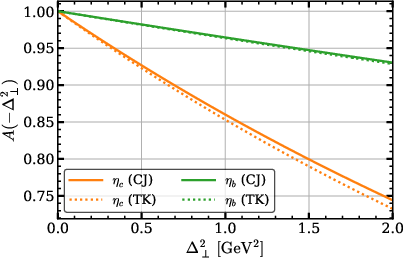
Figure 1: Momentum transfer dependence of the ηc1-term for ηc2 and ηc3, comparing two wave function prescriptions.
The ηc4-term, encoding mechanical stability through pressure and shear, is found to be negative at zero momentum transfer for both systems, with values ηc5 and ηc6, far from the ηc7 chiral limit result for pions, as expected in the non-Goldstone, heavy mass regime. The magnitude of ηc8 is smaller in bottomonium, and sensitivity to the internal wave function is again stronger for charmonium.
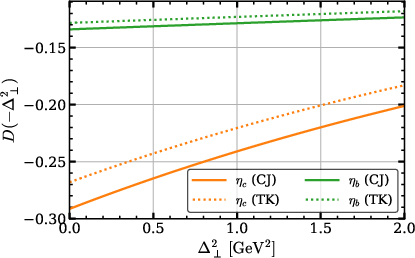
Figure 2: Dependence of the ηc9-term on squared momentum transfer for ηb0 and ηb1.
The electromagnetic form factor (EMFF) is also computed and compared with lattice QCD results for ηb2, showing satisfactory consistency within uncertainties.
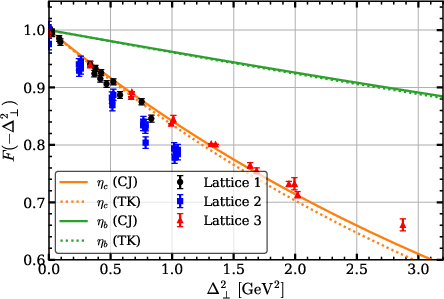
Figure 3: Electromagnetic form factors for ηb3 and ηb4 with lattice QCD comparison for ηb5.
A unified display of all form factors (GFFs and EMFFs) reveals the scale hierarchy between distributions and clarifies the role of each form factor in fixing spatial widths and force profiles.
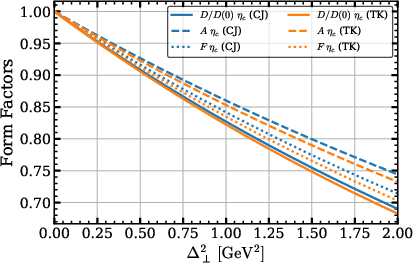
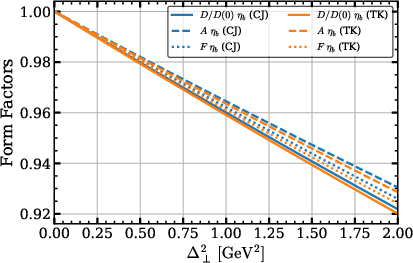
Figure 4: Momentum transfer dependence of all form factors for ηb6 and ηb7; the normalized ηb8-term is displayed for comparison.
Spatial Mechanical Densities
Light-front Mechanical Distributions
Longitudinal momentum density is maximized at the center of the meson (ηb9) and shows marked sensitivity to the wave function; the distribution for A0 is markedly narrower, reflecting the higher constituent mass.
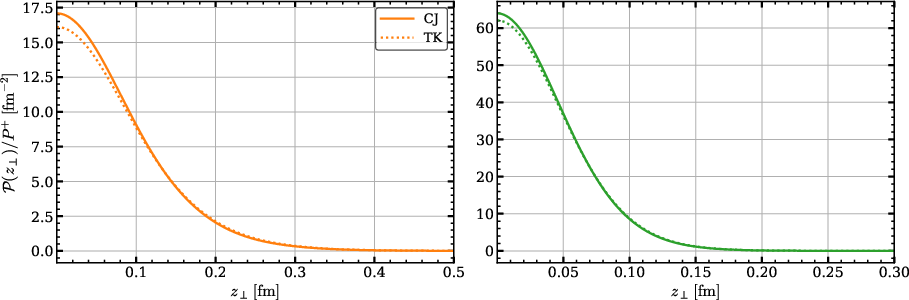
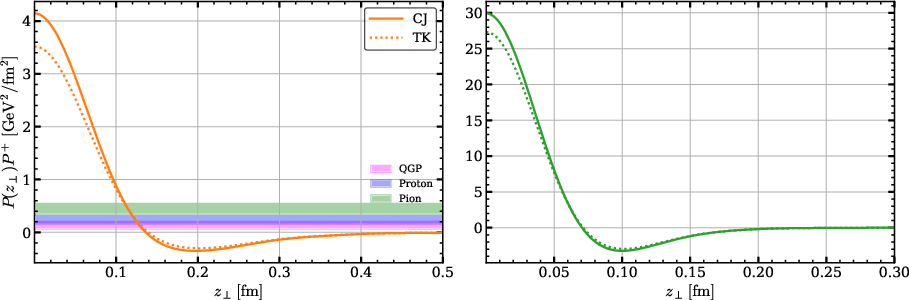
Figure 5: Light-front longitudinal momentum density for A1 and A2 as a function of transverse position.
The pressure distribution exhibits a node, transitioning from positive at small A3 (repulsive core) to negative at larger A4 (attractive surface), as required by the von Laue stability condition. The node occurs at A5 fm for A6 and A7 fm for A8, essentially independent of the chosen wave function. Maximum pressures at the center substantially exceed QGP, proton, and pion values, highlighting the intense internal forces in heavy quarkonia.
The pressure is highly sensitive to the wave function near A9, with less dependence in the periphery.
Shear, Force, and Internal Energy Densities
The shear stress displays a characteristic peak near the pressure node position; its intermediate-D0 behavior is notably sensitive to the wave function. The total mechanical force density, defined as D1, remains positive throughout the transverse plane for both mesons, satisfying the local stability criterion.
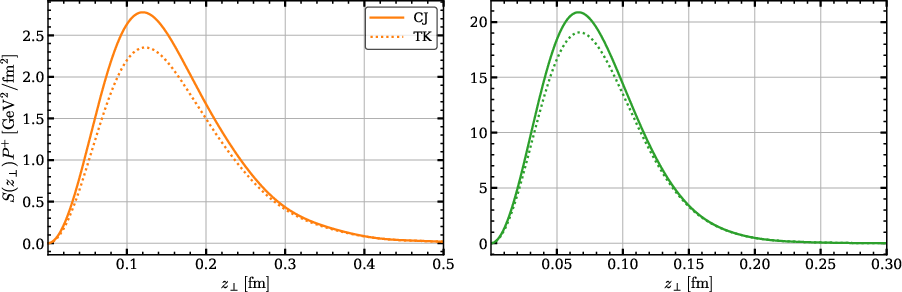
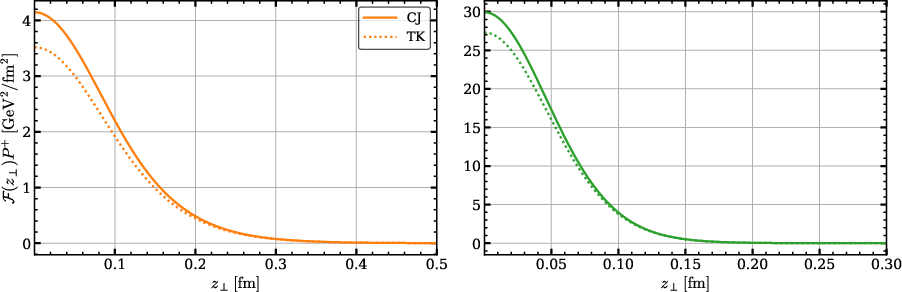
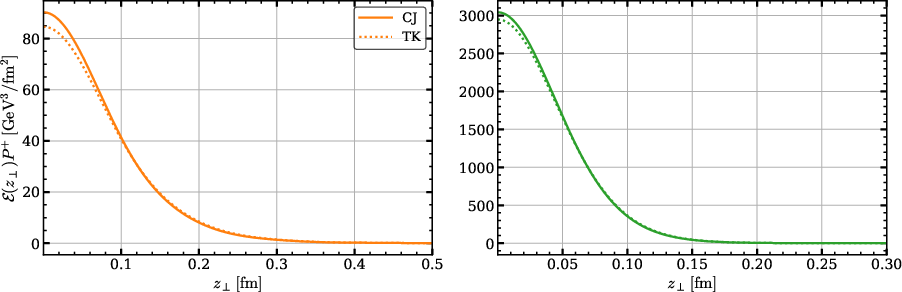
Figure 6: Shear stress distribution in the transverse plane for D2 and D3.
Internal energy density peaks at the center, especially for bottomonium, and declines rapidly for increasing D4. As for other densities, sensitivity to the wave function is localized near the core.
Numerical Results: Radii and Hierarchies
The analysis yields root-mean-square radii for mechanical (momentum and force) and charge sectors. In the D5D transverse plane, momentum and force radii are nearly identical, and all are substantially smaller for bottomonium than for charmonium. The mechanical radii are consistently smaller than the charge radii, indicating that internal mechanical forces are more localized than the overall charge distribution.
The hierarchy D6 holds for D7, in line with the scaling observed in pions, but breaks down in the heavier bottomonium. This supports the presence of nontrivial QCD dynamics in heavy-flavor systems.
Theoretical and Practical Implications
Mechanically, the quarkonia exhibit concentrated internal energy, pressure, and force densities, with spatial distributions highly sensitive to both the constituent mass and the adopted LFWF shape. The reduction of D8 with increasing quark mass underscores the departure from the chiral symmetry-driven structure of light mesons and highlights the influence of heavy-quark symmetry in the EMT sector.
The observed sensitivity of central spatial densities to wave function choice underscores the importance of precision modeling of heavy-meson LFWFs and motivates further investigation of higher Fock sectors, radiative corrections, and model-independent constraints via lattice QCD and GPD physics.
Experimentally, advances in hard exclusive processes (e.g., deeply virtual Compton scattering and generalized parton distribution measurements at future EIC facilities) may eventually provide access to heavy-meson GFFs, making such theoretical investigations essential benchmarks.
Conclusion
This work provides a detailed, two-dimensional light-front characterization of the mechanical structure of heavy pseudoscalar quarkonia, delivering both form-factor data and spatial distributions for energy, momentum, pressure, shear, and force. All results are presented for two distinct LFWF parameterizations, allowing for model sensitivity estimates. The formalism and findings can be directly extended to other heavy mesonic systems, excited states, or to higher Fock sector analyses. These results are expected to inform both the interpretation of future experimental measurements of heavy-hadron structure and theoretical efforts to quantify confinement and QCD mechanical stability in the heavy-flavor sector.