- The paper demonstrates that gravitational TMDs enable determination of the proton's mechanical properties, differentiating between u and d quark contributions.
- It employs a spectator diquark model with light-cone wave functions to compute both leading- and higher-twist TMDs, detailing transverse pressure and shear force distributions.
- The analysis highlights distinct flavor and polarization-dependent structures, advancing understanding of nonperturbative QCD effects in hadron mechanics.
Mechanical Properties of the Proton in Momentum Space: TMD EMT Analysis
Overview
This work addresses the theoretical characterization of the proton's mechanical properties in momentum space through the formalism of gravitational transverse momentum-dependent distributions (TMDs). The proton is analyzed at the quark-parton level using a light-cone spectator diquark model, with explicit attention given to higher-twist effects. The study provides a quantitative mapping between the energy-momentum tensor (EMT) decomposed in terms of TMDs and intrinsic mechanical variables, such as transverse pressure, shear force, and additional polarization-dependent components for both u and d quark flavors. Notably, it extends prior TMD applications by systematically considering higher-twist T-odd contributions and establishing concrete numerical predictions for momentum-space distributions.
Theoretical Framework
The EMT operator for quarks in the proton is parametrized in the context of QCD via gravitational TMDs—quantities linked to generalized, gauge-invariant canonical (gic) versions of the quark EMT. The gic EMT enables a transparent connection to canonical momentum and, critically, a decomposition into 22 independent TMDs: 10 unpolarized, 16 transverse, and 6 longitudinal polarization-dependent distributions. This construction incorporates not only the leading twist (twist-2) but also subleading (twist-3, twist-4) contributions, addressing the longstanding deficiency regarding higher-twist effects in mechanical observables.
The mapping between these TMDs and mechanical variables, such as the transverse pressure σq, shear force, and the polarization-dependent quantities ΠSq and ΠAq, is established by explicit tensor decomposition of the EMT in momentum space. These relations, in particular the dependence on intrinsic transverse momentum k⊥ and longitudinal momentum fraction x, allow the study of detailed spatial and dynamical correlations.
The computation utilizes a light-cone spectator model for the proton, incorporating both scalar and axial-vector diquark configurations. Model parameters are extracted from a fit to the unpolarized TMD f1q, ensuring normalization and phenomenological consistency. T-odd TMDs, sensitive to final-state interactions (FSI), are generated via an explicit one-gluon exchange kernel.
Results: Flavor-Decomposed Mechanical Distributions
Transverse Pressure Behavior
The transverse pressure distribution σq is evaluated as a function of k⊥ for fixed d0 and as a function of d1 for fixed d2 values. For both d3 and d4 quarks, the pressure exhibits a pronounced peak at low d5, situated in the negative region, indicative of a confining (attractive) force.
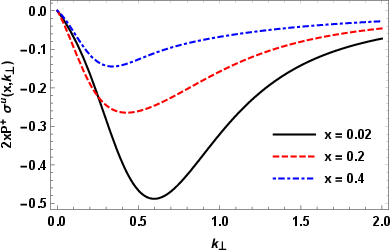
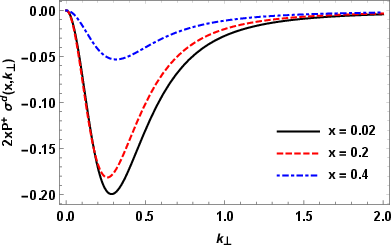
Figure 1: The transverse pressure distribution d6 of (a) d7 and (b) d8 quark flavors of proton as a function of transverse momentum (GeV) at fixed values of d9.
The magnitude of the confining pressure is significantly greater for σq0 quarks relative to σq1 quarks and decreases with increasing σq2, with the distribution's peak shifting toward smaller σq3. This implies a stronger binding in the low-momentum region, particularly for σq4 quarks—a nontrivial flavor asymmetry not captured in leading-twist-only analyses.
When assessed as a function of σq5, at fixed low values of σq6, the transverse pressure remains negative and vanishes as σq7. For σq8 quarks, the distribution saturates and vanishes faster than for σq9 quarks, reinforcing the dominance of ΠSq0-quark binding effects across a broad ΠSq1 range.
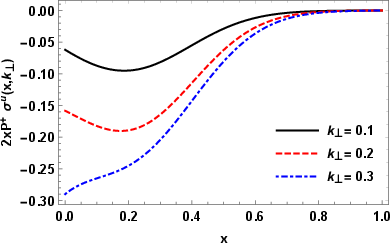
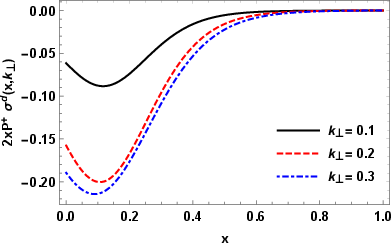
Figure 2: The transverse pressure distribution ΠSq2 of (a) ΠSq3 and (b) ΠSq4 quark flavors of proton as a function of ΠSq5 at fixed values of transverse momentum (GeV).
Shear Force and Higher-Twist Polarization Structures
The study examines the polarization-dependent EMT components, specifically ΠSq6, which isolate T-odd, twist-3 contributions. The distribution of ΠSq7 for ΠSq8 quarks is positive at small ΠSq9, crosses zero, and becomes negative at larger ΠAq0; for ΠAq1 quarks, the sign is inverted, with a negative peak at low ΠAq2 followed by a positive maximum.
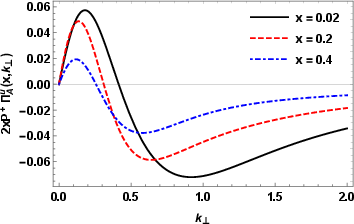
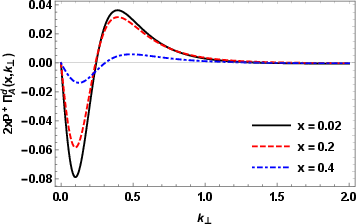
Figure 3: The distribution of ΠAq3 of (a) ΠAq4 and (b) ΠAq5 quark flavors of proton as a function of transverse momentum (GeV) at fixed values of ΠAq6.
The nodal structure observed for ΠAq7 quark ΠAq8 highlights nontrivial interference patterns between low- and high-momentum domains, sensitive to the underlying FSI dynamics. The ΠAq9-dependence shows that both flavors' k⊥0 vanish in the k⊥1 limit, but the sign and location of zero crossings are strongly flavor and k⊥2 dependent.
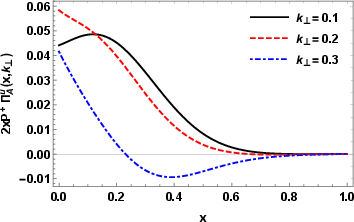
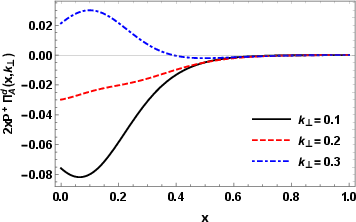
Figure 4: The distribution of k⊥3 of (a) k⊥4 and (b) k⊥5 quark flavors of proton as a function of k⊥6 at fixed values of transverse momentum (GeV).
These higher-twist, polarization-dependent distributions reflect the intricate T-odd structure governed by gluon exchange mechanisms and are directly related to the mechanical response of the proton under external perturbations.
Implications and Future Perspectives
The formalism advanced in this work enables a systematic analysis of the proton's internal mechanical landscape in the three-dimensional momentum domain. The explicit links drawn between gravitational TMDs and mechanical observables provide a robust framework to interpret the dynamical content of the EMT, going beyond the constraints of leading-twist density interpretations.
The strong flavor-separation observed in the low-k⊥7 pressure distributions implies that future phenomenology—particularly lattice QCD and experimental extractions of TMD-sensitive observables—must account for substantial k⊥8 asymmetries inherent in the mechanical sector. The quantification of higher-twist (especially T-odd) contributions suggests that deeply virtual, semi-inclusive, or longitudinally polarized processes could provide indirect constraints on the mechanical properties via their sensitivity to gravitational TMDs.
Despite the non-direct measurability of momentum-space EMT components, the developed methodology paves the way for a deeper understanding of the correlations between QCD binding, hadron structure, and the space-momentum duality of mechanical variables. Extensions to include strangeness, sea quarks, and gluonic contributions are natural next steps. Furthermore, integration with lattice QCD calculations of off-forward matrix elements of the EMT may ultimately synergize model-driven insight with nonperturbative ab initio results.
Conclusion
This study presents a comprehensive mapping of the proton's mechanical properties in the momentum domain through the computation of gravitational TMDs, emphasizing the decisive roles of higher-twist and T-odd effects. Key findings underline the dominance of k⊥9 quark contributions to transverse confinement, significant flavor dependence, and intricate polarization-dependent structures. The formalism and results establish a foundation for future exploration of the dynamical QCD origins of hadronic mechanical stability.

