- The paper presents a stripe-based RIS optimization that reduces the search space from exponential to quadratic by using stripe configurations for real-time UAV communication.
- It details three tracking algorithms—fine-grid, Kalman-aided, and ESC—with ESC achieving a minimal SNR loss of approximately 0.31 dB during UAV mobility.
- Experimental validations show that the stripe-based method outperforms traditional iterative approaches in speed and power, ensuring scalable and robust LAWNs.
Stripe-based RIS Optimization for UAV Communications and Sensing in LAWNs
Introduction and Motivation
This work addresses the practical optimization of reconfigurable intelligent surfaces (RIS) for UAV-assisted low-altitude wireless networks (LAWNs). UAVs operating in these dynamically reconfigurable 3D networks require high-reliability, low-latency coordination, but physical blockage and channel variability often degrade traditional links. By leveraging RISs for controllable propagation, robust virtual line-of-sight (LOS) links can be established between base stations (BS) and UAVs, even in the absence of direct LOS paths (Figure 1).

Figure 1: RIS-assisted UAV-based LAWN scenario where the UAV is located outside the BS serving area.
The main challenge in such systems lies in scaling practical RIS optimization methods. Conventional approaches either optimize each RIS element individually or use block/grouped updates, both suffering from either high computational burden or reduced beamforming resolution, especially as RIS sizes grow. Furthermore, mobile UAVs necessitate real-time adaptation, rendering slow or noise-sensitive algorithms unusable.
System Design and Stripe-based RIS Optimization
The proposed scheme introduces a stripe-based optimization framework that exploits the linear phase-gradient structure governing optimal RIS phase configurations in the far-field. In the scenario (Figure 2), both UAV and BS are sufficiently far from the RIS, ensuring that the optimal phase map reduces to a 2D parameterization: the phase increments along the x and y axes (Δx,Δy).
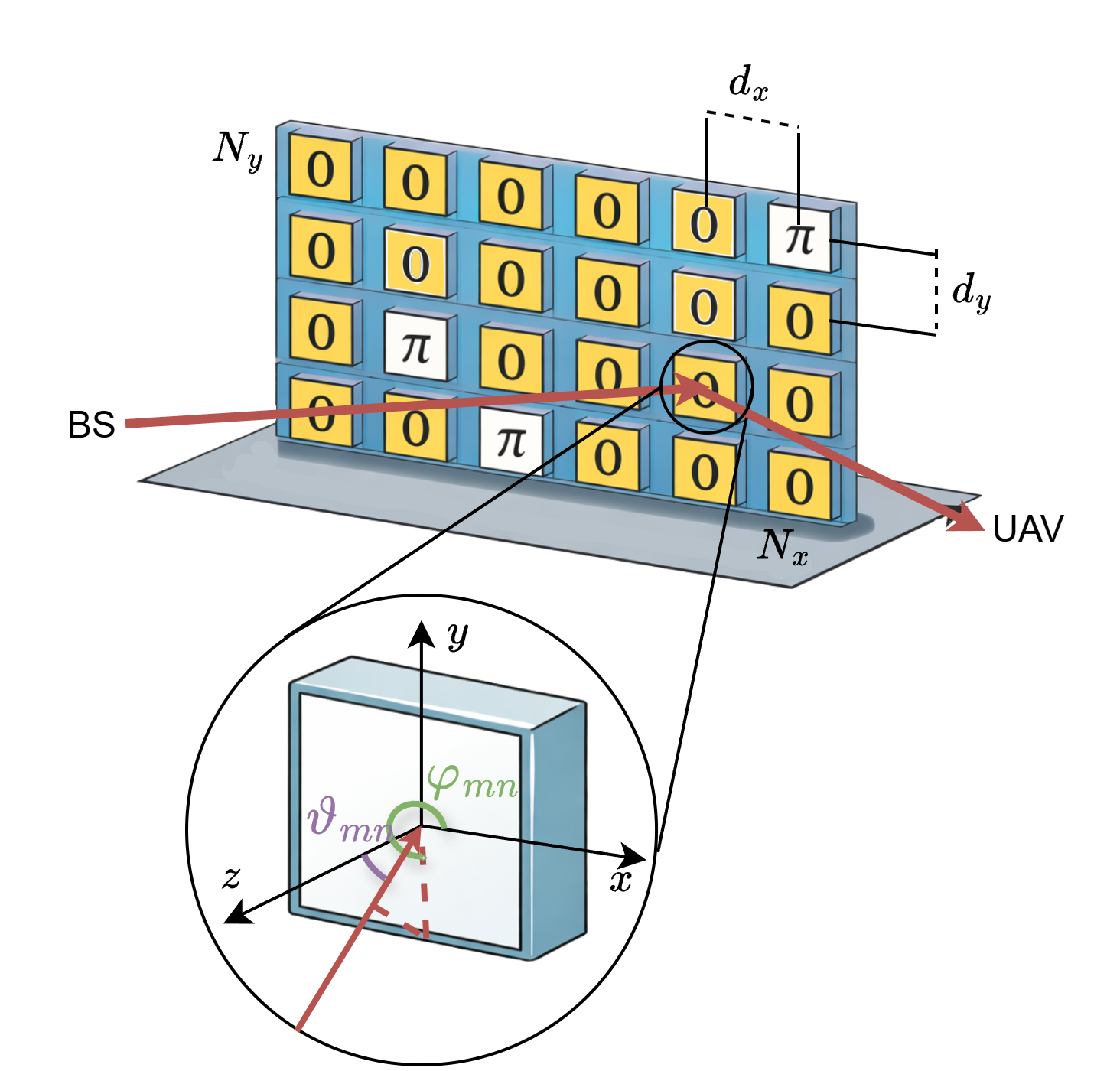
Figure 2: Geometry of the RIS model, showing the BS-RIS-UAV reflection path and local coordinate systems for angular parameters.
Rather than individually adjusting every RIS element, the stripe-based method searches over (Δx,Δy) pairs, constructing full-array phase patterns as stripes or bands, and measuring received power/SNR at the UAV for each candidate. This drastically shrinks the search space from exponential to quadratic in the grid size. Hierarchical coarse-to-fine search further accelerates convergence.
When implemented with 1-bit quantized RIS elements (phases ∈{0,π}, suitable for low-cost hardware), this produces binary “stripe” patterns (Figure 3). Restricting the search to such structured stripe configurations allows sublinear complexity in RIS dimension.
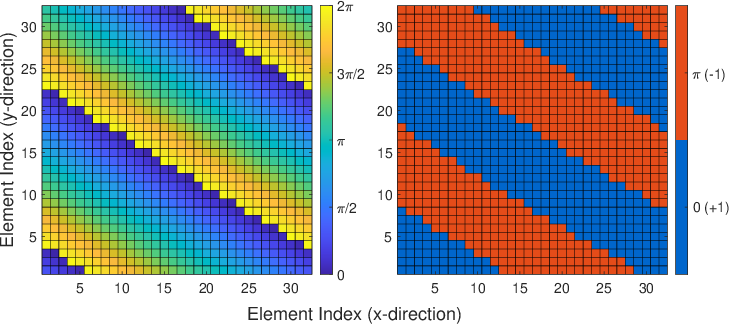
Figure 3: Phase configuration of a 32×32 RIS for continuous (left) and 1-bit quantized (right) phases, showing the stripe structure.
Rigorous analysis is provided for both structured (phase-gradient error) and unstructured (random bit-flip) phase errors. Closed-form loss expressions highlight that structured errors yield only mild SNR degradation, even for large arrays or moderate phase misestimates, whereas random bit errors (uncorrelated flips) introduce significant incoherency and loss, that worsen as RIS size grows.
Simulation and theory show close agreement for the average SNR loss across gradient error magnitudes and system dimensions. The method’s robustness thus stems from its exploitation of inherent array structure, not merely reducing the flip count.
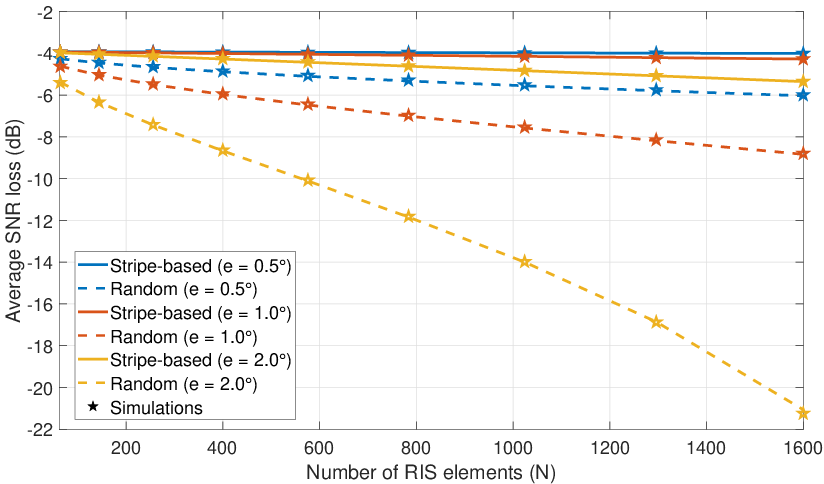
Figure 4: Analytical and simulation results for average SNR loss under various phase estimation errors for random bit flipping and stripe-based methods.
Mobility, Tracking, and Angular Sensing
The framework generalizes to mobile UAVs via three RIS phase-gradient tracking algorithms:
- Simple Fine-grid Tracking: Local grid search at each update, centered near the last estimate.
- Kalman-aided Tracking: Filtering and prediction drive the search window, reducing update latency and improving consistency.
- Extremum Seeking Control (ESC): Continuous adaptation with small perturbations, tracking the maximum received SNR gradient.
Each approach trades off complexity, update speed, and susceptibility to UAV motion. Dynamic bounds on phase-gradient evolution are derived from UAV velocity and geometry, showing that grid-search windows can be tightly constrained, further reducing update cost.
Experiments establish that ESC-based tracking minimizes SNR loss during flight (≈0.31 dB average), outperforming simple or Kalman-aided methods ($0.89$ dB and $0.66$ dB respectively).
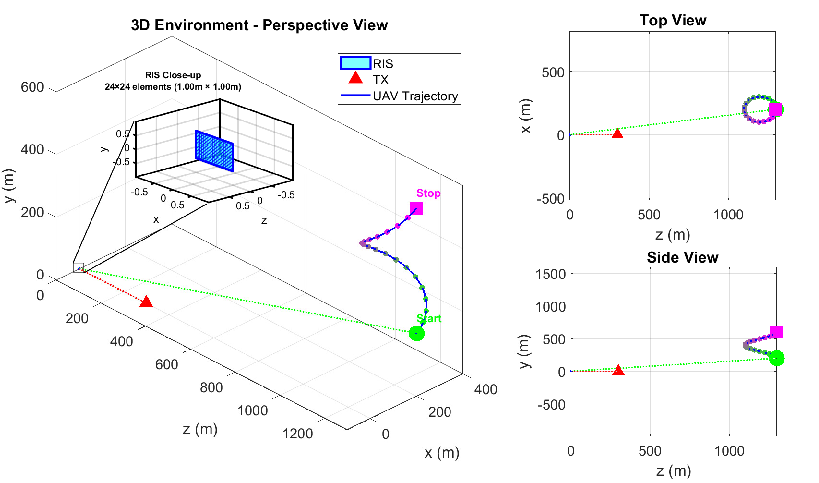
Figure 5: 3D UAV trajectory over which phase-gradient tracking is performed.
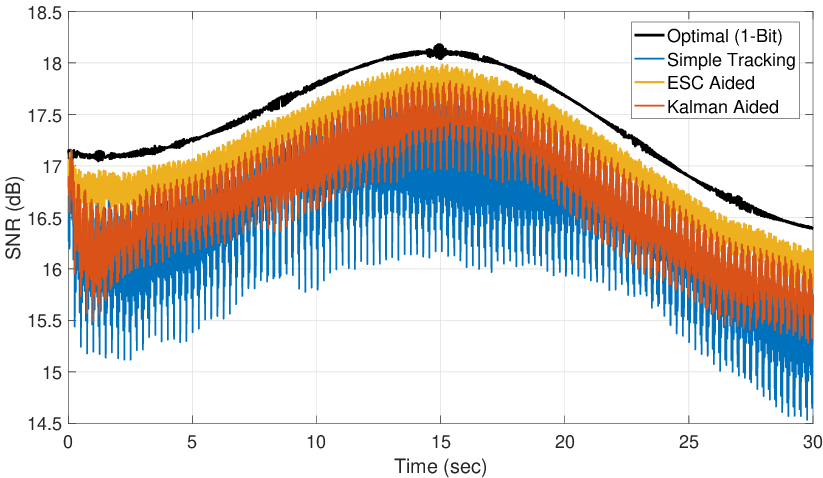
Figure 6: Average received SNR during the UAV trajectory for different tracking algorithms.
Additionally, the resolved phase-gradient parameters enable implicit angular localization of the UAV (elevation and azimuth), as a direct byproduct of the communication-centric RIS optimization. Error statistics over typical UAV trajectories confirm that both estimation and localization accuracy remain high throughout motion (Figures 10 and 11).
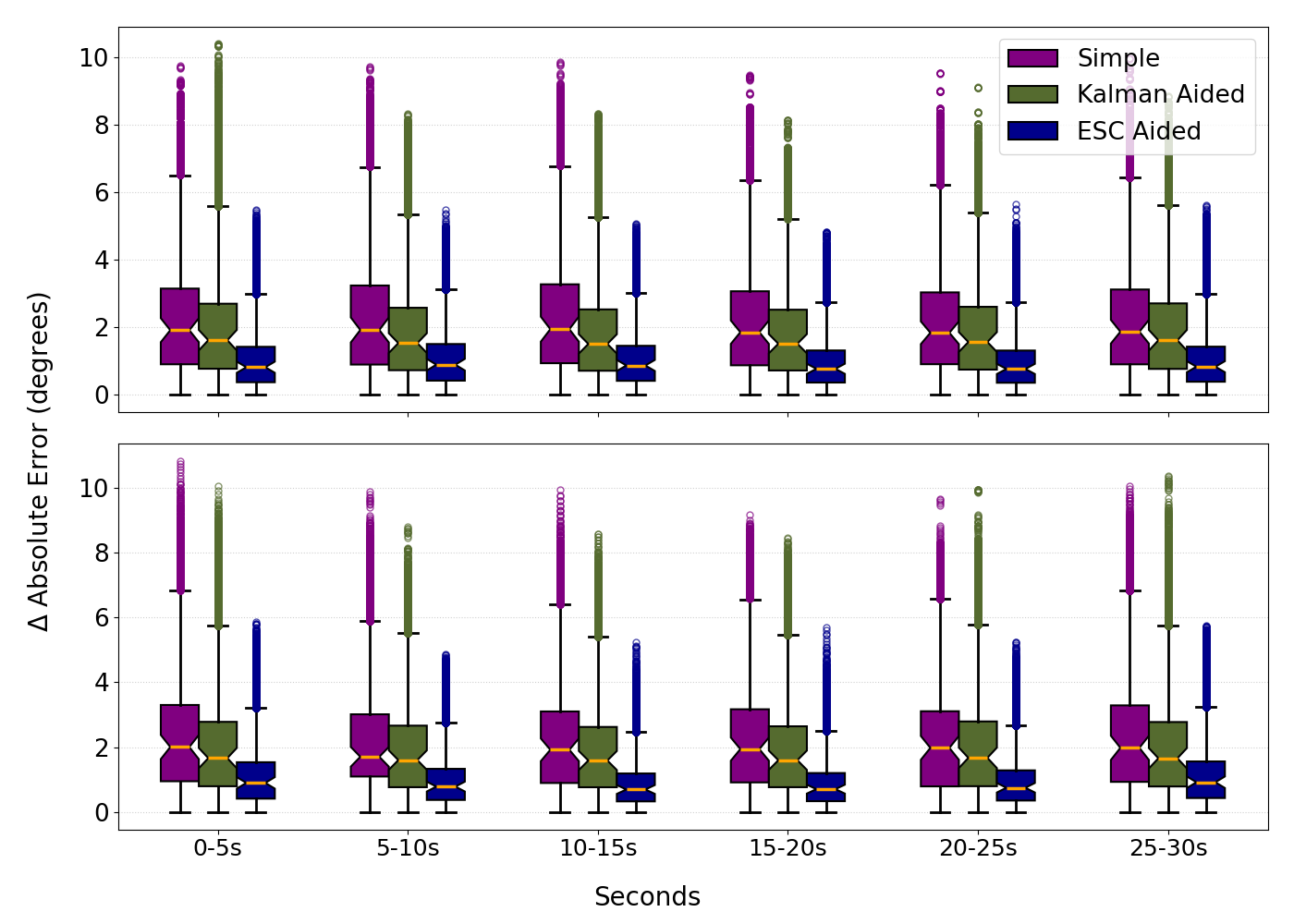
Figure 7: Absolute error boxplots for the combined direction parameters (Δx,Δy) in tracking.
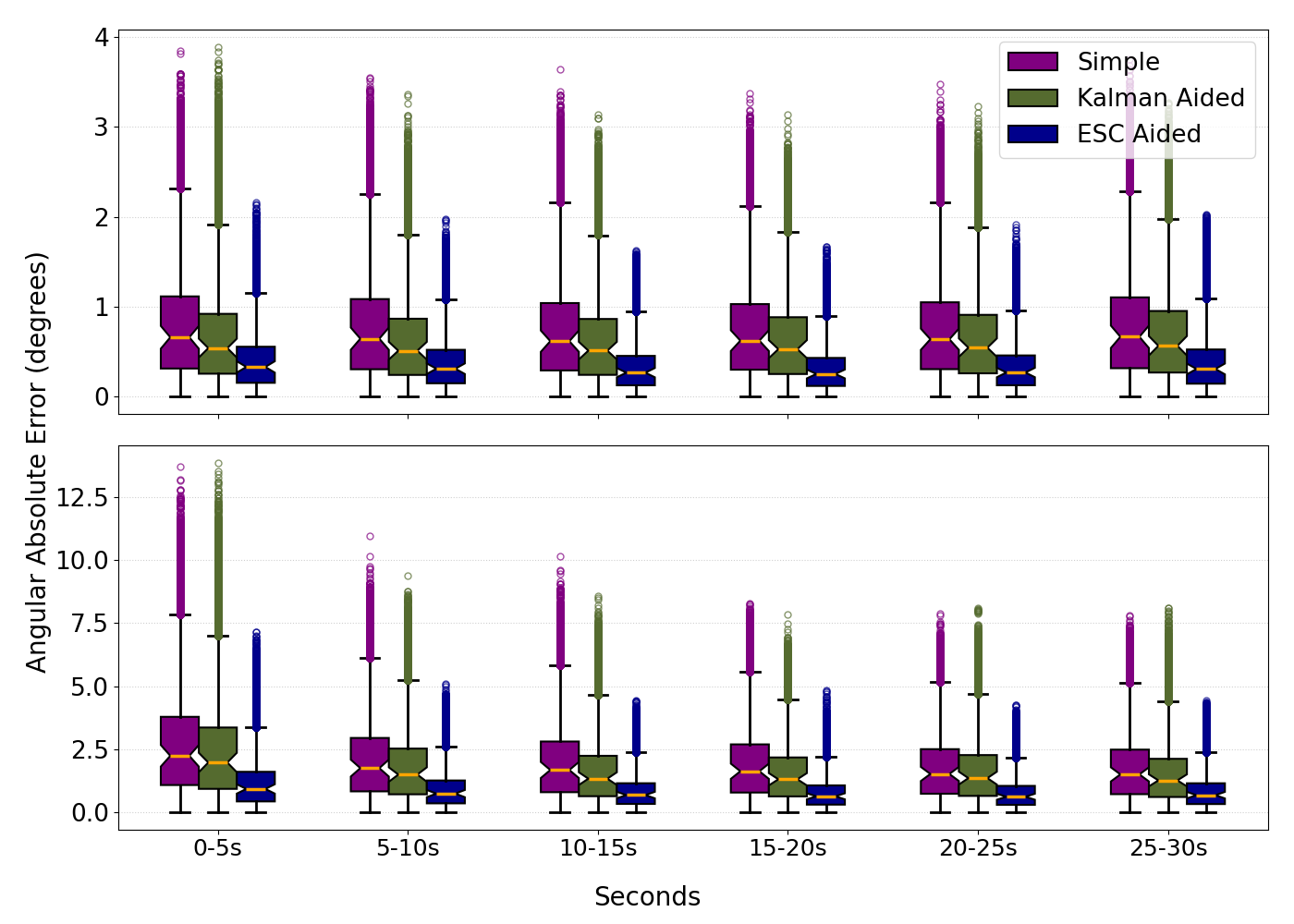
Figure 8: Absolute error boxplots for elevation and azimuth estimation accuracy.
Complexity Analysis
Comparative runtime analysis demonstrates clear scaling advantages over traditional iterative methods. Whereas element-wise or block-wise iterative algorithms have runtime scaling linearly with the number of RIS elements, the stripe-based method achieves sublinear scaling (y0 for a square RIS), making it highly suitable for large-aperture arrays.
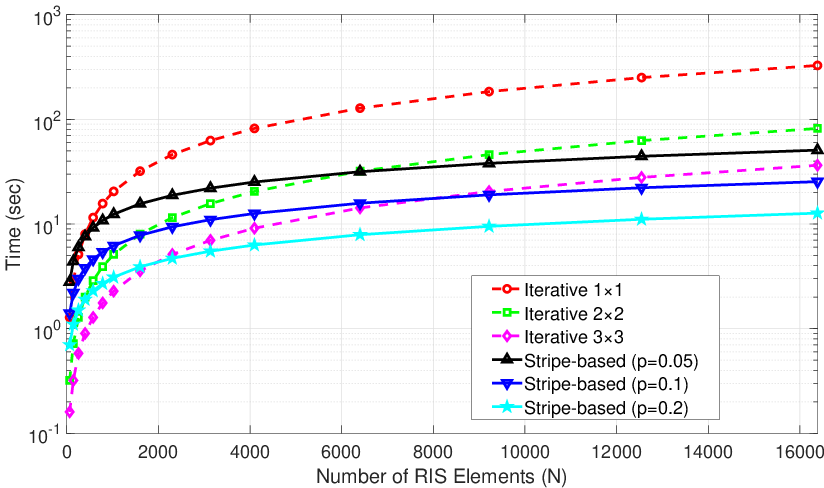
Figure 9: Runtime comparison of RIS optimization methods; iterative methods scale as y1 while the stripe-based method achieves y2 for constant error rate.
Experimental Validation
The practical efficacy of the method is substantiated through outdoor experiments using a real RIS prototype and SDR-based transceivers. In both moderate (47 m) and extended (225 m) transmitter-RIS separation, stripe-based RIS optimization consistently outperforms block-based iterative algorithms, manifesting higher received power, rapid convergence, and resilience in realistic hardware environments (Figures 13 and 14).
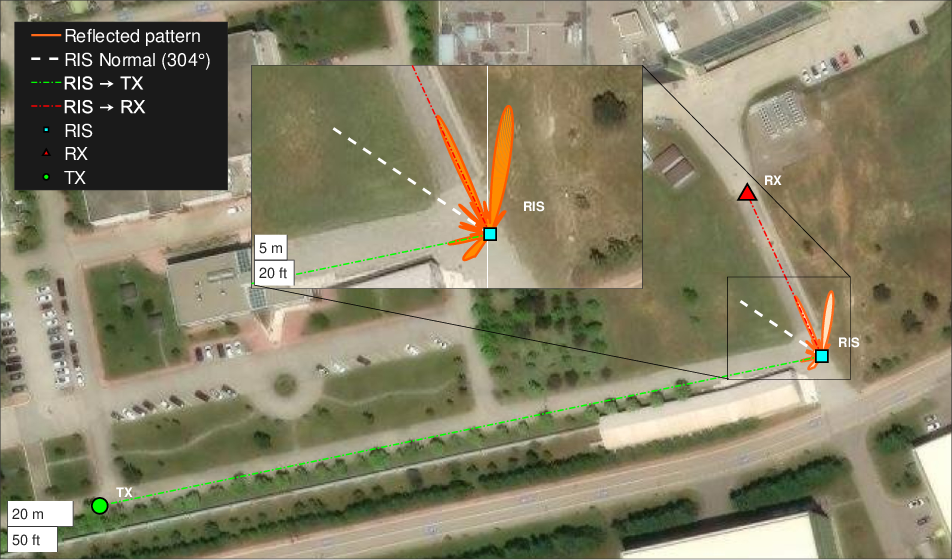
Figure 10: Measurement environment and simulated RIS radiation pattern, confirming array directivity toward receiver.
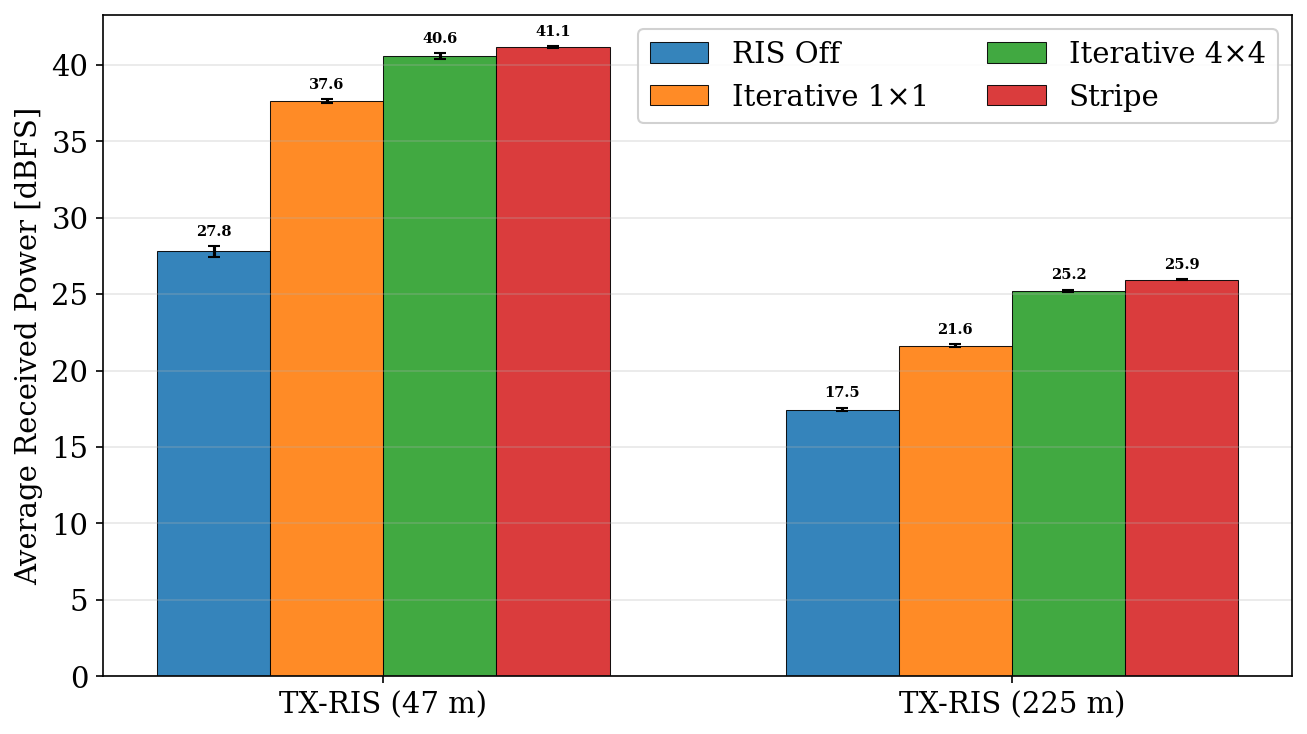
Figure 11: Measured average received power for different RIS optimization methods at two Tx positions.
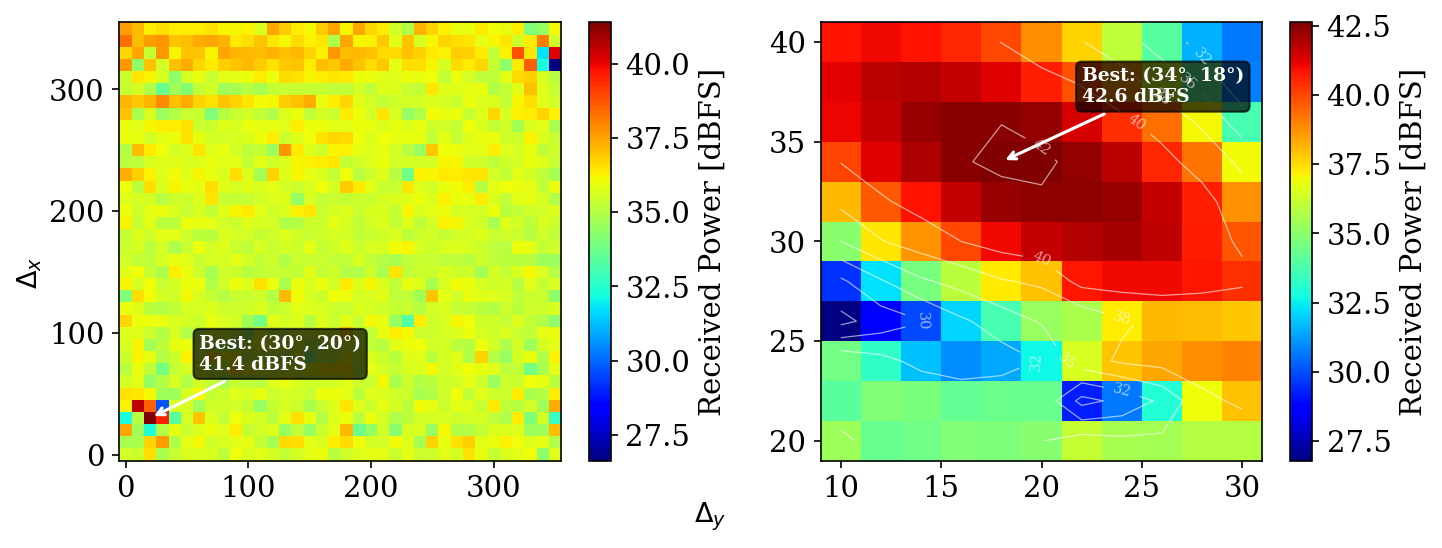
Figure 12: Measured instantaneous received power during coarse and fine stages of stripe-based optimization.
Implications, Limitations, and Future Directions
The stripe-based RIS optimization paradigm directly supports low-complexity, high-SNR, real-time communication and passive angular sensing for UAVs in LAWNs. It significantly advances the practical scalability of RIS-aided wireless infrastructure, enabling not only larger aperture support but also robust UAV tracking under realistic dynamic conditions and hardware constraints.
From a theoretical perspective, the method demonstrates the efficacy of structural phase-gradient reduction for array optimization, with implications for other array signal processing settings.
Practical deployment can be further improved by extending the framework to coordinated multi-UAV environments, addressing inter-user interference and reflection pattern coordination. Additionally, real-time hardware-in-the-loop validation remains critical for benchmarking latency, robustness under non-idealities, and further system integration.
Conclusion
This work introduces a low-complexity stripe-based RIS optimization method tailored for UAV-assisted LAWNs, achieving robust high-SNR connectivity and enabling passive angular sensing under mobility. Theoretical analysis, simulation, and experimental measurements confirm that by exploiting phase-gradient structures, the method overcomes the fundamental scalability limitations of prior approaches. The results establish a clear path toward large-scale, practical RIS deployment for aerial and integrated sensing-communication networks (2606.07026).