- The paper demonstrates that advanced mathematical formulations can optimize power grid topology, achieving up to 30% operating cost reduction.
- It introduces a hybrid learning-heuristic paradigm combining deep GNNs and reinforcement learning that reduces optimality gaps to around 3.68%.
- The study establishes robust approaches for steady-state, transient, and transitional topology control, significantly enhancing system stability and resilience.
Expert Summary of "Power Grid Topology Control" (2606.06995)
Introduction and Scope
"Power Grid Topology Control" delivers a rigorously structured and comprehensive monograph on the domain of network-oriented flexibility in power systems. While the field has experienced significant technological advances—such as remotely-controllable circuit breakers and pervasive sensor networks—the systematic exploitation of network topology as an operational control resource remains far less developed than generation or demand-side flexibility. This text addresses this gap, presenting mathematical formulations, control paradigms, and algorithmic toolchains for steady-state, transient, and transitional topology control across both transmission and distribution levels.
Fundamentals of Topological Control
The monograph clearly distinguishes between three axes of control in power grids: generation-based, load-based, and network-based (topology and branch impedances). Network-based control is uniquely global in its effects, can be implemented at lower marginal cost using extant infrastructure, and is increasingly viable due to modern power electronics and communications.
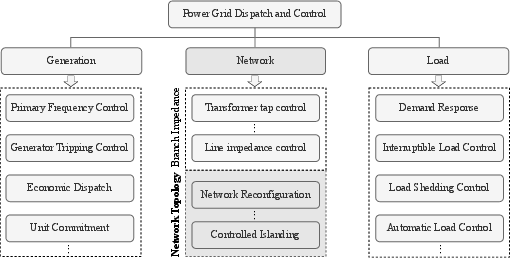
Figure 1: Classification of power grid dispatch and control—contrasting generation-based, load-based, and network-based flexibilities.
Topology control is divided into steady-state (e.g., reconfiguration for cost/stability/security pre- and post-contingency) and transient (e.g., intentional controlled islanding during post-disturbance periods) forms, each with distinct objectives and constraints.
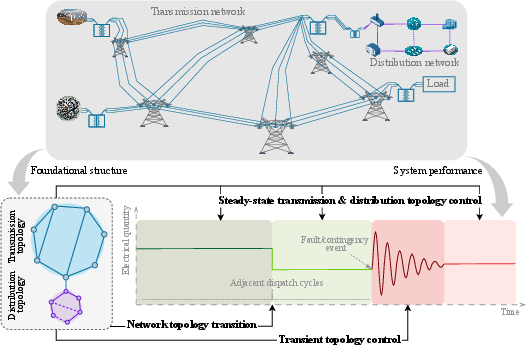
Figure 2: Overview showing the interaction of topology control modes (steady-state, transient, and transitional) with operational objectives.
This section also establishes foundational graph-theoretic constructs (connectedness, radiality, islands, spanning trees/forests) relevant to modeling electrical networks as graphs.
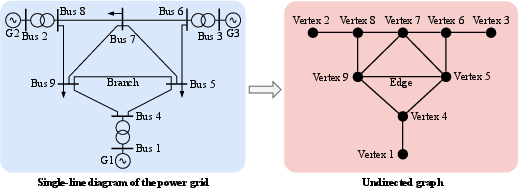
Figure 3: Graph representation of the power grid, equating buses/vertices and branches/edges.
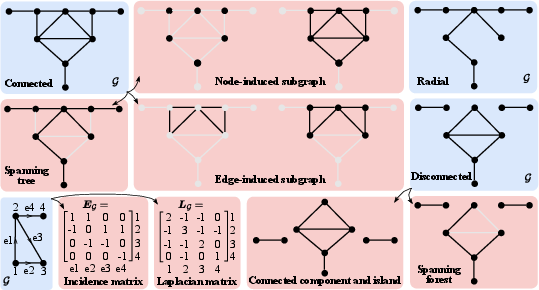
Figure 4: Basic graph concepts such as connected components, islands, spanning trees, and associated matrices.
The monograph develops and compares several key mathematical frameworks to encode topological constraints crucial for optimization and control:
- Connectedness: Both classic (Miller-Tucker-Zemlin) and contemporary (electrical flow-based, network flow-based) formulations ensure that the selected set of active branches retains a connected graph structure in transmission networks.
- Contingency-Aware Connectivity: For security-constrained optimization, novel mixed-integer linear programming approaches guarantee feasible topologies under N−1 and N−k contingency scenarios, with explicit handling of inevitable network disconnections.
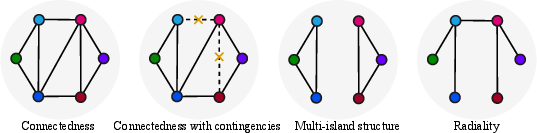
Figure 5: Different requirements including connectedness, radiality, and islanding structures for various network types and scenarios.
- Islanding and Multi-Forest Structure: The precise co-location of generators and partitioning constraints for intentional controlled islanding are formalized for both operational planning and real-time protection contexts.
- Radiality in Distribution: Parent-child and multi-commodity flow formulations provide tractable encodings for enforcing radial operation, with natural extensions to multi-substation (spanning forest) configurations.
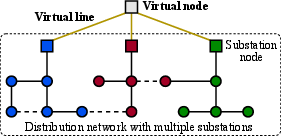
Figure 6: Handling of distribution networks with multiple substations via graph augmentation for spanning forest enforcement.
Steady-State Transmission Topology Control
Mechanisms and Paradoxes
The monograph highlights the practical importance of network topology via Braess’s paradox: in some meshed networks, removing lines can paradoxically lower costs or improve stability.
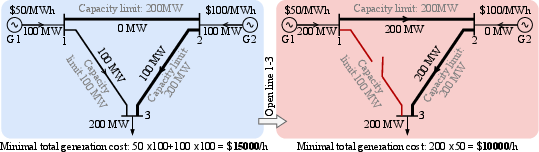
Figure 7: Braess’s paradox for economic dispatch—the counterintuitive effect where disconnecting a line reduces total cost.
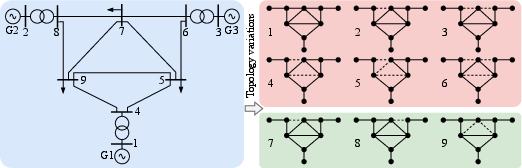
Figure 8: Modified IEEE 9-bus system used for evaluating topological variations.
Strong eigenvalue and time-domain analyses demonstrate that optimal disconnections can both increase small-signal stability margins (reducing the real part of leading eigenvalues) and improve transient stability (maintain synchronism post-disturbance).
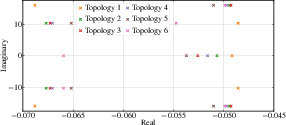
Figure 9: Eigenvalue spectrum shifts under different topologies, quantifying stability improvement by targeted switching.
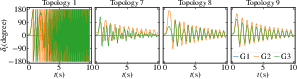
Figure 10: Rotor angle trajectories illustrating effects of line removal on transient stability.
Models and Numerical Results
The canonical Optimal Transmission Switching (OTS) is formulated as a mixed-integer problem coordinating generator dispatch and topology for cost or security objectives. On an IEEE 118-bus benchmark, aggressive OTS (unconstrained by the number of switchings) yields up to 18.7% cost reduction, with most benefits (13% reduction) arising from switching only 5 lines—demonstrating diminishing returns as more lines are switched.
Substation-level (breaker-and-a-half) topology control is also covered, emphasizing the exponential growth in action space and the necessity for scalable algorithms beyond brute-force approaches.
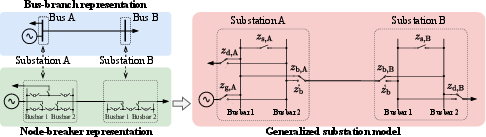
Figure 11: Breaker-and-a-half arrangement and generalized substation models enabling bus-splitting actions.
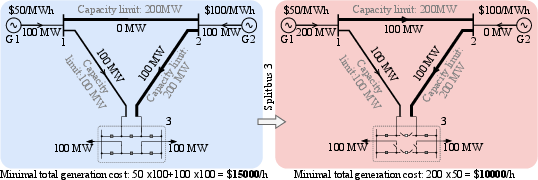
Figure 12: Substation-level control provides cost reductions equivalent to full line switching in model examples.
Methodology Survey
A systematic review is provided, classifying solution strategies by objective (security, stability, resilience, economics), temporal form (preventive, corrective), and algorithmic approach (heuristic, relaxation, learning-based). The review surfaces strong results for various advanced relaxations (quadratically-constrained, SOCP), robust and distributionally robust adaptations for renewables and contingency uncertainty, and the integration of machine learning (notably RL and GNNs) to address the curse of dimensionality in realistic operational settings.
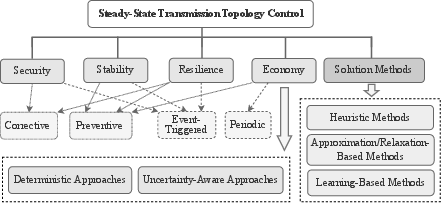
Figure 13: Review structure for steady-state transmission topology control—security, stability, resilience, and economy.
Cutting-edge three-stage OTS methods explicitly co-optimize topology and recourse (generator redispatch and corrective switching) across forecast (renewables), operational, and contingency response stages.
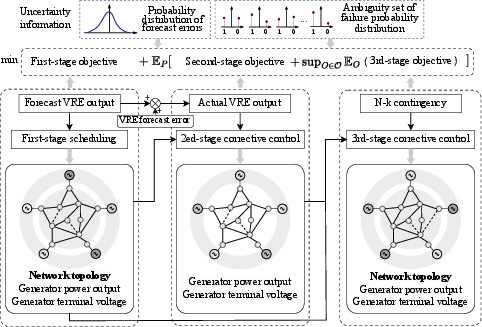
Figure 14: Schematic of the three-stage OTS incorporating stochastic and robust recourse.
Tested on real-world systems (e.g., 50Hertz, Liaoning), the approach yields operating cost reductions up to 30% and, critically, guarantees feasibility under scenarios where fixed-topology models are infeasible.
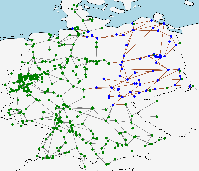
Figure 15: Schematic of the 50Hertz German transmission network for empirical validation.
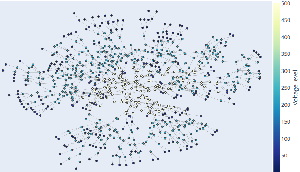
Figure 16: Liaoning transmission network topology used in large-scale experiments.
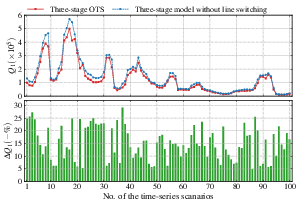
Figure 17: Three-stage OTS performance on the 50Hertz network—consistent cost reduction across scenarios.
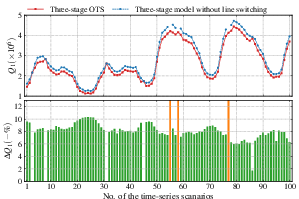
Figure 18: Three-stage OTS performance on the Liaoning network—expanding the feasible operational set.
Steady-State Distribution Topology Control
Problem Structure and Heuristics
Classic Distribution Network Reconfiguration (DNR) is formalized as a mixed-integer nonlinear program targeting loss/cost reduction with operational constraints and strict radiality. Classical pairwise branch-exchange and successive branch reduction heuristics are surveyed, but their greedy nature is shown to result in significant optimality gaps in challenging or large-scale cases.
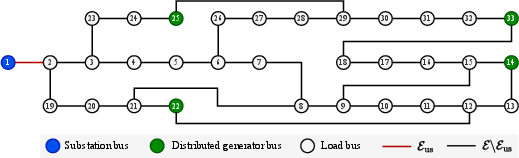
Figure 19: Modified IEEE 33-bus radial distribution network for benchmarking learning-based heuristics.
Hybrid Learning-Heuristic Paradigm
The monograph introduces a hybrid learning-heuristic solution paradigm utilizing deep graph neural networks (GNNs) trained via double deep Q-learning to approximate the value function for branch-switching actions. This achieves average optimality gaps of just 3.68% (versus >10% for classical heuristics) and computational times competitive with the fastest heuristic methods, with strong robustness across scenarios:
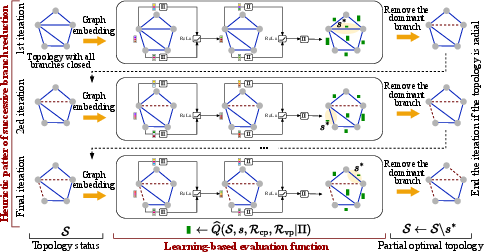
Figure 20: Schematic diagram of the hybrid learning-heuristic solution paradigm uniting GNNs and classic heuristics.
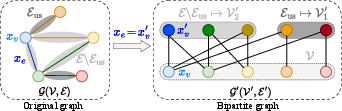
Figure 21: Conversion of the operational power flow network into a bipartite graph structure for GNN processing.
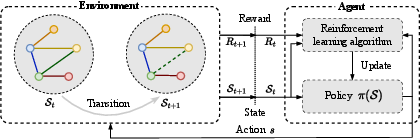
Figure 22: General framework for applying reinforcement learning protocols in topology control.
Topology Transition and Bumpless Strategies
The implementation of steady-state topology control at higher frequencies, especially in highly renewable grids, introduces a new and nontrivial problem: network topology transition—how to migrate from one feasible topology to another via valid intermediate configurations, minimizing both static violations and dynamic (transient) disturbance.
The monograph develops a multi-stage optimization and simulation pipeline for bumpless topology transitions, considering constraints on auxiliary control variables, switching sequences, AC feasibility recovery, and full trajectory simulation. The methodology is illustrated on the IEEE 9-bus system with clear quantification of bumpiness metrics and the demonstration that optimal transitions can improve transient performance by over 90% relative to naive approaches.
Transient Topology Control
For system stabilization post-disturbance, the canonical mechanism is Intentional Controlled Islanding (ICI), with generator coherency grouping (slow-coherency-based spectral analysis) and mixed-integer programming/min-cut models used for network separation. Numerical results on the IEEE 39-bus system illustrate complete loss of synchronism without ICI, while post-islanding all islands regain stable operation.
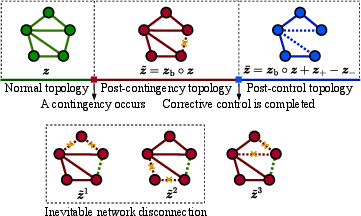
Figure 23: Schematic example of different post-contingency topologies, some leading to inevitable disconnection.
The review extends to non-islanding transient topology control (tree-partitioning, phase-sequence exchange, topology switching), and to recent switched-system-theoretic approaches for microgrid and multi-microgrid stabilization using connected topology transitions.
Implications and Future Directions
This monograph establishes:
- The theoretical and algorithmic tractability of topology control in both steady and transient regimes, with rigorous and scalable formulations now available.
- Practically, topology control delivers substantial operational cost, reliability, and resilience improvements—even under severe renewables and contingency uncertainty—where classical fixed-topology dispatch may be infeasible.
- The integration of RL and GNNs is substantively advancing the optimality and scalability frontier for topology control applications, especially as action spaces grow super-exponentially in size at transmission level.
- Networks will become increasingly dynamic, requiring real-time, robust, and bumpless transition protocols, as well as online stability certification for switching actions—posing both computational and theoretical challenges.
Conclusion
"Power Grid Topology Control" offers an authoritative taxonomy and technical toolkit for researchers and practitioners seeking to operationalize network-side flexibility in modern power systems. The strongest claimed results are explicit, numerically validated improvements in operating costs (up to 30%), enhanced robustness and stability under uncertain, high-renewable operation, and empirical superiority of deep learning–augmented heuristics over historical methods. Future developments will likely emphasize safe, interpretable AI integration and the co-design of topology, dispatch, and protection in an era of high-frequency, fast-acting grid control.