- The paper introduces a two-stage self-supervised framework that jointly learns multi-scale pathology features for clinical applications.
- It employs continuous magnification sampling and dense feature refinement to stabilize representation learning and enhance statistical evaluation across tasks.
- Empirical results on 161 WSI-related tasks demonstrate robust, transferable performance across diagnostic, molecular, prognostic, and specimen-context endpoints.
DaX: General Pathology Representation Learning Across Scales
Introduction
"DaX: Learning General Pathology Representations Across Scales" (2606.06983) proposes a pathology vision foundation model addressing hierarchical contextual dependencies and practical requirements of computational pathology, centering on robust multi-scale feature learning, input-size flexibility, magnification continuity, and statistically sound model comparison. The work acknowledges that whole-slide images (WSIs) encode clinically relevant semantics linked to tissue structures at different spatial scales (from nuclei-level to tissue architecture) and that robust representations must also handle substantial heterogeneity from staining, scanner, and preparation artifacts.
DaX integrates a two-stage self-supervised pretraining protocol built upon a DINOv3-initialized ViT-L backbone. Distinctively, the model advances beyond prior approaches by fusing continuous magnification sampling, comprehensive pathology-driven augmentations, multi-input-size adaptation, and Gram-anchored dense representation refinement into a unified framework. For evaluation, DaX is benchmarked on an unprecedentedly broad collection of 161 WSIs prediction tasks spanning 44 datasets and nine clinical endpoints, utilizing fold-level statistical significance tests for ranking.
Data Composition and Benchmark Construction
DaX’s pretraining is based on a curated collection of 104,569 WSIs from TCGA, GTEx, and HistAI, capturing the heterogeneity in normal, precancerous, and malignant morphologies across organs. All slides are homogenized to 0.5 μm/pixel at 20× magnification. Patches are extracted at 2.5×, 5×, 10×, and 20× anchor magnifications, yielding a multi-resolution pool enabling well-calibrated continuous-scale representation learning.
For evaluation, 44 public datasets are partitioned into 161 tasks aligned with 4 major clinical domains (diagnostic, molecular, prognostic, and specimen-context), further categorized into 9 subcategories to capture the diversity of practical clinical endpoints.
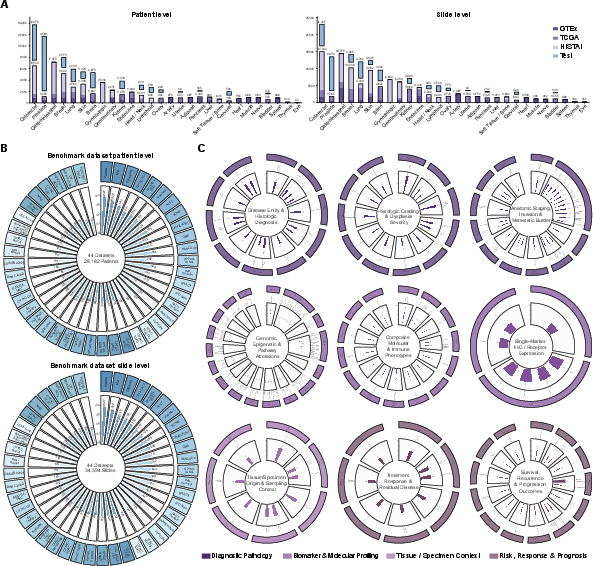
Figure 1: Data composition for DaX pretraining sources and the organization of benchmark datasets, including the domain/task taxonomy and WSI distribution.
The benchmark splits ensure strict patient-level independence between pretraining and downstream evaluation, mitigating overfitting and split bias.
Model Architecture and Pathology-Specific Pretraining
The DaX backbone is a ViT-L initialized with DINOv3 weights, facilitating transfer of generic visual priors such as hierarchical and structural continuity. The training proceeds in two explicit stages:
Stage 1: Pathology-Specific Representation Learning
This stage adapts DINOv3 to pathology-specific constraints:
- Continuous magnification sampling: Multi-scale crops stochastically cover 2.5×−20×, linking local and global representations and improving generalization across unknown magnifications.
- Cross-scale alignment: Local and global crops are spatially linked, ensuring integration of nuclei-level and architectural semantics.
- Pathology-specific augmentation: Arbitrary-angle rotations render the model orientation-agnostic, while color and blur perturbations increase stain and scanner robustness.
Stage 2: Scale-Aware Dense Refinement
The second stage corrects the dense token-level instabilities observed in multi-scale ViTs:
- Multi-input-size training: Crops of varying effective sizes expose the backbone to different spatial supports, ensuring transferability regardless of downstream patch shapes or inference protocols.
- Gram-anchored consistency: The Gram matrix of patch-token outputs (reflecting feature geometry) is anchored to a fixed teacher, stabilizing dense feature topologies and preventing geometric drift across iterations or input sizes.
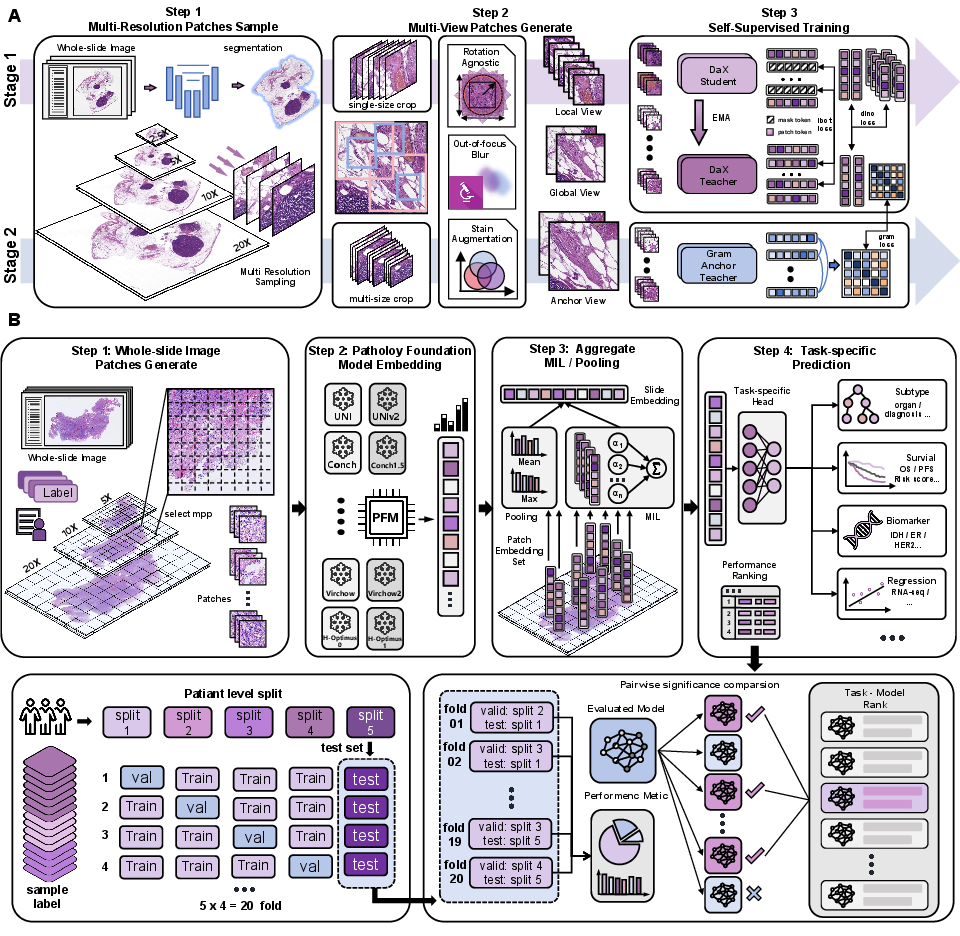
Figure 2: Schematic of the two-stage training protocol, cross-scale student-teacher framework, and the standardized downstream evaluation pipeline.
Standardized Benchmarking and Evaluation Protocol
All foundation models are benchmarked using strict fold-structured cross-validation with patient-disjoint splits. Each WSI is tessellated into patches, processed with the foundation model, and patch embeddings are aggregated by either mean pooling or ABMIL for downstream supervision. Task-specific prediction heads are trained atop these features, and evaluation is performed using the major clinical metric per task (classification, survival, regression, etc.).
Model comparisons rest on fold-level (i.e., 20-fold per task) significance tests, yielding model rankings that reflect robust statistical advantage rather than mean metric supremacy alone, achieving split-variance reduction and reproducibility.
Empirical Results and Statistical Analysis
DaX achieves highest mean performance across all benchmarked models and task categories, with DaX-L outperforming DaX-Base (ViT-B), reflecting positive scaling trends with increased model capacity under the proposed protocol.
Notably:
- Across nine fine-level categories, DaX achieves consistent top-2 task rankings and does not rely on outlier diagnostic categories for its average performance.
- DaX demonstrates balanced transfer across diagnostic, molecular, prognostic, and specimen-context endpoints, without performance collapse in molecular or response/prognosis tasks—unlike several baselines pre-trained at fixed magnifications or lacking acquisition and scale augmentations.
- The architecture and training strategy substantially outperform parameter- or data-scale matched competitors lacking continuous magnification or dense refinement protocols, indicating the impact of pathology-aware design.
Task-level significance-based rankings corroborate the mean metrics: DaX significantly outperforms competitors across a majority of the 161 tasks. These results are stable with respect to the aggregation protocol—mean pooling and ABMIL yield similar ordering—supporting the robustness and generality of DaX patch encodings.
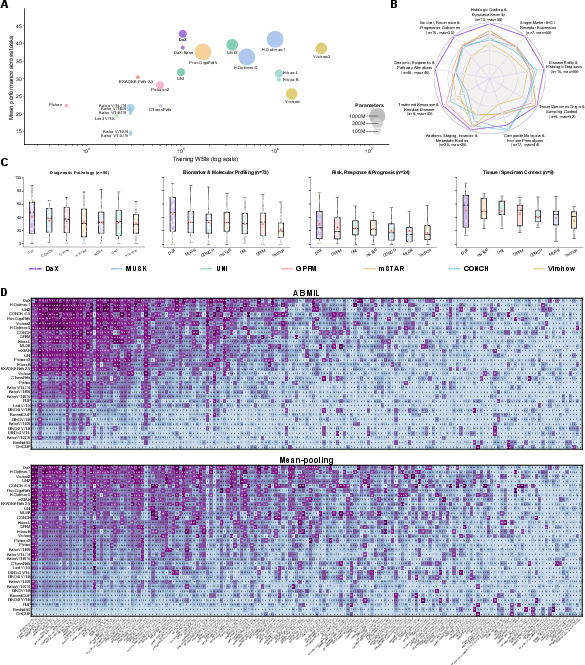
Figure 3: Relationship between model/data scale and benchmark performance (A), category-level and domain-level performance analyses (B, C), and statistical task-level heatmaps (D) for all models.
Implications and Future Work
DaX demonstrates that integrative multi-scale pretraining with explicit dense feature stabilization is critical for clinical translation: models pre-trained at static magnifications or using generic self-supervision show pronounced weaknesses on tasks with indirect morphologic correlates (e.g., treatment response, composite molecular phenotypes). The statistical benchmarking protocol marks a move toward reproducibility and fairness in computational pathology, reducing the influence of dataset bias, split variance, and overfitting.
Practically, DaX serves as a generalist visual encoder for a wide breadth of pathology tasks, providing a highly adaptable baseline for downstream clinical systems, including disease detection, grading, molecular status estimation, and risk stratification—even as label-task associations become weaker. The evaluation framework and benchmark are reproducible and may become standard for foundation model validation in pathology.
The limitations include the absence of multimodal feature fusion (reports, genomics), and restrictions to WSI-level tasks over dense pixelwise ones (e.g., segmentation, registration). Future directions include the extension of DaX to dense spatial tasks, systematic failure analysis across hardware and clinical environments, and expansion of pretraining toward clinical and genomics report integration.
Conclusion
DaX introduces a unified framework for pathology foundation model pretraining, addressing hierarchical scale, acquisition variation, and dense feature stability. Comprehensive benchmarking demonstrates strong statistical advantages and transferability beyond diagnostic endpoints. These contributions imply that robust multi-scale modeling and evaluation are necessary for the next generation of clinical-grade computational pathology systems, setting new standards in both methodology and evaluation protocols.