Scalable Quantum Algorithms for Gutzwiller Projection
Published 5 Jun 2026 in quant-ph, cond-mat.str-el, and cond-mat.supr-con | (2606.06919v1)
Abstract: Quantum simulation requires highly accurate input states. Gutzwiller-projected Bardeen-Cooper-Schrieffer (BCS) states provide physically motivated input states for solving strongly correlated lattice models, but their preparation on a quantum computer is hindered by the non-trivial nature of the Gutzwiller projection. We construct scalable quantum algorithms for this task by combining a circuit construction for arbitrary BCS states with the amplitude amplification for Gutzwiller projection (AAGP) procedure. AAGP yields a quadratic reduction in the number of projection queries compared with measurement-based postselection and leads to substantially improved fault-tolerant resource scaling. For projected BCS states optimized for the square-lattice $t$-$J$ model, we find that the projected-state weight decreases exponentially with system size, but the quadratic improvement is still large enough at physically relevant finite sizes to make a decisive practical difference. In particular, for a 100-site benchmark, AAGP reduces the required number of projection queries by about seven orders of magnitude. These results establish AAGP as an enabling input-state preparation protocol for projected BCS states in quantum simulation.
The paper introduces AAGP, achieving a quadratic improvement in resource scaling over measurement-based projection for Gutzwiller-projected BCS states.
It leverages amplitude amplification and fixed-point quantum search techniques to efficiently prepare correlated many-body quantum states.
The protocol reduces required queries by up to seven orders of magnitude, enabling practical quantum simulation of large lattice models.
Scalable Quantum Algorithms for Gutzwiller Projection
Introduction
Gutzwiller-projected BCS (RVB) states are widely adopted as physically relevant variational ansätze for strongly correlated lattice models, particularly in the context of quantum simulation aimed at exploring models such as the t-J and Hubbard models. The non-triviality of Gutzwiller projection, which enforces the constraint of no double occupancy across all lattice sites, presents substantial barriers to efficient quantum circuit implementation due to the exponential decay of the projected component's amplitude with system size. This paper (2606.06919) introduces a quantum state preparation protocol that achieves asymptotically quadratic improvements in resource scaling by leveraging amplitude amplification, specifically tailored to the Gutzwiller projection. The method, termed "Amplitude Amplification for Gutzwiller Projection" (AAGP), is shown to enable the practical preparation of projected BCS input states on classically intractable lattice sizes, notably improving over measurement-based postselection approaches.
Many-Body Hilbert Space and Workflow
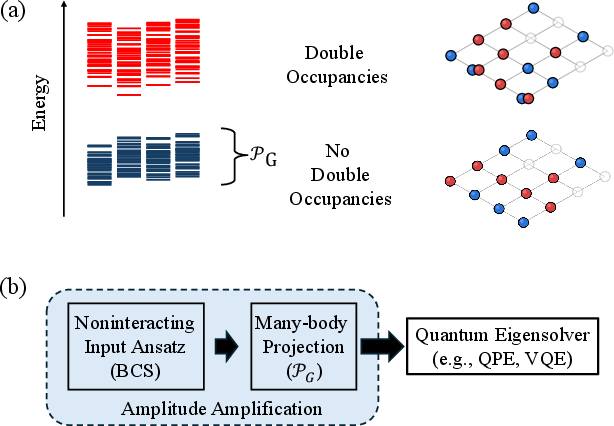
The target many-body Hilbert space involves a low-energy subspace with strictly no double occupancies, reflecting the infinitely strong onsite repulsion relevant in the t-J limit of the Hubbard model. The Gutzwiller projection operator, PG, acts globally and non-locally: efficiently mapping a BCS state onto this subspace is a central technical challenge.
Figure 1: Schematic of many-body Hilbert space partitioning and high-level workflow; Gutzwiller projection enforces exclusion of doubly-occupied configurations, with amplitude amplification accelerating projection success.
The typical workflow involves: (i) preparing a BCS state with parameters that encode model-specific features (e.g., hopping, chemical potential, pairing symmetry), and (ii) applying a projection step to achieve the RVB state, for which naive measurement-based approaches are intractable at scale due to exponentially vanishing success probability.
Amplitude Amplification Algorithmic Structure
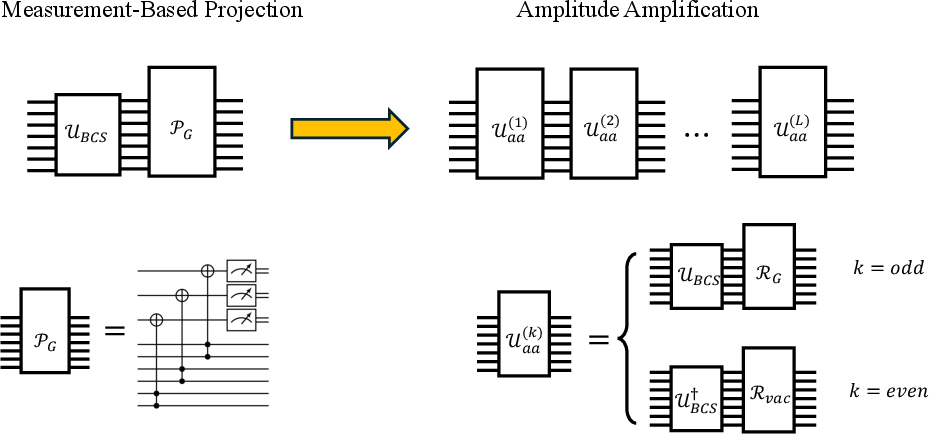
The AAGP protocol directly addresses the poor scaling of measurement-based projection, where the probability weight W=∣⟨ψRVB∣ψBCS⟩∣2 is exponentially tiny in system size. Measurement-based postselection requires O(1/W) repetitions; in contrast, AAGP yields O(1/W) scaling, analogous to Grover’s search improvement.
The algorithmical structure involves alternately applying (i) the unitary circuit preparing the BCS state, (ii) conditional phase rotations on the projected subspace or the vacuum, and (iii) their inverses, iterated with optimally chosen rotation phases to maximize transfer of amplitude into the projected subspace. The protocol harnesses fixed-point quantum search techniques for robust success probability even under limited knowledge of W.
Figure 2: High-level quantum circuit structure for AAGP, showing alternation between BCS preparation, conditional phase rotations, and their composition for amplitude amplification.
Practical aspects such as determining the number of required amplification steps L (set by J0 for target error tolerance J1), and the construction of controlled phase rotations on the (computationally nontrivial) projected subspace, are analyzed.
Quantum Circuit Construction of the BCS State
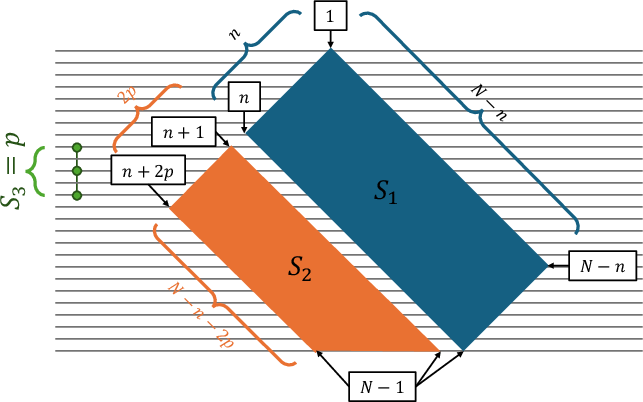
Preparation of arbitrary real-space BCS states (with nontrivial pairing geometry and disorder) utilizes the Bloch-Messiah decomposition, implemented via a sequence of Givens rotations on the modes, following classical preprocessing of the pairing matrix. The depth-1 circuit prepares the canonical BCS product state; further Givens rotations embed the general transformation required by spatially complex J2.
Figure 3: Schematic structure of the circuit implementing the Bloch-Messiah decomposition for full BCS state generation using sequential Givens rotations.
Efficient circuit construction is achieved, yielding J3 two-qubit gates for system size J4. Resource estimates are provided for both Givens rotations and the conditional multi-controlled operations required for amplitude amplification.
Amplitude Amplification Dynamics and Performance
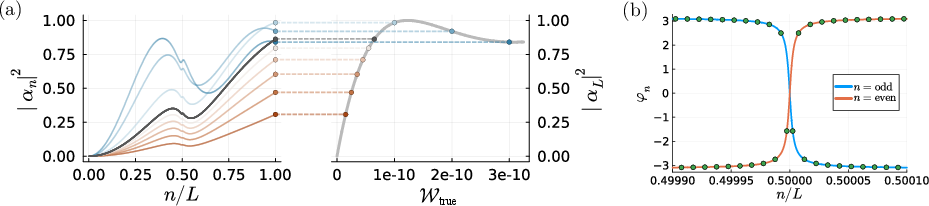
The amplitude amplification process can be represented within a two-dimensional effective subspace (target and orthogonal), with recursive update formulas for amplitude transfer through each step. The analytic solution of the recursion, as detailed in the cited references, enables selection of optimal phase schedules for the conditional rotations; J5 is chosen such that the final failure probability is below J6.
Figure 4: Demonstration of amplitude amplification; evolution of the RVB state's success probability through the fixed-point search iterations, and robustness against uncertainty in J7.
Notably, the algorithm's quadratic rate improvement holds throughout finite-size regimes (e.g., J8), with tangible resource difference—for J9 at t0, AAGP reduces required queries by seven orders of magnitude relative to measurement postselection.
Analysis of Projected-State Weight Scaling
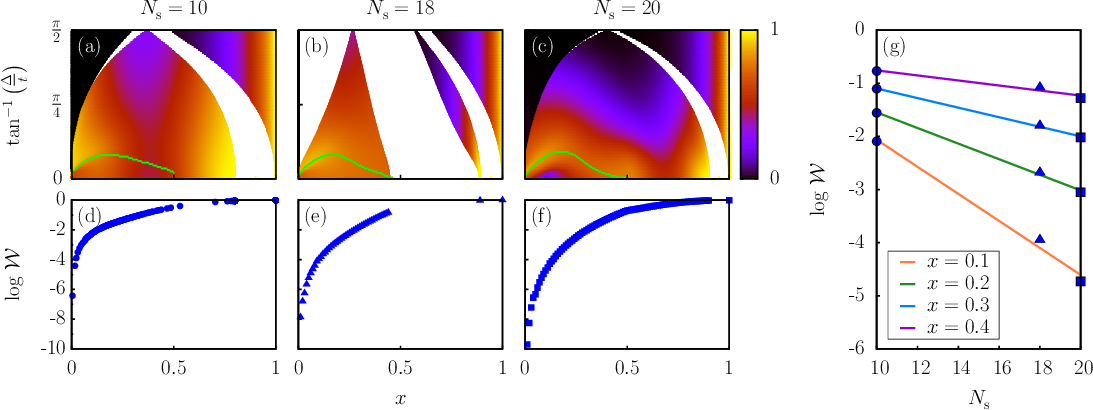
The efficacy of AAGP ultimately depends on the scaling of the projected-state weight t1 as a function of system parameters and size. The paper provides an explicit analysis for the square-lattice t2-t3 model, calculating t4 as a function of site number t5 and hole doping t6 via variational optimization and exact diagonalization.
Figure 5: (a-c) Overlap phase diagrams for RVB with t7-t8 ground state; (d-f) Exponential decay of overlap with increasing system size; (g) Quantitative scaling t9 vs. J0 for representative doping levels.
Empirically, J1 decays as J2, with J3 parameterized by doping. At J4 and J5 (optimal doping for RVB pairing), J6, demarcating the regime where classical validation becomes infeasible but quantum simulation remains viable given the quadratic query reduction.
Implications and Extensions
The primary implication is that amplitude amplification removes a central bottleneck in the fault-tolerant state preparation pipeline for variationally optimal correlated input states. This facilitates practical simulation of strongly correlated fermionic models on system sizes unreachable by classical methods. The flexibility of the approach allows for generalization to models and ansätze beyond the J7-J8, including disordered systems and those lacking translation symmetry; it can also accommodate perturbative corrections to Gutzwiller-projected states, as in controlled J9 expansions for the Hubbard model via post-projection unitaries.
On a theoretical level, AAGP should be regarded as an enabling primitive that, when combined with efficient Hamiltonian simulation, opens the way to robustly interrogating ground state and dynamical phenomena in quantum materials. From the practical standpoint, crossing the finite-size threshold where system sizes of PG0—the natural regime of modern quantum technologies—become algorithmically accessible represents a decisive step.
Conclusion
AAGP provides a scalable quantum algorithm for efficient Gutzwiller projection in the preparation of physically motivated initial states for quantum simulation, yielding a quadratic reduction in resources compared to prior postselection techniques. The protocol's finite-size transparency ensures practical deployability for physically relevant model sizes, removing a key obstacle in simulating strongly correlated electron systems. Future work may target integration with further ansatz flexibility (controlled double occupancy), as well as comprehensive resource and noise analyses in near-fault-tolerant regimes.
“Emergent Mind helps me see which AI papers have caught fire online.”
Philip
Creator, AI Explained on YouTube
Sign up for free to explore the frontiers of research
Discover trending papers, chat with arXiv, and track the latest research shaping the future of science and technology.Discover trending papers, chat with arXiv, and more.