- The paper introduces a complete-class theorem showing that e-processes can be dominated by affine one-step e-variables under finite conditional constraints.
- It employs geometric supporting hyperplane arguments to characterize the optimal structure of e-variables in sequential testing.
- The methodology reduces complexity and aids efficient confidence-sequence construction in adaptive, non-parametric testing scenarios.
Sequential Testing of Conditionally Constrained Hypotheses: A Technical Essay
Introduction and Context
This paper, "Sequential testing of conditionally constrained hypotheses" (2606.06769), addresses the structure of e-processes in the context of sequential hypothesis testing under general conditional constraints. The work fits into the modern framework of e-values and test supermartingales for sequential and anytime-valid inference, providing a formal bridge between arbitrary e-processes and products of one-step e-variables when the null hypothesis is characterized by finitely many conditional constraints. The main technical advance is a complete-class theorem for such hypotheses, asserting that arbitrary e-processes can always be pointwise dominated by predictable products of affine one-step e-variables. This result generalizes previous one-dimensional and single-step findings to a broad class of sequential, non-parametric conditional testing problems.
Problem Framework and Definitions
The authors formalize sequential testing over a standard Borel space, with hypotheses specified as subsets H⊆P, where P denotes the set of Borel probability measures over the sample space. E-variables are non-negative, Borel measurable statistics with expectation under the null bounded by one; they generalize likelihood ratios and admit a natural sequential multiplicative structure. E-processes are even more flexible, encompassing all non-negative adapted processes that maintain the expectation control at every stopping time, thus ensuring valid inference under arbitrary optional stopping.
Constrained hypotheses are of the form:
HΦ,ST={P∈PT:EP[Φ(Xt)∣Xt−1]∈S∀t=1,…,T}
where Φ is a measurable feature map and S is a non-empty convex set in Rm. This approach unifies many important null structures, including conditional mean/variance restrictions and moment constraints, and covers non-parametric conditional testing settings of practical interest.
Single-Step E-Variable Characterization
The single-step scenario admits a clean geometric characterization. The effective support of the null is the set of points x with nonzero mass under some P∈H. The authors show (Proposition 1) that any e-variable for a convex constraint-based hypothesis is dominated by an affine function over the feature map:
eλ(x)=1+λ⋅Φ(x)−σ(λ)
where σ(λ)=y∈S∩aff(Φ(X))supλ⋅y is the support function. The geometric proof involves separating the hypograph of the e-variable from a fixed threshold, leading to an explicit affine dominator via supporting hyperplane arguments.
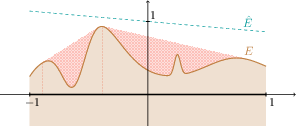
Figure 1: Geometric intuition; every e-variable’s lower set (brown region) must have its convex hull avoid the vertical line above one, enabling a separating hyperplane—corresponding to an affine e-variable—that dominates the original statistic.
This result establishes both necessity and sufficiency: for linear constraints, all e-variables are no more powerful than affine e-variables, i.e., there is no advantage to using more complicated functional forms.
E-Process Complete Characterization
Moving to the sequential setting, the authors' main theorem determines that every e-process under finitely many conditional constraints can be dominated, pathwise, by a predictable product of affine one-step e-variables. For each time P0, a Borel-measurable selection P1 is chosen based on past observations, and the process
P2
majorizes any valid e-process. Thus, the most general e-process can always be represented within (or pointwise dominated by) the class of non-negative supermartingale products, generalizing Ville's classic sequential inference argument to conditionally constrained settings.
The main technical obstacle is the measurability of the predictable selection of the dominating affine coefficients. To ensure the selection P3 is Borel, the authors leverage a Borel-selection theorem from [clerico2026borel], resolving nontrivial measure-theoretic subtlety arising in the conditional, infinite-horizon case. Detailed appendices show how the choice and upper semi-analytic structure of the necessary selections are constructed, relying on convexity and compactness results.
Implications and Theoretical Significance
The strongest implication of the result is that for a broad class of conditional testing problems with finitely many constraints, restricting to predictable products of affine e-variables yields no loss in testing power relative to arbitrary e-processes. This clarifies the structure of anytime-valid inference in a wide range of non-parametric, adaptive contexts, and extends earlier work from bounded mean testing [clerico2025optimality] and single-step linear-constraint testing [clerico2024optimal, larsson2026testing].
Practical implications include:
- Optimization: For power-maximizing e-process design, attention can be restricted to the finite-dimensional parametric class of affine e-variables—an explicit, computationally manageable set.
- Confidence-sequence construction: In online, heavy-tailed estimation or sequential mean/variance testing (see [orabona2024tight], [waudby2024estimating], [fan2025testing]), this characterization enables sharp confidence bounds and efficient test design without loss of generality.
- Sequential testing in discrete settings: On finite support, all conditional nulls correspond—after convexification—to the current setting, enabling full e-process characterization.
- Reduction in complexity: Inferential procedures that might otherwise consider arbitrary stochastic processes can be reduced to predictable products over an affine parameter space.
Theoretically, the result is a "complete class" theorem for e-processes, extending classical notions of admissibility and optimality in sequential hypothesis testing to non-parametric, adaptive settings. The explicit pathwise domination (rather than only validity under the null) strengthens the robustness of inference, even for sequences not supported under P4.
Limitations and Open Problems
The paper's main technical limitation is the restriction to finitely many constraints. Extending the results to hypotheses with infinitely many constraints (e.g., sub-Gaussianity, quantile constraints) remains open and appears to require novel measurable selection techniques or relaxation of measurability requirements.
Another open area is the identification of minimal complete classes: while all dominated e-processes are contained within the affine class, not all affine e-processes are necessarily extremal or minimax optimal in power. Precise sharpness and necessity within the affine family, in the sense of admissibility, is not fully resolved.
The deeper principle, whether general one-step complete class results always "lift" to their sequential conditional analogues, is posed as a research direction. Such a structural theory would unify one-step e-variable and sequential e-process classification across a spectrum of hypothesis types.
Connections to Broader Literature
The work synthesizes and extends several strands of research:
- The structure and optimality of martingale-based sequential inference as in [ramdas2020admissible], [grunwald2024safe], and [shafer2021testing].
- Generalizations to non-parametric and conditional settings, especially via convex constraint frameworks [larsson2026testing], [fan2025testing].
- The role of Borel/measurable selection in construction of valid test processes—an often underappreciated technical feature critical in non-discrete, adaptive settings.
Conclusion
This work provides a rigorous characterization of the structure of sequential e-processes for finite-dimensional, conditional, convex constraint hypotheses. By formally showing that all valid e-processes can be dominated by predictable products of affine one-step e-variables, the authors have clarified both the design and limitations of sequential inference in a broad class of adaptive testing scenarios. Key technical advances in measurable selection suggest further generalizations may be possible in the future, particularly for infinitely constrained or more complex null hypotheses, and the explicit affine representation opens new doors for statistical optimization and algorithmic deployment in sequential settings.

