- The paper demonstrates how a single Kerr nonlinearity within a feedback loop enables continuous-variable quantum reservoir computers to achieve unbounded nonlinear computational capacity.
- It employs both analytical methods and master-equation simulations to reveal strict class inclusion and kernel-rank separation compared to Gaussian reservoirs.
- The findings offer a scalable photonic architecture that trades mode count for measurement efficiency, advancing high-dimensional temporal processing.
Computational Superiority of Non-Markovian Kerr Feedback in Continuous-Variable Quantum Reservoir Computing
Introduction and Core Motivation
The study introduces a rigorous analysis of the computational capabilities of continuous-variable quantum reservoir computers (QRCs) when equipped with a single Kerr nonlinearity in a time-delayed feedback loop. The central technical challenge is that Gaussian (linear) optical reservoirs cannot generate cross-time nonlinear products within the reservoir: products such as uk−2uk−4 are not physically realized, forcing the architecture to rely on exponentially expensive high-order measurements in the readout. This paper demonstrates—both analytically and numerically—how inserting a single Kerr element within a coherent feedback loop enables the system to realize genuine temporal products internally, fundamentally expanding its computational expressivity.
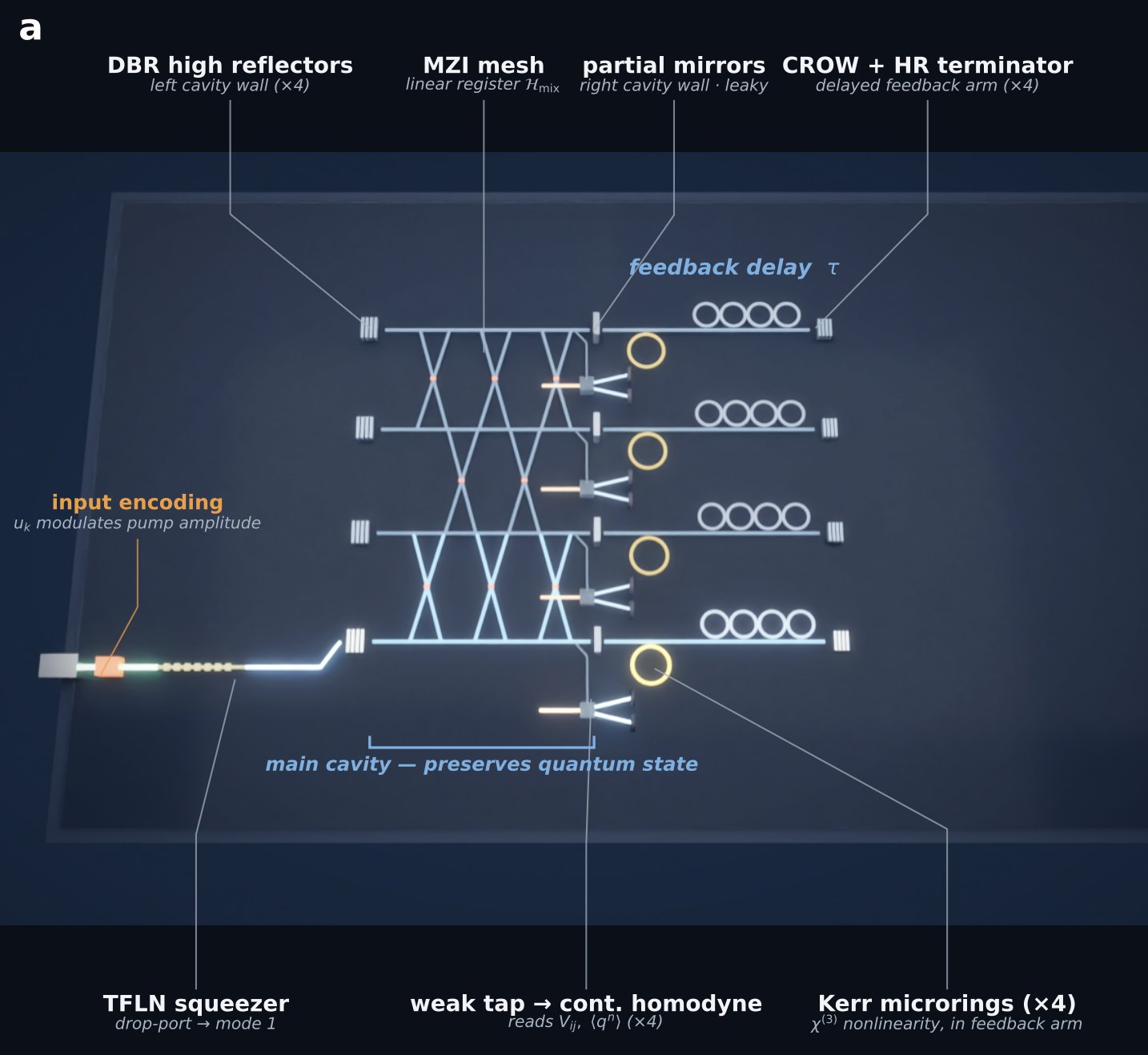
Figure 1: Integrated-photonic realization of the non-Markovian Kerr-feedback continuous-variable QRC.
The feedback architecture enables the conversion of temporal depth into spatial resource: a single Kerr mode revisited D times creates D independent, nonlinear channels, turning time into space. The key finding is a provable, unbounded resource separation: a Gaussian reservoir with N modes is restricted to a cross-time nonlinear rank no greater than $2N$, while a Kerr-feedback loop achieves rank D (feedback depth), a parameter decoupled from the mode count.
Mathematical Foundations and Structural Separation
The analysis formalizes the reservoir state via the cumulant tower of quadrature moments. Gaussian channels only populate cumulant orders up to two; higher-order connected cumulants vanish for χ=0 (no Kerr), confining the reachable function class to disconnected products.
The main theoretical results can be summarized as:
- Strict Class Inclusion: For all N and readout degree d, F0N,d⊊FKerrN,d. A single Kerr mode admits functionals inaccessible to any finite-mode Gaussian reservoir.
- Kernel-Rank Separation: At matched connected order, Gaussian reservoirs yield separable bilinear kernels of rank at most D0, strictly outmatched by the Kerr feedback loop which achieves rank D1.
- Witness Construction: The difference is operationalized via tasks such as nonlinear equalization. For instance, the ability to compute D2 with degree-1 homodyne features is provably unattainable for any finite Gaussian reservoir, while the Kerr architecture succeeds.
Constructive Universality and Explicit Realization
The enriched function class under Kerr feedback is not only strictly larger but constructively universal for fading-memory maps. Exploiting the spectral decomposition of the response propagator, readout weights for arbitrary target kernels are computed via Vandermonde inversion, certifying a monotone resource hierarchy. The capability grows strictly with mode count, a property unavailable in the purely existential universality proofs of Gaussian reservoirs.
Empirical Confirmation: Exact Master-Equation Simulations
The theoretical mechanism is validated through exact open-system simulations, using a master equation embedding for a Kerr cavity with one-bin delay. The discriminating witness—the mixed second derivative of the first moment with respect to time-shifted inputs—is zero to numerical precision for the Gaussian baseline and activates quadratically (in D3) for Kerr feedback, confirming the predicted structural separation.
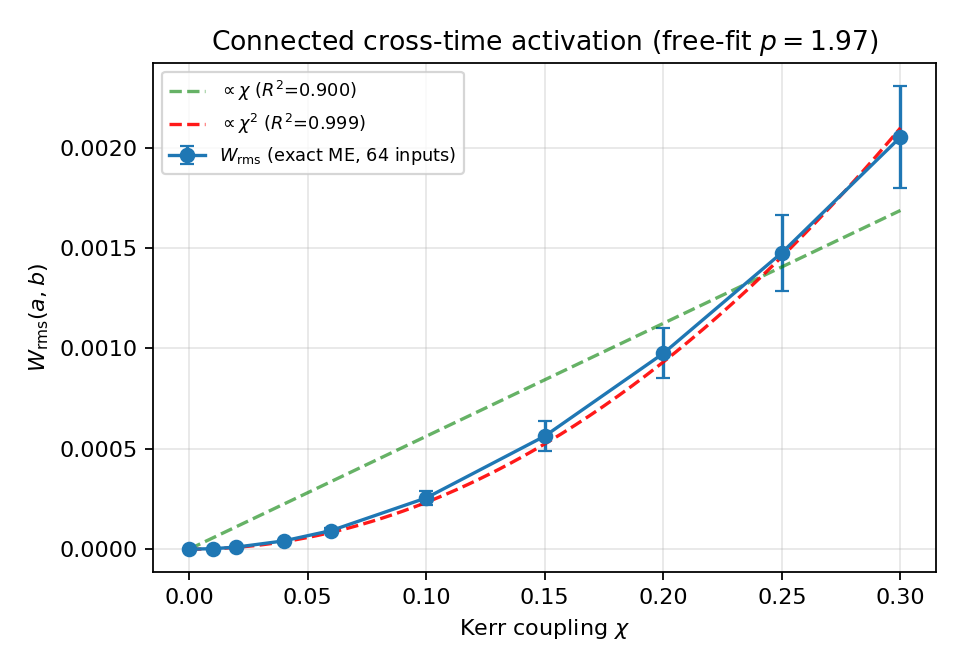
Figure 2: Connected cross-time witness D4 versus Kerr coupling D5, reconstructed from the exact master equation.
Operational tests reveal that in the weak-Kerr regime, trained readouts do not exploit the connected kernel for computational advantage—the amplitude of the feature is orders of magnitude weaker than diagonal moments. The separation is therefore structural: it manifests in the reachable function class, not in practical measurement cost under weak coupling.
The platform's governing parameter is the single-photon Kerr-to-loss ratio D6, dictating the resolvable connected order under feasible measurement budgets. Achievable feedback depths range from D7 (InGaP) to D8 (SiN), allowing one nonlinear mode to replace up to D9 linear modes.
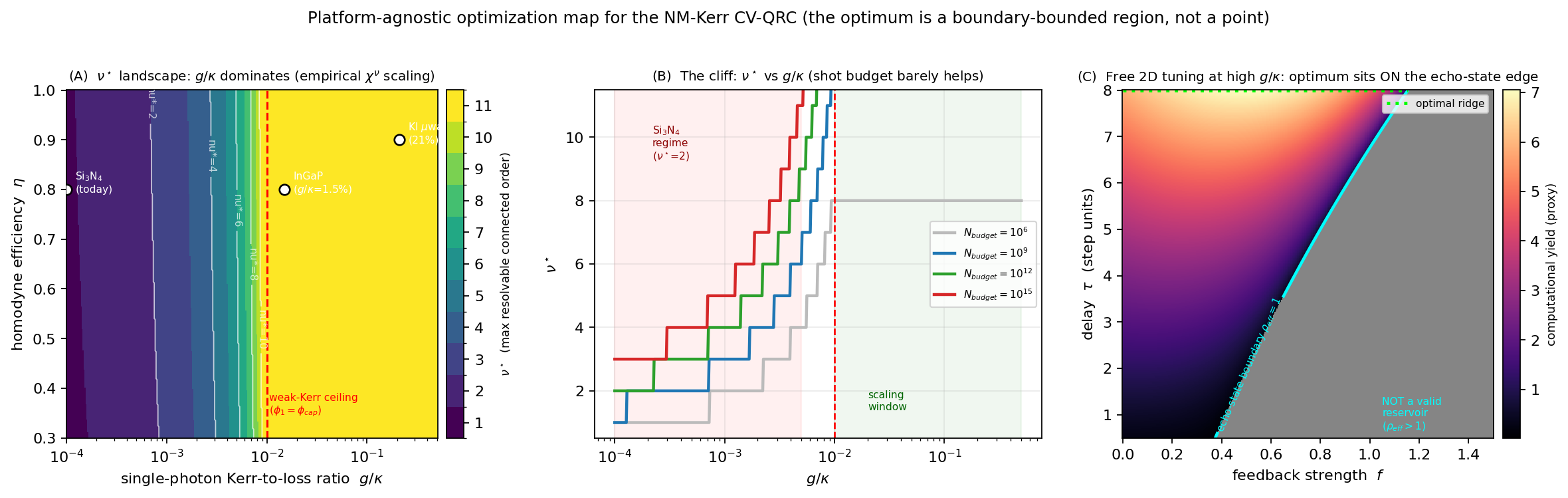
Figure 3: Platform-agnostic optimization map; D0 is the dominant knob for connected order reach.
The resource advantage is explicit: mode count, required degree of readout, detector chains, and chip area are greatly reduced at the cost of increased measurement shots. In integrated photonics, this exchange is favorable since mode count is the binding constraint.
Strong-Coupling Regime and Boundary of Operational Advantage
In the non-perturbative (strong-Kerr) regime, information-processing capacity measurements show that the connected sector (D1) activates with the slightest Kerr nonlinearity but does not scale with increasing coupling, and strong drive instead reallocates capacity within low-order sectors without promoting the connected one. Thus, the structural separation persists even beyond the perturbative regime; however, it does not convert into a dominating operational advantage at degree-D2 readout within the tested architectures and depths.
Implications and Future Directions
The results quantify the boundary between structural resource separation—what the reservoir can represent—and operational exploitability—what can be measured and trained efficiently. This mapping is expected to be relevant for all continuous-variable QRC approaches where high-order kernels are weak compared to diagonal ones.
Practical implications include the design of photonic QRCs where measurement rate is less of a constraint than fabricated mode count. The theoretical results suggest that architectures leveraging deep, non-Markovian feedback with Kerr nonlinearities offer scalable routes to high-dimensional temporal computations without hardware blow-up.
Future work should explore multi-delay-register architectures to probe the operational emergence of connected computational advantages at greater depth, and investigate the uniform degree-economy conjecture for all orders.
Conclusion
This paper provides a rigorous, explicit demonstration of the computational superiority offered by non-Markovian Kerr feedback in continuous-variable quantum reservoir computers relative to any finite Gaussian (linear) system. The separation is proven in reachable function classes and kernel ranks, formally tying physical resource (feedback depth) to computational gain, and is grounded with exact numerical simulation and platform analysis. Operational exploitation of this structural advantage remains limited in the weak-to-moderate Kerr regime due to the faint amplitude of connected features, but the qualitative architectural benefit for photonic hardware is clear. The work delineates the theory–practice boundary sharply, contributing both foundational insight and practical design criteria for quantum reservoir computing architectures.
References: (2606.06689)

