A more effective QCD string at colliders: Decay of excited strings and the worldsheet axion
Published 4 Jun 2026 in hep-ph and hep-th | (2606.06668v1)
Abstract: The confining flux tube of $(3+1)$d QCD is described by an effective string theory with $(1+1)$d worldsheet action that extends the Nambu-Goto form by the addition of a massive pseudoscalar worldsheet ``axion". As argued in companion papers concerning the modified phenomenology of the Lund string model at colliders, QCD flux tubes produced by high-energy collisions are likely to involve excitation of both worldsheet Nambu-Goldstone and axion modes, although the standard Lund model assumes a constant tension ground-state string. Here we detail the path-integral computation of the modified Schwinger-like process of string breaking via nucleation of quark-antiquark pairs in the presence of excitations above the string ground state. We find that the worldsheet axion leads to the dominant change in the string breaking process, the axion excitations producing, among other effects, a varying effective tension of the string, which can exponentially enhance or suppress the string breaking rate depending on the local phase of the excitation. Our computation employs a version of the Schwinger-Keldysh complex time contour method with initial state data specified by a density matrix. In an excited background the Euclidean saddle point is generically complex, but its continuation gives real initial data for post-decay evolution. Our results are of relevance for hadronisation models with excited QCD strings.
The paper demonstrates that background axion excitations modify the effective string tension, exponentially altering the decay exponent for QCD string breaking.
The paper employs a Schwinger-Keldysh formalism to generalize the bounce calculation, incorporating non-ground-state initial conditions and complex bounce geometries.
The paper highlights that these modifications impact hadronization phenomenology and event generator models, especially regarding heavy-flavor production at colliders.
Modifications to QCD String Breaking by Worldsheet Axion Excitations
Introduction
The effective field theory of confining flux tubes in four-dimensional QCD predicts that the worldsheet dynamics are much richer than in the conventional Nambu-Goto (NG) picture. Recent lattice simulations have indicated the presence of a massive pseudoscalar mode—termed the "worldsheet axion"—in addition to the two transverse massless Nambu-Goldstone (NGB) modes. This work rigorously analyzes the implications of these axion excitations for hadronization phenomenology, with a particular focus on string breaking at high-energy colliders, where strings are typically formed in highly excited states. The authors formulate and solve the modified problem of vacuum decay of a metastable string in non-ground-state backgrounds, establishing generic and robust enhancements or suppressions in the string-breaking rate mediated by the axion background.
Effective String Theory and the Worldsheet Axion
The effective string theory (EST) for QCD flux tubes, with parameters determined by the string tension κ, quark endpoint mass mq, and axion mass ma, is based on the (1+1)-dimensional worldsheet action. The NG branch governs the leading-order low-energy degrees of freedom, while the inclusion of the massive axion augments the theory. Lattice studies strongly constrain the axion mass (with ma≈1.85κ) and support the absence of further low-mass worldsheet states.
The standard Lund string picture used in event generators assumes a ground-state string with a constant tension. The decay (breaking rate) is Schwinger-like, with an exponent proportional to mq2/κ. However, this description ignores the possibility that the worldsheet is excited. This paper rigorously derives how background axion excitations alter the effective string tension and, consequently, the decay exponent.
Formalism for String Decay: Schwinger-Keldysh Path Integrals
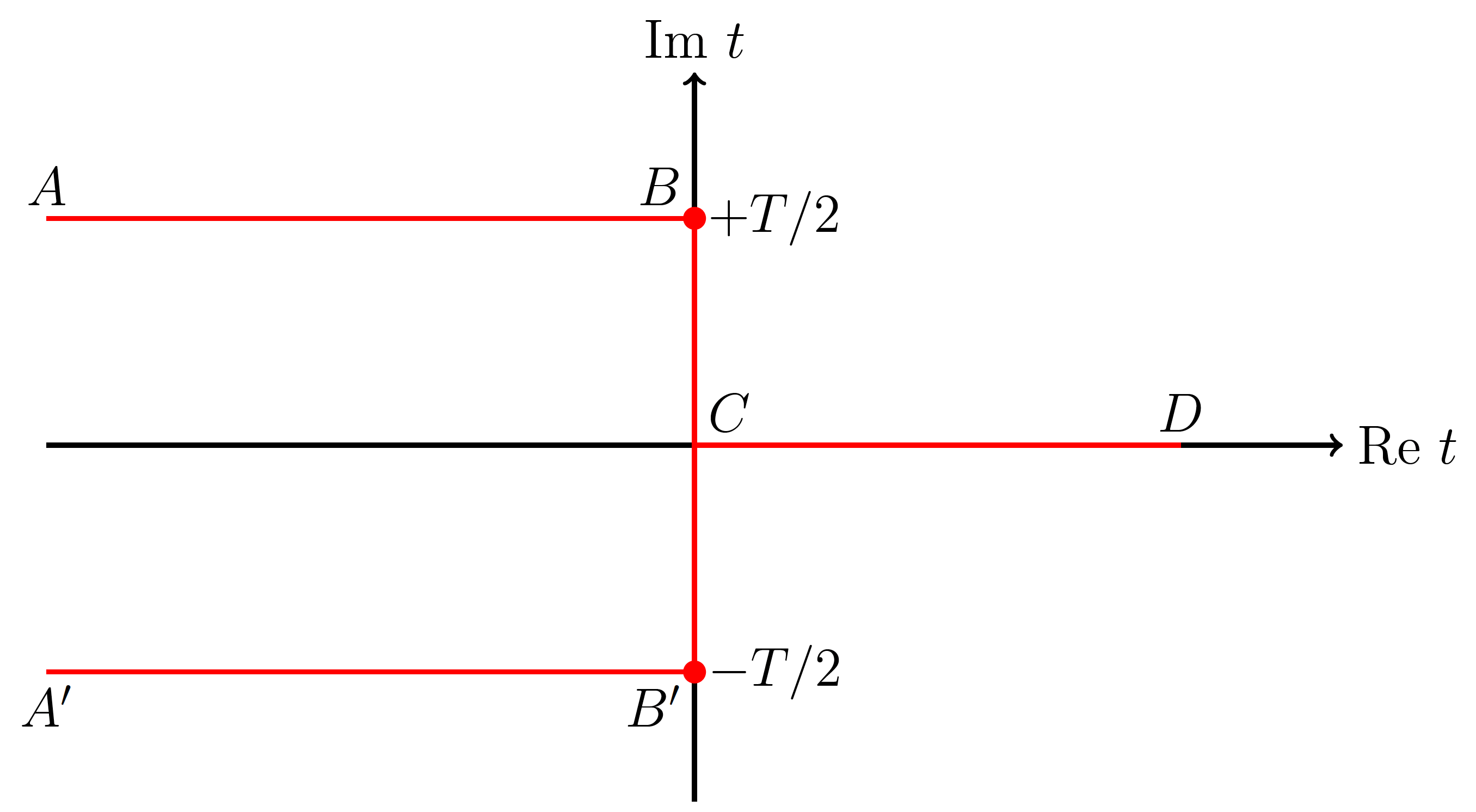
The conventional Euclidean bounce calculation of vacuum decay assumes projection onto the ground state in the infinite Euclidean past. To capture the influence of excited worldsheet backgrounds, the authors extend the description to include generic initial density matrices via a Schwinger-Keldysh complex time contour. This generalizes prior false vacuum decay calculations by encoding the initial state's classical field and momentum data within the functional integral, leading to new saddle-point structure and boundary conditions.
Figure 1: The Schwinger-Keldysh time contour, illustrating the forward (+) and backward (−) path integrations governing the decay probability from excited backgrounds.
The formalism ensures that only the Euclidean segment of the contour contributes to the tunneling exponent, and the decay rate is governed by the difference in Euclidean action between the bounce and trivial solutions, subject to the specified excited initial conditions.
Modified Bounce Geometry and Dynamics
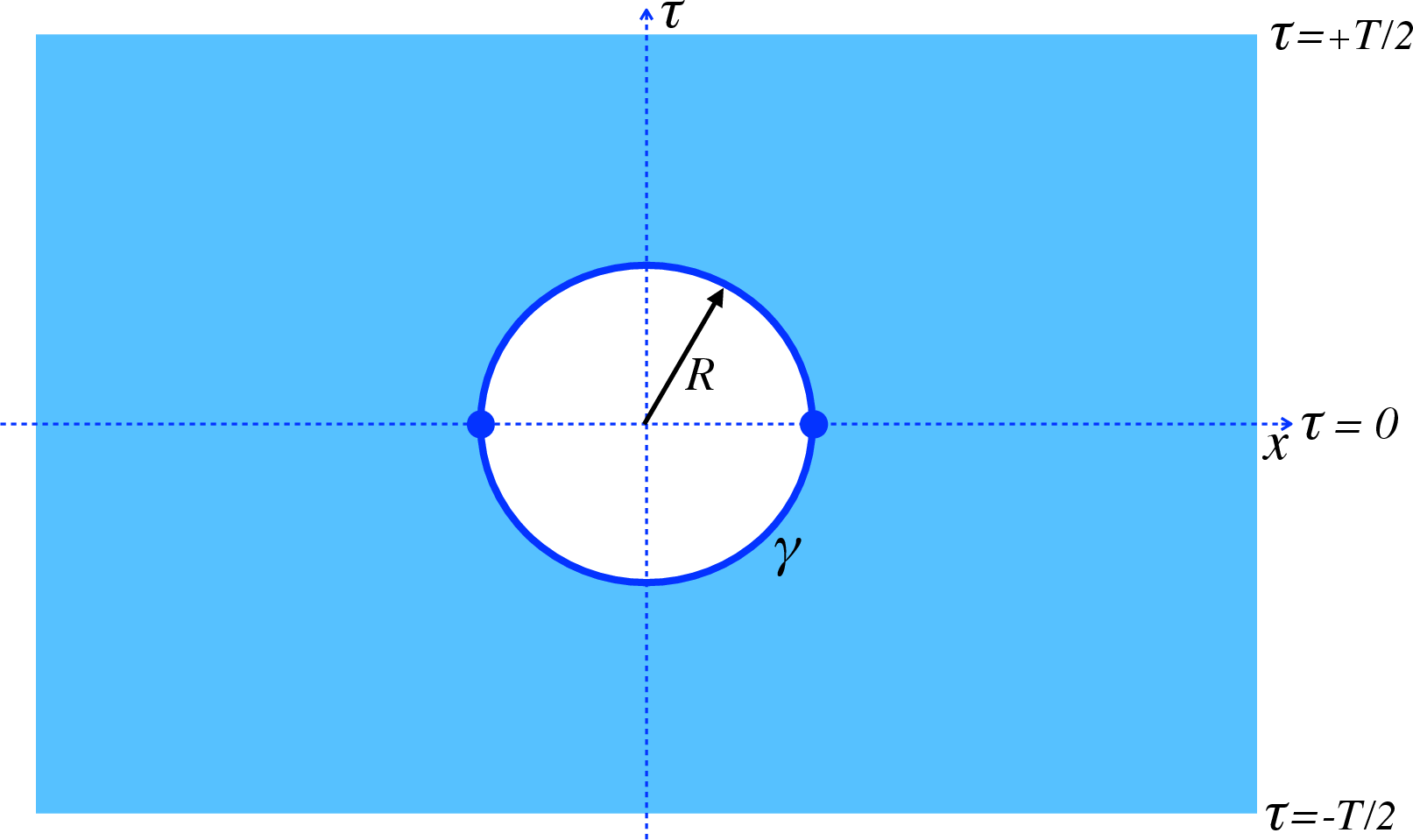
For ground-state strings, the critical "bounce" is a circular Euclidean hole of radius R0=mq/κ on the string worldsheet, corresponding to the nucleation of a quark-antiquark pair at rest in the Lorentzian continuation.
Figure 2: Bounce configuration in Euclidean spacetime—string worldsheet (blue), nucleation boundary, and quark/antiquark positions at τ=0.
In the presence of axion excitations, both the value and derivatives of the field locally deform the bounce geometry. The axion modifies the effective tension via
where mq0 is the background axion field at the nucleation point. Hence, the decay rate exponent becomes
mq1
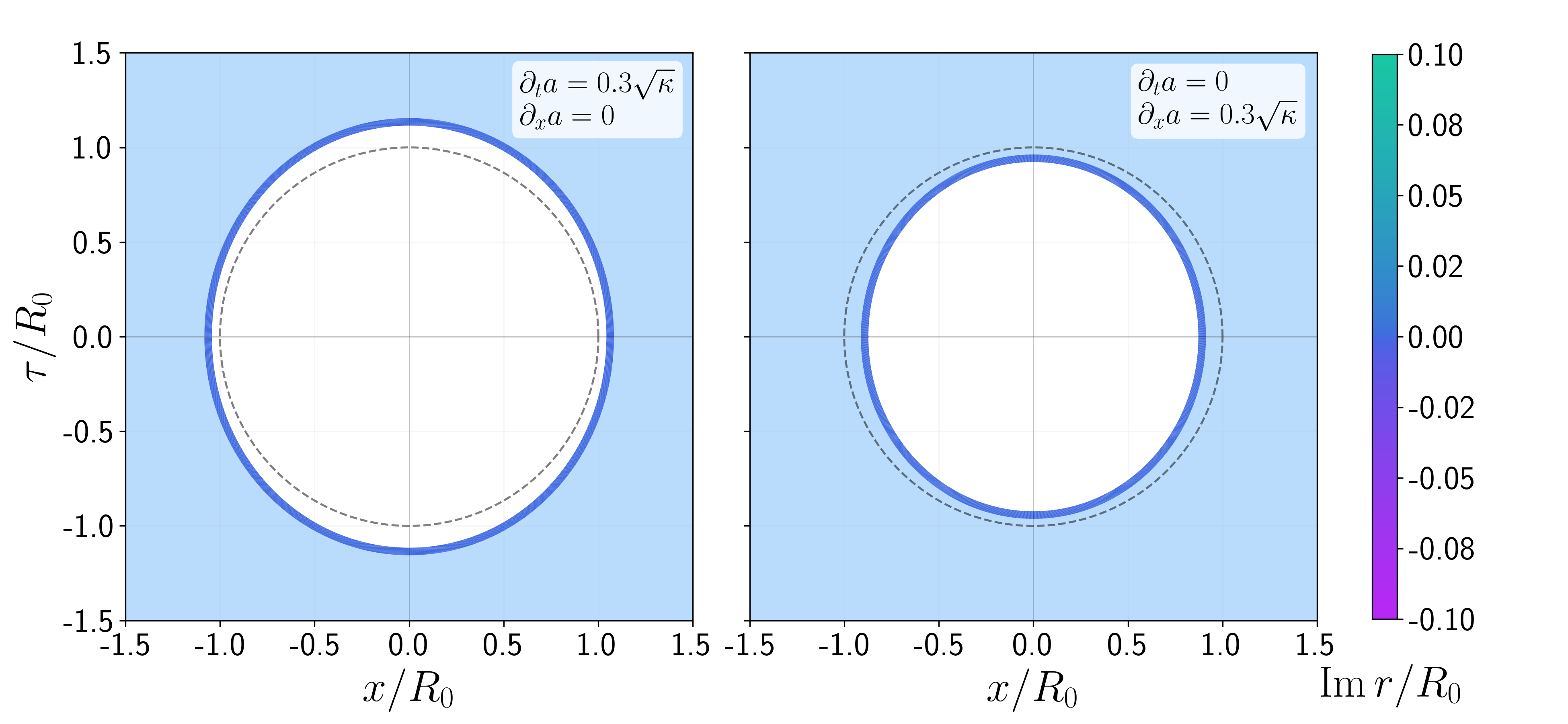
Spatial gradients and large field amplitudes exponentially enhance the breaking rate, while temporal gradients suppress it.
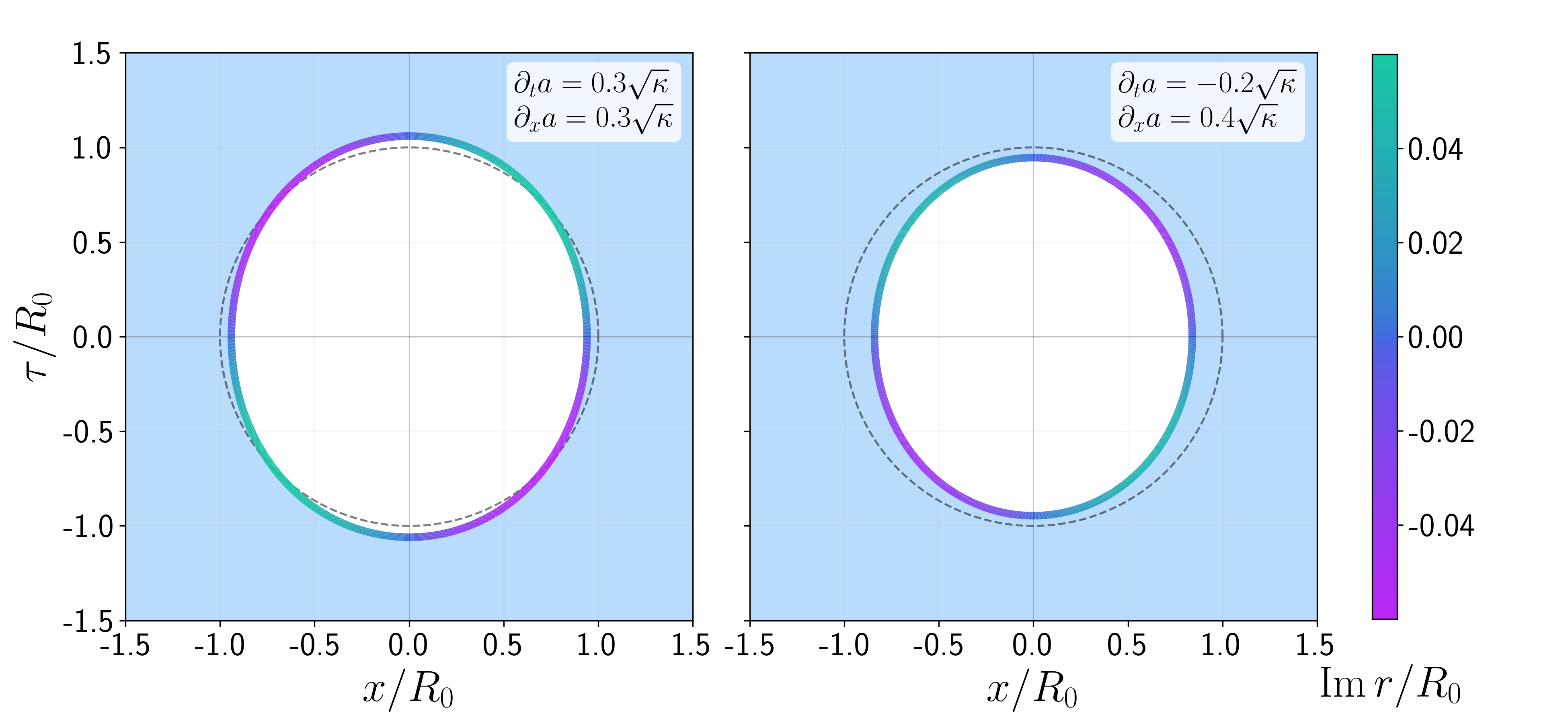
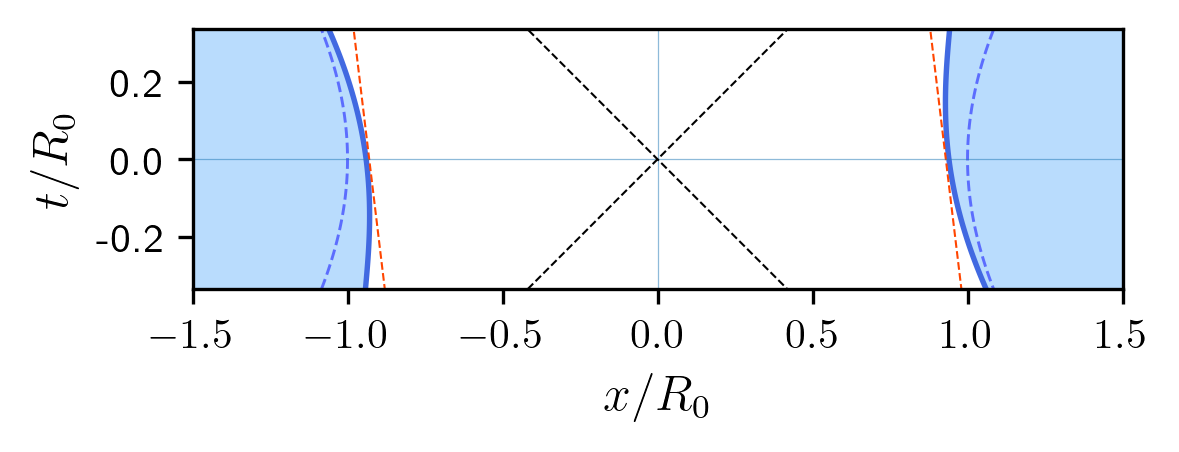
The bounce is distorted away from the circle, and, importantly, the bounce saddle becomes genuinely complex when both mq2 and mq3 are nonzero. This complex structure is necessary to consistently encode initial momentum in the nucleated quark pair (via a nonzero longitudinal velocity at mq4), while ensuring a real Lorentzian evolution.
Figure 3: Leading-order bubble profile deformation due to axion field gradients; real-valued deformations for purely temporal or spatial cases.
Figure 4: Complex bounce boundary for combined spatial and temporal axion gradients; colour indicates imaginary structure of the configuration.
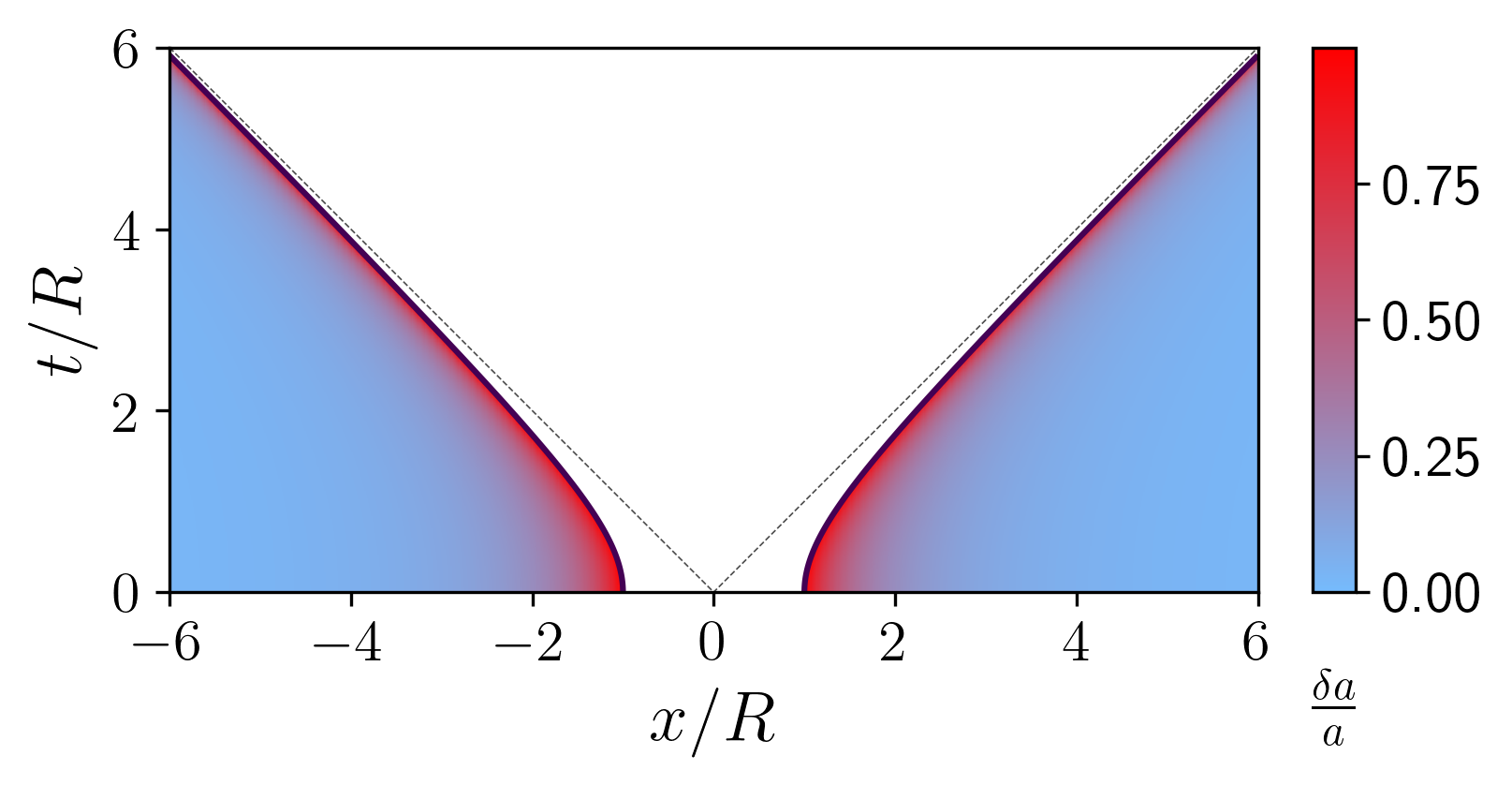
The deformation of the bubble boundary ensures both energy and momentum are conserved in the decay when the contribution from the background axion field is properly included. The modification of the axion field on the worldsheet after nucleation extends beyond the broken region, with exponential order-one changes near the accelerated quark endpoints.
Figure 5: Fractional change in the Lorentzian-signature axion field profile after bubble nucleation, showcasing nonlocal modifications extending outside the immediate nucleation region.
Figure 6: Resultant Lorentzian-time quark trajectories with nonzero initial longitudinal velocity after analytic continuation of the complex bounce.
Analytic Results for Massless and Massive Axion Backgrounds
For a massless axion, the bounce calculation can be solved exactly. The bounce action correction is given by mq5 (where mq6 at the nucleation point). For a slowly varying massive axion, the leading correction is mq7, with mq8 the field amplitude.
The formalism is perturbatively valid for mq9, but realistic QCD parameters yield ma0. In this regime, the authors note that the bounce shape and exponent require numerical solution or improved analytic approaches.
Phenomenological Implications and Outlook
The findings have direct ramifications for event generators and QCD phenomenology:
Hadronization and Flavour Production: The strong sensitivity of the decay exponent to effective tension and quark mass implies axion excitations could enhance heavy-flavour (e.g., strange) production, modifying final-state hadron yields relative to the ground-state Lund model.
Kinematics: Nontrivial axion field backgrounds produce kinematically modified initial quark trajectories, potentially impacting event-by-event distributions in collider environments.
Beyond the Standard Model: The methods provide a blueprint for analyzing vacuum decay and false-vacuum tunneling in excited backgrounds, beyond the QCD string context to cosmological and condensed matter systems.
The analytic extension to physically relevant ma1 and inclusion of statistical distributions over excited backgrounds is deferred to future companion works.
Conclusion
This study delivers a controlled, field-theoretic calculation of QCD-string breaking in non-ground-state, axion-excited backgrounds. The pivotal outcome is the exponential sensitivity of string breaking to worldsheet axion excitations, described via a locally Lorentz-invariant effective tension ma2. This constitutes the dominant correction in the EST regime and provides a roadmap for substantial improvements to hadronization models in collider simulations as well as for theoretical work on metastable vacuum decay in excited settings.
The approach generalizes to other tunneling processes in excited backgrounds and lays a theoretical framework for incorporating non-NG worldsheet excitations into practical event generator models, challenging the long-hold assumption of universal ground-state string tension in QCD fragmentation phenomenology.