Universal Confining Strings: From Compact QED to the Hadron Spectrum
Abstract: We investigate the description of quark confinement in terms of confining strings or flux tubes. We show that compact QED with a topological $θ$-term, in the dyon condensation phase, is described by a massive two-form field $B_{μν}$ that gives rise to a string theory with an IR Brazovskii-Lifshitz fixed point at strong coupling. This corresponds to a quantum consistent "free string" in (3+1) dimensions, representing the dual of asymptotic freedom in the UV. Contrary to critical strings, which correspond to trivial Gaussian fixed points, this string is stabilized by a finite thickness, determined by the mass of the $B_{μν}$ field, instead of living in a higher-dimensional space. It correspondingly contains a massive world-sheet resonance, in addition to the Nambu-Goto phonons, that improves fitting with data. We compute the confining potential and show that it reproduces a generalized Arvis potential $V(L) = aL \sqrt{1 - c/L2}$ with running parameters $a(L), c(L)$. We compute the mass difference ratios for the heaviest quarkonium and find 2.5 percent agreement with experiment already at the infrared fixed point. We also compute the intercept of Regge trajectories and find that the thickness of Brazovskii-Lifshitz strings tends to increase it from the Nambu-Goto value $α_0 = 1/12$. Overall, our findings strongly support Polyakov's longstanding conjecture on universality of confining gauge theories in the IR.
Paper Prompts
Sign up for free to create and run prompts on this paper using GPT-5.
Top Community Prompts
Explain it Like I'm 14
Overview: What this paper is about
This paper looks at a big mystery in physics: why quarks (the tiny particles inside protons and neutrons) can never be pulled apart. The authors explain this “confinement” by showing that quarks are tied together by thin tubes of energy that behave like strings. They build a new, realistic kind of string for our 3D world (plus time), with a small but important thickness, and show it can match real particle data surprisingly well.
Goals: What the researchers wanted to figure out
The authors set out to:
- Build a string model that works in our universe (3 space + 1 time dimensions) and can explain how quarks are confined.
- Show how this string comes from a simpler version of electromagnetism (called compact QED) when certain magnetic objects (monopoles and dyons) clump together.
- Compute the force between a quark and an antiquark from this string model and compare to the masses of heavy quark–antiquark bound states (like bottomonium, also called Υ).
- Check if this string naturally explains known features of hadrons, like Regge trajectories (a pattern relating particle mass and spin).
- Test a famous idea by Polyakov that many confining theories should look the same at large distances (universality).
Approach: How they did it (in everyday terms)
Think of the vacuum (empty space) as a special material. In this material, magnetic “monopoles” (hypothetical particles with a single magnetic pole) can condense—like water vapor turning into a cloud. When this happens:
- Electric field lines (from charged particles) get squeezed into thin tubes, like strands in a rope, joining a quark and an antiquark. These tubes act like strings that pull the quarks together, keeping them confined.
The authors start from a compact version of electromagnetism (compact QED), then add a special “θ-term” (pronounced “theta term”), which is like turning a knob that changes how electric and magnetic effects mix. In the monopole/dyon (dyons are charged monopoles) condensation phase, the usual electromagnetic field can be re-described using a different field (a “two-form” field, a bit like a sheet instead of a line). When they “integrate out” this field—mathematically, they remove it to see its net effect—they are left with an effective theory for a string that lives on the surface swept out by the confining tube.
Key features of their string:
- It has a finite thickness (imagine a garden hose, not an ideal thin line). That thickness makes the model stable and realistic in 3+1 dimensions.
- At very large distances, the string behaves like the classic Nambu–Goto string (the usual string model), but at shorter distances the thickness matters.
- The string’s vibrations include:
- ordinary “phonons” (like ripples along the string), and
- a massive “resonance” mode on the string’s worldsheet (like a drum that has a deeper tone in addition to the basic vibrations). This extra mode helps match data better.
To test the model, they:
- Calculated the energy between a quark and an antiquark as a function of distance, producing a “confining potential.”
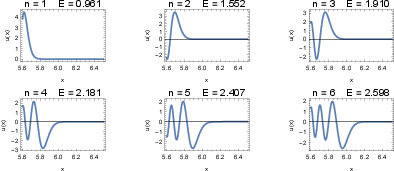
- Solved the Schrödinger equation (the basic quantum mechanics equation) with this potential to predict energy levels of heavy quark–antiquark systems (like Υ states).
- Compared these predictions with experimental mass differences.
They also estimated the “Regge intercept,” a number that helps describe how particle spin relates to mass—another check against known hadron patterns.
Main findings: What they discovered
- A quantum-consistent string in 3+1 dimensions:
- Their string is stable and consistent without needing extra spatial dimensions because it has finite thickness set by a mass scale in the theory.
- In physics language, the string flows to a “Brazovskii–Lifshitz infrared (IR) fixed point,” meaning that at large distances a particular kind of higher-derivative term dominates and controls the string’s behavior safely.
- Confining potential with the right shape:
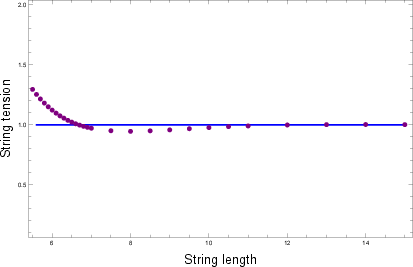
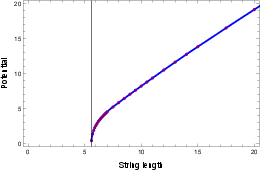
- The quark–antiquark potential grows roughly linearly at large distances (so the string pulls like a stretched rubber band), but at shorter distances it bends in a specific way. They find a generalized Arvis form (a known shape from string theory) with parameters that slowly change with distance.
- There’s a minimum stable string length: the string remains stable when it’s at least about 5.6 times thicker than its own thickness. This length scale plays a similar role to the QCD scale that marks where strong forces get really strong.
- Agreement with heavy quark data:
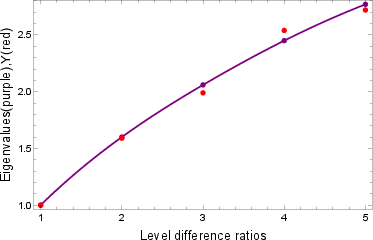
- Using their potential, they predicted ratios of mass differences between excited Υ (bottomonium) states.
- Their predictions agree with experiments to within about 2.5%—already good, even before adding small corrections.
- Regge trajectories improved:
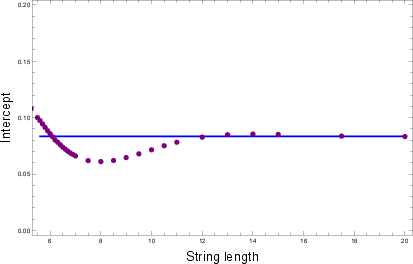
- The “intercept” (a number called α₀) that helps organize hadrons by spin and mass tends to increase from the basic string value when strings are not very long, thanks to the string’s thickness.
- At very large lengths, it approaches the classic Nambu–Goto value.
- Extra worldsheet resonance:
- The built-in massive resonance on the string’s surface can explain certain features seen in computer simulations (lattice calculations) of strong-force theories, providing an alternative to adding an “axion” by hand on the string.
- Role of the θ-term:
- Including the θ-term is crucial. It makes the effective mass scale grow in the strong-coupling limit, letting the model be well-defined and renormalized (kept finite as you remove cutoffs).
- At θ = π, the string picks up a sign when it crosses itself (“fermionic strings”), a subtle topological effect the model naturally captures.
Overall, these results support Polyakov’s “universality” idea: at large distances, different confining theories (even with different colors or details) look like the same kind of string theory.
Why it matters: Impact and implications
- A realistic string for the strong force: This work provides a concrete, math-consistent string model that works in our actual 3D space. It naturally explains confinement and the spectrum of hadrons without needing extra dimensions or facing the classic problems (like ghosts or tachyons).
- Bridges different areas of physics: The same ideas connect particle physics (quarks and gluons) and condensed matter (superinsulators), showing deep unity in how “flux tubes” confine charges.
- Better fits to data: The finite thickness and extra resonance improve agreement with experiments and lattice simulations, offering a practical tool to predict hadron properties.
- Universal behavior: If strings like this describe any confining theory well, then they likely describe QCD (the strong force) at large distances too. That means a single, simple picture—thick, stable strings—could capture a wide range of strong-interaction physics.
In short, the paper builds a thick, stable string model from a well-understood gauge theory, shows it naturally explains quark confinement, and demonstrates that it matches real-world hadron data impressively well—bringing us closer to a unified, simple picture of the strong force at large scales.
Knowledge Gaps
Knowledge gaps, limitations, and open questions
Below is a focused list of unresolved issues, uncertainties, and limitations highlighted or implied by the paper, framed as concrete directions for future work.
- Non-Abelian universality test: Demonstrate explicitly (beyond heuristic universality arguments) that SU(N) Yang–Mills theories flow to the same Brazovskii–Lifshitz (BL) infrared fixed point as compact U(1) with a θ-term; derive or simulate the mapping of parameters between non-Abelian gauge theories and the BL string.
- Dependence on Gaussian truncation: The worldsheet action is derived from the Gaussian approximation to the massive 2-form field; quantify how including the full non-linear (all-orders in ) terms modifies , , and and whether the IR fixed point and stability bounds persist.
- Regularization and scheme dependence: The kernel involves an explicit momentum cutoff via ; determine how physical predictions (e.g., the critical length-to-thickness ratio ≈5.6, the generalized Arvis parameters) depend on the choice of regulator and on , and identify scheme-independent observables.
- Explicit RG flow: Provide a full renormalization-group derivation of the running of and in the generalized Arvis potential, not just at the fixed point; give explicit RG equations and match them to the worldsheet parameters (, , ) and to gauge-theory inputs.
- Short-distance matching: Establish a quantitative matching scheme between the BL-string potential and perturbative QCD (Coulomb + short-distance corrections), including the transition scale where the two descriptions are merged consistently.
- Open-string boundary terms: The derivation uses a closed-string current; for quarkonium, formulate and validate the appropriate open-string boundary action (including endpoint dynamics and possible boundary counterterms) and assess its impact on spectra.
- Sensitivity to neglected remainder terms : The worldsheet action retains only “diagonal” higher-derivative terms and discards remainders for ; estimate their size non-perturbatively and quantify their effect on the potential, spectrum, and stability.
- Worldsheet resonance characterization: Compute the coupling and decay channels of the BL-worldsheet resonance into phonons, derive phase shifts in the two-phonon channel, and compare directly to SU(N) lattice data to distinguish this mechanism from the “worldsheet axion” scenario.
- Sign and magnitude of stiffness : Although emerges from the Bessel-function coefficients, provide a robust derivation including higher-order corrections, and test this sign via lattice-sensitive observables (e.g., dispersion and broadness of the two-phonon state).
- Intercept predictions vs data: The paper reports that finite thickness increases the Regge intercept above ; compute the magnitude and -dependence quantitatively and compare to hadron spectroscopy and lattice determinations.
- Parameter fixing and uncertainties: The agreement (≈2.5%) with heavy quarkonium mass-difference ratios is shown at the fixed point; provide a full error analysis, clarify which parameters are fitted vs predicted, and assess sensitivity to , , , and the regulator.
- Dynamical quark effects and string breaking: Extend the framework to include dynamical light quarks; model string breaking and mixing with multi-meson channels to assess how BL-string predictions for spectrum and potentials survive in full QCD.
- θ-term effects on dynamics: Beyond the self-intersection phase, analyze whether the θ-term induces measurable changes in open-string dynamics, boundary conditions, or spectra (especially near ), and how these would be observed.
- Stability bound verification: The stated stability threshold (string length > 5.6 × thickness) is obtained in a saddle-point/one-loop framework; confirm via non-perturbative methods (e.g., lattice-inspired discretizations of the BL worldsheet) and test for dependence on , , and boundary conditions.
- Minkowski consistency beyond saddle point: The absence of ghosts/tachyons is shown within a controlled truncation; demonstrate unitarity and causality with the full (infinite-derivative) kernel, including reflection-positivity checks in Euclidean space.
- Finite-temperature behavior: Predict the deconfinement transition and thermodynamics within the BL-string framework (e.g., Hagedorn-like behavior, stiffness effects at high T) and compare with lattice SU(N) results.
- Flux-tube thickness and lattice tests: Provide quantitative predictions for the flux-tube width and its length dependence in the BL-string, and compare with lattice measurements of transverse profiles to fix experimentally.
- Multi-string sectors: Generalize to k-strings, string junctions (baryonic Y-strings), and their effective tensions/intercepts within the BL framework; compare to lattice spectra across N and representations.
- Topology and self-intersections: Explore the dynamical consequences of the self-intersection term for closed-string spectra and for topology-changing processes on the worldsheet; estimate corrections to energy levels and to string interactions.
- Matching of gauge-theory inputs: Map , , , and (from compact QED) to QCD parameters; propose a practical calibration strategy (e.g., using lattice SU(3) inputs) to determine and relevant for hadron physics.
- Role of non-locality: Assess the range of validity of the non-local worldsheet kernel vs its derivative expansion; determine at what scales non-local effects become relevant and how they influence spectra and scattering.
- Beyond one-loop worldsheet quantization: Include higher-loop corrections on the worldsheet and study whether the BL fixed point remains stable, how the central charge flows for finite-length strings, and whether new operators are generated.
- Universality across dimensions and matter content: Test whether the BL fixed point emerges in 3D confining theories and in theories with different matter representations, and identify the minimal conditions for its appearance.
- Roton/microstructure implications: For , explore how the roton-like minimum and “egg-carton” microstructure manifest in observables (e.g., excitation spectra, correlations), and whether any lattice observables can directly confirm this microstructure.
- Connection to scattering amplitudes: Develop predictions for high-energy hadron-hadron scattering (Regge behavior) within the BL-string, including the impact of finite thickness on slopes and residue functions, and compare with experimental systematics.
- Boundary spin effects: Incorporate heavy-quark spin-dependent interactions at the string endpoints to address fine and hyperfine splittings in quarkonium, clarifying how much of the spectrum is controlled by the BL-string vs perturbative spin dynamics.
- Robustness of the critical ratio 5.6: Determine whether the critical length/thickness ratio is universal across consistent truncations and under variations of and , or if it shifts when higher-order terms are included explicitly.
Practical Applications
Immediate Applications
The paper introduces a Brazovskii–Lifshitz (BL) confining string with finite thickness arising from compact QED with a θ-term, derives a generalized Arvis potential with running parameters, and identifies a world‑sheet resonance. These results enable several deployable use cases across theory, computation, and data analysis.
- Heavy-quark spectroscopy fits (sector: high-energy physics, software)
- Application: Use the generalized Arvis potential V(L)=a(L)L√(1−c(L)/L²) with running coefficients to fit bottomonium/charmonium spectra via Schrödinger-equation solvers, extracting the string thickness and testing length-dependent Regge intercepts.
- Tools/products: Implement a library module (e.g.,
bl_string_potential) for NRQCD potential fits; add plug-ins to existing spectroscopy tools to include running a(L), c(L). - Assumptions/dependencies: Nonrelativistic treatment and neglect of spin-dependent interactions are adequate for heavy quarkonia; saddle-point/one-loop approximation holds; string stability requires L ≳ 5.6 × thickness.
- Lattice gauge theory data analysis (sector: computational physics, lattice QCD/LGT)
- Application: Replace/augment Nambu–Goto ansätze with the BL-string action (including negative stiffness and a world-sheet resonance) when fitting SU(N) lattice energy levels and extracting string tension and corrections.
- Tools/products: Analysis notebooks/pipelines to fit excited string spectra with a BL-resonance channel (as an alternative to the “worldsheet axion”); length-dependent intercept extraction routines.
- Assumptions/dependencies: Availability of precise long-string lattice data; acceptance of effective-string regime; inferred resonance breadth aligns with observed broad phase shifts.
- Benchmarks for analog/digital quantum gauge simulators (sector: quantum technologies)
- Application: Provide target observables (mass gap scaling , finite thickness, Yukawa world-sheet kernel, length-dependent intercept) to benchmark quantum simulations of compact U(1) with monopole condensation and θ-term.
- Tools/products: Benchmark suites specifying correlation functions and static potentials to validate simulators; datasets of predicted scaling relations for varying e, θ.
- Assumptions/dependencies: Experimental platforms can approximate compactness, implement/topologically emulate θ, and access confining phases with dyonic condensates.
- Interpretation framework for superinsulators (sector: condensed matter)
- Application: Apply the BL-string picture of flux-tube confinement (finite thickness, negative stiffness roton-like features) to analyze transport anomalies and collective modes in superinsulating films and Josephson arrays.
- Tools/products: Phenomenological models connecting string thickness to characteristic energy/length scales in transport; fitting routines for activation curves informed by confining tube structure.
- Assumptions/dependencies: Mapping from compact U(1) confinement to material-specific observables is valid; θ-like effects are either present or negligible in given materials.
- Graduate education and training (sector: education)
- Application: Incorporate dualities (sine‑Gordon ↔ BL), confining strings with finite thickness, and generalized Arvis potentials into advanced coursework and computational labs.
- Tools/products: Teaching modules with code for solving spectra using BL potentials; problem sets on SL(2,ℤ) duality and world‑sheet fixed points.
- Assumptions/dependencies: Availability of instructors and students versed in QFT, strings, and lattice methods.
Long-Term Applications
Several promising directions require further theoretical development, scaling, or new experimental capabilities before deployment.
- Event generator improvements for hadronization (sector: HEP software/phenomenology)
- Application: Incorporate finite string thickness and BL world‑sheet resonance into fragmentation models (e.g., in PYTHIA/Herwig) to refine particle production and transverse momentum spectra.
- Tools/products: New hadronization modules parameterized by thickness and resonance couplings; validation suites against collider data.
- Assumptions/dependencies: Robust mapping from effective string dynamics to hadronization; calibration against global data; treatment of short-string regimes beyond current saddle‑point solutions.
- Quantum simulation of compact QED with θ-term and 2‑form dynamics (sector: quantum technologies)
- Application: Engineer analog platforms (cold atoms, Rydberg arrays, superconducting circuits) to realize compact U(1) with monopoles and θ, probing BL fixed-point properties (mass gap, thickness, resonance).
- Tools/products: Hamiltonian designs implementing compactness and θ; measurement protocols for static potentials and world‑sheet excitations; verification via SL(2,ℤ) duality checks.
- Assumptions/dependencies: Controlled realization of compactness and θ; tunable strong coupling and dyon condensation; error mitigation for long timescales.
- Materials/device engineering leveraging confinement (sector: electronics/quantum materials)
- Application: Design superinsulator-based devices exploiting tunable confining flux tubes (e.g., switchable ultra-insulating states, robust isolation in cryogenic electronics, protection from leakage).
- Tools/products: Device architectures informed by thickness-dependent confinement; characterization protocols for “fermionic string” signatures near θ ≈ π analogs.
- Assumptions/dependencies: Materials with controllable parameters mimicking θ and strong coupling; stability and reproducibility of superinsulating phases; integration challenges at device scale.
- Precision tests of universality and Regge intercept systematics (sector: HEP experiment/theory)
- Application: Use length-dependent intercept predictions and resonance effects to guide and interpret measurements of excited hadron spectra and scattering (e.g., LHCb, Belle II).
- Tools/products: Global analysis frameworks combining lattice, spectroscopy, and BL-string fits; targeted experimental proposals.
- Assumptions/dependencies: Extractable effective string lengths in relevant states; disentangling resonance/continuum effects; systematic control over non-string contributions.
- Enhanced lattice/continuum methods for confining strings (sector: computational physics)
- Application: Develop algorithms and continuum extrapolations that incorporate nonlocal Gaussian kernels and BL fixed-point scaling to reduce systematic errors in string observables.
- Tools/products: Improved actions/fit models for finite-a corrections; renormalization schemes tracking thickness and negative stiffness.
- Assumptions/dependencies: Availability of high-statistics ensembles; theoretical control over nonlocal kernel truncations; validation across N and dimensions.
- Heavy-ion and non-equilibrium QCD phenomenology (sector: nuclear physics)
- Application: Explore implications of finite-thickness flux tubes and roton-like microstructure for early-time dynamics, correlations, and ridge phenomena in heavy-ion collisions.
- Tools/products: Real-time effective models incorporating BL-string features; comparison pipelines with flow and correlation data.
- Assumptions/dependencies: Validity of world‑sheet effective descriptions out of equilibrium; mapping to observables amid strong backgrounds.
- Cross-domain duality-driven modeling (sector: applied math/theoretical physics)
- Application: Use the field↔derivative duality (sine‑Gordon ↔ BL) to reframe complex interacting systems (e.g., in soft matter or plasma physics) as higher‑derivative “free” theories for efficient analytic or numerical treatment.
- Tools/products: General-purpose duality toolkits for mapping interactions to derivative expansions; solver libraries exploiting Gaussian yet nonlocal structures.
- Assumptions/dependencies: Existence and control of appropriate dualities; convergence/consistency of high‑derivative expansions in target systems.
Glossary
- anti-self dual forms: Two-forms in four dimensions that satisfy F = −∗F, used to decompose fields into duality eigenstates. Example: "a basis of dual and anti-self dual forms as "
- antisymmetric tensor: A rank-2 field Bμν with Bμν = −Bνμ appearing in gauge/string dual descriptions. Example: "a massive antisymmetric tensor field theory"
- Arvis potential: The exact ground-state energy of an open Nambu–Goto string as a function of separation, often used for quark–antiquark potentials. Example: "generalized Arvis potential "
- asymptotic freedom: Property of non-Abelian gauge theories where interactions weaken at high energies. Example: "where asymptotic freedom renders the coupling weak"
- Bessel function (modified): Special function (e.g., Kν) appearing in solutions to differential equations in Euclidean space. Example: "can always be expressed in terms of a modified Bessel function"
- BKT critical point: Berezinskii–Kosterlitz–Thouless transition point characterized by vortex–antivortex unbinding in 2D systems. Example: "an ultraviolet BKT critical point at "
- bosonization: Duality mapping between fermionic and bosonic theories in low dimensions. Example: "Through bosonization, it is also dual to the massive Thirring model."
- Brazovskii-Lifshitz fixed point: An infrared fixed point dominated by higher-derivative terms leading to finite-thickness strings. Example: "an IR Brazovskii-Lifshitz fixed point at strong coupling."
- Brazovskii-Lifshitz model: High-derivative scalar field theory featuring quartic derivatives, relevant to modulated phases. Example: "The Brazovskii-Lifshitz model"
- Brazovskii-Lifshitz string: A quantum-consistent string in 3+1D stabilized by finite thickness and hyperfine structure. Example: "the Brazovskii-Lifshitz string introduced in \cite{dkt}"
- Breit-Wigner approximation: Approximation for resonance shapes in spectral densities. Example: "With the usual Breit-Wigner approximation, the spectral density is obtained"
- Chern class (second): Topological invariant characterizing U(1) bundles via F∧F in 4D. Example: "The second Chern class "
- compact QED: Electrodynamics with a compact U(1) gauge group allowing monopoles and confinement. Example: "compact QED in the monopole condensation phase"
- confining strings: Flux tubes modeled as strings that confine color sources in gauge theories. Example: "quark confinement in terms of confining strings or flux tubes."
- covariant Laplacian: Laplace–Beltrami operator on the world-sheet accounting for metric covariance. Example: "the corresponding covariant Laplacian"
- Dirac quantization condition: Quantization rule relating electric and magnetic charges. Example: "as epitomized by the Dirac quantization condition."
- dyon condensation phase: Phase where particles carrying both electric and magnetic charge condense. Example: "in the dyon condensation phase"
- flux tubes: Tubular configurations of confined field lines between charged sources. Example: "flux tubes manifest themselves as confining strings"
- Gaussian fixed point: Free (non-interacting) fixed point of a field theory under renormalization. Example: "Gaussian fixed points"
- Gaussian map: Coordinate choice mapping neighborhoods of a surface to normal/tangent directions. Example: "choosing coordinates through a Gaussian map"
- Hausdorff dimension: Fractal dimension measuring the effective dimensionality of a set/surface. Example: "Hausdorff dimension "
- hyperfine structure (string): Higher-derivative term (quartic in derivatives) stabilizing the string and adding a resonance. Example: "the last term is the string hyperfine structure"
- Lagrange multiplier: Auxiliary field imposing constraints in an action. Example: "by introducing a Lagrange multiplier"
- lattice gauge theory: Discretized gauge theory used for nonperturbative numerical studies. Example: "lattice gauge theory calculations"
- Meissner effect: Expulsion of magnetic flux from a superconductor, with an electric–magnetic dual in confinement. Example: "the electric-magnetic dual of the Meissner effect"
- Minkowski space-time: Lorentzian signature spacetime used for physical (non-Euclidean) dynamics. Example: "upon a Wick-rotation to Minkowski space time"
- monopole fugacity: Exponential weight controlling monopole proliferation in compact gauge theories. Example: " the monopole fugacity."
- Nambu-Goto phonons: Massless transverse oscillations of a string world-sheet in the Nambu–Goto model. Example: "in addition to the Nambu-Goto phonons"
- Nambu-Goto string: Classical string with action proportional to world-sheet area. Example: "The standard Nambu-Goto string"
- Polyakov string: String formulation using an independent world-sheet metric with Weyl symmetry. Example: "The Polyakov string is stabilized by a critical dimension 26"
- Polyakov’s universality conjecture: Proposal that confining gauge theories share a universal IR string description. Example: "Polyakovâs universality conjecture"
- Regge intercept: The value α0 where a Regge trajectory crosses zero mass squared. Example: "the Regge intercept "
- Regge slope: Parameter α′ relating angular momentum and mass squared in string/hadron spectra. Example: "the universal Regge slope"
- Regge trajectories: Approximately linear relations between hadron spin and mass squared. Example: "Regge trajectories"
- rigid string: String model with an additional extrinsic curvature (stiffness) term. Example: "A major problem of the rigid string"
- roton minimum: Local minimum in a dispersion relation at finite momentum indicating microstructure tendency. Example: "the spectrum develops a roton minimum"
- saddle-point approximation: Method approximating functional integrals by expansions around stationary points. Example: "studied in the saddle-point approximation"
- self-intersection number: Topological invariant counting signed self-intersections of a surface. Example: "the (signed) self-intersection number of the world-sheet"
- SL(2, Z) duality: Modular duality mixing coupling and theta-angle in U(1) theories. Example: "full duality."
- sine-Gordon model: Periodic scalar field theory with solitons, dual to various models in 2D. Example: "the sine-Gordon model"
- stiffness (string): Coefficient S of the extrinsic curvature term controlling string rigidity. Example: "with stiffness parameter "
- string tension: Energy per unit length of a string; sets the confinement scale. Example: "generates a dynamical string tension "
- superinsulating state: Condensed-matter phase with dual (electric) confinement and infinite resistance. Example: "in the superinsulating state"
- T-duality: Equivalence between theories with compact target-space radii R and 1/R. Example: "we get the standard -duality"
- tachyon: Instability mode with negative mass squared in a spectrum. Example: "no tachyons nor ghosts"
- two-form field: Antisymmetric tensor gauge field Bμν that couples naturally to strings. Example: "two-form field "
- Virasoro constraints: Conditions from world-sheet diffeomorphism and Weyl invariance setting stress tensor to zero. Example: "The Virasoro constraints of vanishing energy-momentum tensor are also absent."
- Weyl anomaly: Quantum breaking of Weyl invariance in 2D gravity/string theory. Example: "no need to cancel a Weyl anomaly"
- Weyl symmetry: Local rescaling symmetry of the world-sheet metric in Polyakov’s formulation. Example: "there is no Weyl symmetry"
- Wick rotation: Analytic continuation between Euclidean and Minkowski signatures. Example: "upon a Wick-rotation to Minkowski space time"
- worldsheet axion: Pseudoscalar excitation on the string world-sheet proposed to match lattice spectra. Example: "worldsheet axion \cite{axion}"
- Yukawa Green's function: Green’s function of (−∇2 + m2) in 4D giving an exponentially decaying potential. Example: "the $4-$dimensional Yukawa Green's function"
Collections
Sign up for free to add this paper to one or more collections.

