- The paper demonstrates that redundant constraints can impede convergence by doubling gradient magnitudes, challenging conventional heuristics.
- CLS leverages Walsh-Fourier transforms to relax discrete SAT problems into continuous optimization, enabling efficient GPU parallelization.
- Fixing partial variable assignments notably enhances convergence, informing hybrid SAT solver designs and adaptive stopping criteria.
Parallel Continuous Local Search for Pseudo-Boolean Satisfiability
Introduction and Motivation
The paper "A Study of Parallel Continuous Local Search" (2606.06656) investigates continuous local search (CLS) as a parallelizable approach for Boolean satisfiability (SAT) problems with symmetric pseudo-Boolean (PB) constraints. The core innovation is to relax the inherently discrete SAT problem to a continuous non-convex optimization over the real hypercube, leveraging Walsh-Fourier analysis for efficient, differentiable objective construction. The study is motivated by the need to exploit parallel hardware—GPUs especially—by reformulating SAT so that vectorized computation becomes natural and efficient.
Continuous Relaxation via Walsh-Fourier Expansion
CLS applies the Walsh-Fourier transform to Boolean variables, mapping X∈{±1}n to X∈[−1,1]n, thus transforming the discrete search into a continuous optimization setting. For symmetric PB constraints, such as exactly-one (EO), at-most-one (AMO), and cardinality, the Walsh-Fourier expansion yields a multilinear polynomial with a compact representation: the number of distinct Fourier coefficients is O(n), in contrast to the exponential growth with general Boolean functions. This facilitates analytical coefficient derivations for all relevant symmetric PB constraints and enables polynomial-time coefficient computation, forming the computational backbone for CLS-based SAT solvers.
Empirical Findings and Novel Phenomena
The paper employs the Accelerated Fourier SAT (AFSAT) solver on GPU to conduct a range of empirical studies. Three strong findings are emphasized:
Redundant Constraints and Gradient Pathology
Contrary to the intuition that redundant constraints accelerate convergence, the analysis reveals they can significantly inhibit it. When an EO constraint is encoded redundantly as both EO and as a combination of OR and cardinality on negated literals, the resulting gradient magnitude is doubled. This steepens the optimization landscape, causing the local search to exhibit damped oscillatory behavior and stall at non-satisfying assignments, as the gradient field near (partially) satisfied corners overwhelms other active constraint gradients.
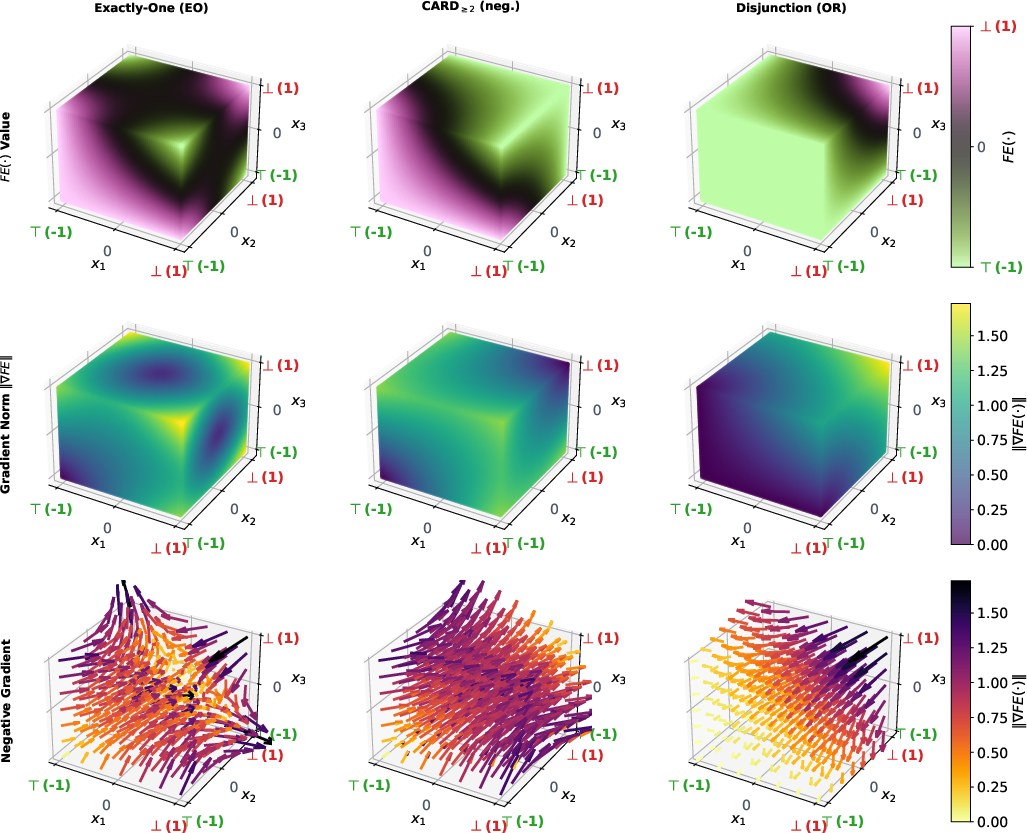
Figure 1: Evaluation, slope, and gradients of EO and related redundant encodings, illustrating steepened gradients and stagnated local minima.
This result directly contradicts common heuristics from combinatorial search, highlighting that for CLS minimal representations are far preferable—suggesting adaptive constraint weighting as a promising avenue to mitigate gradient imbalances.
CLS as a Partial Assignment Completer
CLS fails to solve hard random 3-SAT instances outright. However, in hybrid setups where a small fraction of variables are fixed (i.e., partial assignments derived from a systematic solver), CLS reliably completes the remainder of assignments. Notably, fixing 15–20% of variables suffices for rapid convergence to satisfying assignments, and increasing the amount of fixed variables yields progressively better performance.
This monotonic completion profile is significant for layered SAT solvers—particularly those used for model counting (#SAT) and hybrid approaches—where systematic methods generate promising partials, and CLS acts as an efficient, parallel sub-solver for finalization.
Convergence Profile Analysis in Costas Arrays
The convergence behavior of CLS on Costas array problems is shown to be highly sensitive to the fraction of variables fixed in the input. For highly assigned scenarios (e.g., 66% fixed), the distribution of iterations to convergence is unimodal and nearly all runs complete well within the step limit.
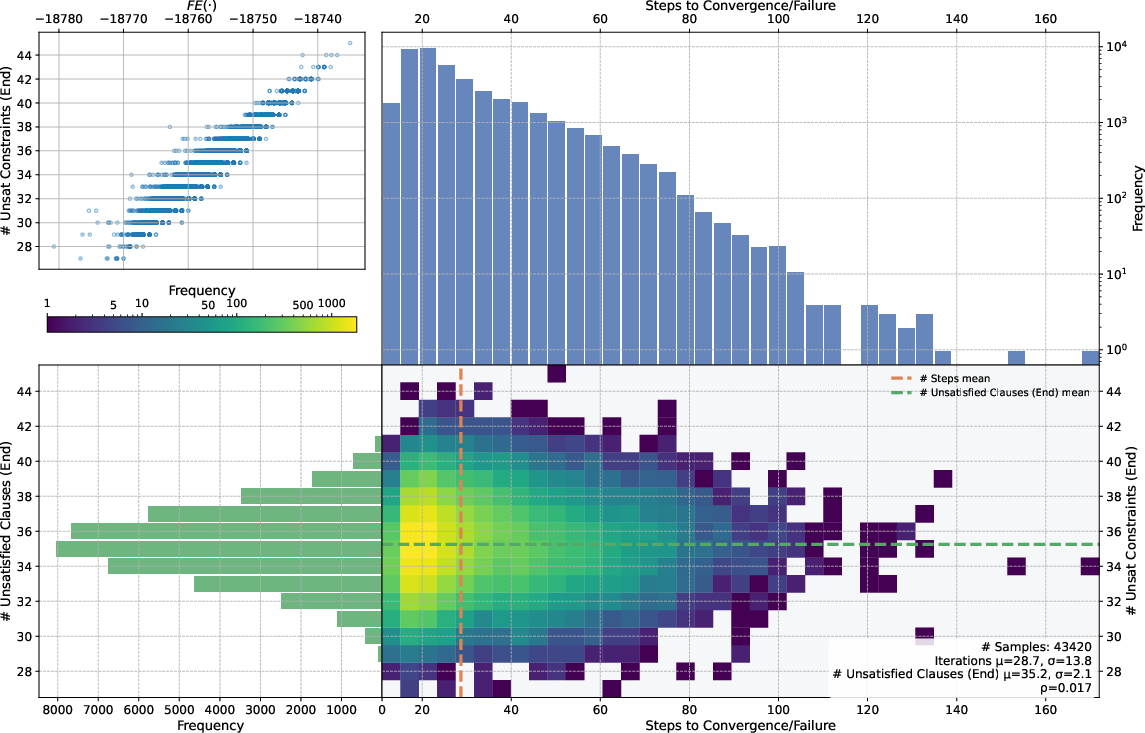
Figure 2: Costas-15 convergence statistics show mostly unimodal behavior and rapid convergence when the majority of variables are assigned.
In contrast, with only a small partial assignment (e.g., 10% fixed), a substantial portion of runs either fail to converge within the given step limit or do so immediately, indicating a bimodal distribution.
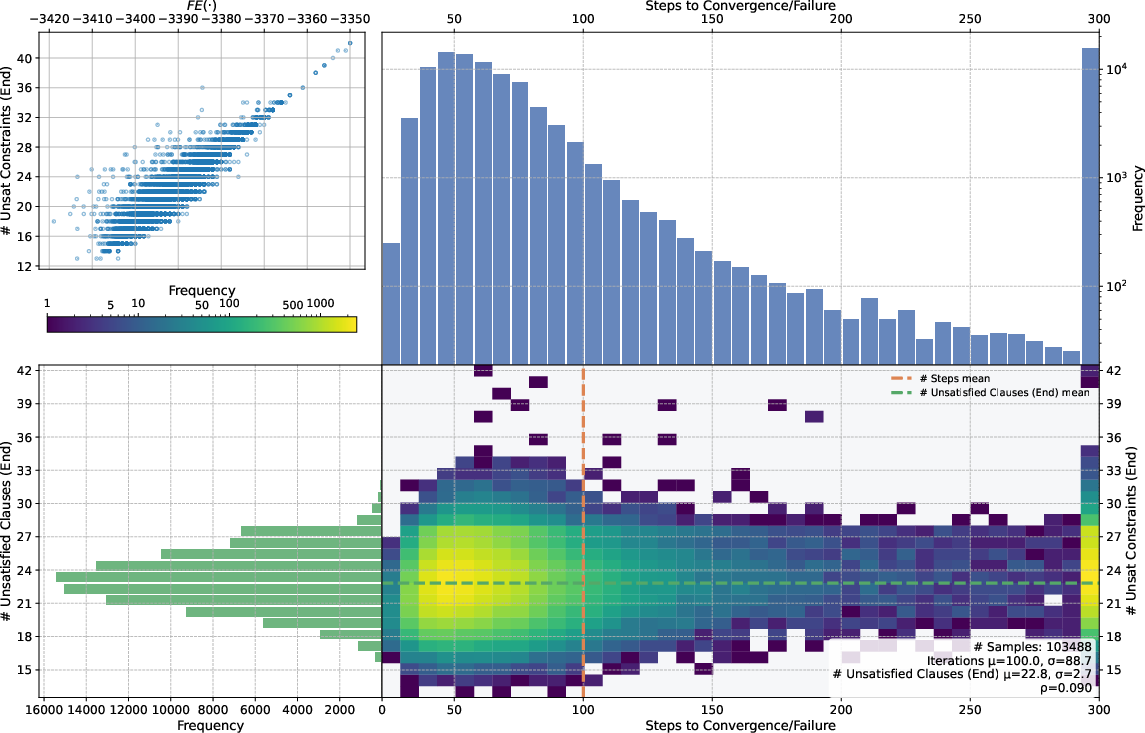
Figure 3: Costas-10 convergence, with few variables fixed, exhibits a bimodal profile and more non-convergent attempts.
These findings have direct implications for throughput: in batch-parallelized CLS, setting the maximum step hyperparameter improperly may waste substantial GPU cycles on already-converged or hopeless runs, pointing to the necessity for profile-informed limit selection and possible adaptive stopping criteria.
Representational Advantages of PB Encodings
A strong claim of the work is the clear representational advantage of Walsh-Fourier-based CLS when problems are specified natively in PB rather than CNF. Unlike CNF encodings—which can undergo exponential blowup and require the introduction of auxiliary variables—PB encodings retain the original variable and constraint counts, translating directly to more scalable parallelization and lower memory requirements. The compactness further enhances the practical feasibility of fully vectorized computation on accelerator hardware.
This property is especially salient for classes of problems such as Ramsey colorings, Costas arrays, and various scheduling and design applications, most of which lend themselves to PB formulations. The work contends that current CDCL and resolution-based SAT solvers are inherently disadvantaged on PB-rich domains when using CNF translations, both from representational and proof-complexity standpoints.
Theoretical and Practical Implications
Practically, the study identifies CLS as a scalable sub-solver candidate in hybrid architectures, e.g., as the parallel search component in distributed systems or as the solution-completer in model counting frameworks. The identification of convergence pathologies in the presence of redundant constraints gives a basis for future fine-grained solver parameterization—especially adaptive constraint weighting and dynamic step size control. The observed convergence profile stratification motivates the design of more sophisticated batching and stop criteria.
Theoretically, the work draws connections between the structure of multilinear relaxations and optimization critical points, notably the saddle-rich interior and boundary-localized minima, explaining fundamental limitations of first-order descent methods and their stalling behavior due to floating-point precision limitations on real hardware.
Future Directions and Outlook
The authors suggest future developments in adaptive constraint weighting, deployment of CLS as a drop-in sub-solver in distributed parallel search, and intelligent PB substructure detection/compilation in generic CNF. The analytic closed-forms for all symmetric PB constraints provide a foundation for efficient hybrid SAT solvers in large-scale combinatorial contexts, and should catalyze further research into theory-informed parameter tuning, better hardware utilization, and new solver paradigms that explicitly leverage PB structure.
Conclusion
This paper incisively explores the paradigmatic shift offered by parallel continuous local search for combinatorial SAT, particularly in PB-rich domains. Its main contributions—analytical closed-forms for symmetric PB constraints, empirical profiling of parallel convergence dynamics, and the identification of practical bottlenecks and advantages—serve as a technical basis for subsequent research into hardware-accelerated SAT, hybrid/portfolio solver design, and large-scale symbolic reasoning. The work advances both practical solver engineering and the theoretical understanding of continuous relaxations in the context of symbolic AI and combinatorial optimization.