Principles and Practice of Deep Representation Learning: or a Mathematical Theory of Memory
Abstract: In the current era of deep learning and especially generative models, there is significant investment in training very large generative models. Thus far, such models have been "black boxes" that are difficult to understand in the sense that they have opaque internal mechanisms, leading to difficulties in interpretability, reliability, and control. Naturally, this lack of understanding has led to both hype and fear. This book is an attempt to "open the black box" and understand the mechanisms of large deep networks, through the perspective of representation learning, which is a major factor - arguably the single most important one - in the empirical power of deep learning models. A brief outline of this book is as follows. Chapter 1 will summarize the threads that underlie the whole text. Chapters 2, 3, 4, 5, and 6 will explain the design principles of modern neural network architectures through optimization and information theory, reducing the process of architecture development (long having been described as a sort of "alchemy") to undergraduate-level linear algebra and calculus exercises once the underlying principles are introduced. Chapters 7 and 8 will discuss applications of these principles to solve problems in more paradigmatic ways, obtaining new methods and models which are efficient, interpretable, and controllable by design, and yet no less - sometimes even more - powerful than the black-box models they resemble. Chapter 9 will discuss potential future directions for deep learning, the role of representation learning, as well as some open problems.
Paper Prompts
Sign up for free to create and run prompts on this paper using GPT-5.
Top Community Prompts
Explain it Like I'm 14
Overview: What this book is about
This book is about a simple but powerful idea: most real-world data (like photos, sounds, text) live in a huge space, but the useful patterns inside them are much simpler than they look. The authors call these simpler patterns “low‑dimensional structures.” The book explains how to discover those patterns and turn them into a compact “memory” of the world. In everyday terms, it’s about teaching computers to build good, small summaries of complicated data so they can understand, predict, and create things—like having a world model in their heads.
Goals and big questions
The book focuses on a few big, easy-to-grasp questions:
- How do we describe the predictable parts of the world in a clean, mathematical way?
- How can a computer learn those patterns from lots of messy, real data?
- How should that learned knowledge be stored so it can be used later, like a memory?
- How do classic methods (like PCA from math class) and modern deep learning (like transformers) actually fit together under the same principles?
How they approach it (with simple analogies)
The authors build a unified toolkit by connecting classic ideas with modern deep learning. Here’s the roadmap, explained in everyday language:
- Classic pattern finders: PCA, ICA, and Dictionary Learning
- Think of cleaning your messy closet. PCA finds the main “directions” your clothes vary (like colors or types), so you can organize faster. ICA tries to separate mixed signals, like pulling apart voices in a crowded room. Dictionary Learning builds a small “word list” of basic pieces that can be combined to describe many items simply.
- Compression as a unifying principle
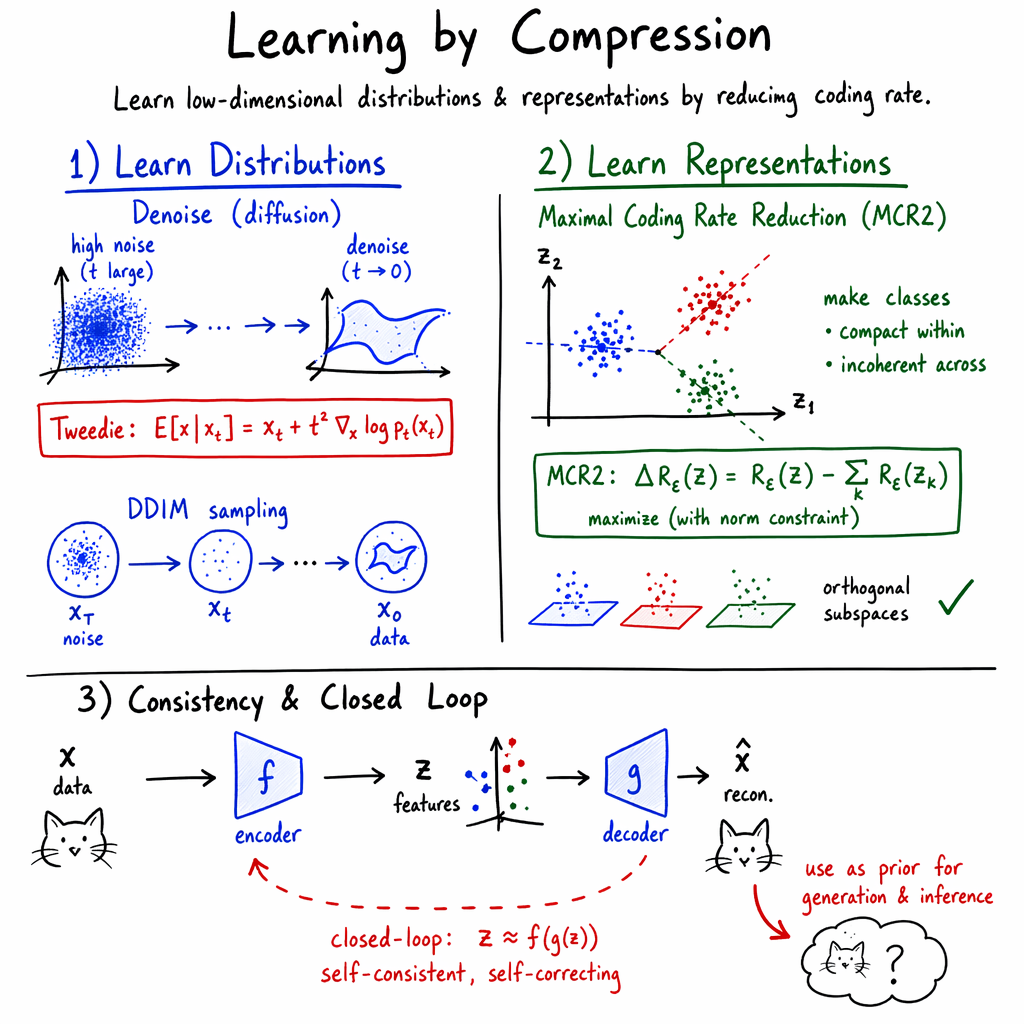
- Compression is like zipping files: keeping the important parts, throwing away extra fluff. The book shows that many different methods—reducing noise, simplifying data, or making features that help with tasks—are all different forms of compression. If you compress well, you learn the key structure.
- Denoising and diffusion
- Denoising is cleaning up a noisy photo. Diffusion models add noise step by step and then learn to reverse it; by learning to remove noise, the model learns what a “real” image looks like. This teaches the computer the shape of the data’s low‑dimensional structure.
- Lossy coding and information gain
- Lossy coding means accepting small, smart losses (like slightly lower image quality) to greatly shrink size. The goal is to keep the information that matters. “Maximizing information gain” is like organizing a library so the categories tell you the most about each book with the fewest labels.
- Deep networks as unrolled optimization
- Deep models like ResNets, CNNs, and Transformers can be seen as repeating a simple improvement step many times—like following a recipe one step at a time. Each layer acts like one step in an optimizer, gradually compressing and organizing the data better. The book presents a “white‑box” transformer called CRATE, showing how its parts come from clear, step‑by‑step principles.
- Autoencoders and closed-loop self-correction
- An autoencoder has two parts: an encoder that compresses data and a decoder that reconstructs it. If the decoder can rebuild the original well, the encoding is probably good. The authors propose a “closed-loop” setup where the encoder and decoder challenge each other (a bit like a practice match), so both improve and the memory stays consistent and correct.
- Using learned memories for tasks (inference)
- Once you’ve learned the data’s structure, you can use it to:
- Fill in missing pieces of images
- Classify or search
- Generate or complete text and pictures
- Recover 3D shapes from 2D photos
- Animate human motion
- This is like using what you’ve memorized about the world to solve puzzles you haven’t seen before.
- Theory meets practice
- The book ties the theory to real examples on images, 3D objects, human motion, and natural language, in supervised, unsupervised, and weakly supervised settings. It also explains popular methods (like contrastive learning, DINO, CLIP, and cross-attention) through the lens of mutual information and compression.
Main results and why they matter
- One big idea connects many methods
- Whether it’s classic math tools (PCA) or modern deep nets (Transformers), they’re all aiming to find and use low‑dimensional structure through compression. Seeing them as part of one family helps us understand and improve them.
- Deep networks as clear, step-by-step procedures
- Instead of treating neural networks as mysterious black boxes, the book shows they can be built as “unrolled” optimization steps that reduce coding length and increase useful information. This leads to simpler, more efficient designs and clearer reasoning.
- Consistent, self-correcting learning
- The closed-loop autoencoding framework helps ensure the learned memory is accurate and can fix itself. That’s important for building systems that keep learning safely over time.
- Solid explanations for popular techniques
- Methods like contrastive learning (DINO), text-image pairing (CLIP), and cross-attention aren’t just tricks; they fit the information/compression view. That gives stronger reasons to trust and extend them.
- Practical, broad applications
- The framework works across images, text, motion, and 3D. It supports tasks like classification, completion, generation, and reconstruction, showing it’s not just theory—it’s useful.
- What’s new in Version 2.0
- Clearer split and expansion of chapters on denoising vs. lossy coding
- Theoretical support for unsupervised learning and DINO
- A causal version of the CRATE transformer for sequences (helpful for text)
- Better links between learning distributions and representations (explaining VAEs and representation autoencoders)
- A mutual-information view of paired-data learning (explaining CLIP and cross-attention)
- Many more detailed, real-world implementations
Why this work matters
- Better understanding = better AI
- A clear, unified theory reduces mystery and hype. It helps researchers and engineers design models that are simpler, more efficient, and easier to trust.
- A step toward a scientific view of intelligence
- By framing “intelligence” as learning, storing, and using compact world models, the book argues we can study it with math and experiments—not just guesswork.
- Open and shareable
- The project is open-source, inviting students, teachers, and researchers to learn from and contribute to a shared foundation.
In short
The book teaches you to think of learning as building a smart, compact memory of the world. It shows that many different AI methods are really doing the same thing: finding low‑dimensional patterns and compressing information in useful ways. With clear principles, step-by-step models, and lots of real examples, it offers a practical path to building AI systems that are more understandable, reliable, and powerful.
Knowledge Gaps
Unresolved knowledge gaps, limitations, and open questions
Below is a single, concrete list of what remains missing, uncertain, or unexplored, based on the manuscript’s stated framework, claims, and scope.
- Empirical validity of the “low‑dimensional distribution” assumption:
- Develop rigorous diagnostics to estimate intrinsic dimension in large-scale image, text, motion, and 3D datasets; benchmark how often real data satisfy the assumed low-dimensional structure and where they do not.
- Characterize failure modes when intrinsic dimension is high or multi-scale/fractal and assess how the proposed methods degrade.
- Choice of distortion metric in rate–distortion formulations:
- Specify and test principled distortion measures for natural images, 3D shapes, motion, and discrete text tokens; analyze sensitivity of learned representations to metric misspecification.
- Study learnable/perceptual distortions and how they alter rate–distortion tradeoffs and representation geometry.
- From denoising to generalization vs memorization:
- Provide formal, testable conditions separating generalization from memorization in denoising-based compression beyond the announced “new section”; include finite-sample bounds and dataset-level detection procedures.
- Quantify how noise model mismatch (type/scale/schedule) affects entropy reduction and generalization.
- Estimating coding rate and rate–distortion in practice:
- Give computationally tractable estimators of coding rate for high-dimensional, non-Gaussian, multi-modal data; validate bias/variance and robustness.
- Provide methods to empirically trace rate–distortion curves for real datasets and relate them to downstream performance.
- Theoretical coverage of discrete sequences and tokenized data:
- Extend the compression framework (entropy, rate–distortion, denoising) rigorously to discrete alphabets and mixed discrete–continuous settings common in NLP and code; clarify the role of cross-entropy vs differential entropy.
- Define appropriate distortion metrics for token sequences (e.g., edit distance, semantic distances) and analyze consequences.
- Measure-theoretic issues for low-dimensional manifolds:
- Resolve well-posedness when differential entropy is infinite/undefined for singular measures supported on manifolds; clarify approximations (e.g., tubular neighborhoods) and their impact on theory and algorithms.
- Unrolled optimization as a model of deep architectures:
- Establish precise equivalence classes between standard CNN/Transformer layers and specific optimization steps under realistic training (stochasticity, normalization, residuals); identify when the mapping breaks.
- Characterize expressivity gaps between white-box (unrolled) and black-box networks and the cost of enforcing algorithmic structure.
- Scalability and efficiency of CRATE/white-box Transformers:
- Provide complexity, memory, and wall-clock scaling laws at modern scales (billions of parameters, long contexts); compare perplexity/accuracy and throughput to state-of-the-art black-box Transformers.
- Analyze stability with mixed-precision, gradient clipping, and optimizer choices; document failure modes (e.g., training divergence).
- Causal CRATE for long-range dependency and streaming:
- Derive formal memory capacity and effective context length; analyze degradation with sequence length and latency constraints.
- Validate on standard language modeling and speech benchmarks with ablations that isolate the contribution of each architectural component.
- Minimax closed-loop transcription (self-consistency):
- Prove convergence and stability guarantees (existence/uniqueness of Stackelberg equilibria) under realistic nonconvex encoder–decoder parameterizations.
- Analyze sensitivity to model misspecification and noise; characterize when the loop amplifies errors or collapses to trivial equilibria.
- Consistent representation learning (AE, VAE, representation AEs):
- Provide identifiability conditions for latent factors under the proposed objectives; characterize and prevent posterior collapse and degenerate optima.
- Establish generalization and calibration guarantees for decoders used as priors in downstream inference.
- Contrastive/DINO theoretical justification:
- Specify assumptions under which MI-based objectives provably recover class-/semantics-preserving representations; quantify the effect of negative sampling, temperature, augmentations, and batch size.
- Clarify when objectives maximize nuisance-invariant features vs spuriously compressive features.
- Robustness and distribution shift:
- Formalize how compression-driven representations behave under covariate, label, and semantic shifts; provide robustness bounds and practical adaptation protocols within the framework.
- Test invariance/robustness tradeoffs (e.g., texture vs shape bias) induced by rate reduction.
- Bayesian inference with learned priors:
- Derive conditions under which plug-in priors from autoencoders/denoisers yield Bayes-risk improvements; quantify errors from prior misspecification.
- Analyze posterior coverage and uncertainty calibration for conditional generation and completion tasks.
- Multi-modal and cross-modal learning:
- Theoretically analyze mutual-information-based pairing (e.g., CLIP) for heterogeneous modalities; identify when alignment harms modality-specific fidelity.
- Provide guarantees for cross-attention conditioning as information transfer, including failure cases with weak or noisy pairs.
- Continual and incremental learning:
- Give formal analyses of class-wise incremental and sample-wise continuous updates (stability, plasticity, forgetting); propose compression-based regularizers with provable guarantees.
- Explore how rate budgets evolve over time and how to reallocate representation capacity.
- Geometry beyond Euclidean settings:
- Extend formulations to non-Euclidean data (graphs, manifolds) and group-equivariant structures; provide distortion and entropy definitions compatible with symmetries and constraints.
- Optimization landscapes and sample complexity:
- Characterize landscapes of rate-reduction and lossy-coding objectives (spurious minima, saddle structure) and give sample complexity bounds for learning representations under realistic data models.
- Evaluation of “memory” quality:
- Define quantitative metrics that tie coding rate/reduction to downstream task performance, robustness, and calibration; standardize evaluation protocols across modalities.
- Security, privacy, and leakage under compression:
- Analyze inversion/membership risks for tightly compressed representations; study tradeoffs between coding rate, utility, and privacy guarantees.
- Energy and compute efficiency:
- Provide empirical and theoretical comparisons of energy per training token/image for white-box vs black-box models; study compute-optimal operating points within this framework.
- Integration with control/reinforcement learning:
- Extend closed-loop learning from perception-only to decision-making; formalize how compressed world models interface with planners/controllers and what guarantees follow.
- Limits of the framework:
- Identify classes of data/tasks (e.g., highly combinatorial, adversarially complex, or with high intrinsic dimensionality) where low-dimensional compression is suboptimal; propose diagnostic tests and alternative formulations.
- Reproducibility and ablation clarity:
- For the application-heavy Chapter 8, provide standardized ablations to isolate the impact of compression objectives vs architectural choices vs training tricks, enabling causal attribution of gains.
Practical Applications
Immediate Applications
The following applications can be deployed now by leveraging the book’s methods (PCA/ICA/DL, lossy coding and rate–distortion, denoising/diffusion, information gain via coding-rate reduction, unrolled optimization/white-box networks, consistent autoencoding, and conditional inference) and the concrete implementations in Chapters 5–8.
- * Bold * - * * - * Bold * - * * - * Bold * - * * - * Bold * - * * - * Bold * - * * - * Bold * - * * - * Bold * - * * - * Bold * - * * - * Bold * - * * - * Bold * - * * - * Bold * - * * - * Bold * - * * - * Bold * - * * - * Bold * - * * - * Bold * - * •
Glossary
- Adam: An adaptive first-order optimization algorithm combining momentum and per-parameter learning-rate scaling. "A.1.5. Putting Everything Together: Adam"
- augmented Lagrangian method: A constrained optimization technique that blends penalties with Lagrange multipliers to handle constraints robustly. "such as the augmented Lagrangian method"
- auto-encoding: Learning to encode data into a representation and decode it back to reconstruct the input. "the auto-encoding architectures that consist of both encoding and decoding become necessary."
- automatic differentiation: A technique to compute exact derivatives of programs via chain rule applied mechanically. "A.2. Automatic Differentiation"
- back propagation: The reverse-mode automatic differentiation algorithm used to compute gradients in neural networks. "A.2.3. Back Propagation ."
- Bayesian inference: Probabilistic reasoning framework that updates beliefs about unknowns using prior distributions and observed data. "Bayesian inference via maximum a posteriori or conditioned sampling"
- CLIP: A multimodal contrastive learning framework aligning image and text representations. "such as CLIP and cross attention."
- closed-loop feedback: A control paradigm where outputs are fed back to adjust actions for error correction. "closed-loop feedback mechanisms"
- closed-loop transcription: A self-correcting learning framework where encoding and decoding interact iteratively to improve representations. "a powerful closed-loop transcription framework"
- coding rate: The number of bits needed on average to encode data under a given code; a measure linked to entropy. "3.1.1. Entropy and Coding Rate"
- coding rate reduction: Decreasing the bits needed to represent data; a principle for learning compact, informative features. "4.2.3. The Principle of Maximal Coding Rate Reduction"
- contrastive learning: A representation learning approach that pulls together positive pairs and pushes apart negatives. "contrastive learning and DINO in particular."
- continuation techniques: Methods that solve difficult problems by gradually transforming from an easy problem to the target one. "versus constrained optimization via continuation techniques1."
- CRATE: A white-box transformer architecture derived from unrolled optimization principles. "white-box transformer architecture CRATE"
- cross attention: A mechanism that computes attention across two sequences/modalities for conditioning. "such as CLIP and cross attention."
- cybernetics: The study of control and communication in animals and machines, emphasizing feedback and information. "Cybernetics program"
- denoising process: A reverse procedure that removes noise to recover structure, often decreasing entropy over time. "B.2.2. Denoising Process Reduces Entropy Over Time"
- dictionary learning: Learning a set of basis elements (dictionary) so data can be represented sparsely as their combinations. "Dictionary Learning (DL)"
- differential entropy: A continuous analogue of entropy measuring the randomness of continuous distributions. "3.1.2. Differential Entropy"
- diffusion process: A forward stochastic process that gradually adds noise to data, increasing entropy. "B.2.1. Diffusion Process Increases Entropy Over Time"
- Diffusion Transformer: A transformer-based architecture used to implement denoising steps in diffusion models. "Realizing Denoising with a Diffusion Transformer"
- DINO: A self-supervised vision method using knowledge distillation for representation learning. "contrastive learning and DINO in particular."
- feedback control: Control strategy using feedback to maintain desired system behavior despite disturbances. "feedback control would enhance your appreciation."
- Independent Component Analysis (ICA): A technique to separate a multivariate signal into statistically independent components. "Independent Component Analysis (ICA)"
- information gain: The increase in mutual information or reduction in uncertainty achieved by a transformation. "maximizing information gain."
- Kronecker product: An operation on matrices producing a block matrix useful in tensorized representations. "Similarly, the Kronecker product of matrices is A & B."
- Masked Auto-Encoding (MAE): A self-supervised task reconstructing masked portions of inputs to learn representations. "8.5.1. The MAE Task and Objective ."
- maximum a posteriori (MAP): A point estimate of parameters maximizing the posterior distribution. "maximum a posteriori"
- minimax game: An optimization framework with opposing objectives, often used to formalize adversarial training. "via a minimax game between the encoder and decoder."
- mixture of Gaussians: A probabilistic model representing data as a combination of multiple Gaussian components. "6.2.2 A Mixture of Low-Dimensional Gaussians"
- mutual information: A measure of shared information between variables, used to guide representation learning. "through the perspective of mutual information."
- neural architecture search: Automated discovery of neural network topologies via exploration and evaluation. "neural architecture search"
- overcomplete dictionary: A dictionary with more atoms than the signal dimension, enabling sparser or more flexible representations. "Overcomplete Dictionary Learning"
- PCA (Principal Component Analysis): A linear technique projecting data onto directions of maximum variance. "Principal Component Analysis (PCA)"
- probabilistic PCA: A latent-variable model interpreting PCA as maximum-likelihood estimation under a Gaussian generative model. "2.1.4. The Statistical View: Probabilistic PCA"
- probability simplex: The set of all discrete probability distributions over a finite set. "this is the probability simplex"
- proximal gradient descent: An optimization method for non-smooth objectives using proximal operators. "A.1.3. Proximal Gradient Descent for Non-Smooth Problems"
- pseudo-inverse: The Moore–Penrose generalized inverse of a matrix, used for least-squares solutions. "The pseudo-inverse is t, e.g., At."
- rate reduction: A principle focusing on reducing coding rate (or length) to achieve compact representations. "Convolutional Networks from Invariant Rate Reduction"
- rate-distortion: The fundamental trade-off between compression rate and reconstruction error in lossy coding. "Rate Distortion and Data Geometry"
- reinforcement learning: Learning to act by trial-and-error using reward signals from the environment. "what is now known as "reinforcement learning,""
- representation autoencoders: Autoencoding architectures tailored to learn discriminative, task-usable representations. "representation autoencoders."
- score-matching: A technique for learning energy-based models by matching gradients of log-densities (scores). "denoising via score-matching"
- sparse coding: Representing data as sparse linear combinations of dictionary atoms. "Sparse Coding with an Overcomplete Dictionary"
- sphere packing: A geometric perspective on covering/quantization used to analyze rate–distortion. "B.3. Lossy Coding and Sphere Packing ."
- Stackelberg equilibrium: A game-theoretic solution concept with leader–follower dynamics. "A.3.1. Learning Stackelberg Equilibria."
- Stackelberg games: Leader–follower games modeling hierarchical interactions in optimization and learning. "Closed-Loop Transcription via Stackelberg Games"
- submanifold: A lower-dimensional smooth subset embedded within a higher-dimensional space. "Constrained Optimization with Submanifolds"
- Token Statistics Transformer: A transformer variant using linear-time attention via token statistics. "5.3.2. Linear-Time Attention: Token Statistics Transformer 208"
- U-Net: A convolutional encoder–decoder architecture widely used for image-to-image tasks and denoising. "Realizing Denoising with a U-Net ."
- unrolled optimization: Interpreting neural network layers as iterations of an optimization algorithm. "White-Box Transformers from Unrolled Optimization"
- variational autoencoding: A probabilistic autoencoding framework that learns latent generative models via variational inference. "variational autoencoding and representation autoencoders."
- Vision Transformer: A transformer architecture applied to images by tokenizing patches. "8.2.3. Architecture: Vision Transformer"
- white-box transformer: A transformer with architecture derived from explicit optimization principles rather than heuristics. "White-Box Transformers from Unrolled Optimization"
Collections
Sign up for free to add this paper to one or more collections.